After months of showing us a camouflage production prototype of the e-tron quattro, Audi was finally going to reveal the official production version of the electric SUV in August.
Now the German automaker has reportedly postponed the launch of the vehicle amidst the arrest of its CEO.
If you haven’t been following the Dieselgate scandal lately, it has started to heat up from a legal standpoint after Audi CEO Rupert Stadler was arrested earlier this month.
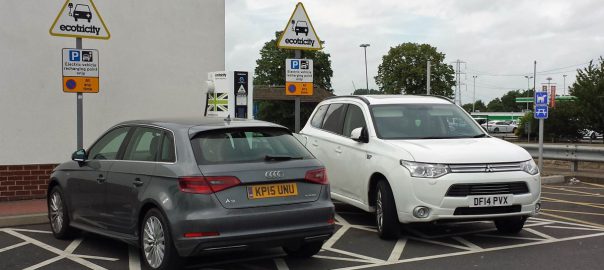
A full charge point at Newport Pagnell services, and my first ever sight of an Audi A3 e-tron (Image: T. Larkum)
Following the events, Audi has decided to cancel its Summit, which was the set of the launch of the production e-tron quattro.
The Financial Times reported:
“Audi, Volkswagen’s most profitable unit, said late on Monday that the Audi Summit, set for August 30 in Brussels where the e-tron will be built, has been cancelled. Instead, the summit will take place at an undetermined time and location in the United States.”
Further to the news reported yesterday (15 August) that Skoda is ramping up plans to launch four electric vehicles (EVs) by 2021 and a further two by 2025, including two SUVs and an image-boosting sports car, more details of EV plans from Volkswagen Group’s other brands Volkswagen (VW) and Audi have come to light.
Also, Jaguar Land Rover (JLR) plans to offer plug-in hybrid variants of its best-selling Range Rover and Range Rover Sport models from the beginning of 2018.
According to an article published on autoblog.com, the I.D. Crozz crossover will be VW’s second EV based on the dedicated MEB (modular electric drive) platform, following the I.D. hatchback. The Crozz is now scheduled for a market launch at the end of 2020 or early in 2021. Autoblog also reports that the Crozz will even be the first MEB-based vehicle to launch in the US as there are no plans to introduce the I.D. hatchback there.
Whereas the I.D. hatchback has a quoted range of 373 miles on the European test cycle, the Crozz is quoted at 311 miles. As the Crozz will feature four-wheel drive, it will be powered by two motors producing a total of 302 horsepower, compared with the 168 horsepower reported for the regular I.D. hatchback.
As previously reported, the I.D. Buzz microbus-styled minivan (pictured) is expected to arrive in showrooms by 2022 and so will be VW’s third EV offering, but autoblog also suggests that this model could now come to market much later, possibly not even until 2025.
Meanwhile, Autocar reports that the second-generation Audi Q3, which is scheduled for launch within the next year, will be offered in both plug-in hybrid and fully electric versions. According to Autocar, ‘Ingolstadt sources involved in the engineering of the new Audi also confirm that the German car maker is working on a pure electric version of the second-generation Q3 as part of plans to meet China’s new energy vehicle regulations.’ Audi is also planning to introduce an electric version of its new Q2 subcompact crossover to the Chinese market within the next year.
Continental, a major supplier for automakers around the world, has come out with a bold prediction: internal-combustion engine development by German automakers will essentially end by the year 2025.
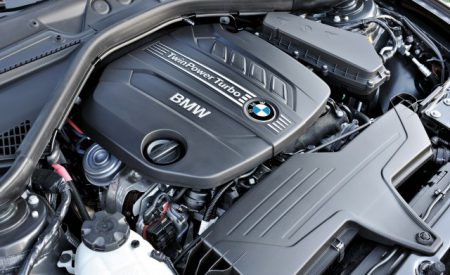
BMW Engine
The supplier, which makes exhaust-gas-cleaning systems for diesel cars and nitrogen oxide-measuring sensors, lists several factors contributing to its prediction: the increasing costs of development, the end of diesel’s dominance, and an overall shift to electric cars and other alternative propulsion methods.
Specifically, Continental CFO Wolfgang Schaefer predicts 2023 will be the final hurrah for German engines running on fossil fuels.
He believes one final generation of internal-combustion engines will be developed and launched by that date. Then investment and engineering will taper off after 2023, with 2025 sealing the engine’s fate with the very last refinements.
“A new generation of combustion engines will again be developed, but after that (around 2023), a further development will no longer be economically justifiable because more and more work will switch into electric mobility,”
he said in an interview with Reuters.
Schaefer’s prediction comes at a time when the use of fossil fuels for transportation faces greater scrutiny than ever across Europe.
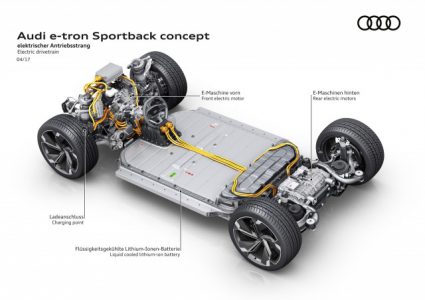
Audi e-tron Sportback concept, 2017 Shanghai auto show.
France, the United Kingdom, the Netherlands, and Norway have all announced similar plans to phase out sales of cars powered by internal-combustion engines.
The Netherlands and Norway want the ban to be in place by 2025, while France and the UK have targeted 2040 for implementation.
All the while, European authorities continue to investigate Volkswagen Group over diesel emission cheating and have alleged BMW, Daimler, and VW Group colluded to manipulate emission regulations.
Each German automaker now plans to update software on its diesel-powered vehicles to curb emissions further, at no cost to customers.
At this point, most industry watchers would agree that car dealers are a barrier to the electrification of the car industry.
Recent studies have painted a negative (borderline disastrous) picture of the electric vehicle shopping experience. Car dealers’ lack of interest in selling EVs have led to poor knowledge about the vehicles, no inventories, cars often being left uncharged and not ready for test drives.
Knowing car dealers make most of their money from service and that EVs have fewer moving parts and therefore require less service, Tesla anticipated the issue and decided to operate its own sales force. But other automakers are stuck with their dealership networks and they are now trying to get them on-board with EVs in order to be competitive in the ongoing electrification of the industry.
The National Automobile Dealers Association (NADA) were holding their annual convention and exhibition in New Orleans last week and during his keynote address, Audi of America President Scott Keogh tried to convince car dealers to embrace electric vehicles.
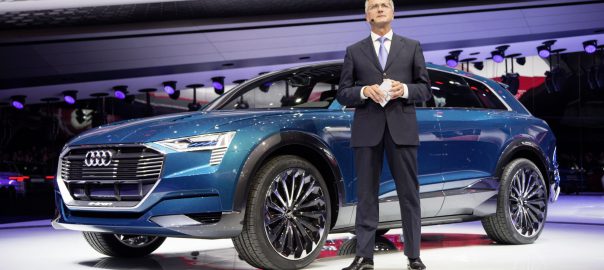
Audi has several electric vehicles coming to market soon, starting with the production version of its quattro e-tron concept (pictured above) next year, and they would appreciate if their dealers would get behind the new electric lineup of vehicles.
Audi Quattro e-tron concept
Keogh told dealers that range anxiety concerns will disappear in the next few years with electric vehicles achieving longer ranges and a more extensive charging infrastructure.
The executive expects that most of the industry will go entirely “battery-electric” within the next 10 years (via WardAuto):
“All this fright about where am I going to get a charge is going to go away extremely fast. The technology on this front is moving at a staggering pace. You’re going to be looking at a marketplace in the next seven, eight, nine, 10 years where for 30 or 40 some brands their entire business is going to be battery-electric vehicles.”
The future is bright for electric cars in 2017, as new figures released recently indicate that more than 100,000 plug-in cars could be on UK roads by the middle of this year.
This prediction is fuelled by record numbers of electric car registrations in 2016, with volumes rising 29% on the previous 12 months. In fact, every quarter of 2016 produced year-on-year growth, with the total number of EVs on UK roads now at more than 87,000.
More and more UK drivers are becoming switched on to the cost-saving benefits and convenience of electric motoring, which resulted in 36,907 electric vehicles being registered between January and December last year, a number that’s set to grow this year.
The ever-increasing selection of electric cars available in the UK is another factor aiding the rise in the market. More than 35 plug-in models are available at the moment, which is four times the number on the market just five years ago.
Plug-in hybrids were particularly popular in 2016, as registrations rose by over 40%. Models such as the BMW 330e, Volkswagen Golf GTE and Audi A3 Sportback e-tron proved to be among the most in-demand.
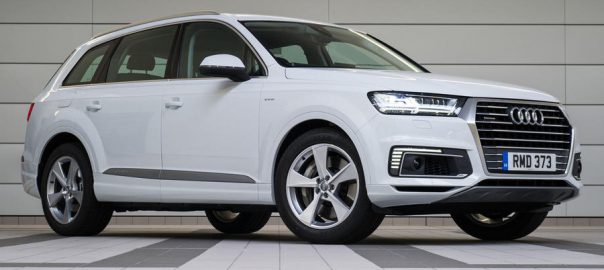
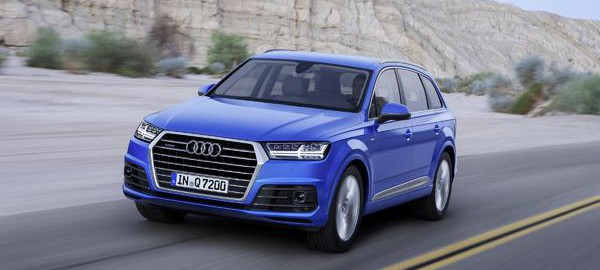
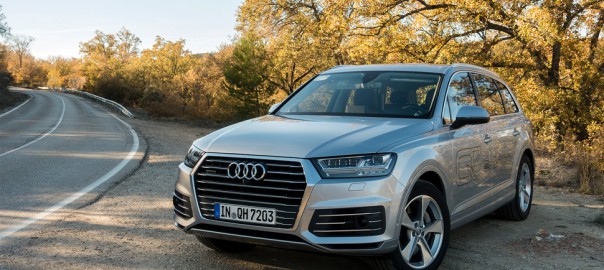
Plug-in hybrid Q7 promises economy of 156.9mpg and BIK rates of 10%. It’ll take you a while to recoup the £10k premium over a standard Q7, though
What is it?
This is the latest addition to Audi’s e-tron range: a plug-in hybrid version of the big Q7 SUV. Like the significantly smaller A3 e-tron, there’s an internal combustion engine under the bonnet that’s coupled to an electric motor and battery pack.
Unlike the BMW X5 xDrive40e and Volvo XC90 T8, you won’t find a petrol-fired four-cylinder turbo engine under the bonnet of the Q7 e-tron, driven for the first time on UK roads. Instead, there’s an optimised version of the 3.0 TDI V6 that can be found in the regular Q7. In this application, it produces 254bhp.
Under the boot floor lives 202kg of battery pack and assorted electrical hardware, robbing the Q7 of its ability to seat seven. Load capacity is reduced by a sizeable 120 litres, but the 650 litres that are left should still be enough for the vast majority of families.
That battery may seem like a hefty thing, but it’s still only enough to provide a maximum electric range of 34 miles.
What’s it like?
With all this talk of economy, emissions and the small matter of a 2.5-tonne-plus kerb weight, you might expect the Q7 to feel sluggish compared with the regular 268bhp model. That is most definitely not the case.
With the diesel and electric motors combined, total system output is 369bhp and 516Ib ft of torque. That’s good enough for performance that would make many a hot hatch blush. Not only does it look quick on paper, but the instantaneous torque of the electric motor also means it feels effortless in the way it piles on speed.
Welcome to the future. Audi’s entry into the hybrid electric car world, the 2016 A3 Sportback e-tron, truly represents the future of personal automotive transporation.
Audi A3 Sportback e-tron on charge
On one hand, it’s packed with the latest hybrid and electric vehicle technology, allowing you to approach 90 MPGe using the hybrid system. On the other hand, it’s a beautifully designed, well-built Audi that with 204 HP (using both the gasoline and electric motors) and Audi’s race-proven driving dynamics, creates a fun performance driving experience true to the Audi brand.
This PHEV (Plug-in Hybrid Electric Vehicle) comes with both an electric and gasoline engine which can be used in tandem or individually. The system has four settings adapting to a range of driving conditions. EV Mode operates the car in an electric-only mode with the high-voltage battery system providing about 16 miles of range. In Hybrid Mode, the car automatically selects which engine should be used based on the driving conditions. The Hold Battery Mode operates the car in hybrid mode, but preserves the charge of the battery for later use. Charge Battery Mode uses just the gasoline engine to power the car and to charge the battery while driving. The settings are controlled by a switch and are switchable when the car is driving or parked.
The tech
Like all Audi models, the A3 e-tron is available with a wonderful suite of infotainment options, all controlled by the easy-to-use MMI touch system. Audi connect is a subscription-based service that features Google Earth, Google Voice Search, a proprietary traffic guidance system along with fuel prices, parking info, music streaming and internet radio. Other tech goodies include the use of Google Earth and 3D satellite technology. The car is a moving Wi-fi hotspot, offering full 4G LTE (powered by AT&T) for up to eight devices.
The A3 Sportback e-tron offers the full suite of Audi safety features like multiple airbags, along with some electronic collision countermeasures. There’s a wide-sweeping side assist system that detects and alerts the driver to other traffic next to them, as well as an optional active lane assist system. This reads the lines in the road and gently nudges the steering wheel when it senses the car is drifting over the lines on either side.
On my long distance travels in the ZOE I’ve noticed that it’s becoming more common to have to queue at a charge point. We’ve not yet had a big problem with it – either we’ve had to wait no more than a few minutes, or else on the motorway we’ve just moved on to the charge point at the next services.
A full charge point at Newport Pagnell services, and my first ever sight of an Audi A3 e-tron (Image: T. Larkum)
However, it is an occurrence that I expect to become more frequent over time. It will be interesting to see if Ecotricity’s policy, in particular, of gradually increasing the number of charge points at motorway services will keep the issue at bay.
Audi hybrid models are seen as a stop-gap between full-petrol or -diesel engines and the introduction of full-electric Audis in the future, says Audi boss Rupert Stadler
Audi Q7 e-tron Quattro (Image: Audi)
Hybrid and plug-in hybrid technology will only be a “bridging technology” for around ten years, according to Audi CEO Rupert Stadler, until full electric driving becomes more mainstream.
“Hybrid and plug-in hybrids are a transitional and bridge technology for about the next ten years,”
said Stadler, who said he expected electrified cars, including hybrids, to account for 20-25% of all sales by 2025.
“In parallel we will offer various battery-electric models in different volume series models until 2025. But, of course, only the customers can decide the sales mix between electrified and conventionally-engined vehicles.”
Audi has already committed to produce its first fully electric SUV, the Audi Q6 e-tron, with a range of 500km (310 miles) from 2018. It will be built at a new factory in Belgium, alongside Audi’s battery plant that will produce batteries developed with its partners, LG and Samsung.
Plug-in electric vehicles are on the rise, with the Audi Q7 e-tron joining the A3 Sportback e-tron and R8 e-tron – taking the German maker’s count up to three. There’s clearly momentum behind electric, thanks to its efficiency, environmental and fuel-saving implications.
Audi Q7 e-tron PHEV
But going green might put you in the red. The Q7 e-tron’s anticipated £65,000 starting price is a good £15k more than the combustion-only model – the one we took for a spin back in the summer of 2015 – which is a sizeable premium for this sizeable SUV. Is it worth it? We took the e-tron electric hybrid on the road to see what we made of it.
Audi Q7 e-tron first drive: It’s a 5-seater
First thing’s first, if you’ve thought about buying an SUV then the Q7 really ought to make your shortlist simply because it’s a good looking driving machine that avoids being too tank-like in its ways.
But – and it’s a critical one – if your eyes have veered over to the e-tron version, hand on environmental heart, then you’ll need to consider the space implication of the batteries. They’ve got to go somewhere, after all, and in the case of the Q7 e-tron that means it can only be a five seater, not a seven seater (which may sound at odds with its name, but that’s that way it is).
Audi Q7 e-tron first drive: Electric range
But the obvious trade-off between seating arrangements is that the Q7 e-tron can scoot along happily using only its electric motor – which with 94kW of output, translates to 128bhp – for up to a 35-mile range per charge. That might sound quite conservative, but let’s not forget this is a 2.5-tonne vehicle (it’s 450kgs more than the standard Q7), so perhaps that’s no surprise.
If you’ve got a commuting route with a charger at the other end (7.2kW charging means a refill in 2.5-hours; at-home means 8-hours per recharge), then you’ll quickly save on those pricey diesel top-ups over the course of time.