All posts by Trevor Larkum

Leasing companies drive uptake of ultra-low emission vehicles

New figures from the British Vehicle Rental and Leasing Association confirm the sector’s position as the UK’s leading adopter of cleaner and more fuel-efficient vehicles.

new_plug-in_market-share_bvrla

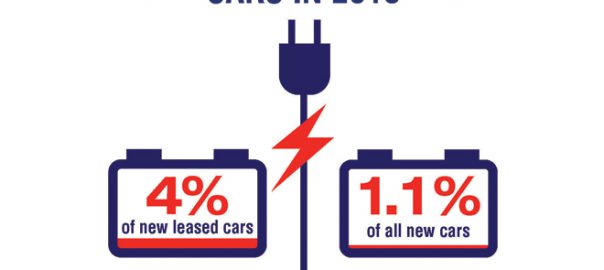
The BVRLA’s latest quarterly survey of its leasing members found that almost one in 20 (4.7%) of all new leased cars registered in the final quarter of 2015 was a plug-in, well-ahead of the market penetration achieved across all new registrations, which stood at 1.3%.

The leasing sector’s low-emission credentials are also demonstrated by the fact that more than 25% of lease cars now sit in VED band A (sub 100g/km CO2) while the overall market share for all new cars sold in 2015 stands at 20%.

Thanks to this ever-increasing adoption of pure and plug-in hybrid electric cars as well as low-emission petrol and diesel vehicles, the average lease car added to a BVRLA member fleet in 2015 emitted just 112.6g/km CO2, more than 7% less than the average new car registered in 2015.

Responding to the news on behalf of Go Ultra Low, Poppy Welch said:

“We’ve been encouraged by the growing number of fleets realising the multiple advantages of electric vehicles – and BVRLA members continue to play a pivotal role through education on whole-life costs and employee benefits. More businesses need to be bold, opening their thinking to incorporate electric vehicles and the cost-savings they bring.”

According to the latest BVRLA survey, leasing companies were responsible for around 1.3 million1 business cars and vans at the end of 2015, which was a 5.5% increase year-on-year.

Commenting on the news, BVRLA Chief Executive Gerry Keaney said:

“More and more businesses are turning to leasing as a source of finance and BVRLA members are helping these companies to operate cleaner, more fuel-efficient vehicles.”

“The government needs to recognise that the company car or van is more than just a taxable perk and a valuable source of revenue for the Treasury. These vehicles are vital business tools that can play a huge role in reducing the UK’s road transport carbon emissions. Without a fair and simple tax regime for company vehicles, this won’t happen.”

Source: BVRLA

Tesla Discontinues 10-Kilowatt-Hour Powerwall Home Battery

Tesla has quietly removed all references to its 10-kilowatt-hour residential battery from the Powerwall website, as well as the company’s press kit. The company’s smaller battery designed for daily cycling is all that remains.

Tesla Powerwall home battery storage system (Image: Tesla)

The change was initially made without explanation, which prompted industry insiders to speculate. Today, a Tesla representative confirmed the 10-kilowatt-hour option has been discontinued.

“We have seen enormous interest in the Daily Powerwall worldwide,” according to an emailed statement to GTM. “The Daily Powerwall supports daily use applications like solar self-consumption plus backup power applications, and can offer backup simply by modifying the way it is installed in a home. Due to the interest, we have decided to focus entirely on building and deploying the 7-kilowatt-hour Daily Powerwall at this time.”

Read more: Greentech Media

The Tesla Model 3 arrives with 215 miles of range

And Tesla claims there are 115,000 preorders, which is madness.

After a long wait, Tesla has finally unveiled the Model 3. It’s what we were expecting (and hoping for) – a less-expensive, versatile, attractive five-seater with decent range and a low price. It rounds out Tesla’s revised Secret Master Plan, as Elon Musk cheekily called it, that started with the Roadster, progressed to the Model S, and grew to encompass the Model X.

Tesla Model 3 Unveil (Image: Tesla)

That’s all fine, but did you catch how many preorders Musk said the company had received for the Model 3 by this evening? 115,000 – a staggering number. If you’ll remember, each reservation to purchase a Model 3 requires a $1,000 (refundable) deposit.

Here’s the other stuff you should really know about Tesla’s entry-level electric vehicle. For one, Musk promises it’ll ace every safety test category. All will be standard with Autopilot hardware (autonomous driving functionality) and Supercharging (very fast recharging) capability.

It’ll also seat five real adults in comfort, as Tesla has squashed the instrument panel a bit and moved the front seats forward to clear rear legroom. To give a sense of airiness to the cabin, and also to gain some extra headroom, it’ll have a roof made of two large panes of glass, with the windshield meeting the backlight just above the A-pillar. Neat. In case you surf, it’ll swallow a 7-foot surfboard, apparently.

Read more: Autoblog

Tesla Model 3: 215-mile, $35,000 electric car revealed

At a launch event held in Hawthorne, California, Tesla Motors CEO Elon Musk introduced the Model 3 sedan, the company’s highest-volume, lowest-priced effort yet.

Tesla Model 3 (Image: Green Car Reports)

The Model 3 quite closely follows the style of the Model S sedan and Model X crossover, and it’s unmistakably a Tesla. Yet at a far more affordable $35,000 starting price, it should help break past dismissals that Tesla is a brand only for the rich. And the Model 3 is a crucial step toward the company’s goal of 500,000 annual sales.

Just over the past couple of days, the company has made great strides toward seeing that goal as perhaps reasonable. In the 24 hours leading up to the beginning of the launch event, more than 115,000 people put $1,000 each down to make a reservation for the Model 3—sight unseen, and before any specifications had been detailed.

Read more: Green Car Reports

Renault BEVs sales – February 2016 (Image: Inside EVs)

Renault Increases Sales Of Electric Cars In February By 60%

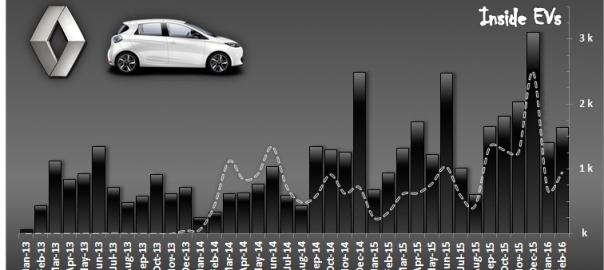
For 18 consecutive months Renault has increased sales of its electric cars (not counting the on and off again Twizy).

Renault BEVs sales – February 2016 (Image: Inside EVs)

In February, the French company moved 2,152 cars (125 Fluence Z.E., 361 Kangoo Z.E. and 1,666 ZOE including 19 commercial registrations), which is 60% more than year ago, and an additional 126 Twizy – bringing the EV total to 2,278.

The key player in the Renault fleet is the ZOE, which is still growing by a fast 74% – from 947 in 2015 to 1,647!

Most of ZOE sales, 1,182 of them – or nearly 72%, were registered in France, so the Renault flagship is pretty dependent on its home market and incentives in this market.

Cumulatively, Renault has now sold over 85,000 electric vehicles.

Source: Inside EVs

The planned VED tax system from April 2017 will unfairly penalise low carbon cars (Image: NGC)

Buy your plug-in hybrid before April 2017 to avoid tax hike

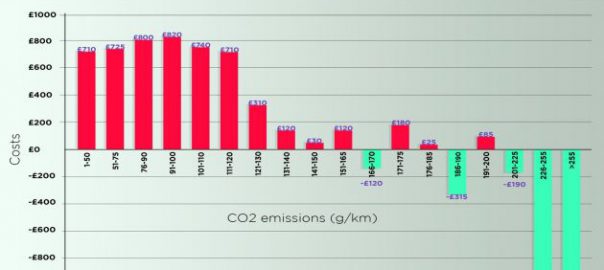
Buyers of lower-emission cars are expected to bear the brunt of changes to Vehicle Excise Duty (VED) car tax [if registered after] next April 2017, with those in the 91-100 g/km of CO2 band hardest hit, seeing costs over six years rise from nothing to £820.

The planned VED tax system from April 2017 will unfairly penalise low carbon cars (Image: NGC)

Research conducted by Parkers suggests that of the estimated £5.2 billion of additional revenue the new VED rules will generate by 2023, £4.7 billion will be from buyers of cars emitting 1-130 g/km of CO2, all of which are currently tax-free for the first year.

Initially, the 2017 VED system appears to be an update of the existing scheme, albeit with new bands created and others combined. Notably, only buyers of cars with zero CO2 emissions will have the ability to remain car tax-free under the First Year Rate, as any model producing even 1 g/km of CO2 will be subject to a charge from next year.

There’s a further surcharge for cars with a list price of £40,000 or higher – regardless of emissions, an annual charge of £310 from year two through to six will be imposed.

Buy a new car emitting just 99 g/km of CO2 from April 2017 and instead of enjoying VED tax-free motoring, you’ll instead be lumbered with an £820 tax bill over the first six years of ownership.

Replacing the Standard Rate sliding scale for year two onwards will hit buyers of cleaner cars and effectively provide a financial incentive to purchase models which pollute most. Zero-emission cars again remain free, but all others face a yearly bill of £140.

Read more: Next Green Car

Electric vehicles are the only solution

Speaking at the New York Auto Show, Ghosn explains why we need EVs

ghosn_nissan_speech_unk

We’ve heard it all before, but that doesn’t mean we don’t enjoy listening to Nissan CEO Carlos Ghosn explain why he’s still in favor of electric vehicles. Plus, if we’ve heard it a few times, imagine how many times he’s had to say it. It happened again this morning at the opening breakfast for the New York Auto Show, and it was as clear and concise an explanation as you can imagine.

When asked why people aren’t buying more electric vehicles, Ghosn said that there were a few factors working against EVs right now, but that, “I still think it’s just a temporary slow down.” He then listed the reasons why.

Ghosn started with the two-degree agreement that came out of COP21, the climate change conference in Paris last year. As the UN explained (PDF):

The goal of limiting global temperature rise to 2 degrees Celsius (3.6 degrees Fahrenheit) by the end of this century was first agreed to in Copenhagen and then by all countries at the Cancun Climate Conference in 2010. It recognizes that climate change is already occurring, but that if we act now, we can avoid the worst impacts of a changing climate.

So, with COP22, which will take place in Morocco this November, not that far away, it’s time to get busy. Transportation makes up 17 percent of all CO2 emissions, Ghosn said, and

“there is no way – no way – we’re going to reach anything around two degrees without the substantial reduction in CO2 from the transportation system. And the only obvious, known technology which allows that is electrification.”

Read more: Autoblog

Audi A3 e-tron, Mitsubishi Outlander and BMW i3 plug-ins

Plug-in Hybrid Sales Are Exploding

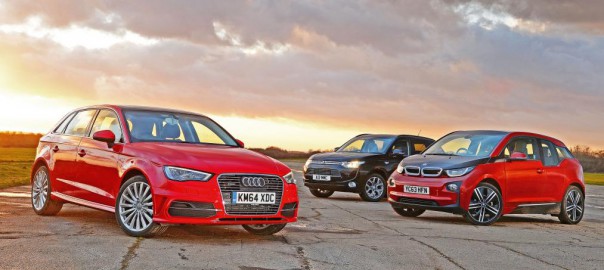
People don’t want plug-in hybrid cars, the auto companies said. Plug-ins are just a stop gap solution on the way to real electric cars, the experts said. But guess what? The plug-ins are here and the manufacturers can’t keep up with demand. In Europe and the UK, demand for the new BMW 330e has far outstripped supply, Motoring reports.

Audi A3 e-tron, Mitsubishi Outlander and BMW i3 plug-ins

BMW has issued this statement:

“We predicted UK sales of 2,500 for the 330e this year, but the demand was much higher than we originally anticipated. We do have high demand across other PHEV models, but it’s not to the same extent as this. Due to very strong demand, we are indeed oversubscribed on 330e. We’re working with affected parties now and will let you know more when we have it regarding future supply.”

Several UK customers have been informed their orders have been cancelled because the factory cannot keep up.

Volkswagen, mired in its diesel cheating scandal woes, has at least one bright spot of good news. It tells Motoring,

“Last year we took around 2,500 orders for the Golf GTE and that number is expected to grow appreciably through 2016. Demand comfortably exceeds supply although we have, of course, adjusted production to accommodate that increasing demand.”

Read more: Gas 2

Jaguar LandRover GroupManager Install (Image: Rolec)

Rolec Launches EV GroupManager

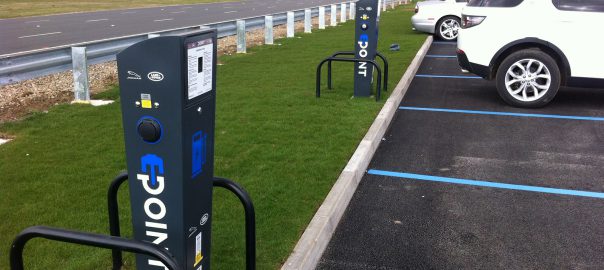
Rolec has announced the launch of its new EV GroupManager system, which has been designed to provide full management control of private Electric Vehicle (EV) charging networks. According to Rolec, the EV GroupManager system has been developed to allow the operator easy management of their entire private EV charging network from a single central computerised location.

Cloud Based System

The system operates by issuing nominated EV drivers with their own secure personal RFID card/fob, containing the driver/vehicle ID. The driver then presents their card/fob to the charging point, which authenticates the card/fob and via GPRS, WiFi or Ethernet communicates with the cloud based back office management system, requesting authorisation to initiate the charging cycle.

Jaguar LandRover GroupManager Install (Image: Rolec)

Upon authorisation from the management cloud, which takes only seconds, charging will commence with the cloud recording the driver/vehicle ID, charging start time, the kWh used and the charging end time. This charging information is always hosted in the cloud and can be accessed at anytime, from anywhere, by the system operator to compile management reports, benefit in kind data and billing information. Kieron Alsop, Rolec’s Managing Director, commented,

“EV GroupManager has been designed to enable private enterprises to have full control over their own private EV charging network and is ideally suited to almost any corporate location – or for housing developments, fleet management, staff vehicles, etc.

The introduction of EV GroupManager eliminates the necessity to engage with the public facing charging networks, which are heavily subscription based and operated via third parties. In effect EV GroupManager gives the operator complete control over their own EV charging network and provides them with the flexibility to accommodate both their own, and their EV drivers’, charging needs.”

Read more: Autovolt

Tesla – “Capable Of Greatness” Commercial

Many thanks to Elon Musk for the inspiration of a better world for all of humanity, and the inspirational words of Carl Sagan, one of my favorite astronomers and philosophers.

“We were hunters and foragers, the frontier was everywhere. We were bounded only by the earth and the ocean and the sky. The open road still softly calls. Our little tarraquest globe is the madhouse of those hundred, thousand, millions of worlds. We who cannot even put our own planetary home in order, riven with rivalries and hatreds; are we to venture out into space?

By the time we are ready to settle even the nearest other planetary systems, we will have changed. The simple passage of so many generations will have changed us. Necessity will have changed us. We’re an adaptable species. It will not be we who reach Alpha Centauri and the other nearby stars, it will be a species very like us, but with more of our strengths and fewer of our weaknesses. More confident, far seeing, capable, and prudent.

For all our failings, despite our limitations and fallabilities, we humans are capable of greatness.

What new wonders undreamt of in our time will we have wrought in another generation and another? How far will our nomadic species have wandered by the end of the next century and the next millennium? Our remote descendants safely arrayed on many worlds through the solar system and beyond, will be unified. By their common heritage, by their regard for their home planet, and by the knowledge that whatever other life may be, the only humans in all the universe, come from Earth. They will gaze up and strain to find the Blue Dot in their skies. They will marvel at how vulnerable the repository of all our potential once was.

How perilous our infancy. How humble our beginnings. How many rivers we had to cross before we found our way.” – Carl Sagan