All posts by Trevor Larkum

Electric Cars Would Lower UK Oil Imports By 40%, But Only With Much Wider Adoption

Outside of Norway and the Netherlands, electric vehicle market share remains under 1 percent, even in environmentally progressive countries such as Iceland and Sweden. While the benefits of wider electric-car adoption — including reduced urban air pollution and a lower long-run cost of vehicle ownership — are well known, researchers in Britain have put some numbers behind the economic effects of battery-powered transport.

Assuming a much broader acceptance of electric cars than exists today in Britain, researchers concluded that the country’s dependence on oil imports could drop by 40 percent, saving drivers 600 British pounds ($905) a year in fuel costs, which would eventually offset the higher upfront price of electric cars. At the same time, the overall economic impact of a broad shift toward electric cars would yield a modest national economic benefit. The implications in the report go beyond Britain, suggesting that countries that depend on oil imports and use more renewable energy have the most to gain economically from investing in electric-car infrastructure.

“Based on the current body of evidence, we conclude that a transition to low carbon cars and vans would yield benefits for U.K. consumers and for the environment (both in terms of reduced greenhouse gas emissions and reductions in local air pollution), and have a neutral to positive impact on the wider economy,”

said Cambridge Econometrics, an independent consultancy, in the study that was released Monday. But in order to get there, governments and the private sector will have to greatly increase infrastructure investment — and soon.

In order to greatly reduce the harmful pollutants emitted by internal-combustion engines by mid-century, the report estimates Britain would have to grow electric-car use from less than 20,000 vehicles today (out of about 35 million vehicles last year) to more than six million by 2030 and 23 million by 2050. This wouldn’t be an easy task.

To get tens of millions of electric cars on Britain’s roads over the next 15 years, the government and private sector would have to build out the charging-station infrastructure to allay consumer concern about running out of power before finding a place to plug in, a phenomenon known as “range anxiety.” According to a report last week from the Human Factors and Ergonomics Society, an organization based in California, range anxiety lessens over time among electric-car owners. However, it’s commonly understood in the industry that electric-car skeptics aren’t going to get over their concerns until they see a combination of longer electric-car ranges (most electric cars travel less than 100 miles per charge), faster charging times (it can take 20 minutes to “fill up” an electric car to 80 percent at a fast-charging outlet) and more charging stations.

“There will be a transition in the next five to 10 years but you won’t see a sudden shift to electric vehicles until consumers have got over their ‘range anxiety’ concerns — and that will only happen with infrastructure spending,”

Philip Summerton, one of the report’s authors, told the Guardian in a report published Tuesday.

In January 2013, the European Commission proposed a $10.7 billion program to build out electric-car charging stations across the European Union. In Britain the plan would have boosted the number of these outlets from 703 in 2012 to 1.22 million by 2020. Other European Union states would have seen similar increases, but by the end of 2013, EU member states, including Britain, successfully delayed the measure, citing the high costs.

Source: IB Times

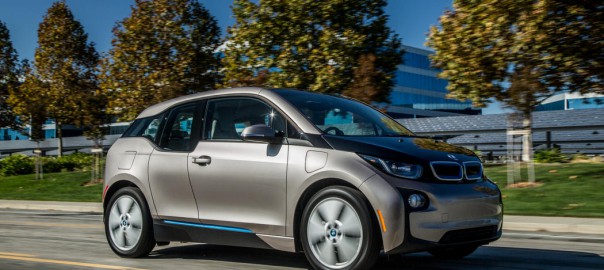
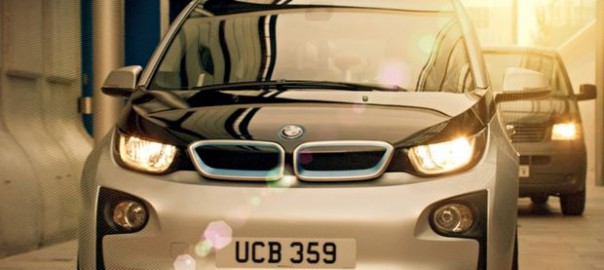
BMW i3, selected as Yahoo Autos 2015 Green Car of the Year (Image: Kerian/Yahoo)

Video Review: The BMW i3 Offers a Glimpse of the Future

Generally, there have been two approaches to creating electric automobiles: Stuff batteries and an electric motor into existing gas-power cars, or start from scratch and create a new design. Not satisfied with either of those methods, BMW in a sense used a time machine.

Its new i3 is a deep dive into what the car of the future should be: efficient and sustainable. It’s transportation to be sure, but the i3 is also just as much an environmental think tank on wheels.

Its passenger cell is made from lightweight carbon fiber and reinforced plastic manufactured in a hydroelectric-power factory in Washington State. Interior panels use renewable Asian kenaf plants. It’s all assembled in a German plant amped up by wind power. It would be no surprise to find that the i3 is organic. And edible.

The motor provides 170 horsepower and 184 pound-feet of instant torque. While the i3 can be purely electric, drivers seeking more range will insist on the model with the 2-cylinder gasoline-power generator for $3,850 more. At 1.9 gallons, the gas tank adds about 60 miles of range. At speeds over 25 miles an hour, road noise masks the engine drone. Pedestrians may think you’re mowing the lawn. With the generator, i3 weighs just 2,900 pounds.

BMW claims 80 to 100 miles on battery power alone. My average was 65 using the midlevel efficiency mode Eco Pro. My range was confirmed by a couple in a grocery store parking lot who have owned their i3 for a few months.

Rear-wheel drive, 50-50 weight distribution and a spunky 0-to-60 time of 7.5 seconds seem a God-given right for BMW (it’s slower in Eco modes and in range-extender operation). But a stiff ride and lack of any road feel should prevent the Bavarians from using the Ultimate Driving Machine tagline here. Tires not much wider than my foot don’t help much.

The brake pedal is seldom needed in urban driving. Power regeneration is so aggressive that lifting off the throttle slows things strikingly. One-pedal driving activates the brake lights. At higher speeds, the i3 coasts with less resistance.

Inside, the car makes me wary of the future. The power button location is awkward, and the unusual drive selector takes practice. Creative and renewable materials used on the base Mega World model — one of three, along with Giga World and Tera World — give off an office cubicle vibe. Nearly all my passengers viewed the kenaf fiber panels as trunk liner material. That couple at the grocery store bought the Giga World model with leather and eucalyptus wood trim. It’s highly preferable to the Mega’s budget plastic look (and sometimes feel) and adds a larger data screen. It’s a bargain at $1,500 more.

At $47,050 as tested (without tax incentives), navigation is standard; heated seats add $550. Note: A huge medical-grade electric heating pad can be found on Amazon for under $50. I’ll once again gripe that BMW’s rearview camera is part of a $1,000 grouping. Who knew that the future, and safety, was about option packages?

Getting to the two rear seats requires using cumbersome rear-hinge coach doors. Average adults will fit fine, and the i3’s floor is delightfully flat, though feet in back will be cramped.

Looking like the avant-garde offspring of BMW’s classic Isetta and 2002, people instantly know if they love or hate the i3’s design. Comparably equipped, the Nissan Leaf and Chevy Volt are easily $11,000 less than the i3. All of them will get you to work; the i3 takes owners into the future.

Source: NY Times

A Major Surge in Atmospheric Warming Is Probably Coming in the Next Five Years

Forget the so-called ‘pause’ in global warming—new research says we might be in for an era of deeply accelerated heating.

While the rate of atmospheric warming in recent years has, indeed, slowed due to various natural weather cycles—hence the skeptics’ droning on about “pauses”—global warming, as a whole, has not stopped. Far from it. It’s actually sped up, dramatically, as excess heat has absorbed into the oceans. We’ve only begun to realize the extent of this phenomenon in recent years, after scientists developed new technologies capable of measuring ocean temperatures with a depth and precision that was previously lacking.

In 2011, a paper in Geophysical Research Letters tallied up the total warming data from land, air, ice, and the oceans. In 2012, the lead author of that study, oceanographer John Church, updated his research. What Church found was shocking: in recent decades, climate change has been adding on average around 125 trillion Joules of heat energy to the oceans per second.

How to convey this extraordinary fact? His team came up with an analogy: it was roughly the same amount of energy that would be released by the detonation of two atomic bombs the size dropped on Hiroshima. In other words, these scientists found that anthropogenic climate is warming the oceans at a rate equivalent to around two Hiroshima bombs per second. But as new data came in, the situation has looked worse: over the last 17 years, the rate of warming has doubled to about four bombs per second. In 2013, the rate of warming tripled to become equivalent to 12 Hiroshima bombs every second.

So not only is warming intensifying, it is also accelerating. By burning fossil fuels, humans are effectively detonating 378 million atomic bombs in the oceans each year—this, along with the ocean’s over-absorption of carbon dioxide, has fuelled ocean acidification, and now threatens the entire marine food chain as well as animals who feed on marine species. Like, er, many humans.

According to a new paper from a crack team of climate scientists, a key reason that the oceans are absorbing all this heat in recent decades so well (thus masking the extent of global warming by allowing atmospheric average temperatures to heat more slowly), is due to the Pacific Decadal Oscillation (PDO), an El Nino-like weather pattern that can last anywhere between 15-30 years.

In its previous positive phase, which ran from around 1977 to 1998, the PDO meant the oceans would absorb less heat, thus operating as an accelerator on atmospheric temperatures. Since 1998, the PDO has been in a largely negative phase, during which the oceans absorb more heat from the atmosphere.

Such decadal ocean cycles have broken down recently, and become more sporadic. The last, mostly negative phase, was punctuated by a brief positive phase that lasted 3 years between 2002 and 2005. The authors of the new study, Penn State climatologist Michael Mann, University of Minnesota geologist Byron Steinman, and Penn State meteorologist Sonya Miller, point out that the PDO, as well as the Atlantic Multidecadal Oscillation (AMO), have thus played a major role in temporarily dampening atmospheric warming.

“In other words, the ‘slowdown’ is fleeting and will likely soon disappear.”

So what has happened? During this period, Mann and his team show, there has been increased “heat burial” in the Pacific ocean, that is, a greater absorption of all that heat equivalent to hundreds of millions of Hiroshimas. For some, this has created the false impression, solely from looking at global average surface air temperatures, of a ‘pause’ in warming. But as Mann said, the combination of the AMO and PDO “likely offset anthropogenic warming over the past decade.”

Therefore, the “pause” doesn’t really exist, and instead is an artifact of the limitations of our different measuring instruments.

“The ‘false pause’ is explained in part by cooling in the Pacific ocean over the past one-to-two decades,” Mann told me, “but that is likely to reverse soon: in other words, the ‘slowdown’ is fleeting and will likely soon disappear.”

The disappearance of the ‘slowdown’ will, in tangible terms, mean that the oceans will absorb less atmospheric heat. While all the accumulated ocean heat “is certainly not going to pop back out,” NASA’s chief climate scientist Dr. Gavin Schmidt told me, it is likely to mean that less atmospheric heat will end up being absorbed. “Ocean cycles can modulate the uptake of anthropogenic heat, as some have speculated for the last decade or so, but… net flux is still going to be going into the ocean.”

According to Mann and his team, at some point, this will manifest as an acceleration in the rise of global average surface air temperatures. In their Science study, they observe: “Given the pattern of past historical variation, this trend will likely reverse with internal variability, instead adding to anthropogenic warming in the coming decades.”

So at some point in the near future, the PDO will switch from its current negative phase back to positive, reducing the capacity of the oceans to accumulate heat from the atmosphere. That positive phase of the PDO will therefore see a rapid rise in global surface air temperatures, as the oceans’ capacity to absorb all those Hiroshima bomb equivalents declines—and leaves it to accumulate in our skies. In other words, after years of slower-than-expected warming, we may suddenly feel the heat.

So when will that happen? No one knows for sure, but at the end of last year, signs emerged that the phase shift to a positive PDO could be happening right now.

In the five months before November 2014, measures of surface temperature differences in the Pacific shifted to positive, according to the National Oceanic and Atmospheric Administration. This is the longest such positive shift detected in about 12 years. Although too soon to determine for sure whether this is, indeed, the beginning of the PDO’s switch to a new positive phase, this interpretation is consistent with current temperature variations, which during a positive PDO phase should be relatively warm in the tropical Pacific and relatively cool in regions north of about 20 degrees latitude.

In January 2015, further signs emerged that the PDO is right now in transition to a new warm phase. “Global warming is about the get a boost,” ventured meteorologist Eric Holthaus. Recent data including California’s intensifying drought and sightings of tropical fish off the Alaskan coast “are further evidence of unusual ocean warming,” suggesting that a PDO transition “may already be underway a new warm phase.”

While it’s still not clear whether the PDO is really shifting into a new phase just yet, when it does, it won’t be good. Scientists from the UK Met Office’s Hadley Center led by Dr. Chris Roberts of the Oceans and Cryosphere Group estimate in a new paper in Nature that there is an 85 percent chance the faux ‘pause’ will end in the next five years, followed by a burst of warming likely to consist of a decade or so of warm ocean oscillations.

Roberts and his team found that a “slow down” period is usually (60 percent of the time) followed by rapid warming at twice the background rate for at least five years, and potentially longer. And mostly, this warming would be concentrated in the Arctic, a region where temperatures are already higher than the global average, and which is widely recognized to be a barometer of the health of the global climate due to how Arctic changes dramatically alter trends elsewhere. Recent extreme weather events around the world have been attributed to the melting Arctic ice sheets and the impact on ocean circulations and jet streams.

What this means, if the UK Met Office is right, is that we probably have five years (likely less) before we witness a supercharged surge of rapid global warming that could last a decade, further destabilizing the climate system in deeply unpredictable ways.

Source: Vice

Electric car boom will require an infrastructure rollout to win over consumers who are worried about batteries running out of power (Image: Engine)

Electric cars could cut oil imports 40% by 2030, says study

Massive switch to electric cars could save drivers £1,000 a year on fuel costs, if infrastructure is built to support the vehicles

Electric cars could cut the UK’s oil imports by 40% and reduce drivers’ fuel bills by £13bn if deployed on a large scale, according to a new study.

Electric car boom will require an infrastructure rollout to win over consumers who are worried about batteries running out of power (Image: Engine)

An electric vehicle surge would deliver an average £1,000 of fuel savings a year per driver, and spark a 47% drop in carbon emissions by 2030, said the Cambridge Econometrics study.

The paper, commissioned by the European Climate Foundation, said that air pollutants such as nitrogen oxide and particulates would be all but eliminated by mid-century, with knock-on health benefits from reduced respiratory diseases valued at over £1bn.

But enjoying the fruits of a clean vehicle boom will require an infrastructure roll-out soon, as the analysis assumes a deployment of over 6m electric vehicles by 2030 – growing to 23m by 2050 – powered by ambitious amounts of renewable energy.

“There will be a transition in the next five-10 years but you won’t see a sudden shift to electric vehicles until consumers have got over their ‘range anxiety’ concerns and that will only happen with infrastructure spending,”

said Philip Summerton , one of the report’s authors.

With recharging stations still relatively few and far between, the ‘range anxiety’ fear that battery-powered vehicles could run out of power has been a notorious deterrent for consumers.

One study earlier this month found that such concerns were more common among less experienced electric vehicle drivers. But the EU also believes that a lack of recharging infrastructure is holding back the budding industry.
Advertisement

Two years ago the European commission proposed a €10bn (£7bn) public works programme, which would have exponentially grown recharging station numbers across Europe. In the UK alone, their numbers would have multiplied from 703 in 2012 to 1.22m in 2020.

But the Tory-led government helped to successfully oppose the measure because of the costs involved in ensuring that a minimum 10% of recharging stations were publicly accessible in every country. Despite this, British subsidies of about £5,000 for new electric car sales have helped the industry develop, industry sources say.

Read more: The Guardian

Government departments sign up to ‘green revolution’

Green move adds electric cars to government car fleet.

Over 100 plug-in cars and vans will join the government vehicle fleet as part of a commitment to green transport, the government has announced today (10 March 2015).

Fifteen government departments and agencies, including the Foreign and Commonwealth Office, Ministry of Defence and the Home Office, will benefit from adding 140 ultra-low emission vehicles (ULEVs) to their fleets as part of a £5 million investment to reduce emissions.

The fleet includes cars and vans used by government when transporting staff and equipment.

The introduction of plug-in cars – such the British built all-electric Nissan LEAF – puts UK automotive technology at the heart of government.

The Government Car Service, which provides cars for ministers, will also adopt 4 ULEVs.

This announcement is the first phase in a project designed to illustrate the effectiveness of the vehicles, and encourage fleets to commit to greater take-up over the coming years.

Transport Minister Baroness Kramer said:

“This is an important step. These cars will save taxpayers money on running costs and will bring low emissions benefits to our fleet.

“Today’s announcement proves that Britain is leading the electric charge while supporting the growth of this important industry.”

The £5 million investment will also fund take-up by the wider public sector – including councils, police forces and the NHS – of plug-in vehicles and pay for charge-points to be installed to allow the vehicles to be charged at work.

ULEVs are a major area of growth for the hugely successful UK automotive sector, which is worth over £11 billion to the economy.

Chief Secretary to the Treasury Danny Alexander said:

“I have led the drive for electric cars and vans across government because – with much lower running costs and close to zero emissions – this is the right thing to do for both the environment and the taxpayer.

“This government is also investing significantly in ultra-low emission vehicles, and I recently launched a £10 million battery prize for UK scientists to ensure that we are world-leading in this major new technology.”

Business Minister Matthew Hancock said:

“We want to make the UK one of the best places in the world to design, manufacture and sell ultra-low emission vehicles. This important step demonstrates government’s commitment to promoting the economic and environmental benefits of these cars.

The investment forms the latest part of a £500 million package set aside for ULEV vehicles announced last year.”

Source: Gov.uk

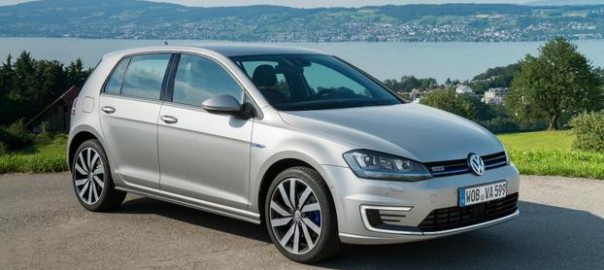
Volkswagen Golf GTE (Image: VW)

Volkswagen Leads Plug-In Electric Car Sales In Europe

Europe, with over 9,500 plug-in electric car sales in January 2015, far exceeded the US’ result of 5,924.

This year began especially strong for Volkswagen, which seems to now be most popular brand among plug-in electric car buyers.

We are not sure if VW will be able hold onto the #1 spot, but in January the automaker delivered over 2,300 cars (Golf GTE, e-Golf and e-up!) and some 2,800 if we include the whole VW Group (Audi and Porsche).

In second place is Nissan Tesla Renault Mitsubishi! Outlander PHEV had almost 2,000 sales, and with i-MiEV added in the result stood at nearly 2,100.

Nissan, combined with Renault (below 2,000), is at similar level, but only if we include Twizy.

Both BMW and Tesla are down in the hundreds range.

Well, Volkswagen might’ve come to the party late, but as a Group it’s moving forward to quickly become the sales leader in Europe.

Source: EV Sales Blog via Inside EVs

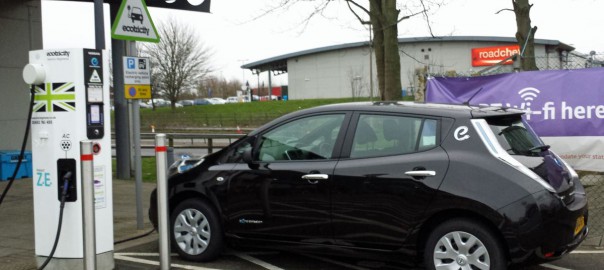
Charging the Nissan Leaf at an Ecotricity Rapid Charger (Image: T. Larkum)

Getting Familiar with the Nissan Leaf

The most popular car we supply is, naturally, the Nissan Leaf – the most popular electric car in the UK and, in fact, the world. However, being a Renault ZOE driver, it is relatively unfamiliar to me. I’ve only driven it twice, once way back in 2012 and the second time more recently during the test drive day last December.

For a while I felt I ought to become more familiar with the Leaf and, having joined the e-Car Club, it seemed like the Club gave the perfect opportunity. I therefore decided on a free afternoon to book a Leaf from the Club for a couple of hours (it costs £6 per hour) and to take it for a spin.

There are three Leafs permanently parked up in Northampton town centre, close to the Derngate Theatre. They are connected to charge points so they are always ready for use. Having booked one online I went to pick it up, and that’s when things went a bit wrong.

e-Car Club Nissan Leafs outside Northampton Derngate (Image: T. Larkum)

The website gave instructions for unlocking the car which worked fine – you just need to use your access card on the windscreen sensor. However, it didn’t give clear instructions on the process for releasing the immobiliser – in fact, I didn’t even know there was one. Being unfamiliar with the Leaf things seemed to be going fine: it appeared to power up and then reverse gently out of its parking space. What I didn’t realise was that there was actually no power to the drivetrain and it was just rolling backwards down the slope from the pavement.

After an embarrassing time getting pushed to the kerb by passers-by I investigated further and found a PIN-machine in the glove box. Once given the correct number the drivetrain came to life and we were ready to go. I later found out that there were detailed instructions in a log book folder in the passenger door pocket.

Charging the Nissan Leaf at an Ecotricity Rapid Charger (Image: T. Larkum)

First of all we just took a quick trip back home, and then headed out for a longer run. I took it up and down the motorway for a while to get its charge level below 80%. That gave me the chance to try out a fast charge at Rothersthorpe Services (at Junction 15A of the M1). I found the Chademo connector very fiddly and it took a couple of attempts before I was comfortable inserting it correctly and getting the charge to work. I was also caught out by the fact the dashboard screen needs to be powered down to accept a charge (and you can monitor it by blue LEDs on the top of the dash). This is in contrast to the ZOE where you monitor the charging through the dashboard screen.

Anyway, learning about these issues and the differences from the ZOE was precisely the point of the exercise so I deemed it a success. After this time spent with the Leaf I felt much more comfortable driving and charging it, and felt ready to undertake a long journey in one.

Figure 2: Composite image of hot water tank after insulating (Image: T. Larkum)

Using an Infrared Camera to Look for Wasted Energy – Part 2

Having used the FLIR camera to do an audit around the house I wanted to try a project where I could use it for a ‘before and after’ comparison. Since I only had a limited time before returning the camera, the project had to be fairly small. I decided on adding an insulating jacket to the hot water tank in our airing cupboard – something I had been meaning to do for some time.

Figure 1 is the ‘before’ image showing the tank with its integral white foam insulation layer. In the IR image we can see that the tank shows up very hot in bright yellow and orange. We can also see a large amount of hot air above it, plus the hot pipes going into it show up white.

Figure 1: Composite image of hot water tank before insulating (Image: T. Larkum)

Figure 2 is the ‘after’ image showing the red insulating jacket I had tied around the tank – a standard jacket bought at a local DIY superstore for about £15. In the IR image we can see that the tank now shows up much cooler, mostly blue and green with some yellow patches. There is less hot air above it, while the hot pipes going into it still show up white – I’m planning to insulate those next. An intentional gap in the jacket around the thermostat can also be seen showing up in white.

Figure 2: Composite image of hot water tank after insulating (Image: T. Larkum)

Use of the FLIR camera clearly indicates the significant benefit of even this simple insulation project, with much less heat being lost from the hot water tank. This is confirmed by our experience in the following days that the hot water became noticeably hotter than it used to be so I was able to turn down the temperature on the thermostat, and so save money as well as waste.