ELECTRIC car owners can travel to some of the UK’s most stunning beaches for staycation trips on a single charge.
Analysis from LeaseCar has shown drivers can travel to locations such as Newquay Beach, Eastbourne and Brighton Pier with a range of electric vehicles. The warning comes as staycations are expected to soar in 2021 while electric car ranges continue to rise with many vehicles now capable of over 250 miles.
A spokesperson said: ”With travel still limited in and out of the UK Brits are likely to be going on plenty of road trips this summer.
“So we’ve done some research and located the best coastal locations that these popular electric cars would make it to on a single charge.
“There is always a worry that you might not make it to your destination off of one charge, so we’ve taken the hassle out of finding the best summer spots to take your vehicle.”
Ford Mustang Mach-E
LeaseCar says the most impressive electric car they tested was the Ford Mustang Mach-E which is capable of 260 miles on one charge.
They said this would take you from the centre of Birmingham all the way down to Newquay Beach.
However, experts at Waze have warned tourist areas such as Cornwall, Devon and the Lake District would be some of the worst affected roads.
Kia e-Niro
Drivers can travel from Birmingham to Eastbourne in the affordable Kia e-Niro.
The car is fitted with a 64kWh battery which provides a substantial increase compared to the old 32kWh battery.
This new tool provides an extra 100 miles meaning the car is now capable of 230 miles.
Mercedes EQC
LeaseCar says drivers can travel to the South Coast on just one charge using the new Mercedes EQC.
The experts said the model provides a “comfortable journey” as well as 230 miles of range.
If you would like to know more about Solar Panels and the PowerBanx range of home battery systems, and get a free instant quote, please complete our online form:
Executives at Toyota had a moment of inspiration when the company first developed the Prius. That moment, apparently, has long since passed.
The Prius was the world’s first mass-produced hybrid car, years ahead of any competitors. The first model, a small sedan, was classic Toyota—a reliable vehicle tailor-made for commuting. After a major redesign in 2004, sales took off. The Prius’ Kammback profile was instantly recognizable, and the car’s combination of fuel economy and practicality was unparalleled. People snapped them up. Even celebrities seeking to burnish their eco-friendly bona fides were smitten with the car. Leonardo DiCaprio appeared at the 2008 Oscars in one.
As the Prius’ hybrid technology was refined over the years, it started appearing in other models, from the small Prius c to the three-row Highlander. Even the company’s luxury brand, Lexus, hybridized several of its cars and SUVs.
For years, Toyota was a leader in eco-friendly vehicles. Its efficient cars and crossovers offset emissions from its larger trucks and SUVs, giving the company a fuel-efficiency edge over some of its competition. By May 2012, Toyota had sold 4 million vehicles in the Prius family worldwide.
The next month, Tesla introduced the Model S, which dethroned Toyota’s hybrid as the leader in green transportation. The new car proved that long-range EVs, while expensive, could be both practical and desirable. Battery advancements promised to slash prices, eventually bringing EVs to price parity with fossil-fuel vehicles.
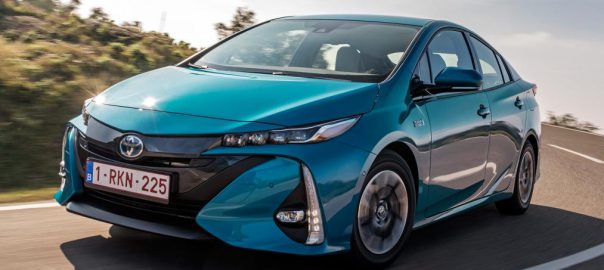
Toyota Prius Plug-in hybrid 2017 (image: Toyota)
But Toyota misunderstood what Tesla represented. While Toyota invested in Tesla, it saw the startup not as a threat but rather a bit player that could help Toyota meet its EV mandates. In some ways, that view was justified. For the most part, the two didn’t compete in the same segments, and Toyota’s worldwide volume dwarfed that of the small US manufacturer. Besides, hybrids were just a stopgap until Toyota’s hydrogen fuel cells were ready. At that point, the company thought, hydrogen vehicles’ long range and quick refueling would make EVs obsolete.
Yet, Toyota hadn’t picked up on the subtle shift that was occurring. It’s true that hybrids were a bridge to cleaner fuels, but Toyota was overestimating the length of that bridge. Just as Blackberry dismissed the iPhone, Toyota dismissed Tesla and EVs. Blackberry thought the world would need physical keyboards for many more years. Toyota thought the world would need gasoline for several more decades. Both were wrong.
In tethering itself to hybrids and betting its future on hydrogen, Toyota now finds itself in an uncomfortable position. Governments around the world are moving to ban fossil-fuel vehicles of any kind, and they’re doing so far sooner than Toyota anticipated. With EV prices dropping and charging infrastructure expanding, fuel-cell vehicles are unlikely to be ready in time.
In a bid to protect its investments, Toyota has been strenuously lobbying against battery-electric vehicles. But is it already too late?
Hydrogen dead end
Having spent the last decade ignoring or dismissing EVs, Toyota now finds itself a laggard in an industry that’s swiftly preparing for an electric—not just electrified—transition.
Sales of Toyota’s fuel-cell vehicles haven’t lit the world on fire—the Mirai continues to be a slow seller, even when bundled with thousands of dollars’ worth of hydrogen, and it’s unclear if its winsome-but-slow redesign will help. Toyota’s forays into EVs have been timid. Initial efforts focused on solid-state batteries that, while lighter and safer than existing lithium-ion batteries, have proven challenging to manufacture cost-effectively, much like fuel cells. Last month, the company announced that it would release more traditional EV models in the coming years, but the first one won’t be available until the end of 2022.
If you would like to know more about Solar Panels and the PowerBanx range of home battery systems, and get a free instant quote, please complete our online form:
With electrified cars now coming in all shapes and sizes – and available to suit every budget – we’ve named the best models in every class. Here we look at the best used electric small car…
If you want a small electric vehicle (EV) but your budget is limited, the answer, of course, is to buy a used one. But even then, a lot of them are beyond the pocket of the average motorist.
That’s where the Renault Zoe scores. You see, the Zoe is one of the older EVs on the market now, and it really does bring zero-emissions motoring within the reach of the masses; you can pick up an early example for as little as £6000.
Renault ZOE 2020 (Image: Renault.com)
Admittedly, those earlier Zoes with the 22kWh battery and 88bhp motor had pretty modest ranges, but later models with a 41kWh battery upped the official range to 186 miles – a very respectable figure – and these can now be had from around £12,000. A major facelift in 2020 brought a further increase in official range to between 238 and 245 miles.
Whether you buy an older or newer Zoe, what you’ll get is a small hatchback that’s smooth and easy to drive, and if you go for our preferred version, the later ZE40 R110, it’s nippy as well. Ride comfort is also good, with broken urban surfaces absorbed effectively.
If you would like to know more about Solar Panels and the PowerBanx range of home battery systems, and get a free instant quote, please complete our online form:
If you’ve been following the ups and downs of the automotive industry recently then you’ll be acutely aware the future is electric.
The sector globally is in the midst of its most seismic shift in its history as everyone makes the move from internal combustion engines to batteries and electric motors.
Coventry car maker Jaguar Land Rover has made its plans clear and Jaguar will pave the way for the switch by becoming an all-electric brand from 2025.
Another electric vehicle make on the edge of Coventry is also some way down this road, namely LEVC, or the London Electric Vehicle Company.
New LEVC electric van (Image: LEVC)
LEVC makes the iconic London taxi, which sometime back ditched diesel power to go electric.
The company also switched production from its Holyhead Road factory to a state-of-the-art new facility at Ansty Park.
Electric TX taxis have been rolling off the production lines there for some time and last year the factory started producing a second vehicle – the VN5 electric van.
The VN5 shares much in common with the TX, utilising the same platform and there is a distinct family resemblance.
Arguably electric vans are going to be even bigger than electric cars in the short to mid-term.
One only has to consider just how much we now rely on van deliveries, as well as the emergence of congestion zones in UK cities which penalise more polluting petrol and diesel-powered vehicles financially.
So, is the VN5 the future – and in particular the future of the white van man?
We took up the offer to try one out for a week, courtesy of Guest Taxi & Van based in Birmingham, who sell both the TX taxi and VN5 van made by LEVC.
If you would like to know more about Solar Panels and the PowerBanx range of home battery systems, and get a free instant quote, please complete our online form:
ELECTRIC cars are on average more cost effective than petrol and diesel vehicles, according to a new study.
It found that over a seven-year period of owning a car, electric vehicles such as the Nissan Leaf, Volkswagen ID and the MG ZS EV are more cost effective than internal combustion engine equivalents. This is due to lower annual running costs, according to the LV= ‘Electric Car Cost Index’.
The ‘Electric Car Cost Index’ explores purchase price, tax, insurance, fuel and maintenance costs for nine electric cars vs their petrol/diesel equivalent to establish the total cost of ownership.
According to the Index, savings driven by average annual running costs were around 49 percent or £1,306 cheaper than petrol and diesel cars.
Seven out of nine electric cars evaluated offer better value over a four-year lease, including the Kia e-Niro, the Nissan Leaf and the Volkswagen e-UP.
The largest saving over a four-year lease is the Nissan Leaf compared to the Ford Focus ecoboost, which sees over £7,000 in savings.
BMW iX3
Despite its popularity, the Tesla Model 3 would actually be more expensive to run over four years in comparison to the BMW 320i, with losses of £741.
Alex Borgnis, Head of Motor Underwriting at LV= General Insurance, commented: “With this new Electric Car Cost Index we’re really trying to show, in the most comprehensive way, how the costs breakdown for people considering taking the plunge and making an electric model their next car.
“While the initial purchase will seem intimidating for some, once you break down the monthly costs, especially on a lease or PCP, and then throw in the lower running costs each year, suddenly it becomes something that provides great value over the course of the ownership period.
“You really don’t need to remortgage to get yourself on the electric car ladder.”
The savings on electric cars are heavily driven by lower average annual running costs – £1,304 compared to £2,610 for a petrol or diesel car.
This means that electric car drivers save an average of £109 a month, with savings extending further as they require less maintenance and have a longer life span.
For cars compared over a seven-year ownership, drivers could save more than £13,000 with an MG ZS EV rather than a Seat Ateca.
However, big losses can also be made on electric cars with a £8,105 loss when comparing the Renault Zoe GT Line and the Renault Clio.
Dr Euan McTurk, Consultant Battery Electrochemist at Plug Life Consulting spoke of his own experiences and savings when using an electric car.
He said: “Having driven electric cars for the past ten years, these results are not in the least bit surprising.
“My own electric car saves me £800 per year in fuel, tax and maintenance vs even the most efficient hybrid on the road.
“Comparing it to an equivalent, 5-seater family car, that saving is nearer £1,300 per year.
If you would like to know more about Solar Panels and the PowerBanx range of home battery systems, and get a free instant quote, please complete our online form:
Some electric vehicles (EVs) are cheaper over a seven year-period than a petrol or diesel alternative, according to research conducted by LV General Insurance.
The researchers examined the purchase, financing and running costs for nine popular EV models and their petrol and diesel equivalents.
They found that three of the nine EVs: Nissan Leaf, WV ID3 and MG ZS EV were cheaper.
The MG ZS EV had the biggest long-term savings – £13,316 on outright purchase over seven years, £5,772 via a standard lease agreement over four years and £2,320 via a standard PCP arrangement over three years.
The savings on EVs is heavily driven by lower annual running costs. With EV drivers saving an average of £109 per month.
Additionally, with electric cars traditionally having a longer life span and requiring less maintenance, the savings can be even bigger.
If you would like to know more about Solar Panels and the PowerBanx range of home battery systems, and get a free instant quote, please complete our online form:
Aberdeenshire Council has taken delivery of 20 new zero-emission electric vehicles, 18 of which have been 100 per cent funded by the Scottish Government’s Switched on Fleets initiative through the Energy Savings Trust and will replace older vehicles within the council’s fleet.
The seven Renault Zoe vans, six Vauxhall e-Vivaro and five Vauxhall Corsa-e will be issued to frontline council services ranging from Environmental Health, Property and Social Care.
Completing the line-up are two low-entry accessible Mellor e-Orion minibuses.
One has been match-funded by Transport Scotland and the other has been fully funded by Regional Transport Partnership, Nestrans, along with a contribution to the installation of charging points.
The Scottish Government intends to remove the need for petrol or diesel cars or the purchase of new light commercial vehicles in public fleets from 2025.
The Switched on Fleets initiative helps local authorities transition from traditional internal combustion engines to cleaner zero-emission vehicles.
That support has enabled Aberdeenshire Council to increase its zero-emission vehicle fleet to 40.
Councillor Peter Argyle, chair of the council’s infrastructure services committee, said: “We remain absolutely committed to de-carbonising our fleet and grants like Switched on Fleets mean we can accelerate that change to cleaner vehicles.
“With further advancements in battery and hydrogen technology – and as more light and heavy commercial vehicles come to market – we will be able to introduce these fit-for-purpose vehicles to increasingly support our key frontline services.”
Vice-chair John Cox added: “It is important that we – as a forward-thinking council – continue to look to the future and take action now to provide clean transport alternatives.
If you would like to know more about Solar Panels and the PowerBanx range of home battery systems, and get a free instant quote, please complete our online form:
Rachel Maclean, Minister for the Future of Transport and Decarbonisation, has dropped a fresh hint that the Government intents to scrap grants to help drivers buy expensive electric vehicles.
With the ban on sales of new petrol and diesel cars just eight-and-a-half years away, driver purchases are soon to be limited to battery-powered models only.
The high price of electric models remains one of the key stumbling blocks preventing motorists buying them in larger numbers today.
However, despite this, the Government in March slashed the Plug-in Car Grant, reducing both the subsidy amount by £500 to £2,500 and eligibility for only models priced up to £35,000 when it had previous been available for those up to £50,000.
In a recent interview with Autocar, Mclean defended the decision to reduce the grant – and said its availability would be kept under under review.
The grant was first launched in 2011 and offered up to £5,000 off the price of new plug-in vehicles.
In the prevailing decade, the grant amount and qualifying vehicle types has been frequently adjusted, with the latest changes coming just months ago.
The move was lambasted by industry insiders and vehicle manufacturers at the time, with Mike Hawes, chief executive at the Society of Motor Manufacturers and Traders, described the decision as the ‘wrong move at the wrong time’.
He said the government had risked putting the UK ‘even further behind other markets’ in terms of vehicle supply and said it sent the ‘wrong message’ to consumers’ who might have been considering buying a greener vehicle.
Ford of Britain chairman, Graham Hoare, said it was a ‘disappointing’ step that was ‘not conducive to supporting the zero emissions future we all desire’ while RAC head of roads policy Nicholas Lyes criticised MPs for making a decision that risked ‘people holding onto their older, more polluting vehicles for longer’.
Q4 e-tron (Image: audi.co.uk)
However, Maclean, speaking exclusively to Autocar magazine, defended the actions.
She said it was right for the Government to target grants only towards lower-priced electric vehicles because ‘that’s where people are less likely to be able to fund the cost out of their own pocket entirely’.
The move means that not a single Tesla vehicle qualifies for the scheme, nor does Ford’s new Mustang Mach-e, which is priced from £40,270 in the UK.
In fact, fewer than 30 electric cars on sale today now qualify for the scheme – you can find out which ones are eligible in our full report.
In the interview, Maclean also hinted that the days of the grant could be numbered, with the prospect of the incentive being scrapped completely.
The Government’s Road to Zero strategy in 2018 first stated that as the market became ‘better established and more competitive, the need for direct government financial support will decrease’.
It added: ‘We therefore expect to deliver a managed exit from the grant in due course and to continue to support the uptake of ultra low emission vehicles through other measures.’
Maclean – who owns an electric Jaguar i-Pace, which costs £65,000 and has never been eligible for the plug-in car grant – reiterated that statement to Autocar, saying: ‘I think it’s right to keep on looking at that [the future of the scheme], because ultimately we need to make sure we’re not using government money to help people buy cars who could have afforded them anyway.
‘One of our concerns is to make this an equitable transition for everyone, and of course at the moment electric cars are a bit more expensive – although if you factor in the overall cost of ownership, they will be on a parity soon.’
The Department for Transport referred us to their plug-in car grant delivery plan when we approached the government agency for comment.
The plan says: ‘We have been clear since 2018 that we intend to reduce the plug-in car grant over time.’
It adds a final commitment statement, saying: ‘We will continue to fund the plug-in car grant until at least 2022/23.’
Hydrogen and synthetic fuels will play a part to decarbonise transport – but NOT for passenger cars
In the interview, Maclean also suggested that hydrogen and synthetic e-fuels will play a part in decarbonising transport, but they will more likely be adopted for other vehicle types away from passenger cars.
‘The truth about hydrogen is that it’s very expensive to produce,’ the transport minister explained.
She added that the government will produce a hydrogen strategy very soon, but suggested it would be for decarbonising other vehicle types, including heavy goods vehicles, planes and ships.
Maclean added that synthetic fuels, like Porsche’s e-Fuel currently being developed in Chile, will also have ‘a role to play’ in driving down emissions, but explained it would more likely be used for the aviation and maritime industry.
If you would like to know more about Solar Panels and the PowerBanx range of home battery systems, and get a free instant quote, please complete our online form:
When Henry Ford started to build his first car assembly line, horse dung was still littering the streets. What he invented in 1913 was not a new technology. Ford understood that mass production would mean the end of cars as a luxury item. 10 years on, motor cars had become accessible to most working people in the US. With the European Commission proposing to go to 100% zero emission cars sales from 2035, flanked by a 55% CO2 cut for new cars in 2030, we are about to witness another Henry Ford moment. This time in Europe – and with electric cars.
To meet our climate goals and be at zero in 2050, the last new car (or van) with any CO2 emitting engine – be it gas, diesel or hybrid – should be sold no later than 2035. But it is not just a climate essential, it is an industrial necessity too. Major economies such as the UK and Canada and even large carmakers such as VW all plan to go 100% electric by that date. The EU cannot afford to lag behind in this global race to zero emissions, and the current proposal will ensure all EU member states and carmakers transition on time.
The trajectory to get there matters. The 55% CO2 target means half of cars sold in 2030 across the EU will be battery electric (less if some of them are hybrids). This is considerably less than the two-thirds battery electric sales needed to be on a cost-effective path to full electric by 2035. Many current loopholes remain, such as CO2 credits for things like efficient lights or more lenient targets for heavier cars. So while better than the current target, the 55% goal will be less than that in reality.
Ford Mustang Mach-E (Image: Ford.co.uk)
On costs and volumes…
Produced in small numbers – just enough to allow car makers meet the CO2 targets until now – electric cars are still expensive. Carmakers need to move to mass production to drive costs down, just as Henry Ford did with petrol cars at the beginning of the last century. Except the conveyor belts of the 1910s have been replaced by platforms dedicated to EVs and battery gigafactories. Analysis shows that if we continue to ramp up electric car volumes, these will be cheaper to buy than petrol in just six years time.
That requires increasing the CO2 targets from 2025 onwards – not only in 2030 – to make them accessible and affordable to all Europeans from Porto to Poznań. Regrettably the Commission has only increased the 2030 target, meaning little progress in the next 9 years. Higher retail prices, slower uptake of charging infrastructure, and worse, supply from outside Europe will dominate if domestic supply is insufficient.
Some electric cars are more equal than others
But what electric cars will Europeans buy? We have the real deal: battery electric. And we have a transitional solution: plug-in hybrids, that in reality are driven on a petrol engine most of the time but tout low CO2 emissions on paper. Europe is where most of these “fake electrics” are sold today because they offer easy compliance with the current CO2 standards.
By not reforming the way credits are given to plug-in hybrid cars until 2030, the Commission has decided to continue over-rewarding them for another decade – way longer than their transitional status justifies. This is not just a question of climate credibility as many emit 3-4 times their official CO2 results, but also brings into question our regulatory standing. Europe is still living the aftermath of the Dieselgate emissions scandal with major carmakers still being fined for colluding to delay cleaner vehicles. There is no place for fake climate solutions: that means no hybrids after 2035, and no bad hybrids already today.
If you would like to know more about Solar Panels and the PowerBanx range of home battery systems, and get a free instant quote, please complete our online form:
Analysis: UK power infrastructure needs a big upgrade to tackle a surge in electric vehicles and manufacturing of alternative fuels
The challenge of decarbonising the UK’s roads, railways and flight paths will rely on harnessing the UK’s cleaner energy system to power the future of the transport sector.
Carbon emissions from the UK’s energy industry have tumbled in recent years, largely due to the shutdown of old coal power plants in favour of more renewable energy.
But senior energy industry sources have warned that the UK’s ambitious targets to drive down carbon emissions from the transport sector will require an acceleration of green investment in the energy system too.
“The energy industry has a huge role to play in facilitating the decarbonisation of transport,” said Graeme Cooper, the head of future markets at National Grid.
He says a green transport system will require a multibillion-pound investment to rewire ageing power grids and fit vast amounts of electric-vehicle charging infrastructure. Additionally, it will spur a boom in demand for green energy to produce hydrogen for heavy trucks, ferries and long-haul coach travel.
“There will be an uptick in demand for energy, so we need to ensure that we are future-proofing, putting the right wires in the right place for future demand. We also want to ensure that the energy we’re plugging in for the increased demand is as green as possible,” Cooper said.
The energy regulator, Ofgem, recently gave the green light to a £300m investment spree to help triple the number of ultra-rapid electric car charging points across the country over the next two years. Energy networks are expected to install 1,800 ultra-rapid charge points at motorway service stations and a further 1,750 charge points in towns and cities. It’s a taste of what’s to come if the UK hopes to meet its green transport targets.
In a couple of decades’ time, UK electricity demand will double. In short, we need to electrify the hell out of everything”
Keith Anderson, Scottish Power
The Energy Networks Association (ENA) estimates that by 2028 the industry will have needed to invest in enough grid connections for charging points to power 8.2 million electric vehicles. A green transport system will also require the equivalent of about 30 terawatt hours of hydrogen fuel per year by the middle of the century, which will require roughly a tenth of the UK’s current electricity use to manufacture, it says.
Peter Kocen at the ENA said the speed of the transition would require a new approach to regulation – one that helped energy companies invest in anticipation of the boom in green transport. “The regulatory environment sets out investment over a five-year period and requires energy networks to provide evidence of immediate ‘need’ for this investment. But energy networks also need to be able to be responsive to the energy transition, including investing before there’s the immediate need,” Kocen said.
If you would like to know more about Solar Panels and the PowerBanx range of home battery systems, and get a free instant quote, please complete our online form: