Pod Point are a UK company specialising and innovating the way we charge electric cars.
In this video Fully Charged are onsite at the Pod Point head office with Erik Fairbairn, the CEO and founder of the company.
Pod Point are a UK company specialising and innovating the way we charge electric cars.
In this video Fully Charged are onsite at the Pod Point head office with Erik Fairbairn, the CEO and founder of the company.
Carmakers face short-term pain and long term gain

THE high-pitched whirr of an electric car may not stir the soul like the bellow and growl of an internal combustion engine (ICE). But to compensate, electric motors give even the humblest cars explosive acceleration. Electric cars are similarly set for rapid forward thrust.
Improving technology and tightening regulations on emissions from ICEs is about to propel electric vehicles (EVs) from a niche to the mainstream. After more than a century of reliance on fossil fuels, however, the route from petrol power to volts will be a tough one for carmakers to navigate.
The change of gear is recent. One car in a hundred sold today is powered by electricity. The proportion of EVs on the world’s roads is still well below 1%. Most forecasters had reckoned that by 2025 that would rise to around 4%. Those estimates are undergoing a big overhaul as carmakers announce huge expansions in their production of EVs.
Morgan Stanley, a bank, now says that by 2025 EV sales will hit 7m a year and make up 7% of vehicles on the road. Exane BNP Paribas, another bank, reckons that it could be more like 11%. But as carmakers plan for ever more battery power, even these figures could quickly seem too low.
Ford’s boss is bolder still. In January Mark Fields announced that the
“era of the electric vehicle is dawning”
and he reckons that the number of models of EVs will exceed pure ICE-powered cars within 15 years. Ford has promised 13 new electrified cars in the next five years. Others are making bigger commitments. Volkswagen, the world’s biggest carmaker, said last year that it would begin a product blitz in 2020 and launch 30 new battery-powered models by 2025, when EVs will account for up to a quarter of its sales. Daimler, a German rival, also recently set an ambitious target of up to a fifth of sales by the same date.
Read more: The Economist
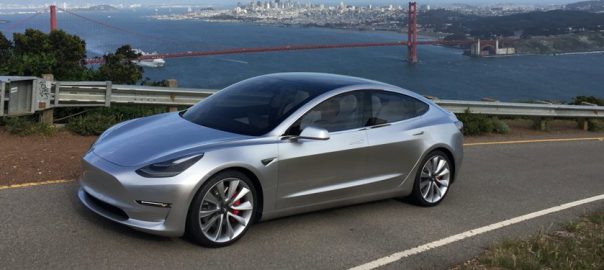
Even though the total number of electric cars has been on a steady rise for more than half a decade (and up 38% in the USA in 2016), many organizations and individual consumers still aren’t aware of how electric vehicles compare to traditional gas-guzzlers.

Performing basic calculations, the average electric vehicle can save a driver who drives 15,000 miles in a year about $850 annually on fuel. Keep in mind that these estimates have been made without taking any special charging systems into consideration. For EV owners and fleets participating in a smart charging program, the savings can be much higher.
One overlooked advantage of electric vehicles is the ability to charge them at home or at a parking lot. People who live in family houses can simply plug in their vehicles after they return home from work, and leave the next morning with batteries fully charged. Fleet vehicles can be charged using smart EV charging systems that offer maximum cost savings, thanks to advanced energy management tools.
Noise pollution is detrimental to human health, and the engines of gasoline- and diesel-powered vehicles are among its most significant sources. According to a study published by the National Institute of Environmental Health Sciences (NIEHS),
“Tens of millions of Americans suffer from a range of adverse health outcomes due to noise exposure, including heart disease and hearing loss.”
The same study claims that
“nearly 100 million people in the United States (about 50% of the population) had annual exposures to traffic noise that were high enough to be harmful to health.”
Most recent speed records have been achieved by electric vehicles. For example, the Tesla Model S P100D hit 60mph in 2.28 seconds, making it the first production car to reach 60mph in under 2.3 seconds. That’s because electric vehicles offer superior power-to-weight-ratios compared to traditional cars.
Battery electric vehicles (BEVs) don’t produce any tailpipe emissions, which are known to be a serious threat to human and environmental health. In comparison, the average gasoline car produces over 350 grams of CO2 per mile.

At the moment, the biggest perceived negative of battery electric cars is their limited range, which leads to what is known as range anxiety. To give an example, the 2016 Nissan Leaf can travel up to 107 miles on a single charge. The thought of only being able to drive 100 miles on a charge worries a lot of potential customers, who think that the somewhat limited range of electric vehicles isn’t enough to meet their needs.
Electric vehicles usually cost more upfront than their gasoline- or diesel-powered counterparts, but they are expected to be cheaper than conventional vehicles by 2022, even if the conventional cars improve their fuel efficiency by 3.5% a year.
New electric vehicles are being introduced on a weekly basis, but it will take years before customers will be able to choose from the same range of models as they can now when it comes to cars with internal combustion engines. After all, the first automobile, Benz Patent Motor Car, started its engine for the first time on New Year’s Eve 1879.
Read more: Fleetcarma
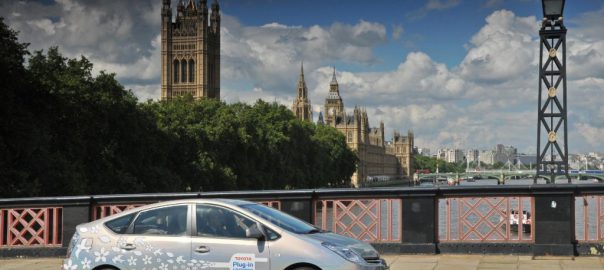
Brexit be damned. In an effort to comply with European Union pollution regulations, London says that later this year it will begin levying a £10 (about $12.50) charge on older cars if they want to drive in the city’s core.
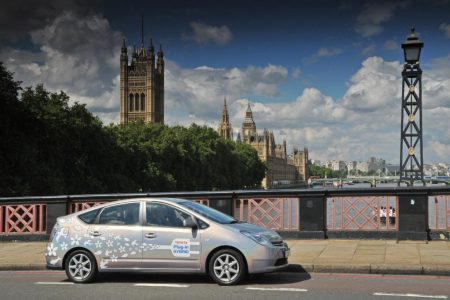
Though not an outright ban on cars, the fee is a step toward creating the
“toughest emission standard of any major city,”
said London mayor Sadiq Khan in a release issued to members of the media.
London plans to implement the new charge on October 23, 2017, the 14th anniversary of the city’s first congestion fee. The city estimates that the fee will apply to about 10,000 vehicles driven into central London on weekdays.
The new “T-charge” is in addition to a £11.50 fee (£10 with automatic payments) that is already collected on all cars driven into central London between 6 a.m. and 7 p.m. on weekdays. While the existing charge applies to nearly all motor vehicles, the T-charge will be levied on cars that do not comply with at least the Euro-4 emissions standards. Broadly speaking, Euro-4 cars date from 2005 or later.
That’s not to say that the new T-charge is not without its detractors. The Telegraph calls it
” a tax on the city’s poorest motorists.”
Khan has also said his administration is investigating a diesel scrapping scheme to pull older, polluting vehicles off of the road and that it is accelerating plans for a separate Ultra Low Emissions Zone that would charge an even larger amount of money to higher emissions vehicles.
Source: The Car Connection

I’m a 34 year old woman who is not naturally drawn to technology and yet I am an early adopter of the electric car.

I try to live a simple life, and there is little I enjoy more than a bit of nostalgia and switching off from the modern world, so it was a bit of a surprise to some of my friends and family when I decided to get an electric car.
The truth is, that it’s actually not much different to driving a regular car, except you’re considering your fuel consumption differently and of course you are saving the environment, and those are good things to concern yourself with, right?!

I took my mum and sisters to the spa the other week, it was the first time my older sister had been in the car and she was sceptical “are we going to get there and back OK, is there enough charge” she must have said this at least 4 times before she forgot about range and concerned herself with other aspects of the car. She was like a kid with a new toy, pressing the touch screen display, asking “what does this do”, “what does that do”, then noticing how silently the car moves and yet how quick it is off the mark. She was impressed. On the way home she noticed the remaining range “36 miles, oh we’ll get home on that” – she was getting it. More at ease and enjoying the ride she asked if I wanted any money towards fuel, I laughed and said “well the journey cost less than £1, so I think I’ll let you off” – she was speechless.
‘Getting over’ the technology aspect of the car is very easy, there isn’t actually much to learn, in fact the car itself makes driving and running it very simple, and I do love a simple life ?
The future is bright for electric cars in 2017, as new figures released recently indicate that more than 100,000 plug-in cars could be on UK roads by the middle of this year.

This prediction is fuelled by record numbers of electric car registrations in 2016, with volumes rising 29% on the previous 12 months. In fact, every quarter of 2016 produced year-on-year growth, with the total number of EVs on UK roads now at more than 87,000.
More and more UK drivers are becoming switched on to the cost-saving benefits and convenience of electric motoring, which resulted in 36,907 electric vehicles being registered between January and December last year, a number that’s set to grow this year.
The ever-increasing selection of electric cars available in the UK is another factor aiding the rise in the market. More than 35 plug-in models are available at the moment, which is four times the number on the market just five years ago.
Plug-in hybrids were particularly popular in 2016, as registrations rose by over 40%. Models such as the BMW 330e, Volkswagen Golf GTE and Audi A3 Sportback e-tron proved to be among the most in-demand.
Source: Go Ultra Low

Diesel technology is set to be a thing of the past, UK car industry executives believe.
The plan is to invest in the technology needed for battery electric vehicles over the next five years, according to 93% of executives while 62% felt that dieselis losing its importance for manufacturers.
Figures from KPMG’s annual global automotive executive survey also show that 90% of executives expect battery electric vehicles to dominate the marketplace by 2025.

John Leech, of KPMG, said:
“Improvements in the cost and range of battery technology, coupled with growing concern over the emission of both carbon dioxide and nitrogen oxides from diesel engines, means that almost the whole automotive industry believes that the mass adoption of electric cars will happen during the next decade.”
Senior executives working for vehicle manufacturers, suppliers, dealers, financial and mobility service providers plus car users took part in the survey.
Some 74% of executives thought more than half of car owners today would not want to own a vehicle.
Researchers believe there will be fewer cars and therefore less money to be made from building vehicles in the future as people may opt to use, rent or pay for a car service rather than to own a car.
This was not feared as a looming problem because 85% of executives were convinced their company might make more money by providing new digital services than by selling cars alone.
Mr Leech said:
“Carmakers plan to sell a myriad of new digital services to vehicle users. Today car makers already make substantial profits from the sale of consumer finance and annual vehicle insurance but this will grow in the future as innovative services such as remote vehicle monitoring and the integration of the car as a focal point in people’s ever more connected lifestyles are demanded by consumers.”
Source: The Independent Online

Electric Vehicle consultancy, Zero Carbon Futures, has been appointed as project manager to Milton Keynes Council to support the delivery of their Go Ultra Low City programme.
The appointment follows the announcement last year that Milton Keynes has been awarded £9 million from the Office for Low Emission Vehicles’ Go Ultra Low City Scheme. The funding is to support the city to become a showcase of what can be done to encourage the uptake of Ultra Low Emission Vehicles.
Following a competitive tender process, Zero Carbon Futures has been commissioned to oversee the project’s key strands including the EV Experience Centre, EV charge point infrastructure and innovation as well as work on the Highways to support the programme.
Brian Matthews, Head of Transport Innovation, at Milton Keynes Council, said:
“We had a number of exceptionally strong tender submissions for the project management contract however Zero Carbon Futures’ expertise and knowledge of the industry really stood out. The company will be a critical friend for the project throughout its five years.”
Zero Carbon Futures has been involved in a number of high profile electric vehicle projects such as the Rapid Charge Network, Plugged in Places and My Electric Avenue and has overseen the development of charge point networks across the UK including at motorway service stations. The company has also developed a number of electric vehicle marketing and promotional campaigns to encourage residents and businesses to consider making the switch to electric.

Dr Colin Herron, Managing Director at Zero Carbon Futures, said:
“Milton Keynes put forward an exceptionally strong bid to become a Go Ultra Low City and we are delighted to be working with the Council to support its delivery. This is a significant programme which will make a demonstrable difference to electric vehicle uptake in the City and we hope that our expertise will provide real added value to the Council.”
Read more: Zero Carbon Futures

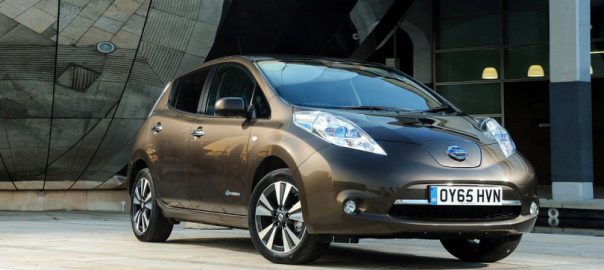
An overhaul of UK car tax rules will increase the cost of motoring – but not if you’re buying a Nissan LEAF
On April 1, the system for taxing new cars in the UK, known as Vehicle Excise Duty (VED), is being radically overhauled (click here for details). The revamp will make it more expensive to run certain types of low-emissions cars – but the Nissan LEAF, the world’s best-selling electric car, will remain exempt from tax.

If you’re confused by the changes, or uncertain of what they mean if you’re considering buying a new car, here’s a quick guide.
The amount of VED you currently pay is based on your car’s CO2 emissions. There are 13 VED bands: vehicles that emit between 0 and 130g/km of CO2 (think electric vehicles and certain hybrids) don’t pay any VED in their first year. After that, vehicles that emit 101-120g/km of CO2 have to pay between £10 and £30. The duty jumps from there, to at least £100 for cars that emit 121g/km of CO2 or more.
From April 1, only vehicles that produce no emissions while driving, such as the Nissan LEAF, will be exempt from VED in year one. Vehicles that produce 1-50 g/km of CO2 pay £10; those that emit 51-75 g/km pay £25. VED then leaps to £100 for vehicles that emit 76-90 g/km. From year two on, CO2-producing vehicles costing less than £40,000 pay an annual rate of £140 – with a £310 premium for cars that cost more than £40,000.
Cars that produce 0g/km of CO2 and cost less than £40,000 will remain exempt from VED for their lifetime. The fully-equipped, five-seat electric Nissan LEAF falls into that category – and it’s also exempt from congestion charges. So as well as fuel costs of as little as 2p a mile, buying a safe and reliable LEAF could save you hundreds of pounds in tax.
When it comes to fuel efficiency, the British-built Nissan LEAF remains ahead of the pack – because it uses no combustible fuel at all.
Read more: What Car?
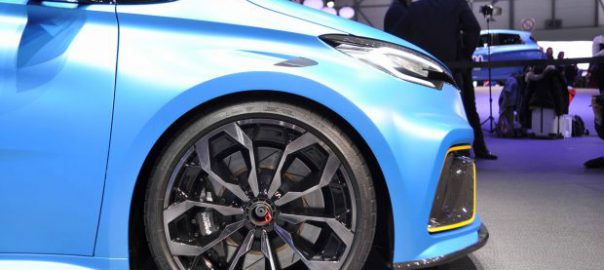
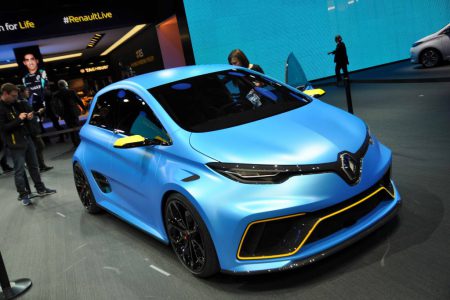
We’ve been warbling on for years now about how there’s been a distinct lack of small, fun electric cars to bolster a cool, youthful appearance of these future-fuelled machines.
But finally, FINALLY, Renault has attempted to fill in the gaps by unveiling an EV hot hatch concept at this year’s Geneva Motor Show, in the form of the Zoe e-sport.
Strictly a concept car for now, the pumped-up version of the popular electric supermini ticks all the right boxes for us here at EV Performance towers. Time to get more excited about EVs…!
“The brief for the Renault ZOE e-sport concept couldn’t have been simpler: ‘Have fun!’. So we came up with something midway between a production model and a racing car… It’s perfect for lovers of extreme driving sensations!”
said Stéphane Janin, Director of Concept Car Design for the firm.
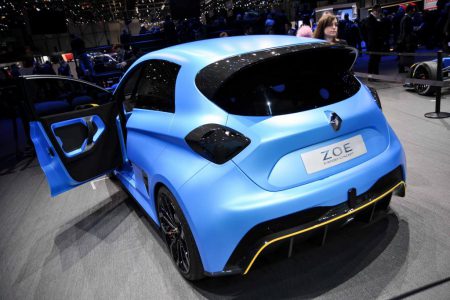
Although it might be a million miles away from a production model, it’s absolutely fantastic to see a firm such as Renault addressing the fun side of electric cars. It’s all too easy to be overwhelmed with range statistics and kW figures in this crazy world of electric cars, so it’s nice to see some serious hints at performance models potentially being in the pipeline in the coming years.
Read more: EV Performance