All posts by Jo

China just built a 250-acre solar farm shaped like a giant panda

The Panda Power Plant in Datong, China. China Merchants New Energy/Panda Green Energy

The Panda Power Plant in Datong, China.

Most solar farms align their solar arrays in rows and columns to form a grid.

A new solar power plant in Datong, China, however, decided to have a little fun with its design. China Merchants New Energy Group, one of the country’s largest clean energy operators, built a 248-acre solar farm in the shape of a giant panda.

The first phase, which includes one 50-megawatt plant, was completed on June 30, according to PV magazine. The project just began delivering power to a grid in northwestern China, and a second panda is planned for later this year.

Called the Panda Power Plant, it will be able to produce 3.2 billion kilowatt-hours of solar energy in 25 years, according to the company. That will eliminate approximately million tons of coal that would have been used to produce electricity, reducing carbon emissions by 2.74 million tons.

China Merchants New Energy Group worked with the United Nations Development Program (UNDP) to make the Panda Power Plant a reality. The project is part of a larger effort to raise awareness among young people in China about clean energy, the UNDP wrote in a statement.

The Panda Power Plant in Datong, China will stretch 1,500 acres when complete.

The groups hope to build more panda-shaped solar plants throughout China in the next five years.

Source: Business Insider

The Electric Car Revolution Is Accelerating

  • Electric cars will be as cheap as gasoline models by 2025
  • Battery manufacturing capacity will triple in the next four years
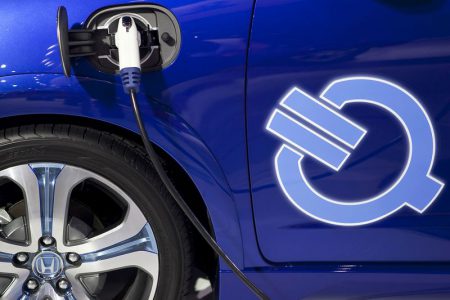
The charging port of Honda Motor Co.’s Fit electric vehicle. Photographer: Andrew Harrer/Bloomberg

Electric cars will outsell fossil-fuel powered vehicles within two decades as battery prices plunge, turning the global auto industry upside down and signaling economic turmoil for oil-exporting countries.

The Bloomberg New Energy Finance forecast says adoption of emission-free vehicles will happen more quickly than previously estimated because the cost of building cars is falling so fast. The seismic shift will see cars with a plug account for a third of the global auto fleet by 2040 and displace about 8 million barrels a day of oil production—more than the 7 million barrels Saudi Arabia exports today.

“This is economics, pure and simple economics,”

BNEF’s lead advanced-transportation analyst Colin McKerracher said before forecasts were published on Thursday.

“Lithium-ion battery prices are going to come down sooner and faster than most other people expect.”

The forecast is BNEF’s most bullish to date and is more aggressive than projections made by the International Energy Agency. Surging investment in lithium-ion batteries, higher manufacturing capacity at companies including Tesla Inc. and Nissan Motor Co., as well as emerging consumer demand from China to Europe support BNEF’s projections.

Read more: Bloomberg Businessweek

Volvo and the allure of EVs

Times are changing for drivers

Volvo’s announcement on 5 July that from 2019 it would be making only EVs is not a statement about demand now, but about demand that manufacturers want to create.

For now, penetration of EVs is low. The global stock doubled from 1m units in 2015 to 2m last year, says the International Energy Agency—but that’s still less than 1% of the world’s fleet.

One percent seems a small market to pin your future on. But if Volvo, Tesla and the others have their way, the S-curve for EVs will deal with the rest. Marketing will too. Be ready for the spiel that forever renders the internal-combustion engine something akin to a Nokia 3310 handset and the battery-powered car like the iPhone 6: yesterday’s technology versus today’s.

Back to the future

In short, whatever the size of the market now, carmakers sniff an opportunity to revive their industry by selling not just another tired diesel or gasoline model but something that genuinely feels like it belongs in the same century as a smartphone. Scores of new models will be offered in the next two years—with longer ranges and smaller price tags.

Volvo is too small in most of the world to be anything but a symbol of this. As EV sceptic Cüneyt Kazokoglu, an analyst at Facts Global Energy, wrote on Twitter , despite the company’s “cheap marketing trick”, Volvo’s market share in Europe is just 1.8% and globally only 0.7%.

Still, since 2010, Volvo has been owned by Zhejiang Geely Holding Group, a Chinese conglomerate, and the announcement reflects the proprietor’s priorities. Chinese companies, like their government, are serious about EVs. Purchases there are soaring, thanks in part to subsidies. Beijing wants to increase annual sales tenfold in the next decade, to 7m units a year by 2025. Bloomberg New Energy Finance reckons EVs will account for all new-vehicle sales growth in the next eight years.

It’s hard to overstate how big a problem this is for the oil industry. First the obvious: real EV take-off from consumers has the potential to wipe millions of barrels of daily oil demand from forecasts, especially if trucks start plugging in too.

It would be a problem—though it might not be imminent. A mainstay of industry conferences are the speakers who line up to assure their audience of oil’s longevity, the developing world’s thirst for more crude, the resurgence of SUVs and the statistically peripheral position of EVs in the market. They’ve been right in the past (remember the peak oil threat?) and might be this time too.

If the oil industry’s best answer to EVs is a belief that consumers will resist their urge to buy shinier, more advanced, more efficient and, eventually, more economical technology, then investors will punish them. Pinning a business on hopes that drivers will stick with older, dirtier technology is risky.

Read more: Petroleum Economist

France will ‘ban all petrol and diesel vehicles by 2040’

Environment minister unveils five-year-plan to fulfil country’s commitments under Paris Agreemen.

France plans to ban all petrol and diesel vehicles by 2040, the country’s new environment minister has announced.

Nicolas Hulot made the announcement as he unveiled a series of measures as part of newly elected President Emmanuel Macron’s plan to make the country carbon neutral by 2050.

Mr Hulot said he recognised the target would put pressure on France’s car manufacturers, but he said they currently had projects which

“can fulfil that promise”.

As part of the plan, poorer households will receive a premium so they can swap their polluting vehicles for clean alternatives.

The announcement comes after Volvo said on Wednesday it planned to build only electric and hybrid vehicles from 2019.

Speaking at a press conference, Mr Hulot told reporters France would stop using coal to produce electricity by 2022 and that up to €4bn of investments will help to boost energy efficiency.

The announcements are part of a five-year-plan to encourage clean energy and fulfil the country’s commitments under the Paris Agreement.

Mr Hulot said the government wanted to maintain the country’s “leadership” in climate policy.

“We want to demonstrate that fighting against climate change can lead to an improvement of French people’s daily lives,”

he said.

France is not the only country which aims to ban combustion-powered cars. The Netherlands and Norway previously said they wanted to get rid of petrol and diesel vehicles by 2025 and Germany and India announced similar plans ahead of 2030.

Reacting to the news, ClientEarth CEO James Thornton said: “This is a huge statement of intent from the French government and an example of how we’re likely to see exponential change in the coming years as governments grapple with the necessary changes we have to make for air quality and our climate.

“Coming hot on the heels of Volvo’s announcement yesterday, the outlook for the internal combustion engine is bleak. This is now clearly the direction of travel and industry players who are not on board will find themselves struggling before long.

“These moves should be heeded by other governments and industry, who need to act to protect us from air pollution in our towns and cities and help mitigate climate change.”

Read more: Independent

Cars we won’t regret going electric: Speed Matters

Ditching internal combustion may be the best thing that ever happened to the Smart – could any other cars benefit?

What will the Goodwood Festival of Speed be like in 25 years’ time? Just as noisy and thick with the smell of tyre smoke and exhaust fumes I’d hope. And populated by our generation, misty-eyed at displays of the machinery of our youth being given a run out. Much as our parents may enjoy visits to volunteer branch lines to relive the glory days of steam or gaze in wonder at Spitfires looping the loop at air shows.

I’d expect there to be rather fewer internal combustion powered cars in the queues for the car parks though. A thought that struck me as I watched a Formula E car whistle past me at the Festival at the weekend. It was fast. But up against the mightiest examples of petrol-powered excess, an electric car was always going to suffer on the excitement stakes. An opinion perhaps not shared by the driver of the Rimac that very nearly ‘did a Hammond’ in front of the hospitality pavilions. But even that raised little more than a curious shrug from onlookers against the thunder of Jochen Mass power sliding a Mercedes W125 or the sound of the sky being ripped apart by an 8.4-litre McLaren M8F.

Will I be so nostalgic about the car I drive to the event though? Not sure. Accepted wisdom has it that electric cars are interesting. They can be fast – ludicrously so in the case of Tesla. But can they ever be better than their internal combustion equivalents? Does, for instance, the idea of an electric Porsche 911 fill you with hope? Or fear?

Read more: PistonHeads

Renault Zoe becomes first EV pool car for Slough Council

Slough Borough Council has purchased three Renault Zoe EV vehicles as staff pool cars.

The purchase follows Slough Borough Council’s ‘journey to clean air’ initiative, as part of its low emissions strategy.

The pool car scheme is part of Slough’s wider fleet challenge programme, providing ‘environmentally friendly’ solutions for staff travel to meetings, site inspections and client visits. This all helps towards Slough’s aim to decarbonise its fleet.

Leader of Slough Borough Council Cllr Sohail Munawar said:

“The fleet challenge is just one of the ways we are making a difference to our communities and our environment. By introducing a pool of both ultra-low emissions electric cars and e-bikes, we are moving towards that goal.

“Forty staff tried the Renault Zoe and the feedback was excellent. They found it easy to drive and the controls clear and simple to understand. The charging lead is easy to connect and the range the car offers makes it ideal as a pool car.

The three Zoe Dynamique iNav R90 Z.E.40 models were sourced through Renault Croydon and have been fitted with the optional rear-view parking camera.”

Groupe Renault UK’s national fleet manager Mark Potter said:

“We’re delighted that Slough Borough Council has chosen the Renault Zoe as its first electric pool car. The Zoe creates no emissions at the tailpipe, and with the 250-mile range (NEDC) available from its Z.E.40 battery, it will be able to complete return journeys across the borough without needing to stop and charge up again. We are sure staff will also enjoy its smooth, quiet performance and fun character.”

Source: FleetNews

Every new Volvo model to be electrified by 2019

From 2023, you won’t be able to buy a new Volvo without an electric motor.


As part of a radical move to increase sales of its electrified cars, every newly launched Volvo will come as either a hybrid, a plug-in hybrid or as a fully electric vehicle by 2019, with the brand’s entire portfolio of models following within four years.

Five new electric cars

Volvo will also build five new fully electric cars between 2019 and 2021. Two of these will be sold under Volvo’s new Tesla-rivalling performance sub-brand, Polestar.

The remaining three new Volvo electric cars will be all-new models, rather than being derived from existing cars. The electric vehicles will be offered with two battery choices – in much the same way as Tesla offers different varieties of both the Model S and Model X depending on desired range and performance.

It’s understood that one option will focus on extended range, while the other will maximise power. That second option will still have a range of around 310 miles, meaning you’d be able to travel further than in a Nissan Leaf, Renault Zoe or entry-level Model S.

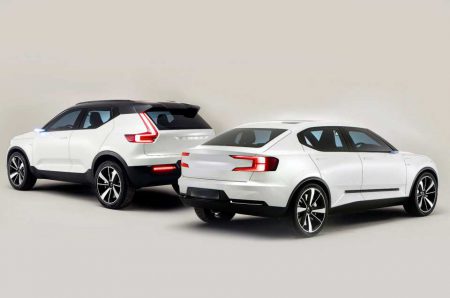
While it hasn’t been confirmed what form Volvo’s all-electric models will take, the most likely candidate is the upcoming XC40 small SUV.

Volvo hasn’t said how much it will charge for its electric models, but has re-iterated that it intends to create premium cars. The brand wants to sell one million electric cars globally by 2025.

A range of hybrid vehicles

Throughout the rest of Volvo’s product range, new cars will be offered as either a hybrid, a plug-in hybrid or as a mild hybrid. Mild hybrids are the least noticeable form of electrification, as the small electric motor only provides extra power when accelerating away from junctions or traffic lights.

That means time is limited for Volvo’s current range of petrol and diesel-engined cars, although the Swedish car maker already offers plug-in hybrids, most recently on the XC60 small SUV.

Read more: Whatcar

Renault Actually Considering Production Of Hot Zoe RS

Fingers crossed that it will make it!

Renault ZOE E-Sport

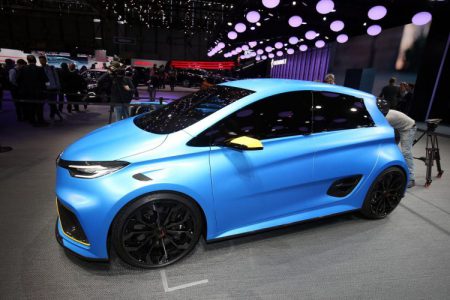
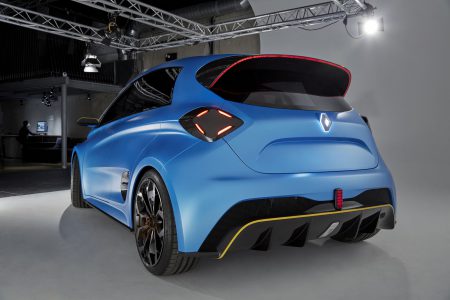
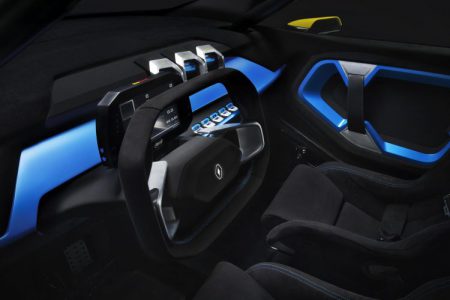
The pint-sized Zoe is far from being the most exciting electric car out there, but it’s a whole different story with the bonkers E-Sport concept. Unveiled earlier this year in Geneva, the zero-emissions city car had a pair of electric motors good for a combined output of close to 460 horsepower (343 kilowatts) and a torquetastic 472 pound-feet (640 Newton-meters).

As it turns out, Renault Sport is actually analyzing the prospects of coming out with a high-performance Zoe that would carry the “RS” suffix. In an interview with Autocar, the go-faster division’s boss, Patrice Ratti, admitted

“we are thinking about doing a Zoe RS but it is a big study that will take time.”

He went on to specify the hot e-hatch is being considered thanks primarily to the developments made in battery technology, thus making the Zoe RS a feasible project worthy of being evaluated for a potential production model.

Renault ZOE E-Sport

If green-lighted, the Zoe RS (see render here) will go through some significant changes compared to the concept. Besides being subjected to steering and chassis modifications, the batteries would also have to be tweaked in order to boost range over the E-Sport, which had enough juice for a mere 15 minutes while being driven at full throttle. For the sake of comparison, the regular Zoe ZE 40 you can actually buy can cover up to 250 miles (400 kilometers) between charges as per the New European Driving Cycle (NEDC).

Should the road-going model get even close to the concept’s performances, it’s going to be a little electric beast. Renault Sport said the show car would do 0 to 62 mph (100 kph) in just 3.2 seconds. Top speed was electronically capped at 130 mph (210 kph), a process which took less than 10 seconds from a standstill.

Renault ZOE E-Sport

But Renault Sport has bigger fish to fry right now as it’s gearing up to introduce the all-new Megane RS. Slated to debut on September 12, the newest performance model carrying the diamond logo will premiere at the Frankfurt Motor Show.

Source: InsideEVs

Plug-in hybrid completes Ioniq trio

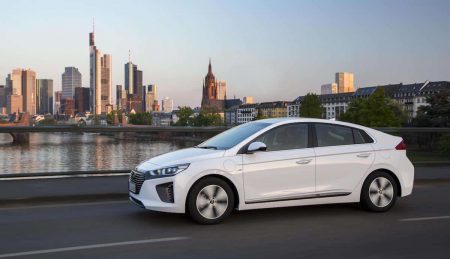
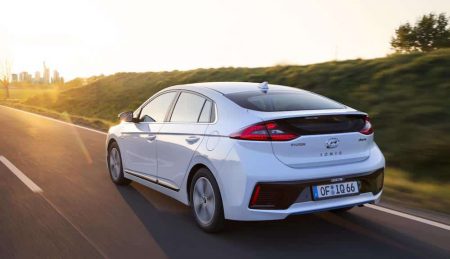
The plug-in hybrid uses a 105hp 1.6-litre petrol engine in conjunction with a 61hp high-efficiency electric motor driven through a six-speed dual-clutch transmission. This produces a combined output of 141hp and CO2 emissions of 26g/km, thereby attracting a zero-rate Vehicle Excise Duty for the first year.

Hyundai has completed the line up of its Ioniq with a plug-in hybrid model.

Hyundai claims that its new PHEV is capable of up to 39 miles of pure electric driving and a total range of 680 miles.

The Ioniq PHEV can be plugged into a domestic three-pin outlet when no dedicated charging points are available. For an additional £300, a 7kW charger and wall box can be supplied and installed at a customer’s home.

The standard paint finish is Polar White, though customers are able to specify from Phantom Black, Platinum Silver, Iron Grey, Demitasse Brown, Marina Blue and Phoenix Orange. Two trim levels, Premium and Premium SE, are available.

The Ioniq PHEV goes on sale this month with UK pricing starting from £24,995, including a £2,500 Plug-in Car Grant.

Polar White is the standard paint finish for the new PHEV

Source: The Car Expert

BMW i3 is the good kind of nerdy

There’ a new crop of nerds. Not the old-style outcasts of high school, but instead, the new age definition where brains are worn as a badge of honor. And this is their car.

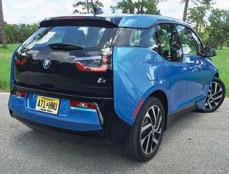
BMW i3

The BMW i3 is intelligence for the road by offering an electric vehicle that’s engineered to maximize every last kilowatt. And it does so while boldly standing out from the crowd — loudly and proudly proclaiming its nerd-mobile status.

Its short stubby nose and blocky build give the i3 a memorable silhouette. BMW’s hallmark twin-kidney grille helps create an angry face, but the standard tri-tone color options make the whole package feel a bit livelier. So the total impression is like an electric bulldog on wheels (bet you’ll never find that kind of comparison on any other car.)

BMW i3

The front doors are large enough to look like a coupe, but there’s a second set of rear-hinged ones for better access to the back seats. Other cars of the last decade like the Honda Element and Mazda RX-8 have done this, too, but the i3 seems to open larger and wider, which makes it particularly impressive.

The extra exposure comes from its revolutionary construction. The frame is made of carbon fiber reinforced plastic. It’s a material that’s both extremely lightweight and exceptionally strong. BMW left it unpainted in the door jams so the cool nerds can marvel at the metallic-like weave that isn’t found in many production vehicles.

BMW i3

Once inside, this electric car reminds that it’s one with nature. The seats are made from a broad thread that looks like woven on a country loom. The optional leather was tanned with olive leaf extract. The dash and door panels have a fibrous appearance that clearly came from recycled plastics. And completing the natural atmosphere is the optional open-pore Eucalyptus Wood flowing over the glovebox and under the infotainment screen. BMW says it’s one of the most sustainable lumbers available, but really, we just like how it gives the i3 a unique and premium atmosphere.

Read more: Fort Myers Florida Weekly