All posts by Jo

Electric Mini to be built in Oxford

A fully electric version of the Mini will be built at the Cowley plant in Oxford, BMW has said.

The carmaker said the model would go into production in 2019, with Oxford the main “production location” for the Mini three-door model.

However, the electric motor will be built in Germany before being shipped to Cowley for assembly.

BMW said it had “neither sought nor received” any reassurances from the UK on post-Brexit trading arrangements.

The electric vehicle will be based on the 3-door hatchback model

Last year, the government faced questions about the “support and assurances” given to Nissan before the company announced that new versions of its Qashqai and X-Trail would be made in the UK.

And there have been reports that Toyota agreed to invest in the UK after receiving a letter reassuring the Japanese carmaker over post-Brexit arrangements.

‘Vote of confidence’

About 360,000 Minis are made each year, with more than 60% of them built at Oxford. But BMW has built up an alternative manufacturing base in the Netherlands amid concerns about Britain’s suitability as an export hub after Brexit.

BMW has warned about the damage of Brexit uncertainty, and in May chief executive Harald Krueger said the company had to remain “flexible” about production facilities.

UK Business Secretary Greg Clark hailed BMW’s announcement as a “vote of confidence” in government plans to make Britain

“the go-to place in the world for the next generation of vehicles”.

On Monday, he set out plans to invest in development of battery technology in the UK.

Mr Clark met BMW’s head of sales and marketing, Ian Robertson, at the company’s headquarters in Munich in January and March this year. The two also held meetings at Westminster in March and June.

David Bailey, professor of industry at Aston University, said the true test of the global car industry’s desire to invest in the UK would come next year:

“I don’t think it [BMW’s decision] tells us much about Brexit and the form of trade barriers we may face in the future.

“The big decisions will be about future models [which would have redesigned bodies], both at Mini and at companies like Vauxhall when they announce their new models in the next couple of years.”

Read more: BBC News

200th eVolt Rapid EV Charging unit to be installed at Heathrow Airport

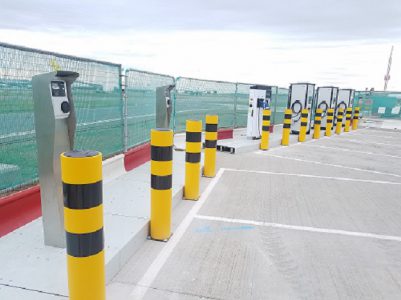
eVolt’s 200th electric vehicle (EV) Rapid Charging unit has been supplied to Heathrow Airport, after the charge point supplier was awarded the contract to provide the UK’s largest airport with 18 of its units in phase one.

The significant milestone has been achieved as a result of the hard work of Freemantle Electrical – the selected EV charger and infrastructure installer for the initial phase of works. The chargers were installed using a specific new designed EVCI-Go modular plinth system developed by Freemantle that allows wiring through the plinth system, which avoids any major civils works and speeds up the installation process. The Airport selected eVolt as its supplier of EV charge points following a competitive tender where multiple suppliers were reviewed.

The new Rapid charging units have been installed at eight of the airport’s airside locations including the Airside Operations Facility (AOF). They will be used by Heathrow Airport’s growing fleet of EVs run by Heathrow Airport Limited and its tenants assisting in everyday operations.

Richard Freemantle, Managing Director at Freemantle Electricals, says eVolt came highly recommended:

“The reliability of eVolt’s charging units is well known and that was key to Heathrow Airport Limited’s selection,” he says. “Its units are well maintained and have a high up-time, meaning the Airport’s EVs will be able to operate with maximum performance.”

Three Compact Rapid charging points, that can simultaneously charge two EVs to 80% battery capacity in 30 minutes at 50kW DC and 43kW AC, have been installed, taking the number of eVolt Rapid charging units installed in the UK to over 200. A Semi-Rapid Raption 22kW Triple charging unit that charges an EV to 80% in one hour has also been installed. This is ideal for fast top-up charges and utilises the latest modular power technology for enhanced reliability and performance.

The contract also includes the supply of eVolt 7kW and 22kW AC Wall mount charging units, which typically take up to four hours to charge an EV (battery size dependent). It is expected that these will be used to provide charging to ‘off-duty’ EVs, ensuring that when a shift starts the vehicles are able to make use of a full charge.

Justin Meyer, General Manager of eVolt UK, says:

“We are seeing increasing opportunities with major public transport hubs looking at ways to reduce emissions,” he says. “It’s a testament to our equipment’s reliability and performance that 200 Rapid charging units, the most technical and desired in terms of charging time, are operational.”

Source: Gravity London Email Press Release

Ecotricity Change Cost Structure of their Rapid Chargers.

Ecotricity recently changed the cost structure for their rapid chargers. Below is a summary of the letter they sent to their customers explaining the changes.

It is about a year since Ecotrictity introduced ‘charging for charging’ on the Electric Highway, after being free to use for five years. Charging was set at a rate of £6 for 30 minutes, with intention to monitor use and later produce “a more sophisticated approach to charging”.

With that now done a new model has been developed and rolled out, promising to give

“more flexibility and typically lower charging costs across all makes and models”.

The new rates are charged at 17p per unit, which they explain is

“pretty much the rate that people pay at home”

the cost of providing the service is administered via a £3 connection fee for all sessions.

Dale Vince wrote

“In our modelling this will typically lower the cost of charging for all makes and models as well as charge more proportionally for energy taken.”

They have also increased the maximum length of charging sessions to 45 mins, it is hoped this will offer greater flexibility to those customers who need a bit longer to charge up.

For Ecotricity customers there currently is no connection fee, this reflects their opinion that their customers’ energy bills help them build the network.

Those existing Ecotricity customers that benefit from the offer of 52 free charges in a year will continue to benefit from this arrangement until their first anniversary with the company, or their first 52 charges (whichever comes first). After this they will be automatically transferred to the new charging model.

The new rates and process came into effect on 26th June 2017, it is recommended that customers of update their mobile phone app’s to pick up the new tariff changes.

Information Source: Email from Ecotricity

Tesla Rolls Out Its First Model 3, and It’s Elon’s

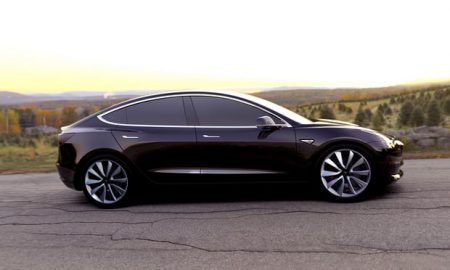
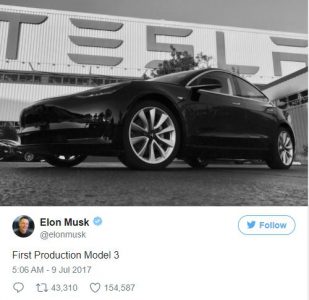
It’s finally here: The Model 3, Tesla’s $35,000 electric gamechanger. A single black Model 3 rolled off the production line Friday with a serial number all its own, kicking off a company-defining six months. The car will belong to Elon Musk, Tesla’s CEO and co-founder, who shared images of it on Twitter over the weekend.

Serial Number: 1. This one goes to Musk.

Tesla has already taken in roughly half a billion dollars in Model 3 deposits, at $1,000 apiece, and its proposed ramp-up schedule would have it rivaling well-established U.S. market peers like BMW and Mercedes by year’s end. The only thing standing between Tesla and being the world’s first mass-market electric carmaker is proving it can build, deliver, and service enormous numbers of these vehicles—without sacrificing quality.

The production acceleration will be slow at first. Tesla plans to hand over the keys to 30 cars at a launch celebration on July 28. It then envisions building 100 cars—less than three a day—for the month of August, according to a series of Twitter posts by Musk last week. September will bring another 1,500 cars, and the ramp will build to a rate of 20,000 cars a month by December, Musk said. It’s an aggressive schedule that will more than double Tesla’s total production rate in six months, and then quintuple it by the end of next year.

If Tesla achieves all of Musk’s targets, it will build more battery-powered cars next year than all of the world’s automakers combined in 2016. U.S. sales under Musk’s 2018 targets would significantly outpace the BMW 3 Series and the Mercedes C-Class, the best-selling small luxury cars in the country.

Tesla, by tradition, delivers the first new car off the line to the first customer to pay full price once the car officially goes on sale. Musk’s collection includes the first Tesla Roadster and the first Model X—but not the first Model S. That trophy belongs to Tesla board of directors member Steve Jurvetson, who told the Chicago Tribune in 2010 that he scored the first of Tesla’s flagship sedans by writing out a check just before a board meeting and tossing it across the table. The right to the first Model 3 was won by board member Ira Ehrenpreis, who then gifted it to Musk for his 46th birthday, on June 28.

Read more: Bloomberg

The Uninhabitable Earth

Famine, economic collapse, a sun that cooks us: What climate change could wreak — sooner than you think

I. ‘Doomsday’

Peering beyond scientific reticence.

It is, I promise, worse than you think. If your anxiety about global warming is dominated by fears of sea-level rise, you are barely scratching the surface of what terrors are possible, even within the lifetime of a teenager today. And yet the swelling seas — and the cities they will drown — have so dominated the picture of global warming, and so overwhelmed our capacity for climate panic, that they have occluded our perception of other threats, many much closer at hand. Rising oceans are bad, in fact very bad; but fleeing the coastline will not be enough.

Indeed, absent a significant adjustment to how billions of humans conduct their lives, parts of the Earth will likely become close to uninhabitable, and other parts horrifically inhospitable, as soon as the end of this century.

Even when we train our eyes on climate change, we are unable to comprehend its scope. This past winter, a string of days 60 and 70 degrees warmer than normal baked the North Pole, melting the permafrost that encased Norway’s Svalbard seed vault — a global food bank nicknamed “Doomsday,” designed to ensure that our agriculture survives any catastrophe, and which appeared to have been flooded by climate change less than ten years after being built.

The Doomsday vault is fine, for now: The structure has been secured and the seeds are safe. But treating the episode as a parable of impending flooding missed the more important news. Until recently, permafrost was not a major concern of climate scientists, because, as the name suggests, it was soil that stayed permanently frozen. But Arctic permafrost contains 1.8 trillion tons of carbon, more than twice as much as is currently suspended in the Earth’s atmosphere. When it thaws and is released, that carbon may evaporate as methane, which is 34 times as powerful a greenhouse-gas warming blanket as carbon dioxide when judged on the timescale of a century; when judged on the timescale of two decades, it is 86 times as powerful.

Read more: New York Mag

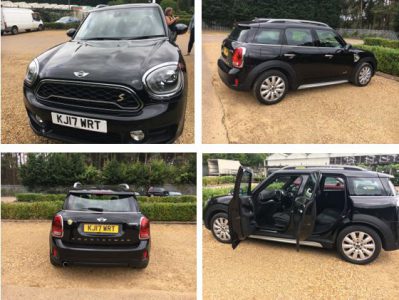
MINI Countryman Plug-In Hybrid gets the thumbs up

I was recently lucky enough to have an extended test drive of the MINI Countryman Plug-In Hybrid, a car I’ve been keen to experience since I got word that the electric MINI’s were coming.

With an electric range of 24.8 miles (NEDC) this car could be the answer to fairly short distance commuters who are not quite ready to go All-Electric but want something a bit more eco-friendly and a little more trendy than some of the other PHEVs on offer.

On first impressions of the exterior I really liked it, it was sleek and just a little aggressive, it’s reasonably sized yet still manages to keep some of the iconic MINI features.

MINI Countryman Plug-In Hybrid

Inside I found it roomy and comfortable, the 3 driving modes made it easy to switch from fully electric (Max eDrive), Petrol use only (Save Battery) and Auto eDrive – the option where the car decides what fuel source to use based on your driving style.

There are some useful features to help you ‘keep an eye’ on your consumption and your fuel usage. The first being the trim surrounding the display, when using electric it glows yellow and gives you an indication of your remaining electric range. You can also toggle through different options on the display to show you the percentage of battery remaining and remaining range. The E-Instruments gauge is to the left of your tachometer and this shows you the status of your fuel usage (i.e. when you are using petrol and when using electric).

On usage, it breezed through my short 12 mile commute to work on fully electric – I knew it would. I used the car around town on the Saturday taking it to the DIY store where the roomy boot space came in useful, again only using electric for my short journeys.  On the Sunday I travelled a bit further, taking the MINI to Woburn Centre Parks. With a car full of family I decided to try the ‘Auto eDrive’ driving mode. It changed effortlessly between petrol and electric fuel whilst maintaining a quiet ambience within the cab.

The Navigation software was a little complicated to read, but I think this is just the style of the software, much like the BMW Navigation system. I’m sure I would have got used to it after a bit more use.

My experience on charging will be a little different to others as I don’t have a charge point at home, it was doable but I did need to charge publicly quite often which wasn’t ideal. Not having a home charge point doesn’t cause me any issue with my fully electric car because I don’t need to charge up as often but this approach doesn’t lend itself well to a plug-in Hybrid, as you do need to charge it everyday to make real use of the electric motor.

Overall I really liked this car. It was good to drive, I love the look and I can certainly see this being a top player in the PHEV market.

If the spec, look and feel of the MINI Countryman PHEV is anything to go by then I eagerly await the all-electric MINI.

See our dedicated page for MINI Countryman Plug-In Hybrid prices.

Electric Vehicle Experience Centre – a little bit of Zen in a car showroom

Last Friday I had the pleasure of attending the ‘Sneak Preview Event’ of the Electric Electric Experience Centre, with the official opening taking place the day after on Saturday 22nd July in Milton Keynes.

The first of its kind in the UK and part of the city’s Go Ultra Low Scheme; it previewed to a relatively small audience of electric car owners & enthusiasts, with the message being to “spread the word”.

Entering the showroom it was hard not to compare the slick minimalist design to that of an Apple store. With a tree at its centre and a wall of foliage set against a cool stone-like interior, it does well to balance something as man-made and mechanical as the car in an environment that would be more expected at a spa reception. It works, and the simplicity highlights how you can now drive a car and be eco-friendly at the same time, they are no longer exclusive.

The showroom cars are displayed in a way that lets them speak for themselves, allowing visitors to explore them in detail and without the pressure of a sale.

The centre is primarily there to educate, with a small team of ‘EV Gurus’ on hand to answer questions and talk about the benefits of electric car ownership you can go along for some impartial advice and discussion and a test drive(s) if you wish.

It is hoped that the Electric Vehicle Experience Centre will support the cities Go Ultra Low Scheme, with a target of about 23% take up of new electric car sales by 2023.

f

Second electric vehicle charge point installed in Daventry

A second free public charging point for electric vehicles has been installed in a Daventry car park due to increased demand.

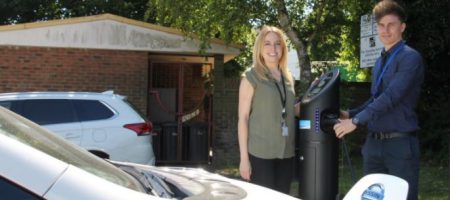
DDC’s Environmental Improvement Officer Joely Slinn with Operations Assistant Rob Burton at the new electric vehicle charging point in Lodge Road.

The addition of the new facility in the Lodge Road car park means up to four electric vehicles can now be charged for free at the same time. It has been installed by Daventry District Council (DDC) following the success of the first charge point, which opened in May 2013.

The £7,000 project follows the publication of DDC’s Electric ‘Plug-In’ Vehicle Infrastructure Plan 2016-18, which highlighted the need to improve facilities across the district in response to a 250% increase in the numbers of electric vehicles on our roads in the last two years.

The first charge point at Lodge Road has been used more than 1,400 times since it was installed, saving 7.6 tonnes of CO2 compared to the emissions produced by the average petrol or diesel vehicle. That’s roughly the amount of CO2 that would be created by driving an average petrol car for more than 12 days non-stop.

Councillor Jo Gilford, Environment Portfolio Holder at Daventry District Council, said:

“We have seen growing demand for the public charge point as the take-up of electric vehicles has grown.

“We are committed to being at the forefront of environmental innovations in transport, and key to that is having the infrastructure in place to meet future demand. This new charge point will help us meet that demand and we expect it to be well-used by the public.”

Both of the public charge points at Lodge Road are Chargemaster single phase 32 Amp/7KW with type 2 sockets (7-pin sockets) and are free to use for up to 4 hours.

They are compatible with Plugged in Midlands (formerly Plugged in Places), POLAR/Chargemaster, Plugged in Midlands and BMW RFID cards. Compatible cards are also available to borrow from the Council’s reception during office opening hours.

Read more: Daventry District Council

Hyundai Ioniq Plug-In Hybrid UK pricing revealed

Hyundai has confirmed pricing and specification details for the plug-in hybrid version of its Ioniq family car. It will launch in the UK on 13 July and it starts pricing at £24,995 after taking into account the government’s plug-in car grant (PICG).

The Hyundai Ioniq is a practical, low-emissions hatchback which is already available with a conventional hybrid powertrain and a fully-electric powertrain too. With the arrival of the plug-in hybrid, the Hyundai Ioniq becomes the first production car to offer three different types of electrified powertrain at the same time.

There are two trim levels available with the Ioniq Plug-In, but whichever you pick the car utilises a 104bhp 1.6-litre GDi petrol engine combined with a 44.5kW electric motor and six-speed dual-clutch automatic gearbox to deliver 139bhp and CO2 emissions of just 26g/km.

According to official figures, the Hyundai Ioniq Plug-In can travel for up to 39 miles on purely electric power and the total range possible is 680 miles.

Hyundai IONIQ Plug-In Hybrid 2017

The entry-level trim is called Premium and as standard it comes with 16-inch alloy wheels plus an eight-inch infotainment system with sat-nav, Bluetooth and Apple Car Play and Android Auto all supported. Other standard features include wireless phone charging, a rear parking camera, lane keep assist and autonomous emergency braking.

Above Premium is the Premium SE trim, which starts from £26,795 when factoring in the plug-in car grant. This version adds the likes of leather and ventilated front seats, heated rear seats, alloy pedals, rain-sensing wipers, blind spot detection and front park assist.

The Ioniq Plug-In has one free exterior paint job – Polar White – while other finishes which include Phantom Black, Platinum Silver, Marina Blue, Phoenix Orange and Iron Grey are £565 options.

Source: Carkeys

First Tesla Model 3 rolls off production line

Lower-cost electric car begins delivery with first model to company chief executive as first 30 customers to get vehicles at 28 July party.

Tesla Model 3

The first of Tesla’s highly anticipated lower-cost electric cars, the Model 3, has rolled off the production line to its new owner, Tesla chief executive Elon Musk.

The one-man marketing machine, who also took on a large, high-profile battery project in Australia and a runs a privateer space company Space X, shared a couple of photos of the Model 3.

The Model 3 is the third model in the current range from the company that includes the Model S and Model X – a crossover SUV that was delivered to customers almost 18 months later than planned.

Tesla’s limiting of options for the Model 3 to choice of colour and wheels was made in an effort to speed manufacturing and reduce the production issues it has suffered in the past with an over-complicated list of options for its Model X.

Read more: The Guardian