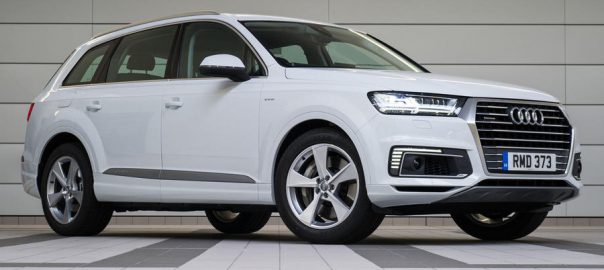
Plug-in hybrid Q7 promises economy of 156.9mpg and BIK rates of 10%. It’ll take you a while to recoup the £10k premium over a standard Q7, though

What is it?
This is the latest addition to Audi’s e-tron range: a plug-in hybrid version of the big Q7 SUV. Like the significantly smaller A3 e-tron, there’s an internal combustion engine under the bonnet that’s coupled to an electric motor and battery pack.
Unlike the BMW X5 xDrive40e and Volvo XC90 T8, you won’t find a petrol-fired four-cylinder turbo engine under the bonnet of the Q7 e-tron, driven for the first time on UK roads. Instead, there’s an optimised version of the 3.0 TDI V6 that can be found in the regular Q7. In this application, it produces 254bhp.
Under the boot floor lives 202kg of battery pack and assorted electrical hardware, robbing the Q7 of its ability to seat seven. Load capacity is reduced by a sizeable 120 litres, but the 650 litres that are left should still be enough for the vast majority of families.
That battery may seem like a hefty thing, but it’s still only enough to provide a maximum electric range of 34 miles.
What’s it like?
With all this talk of economy, emissions and the small matter of a 2.5-tonne-plus kerb weight, you might expect the Q7 to feel sluggish compared with the regular 268bhp model. That is most definitely not the case.
With the diesel and electric motors combined, total system output is 369bhp and 516Ib ft of torque. That’s good enough for performance that would make many a hot hatch blush. Not only does it look quick on paper, but the instantaneous torque of the electric motor also means it feels effortless in the way it piles on speed.
Read more: Autocar