Former Top Gear Stig, Ben Collins takes a spin in 7 different mid-range and/or lower-price range plug-in electric cars with 7 different passengers.
https://youtu.be/hn1kvt3bFV0
Read more: Inside EVs
Former Top Gear Stig, Ben Collins takes a spin in 7 different mid-range and/or lower-price range plug-in electric cars with 7 different passengers.
https://youtu.be/hn1kvt3bFV0
Read more: Inside EVs
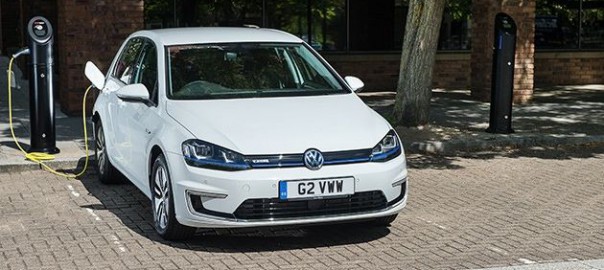
Next Green Car today announces the first results from the latest EV survey conducted in partnership with KiWi Power, Carbon Trust and the High Speed Sustainable Manufacturing Institute (HSSMI) who are working with InnovateUK to investigate viable ways of integrating electric vehicles (EVs) into the national grid.
The survey, which was conducted in July 2015, provides strong evidence that the availability of charge points can influence where EV drivers decide to park. This implies that car destinations can attract more customers by investing in EV charging infrastructure.

The results of the survey also shows that, despite most EV users having a home-based charger, almost 70% use a public charging point at least once per week. In contrast, the results indicate that workplace chargers are far less common with over half of EV users having no charging facilities at work.
Read more: Next Green Car
How does he make his lips move like that?
Advics and some practical and simple tools to help you minimize your electricity consumption and thus maximize the range of your Renault ZOE.
https://www.youtube.com/watch?v=J1eIQ2EoRIY

My first repost – I suspect of many – on the subject of Peak Oil
Over the past couple of months the story keeping many people on the edge of their seats has been the ongoing dilemma of Greece’s detested debt burden, its Great Depression-worthy 25% contraction of its economy, and its voluntary or even forced withdrawal from the eurozone – the fabled “Grexit.”

For about five years now, heavy austerity policies (cutbacks in government spending) have contributed to what is being described by some as a “humanitarian crisis.” As per stated in the conditions of €240 billion in loans that Greece has received over these years, the Greek government has had to significantly cut back on expenditures, which has included laid off government workers, reduced pensions, a gutted minimum wage, and the selling of state institutions. Partially as a result of this, general unemployment is a bit above 25% while youth unemployment is at nearly 60%; suicide rates are up by 35%; rates of divorce, depression, children suffering from malnutrition, children suffering from physical and emotional abuse, and hospitals lacking basic equipment and medicines are all up; infant mortality has increased 43%; and married women are begging brothels to let them work, but who are then turned away because, well, it’s apparently illegal to sell oneself for sex if one is already betrothed.
Nonetheless, and to the acclaim of many alternative media outlets, late-January saw the stunning election-win of what is called a far-left political party, Syriza. The prime mandate on which it was voted in on by the Greek electorate was to reverse the five-year policy of austerity and to essentially tell its Troika creditors (the European Union, the European Central Bank, and the International Monetary Fund) to shove it where the sun don’t shine.
With Syriza promising to repeal all the aforementioned discomforts, accolades came pouring in, possibly the most astoundingly hyperbolic drivel coming from the online magazine Truthdig.
Read more: From Filmers to Farmers
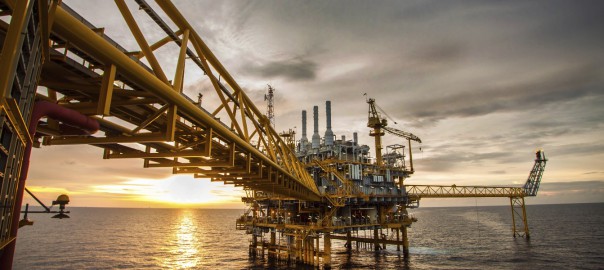
Why do oil prices go down? Because they went up. Why do oil prices go up? Because they went down. That’s what they do. To avoid oil-price volatility, you must kick the oil habit.
You can do this by switching to efficiency and renewables. You’ll get cheaper energy services at steady prices; free price insurance; and lower risks to climate, health, environment, global development and security, and America’s independence and reputation.
In contrast, the oil for which the U.S. pays $1 billion a day — and paid $2 billion a day until mid-2014, when $100+ per-barrel prices halved — comes with price risk and far bigger hidden costs that at least triple the real societal cost to upwards of $4 billion a day.
So why, after four relatively placid years, did the world oil price tumble starting in mid-2014, and what’s next?
People burn 1.3 cubic miles of oil a year, or 93 million barrels a day (each barrel equal to 42 U.S. gallons or 159 liters). Scott Pugh, energy advisor to the Department of Homeland Security, visualizes those barrels, each 20 inches in diameter, laid end-to-end and joined to form a pipeline. It’d stretch 1.8 times around the earth. To traverse that pipeline in 24 hours, the oil must flow at 1,835 miles per hour — 2.44 times the speed of sound.
Crude oil’s price fluctuates at more like the speed of light, varying with global, regional, local, and firm-specific market conditions. Despite many complexities, some broad observations are usually valid.
Oil prices tend to rise with instability in major exporters — Persian Gulf, Nigeria, Venezuela, Russia — though diversified supplies, suppliers, and delivery routes have made markets more placid. Strong economic growth also tends to raise prices — until they get high enough to dampen or reverse the economic growth. Conversely, oil prices fall when major exporters do what John D. Rockefeller used to do regularly: “sweat the market” with oversupply to bankrupt high-cost producers and thus raise one’s own monopoly rents.
Read more: Medium
If anyone needs proof that the world is slowly changing, look no further than the major car manufacturers. These lumbering dinosaurs are being forced, kicking and screaming, into the eco driven future to the extent that they’re even converting their major sellers into green machines. The latest example is this Volkswagen Passat GTE, a plugin hybrid (PHEV) which boasts ‘official’ consumption figures of 149 mpg and 31 miles of all electric range. And at a price which is very nearly the same as the diesel version it will presumably one day replace.
What makes this new car so special is the fact that 70% of all Passat sales go to fleet buyers, the faceless men who buy thousands of cars for their corporate, mile eating executives who spend their lives driving up and down the nation’s highways. These guys demand the best deal for their bulk buying, so when a hybrid becomes a part of the menu, you know that times have indeed changed.
The new Passat is an impressive saloon/sedan, no question. The sleek elongated bodyline looks every inch a motorway cruiser, and it’s clear that the company has its sights set on the BMW and Mercedes equivalents with the introduction of this new 2015 model. The car we tested had all the fancy trim and upmarket materials of a deluxe limo, thankfully with a character to match. Watch our video below to get an idea of how the car performs in practice.
Read more: Red Ferret
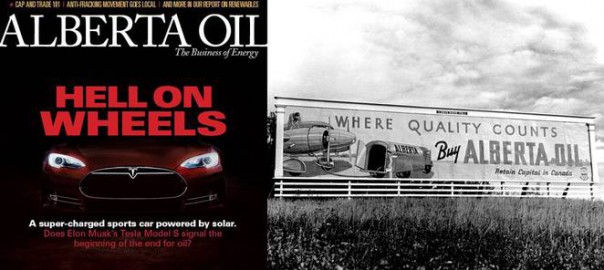
A good find by our friends at EV Obsession, apparently a trade magazine from the oil industry, Alberta Oil, has put a Tesla Model S electric car on its cover (“Hell on wheels”) and published an article with this title and sub-title: “Is Tesla’s Model-S the Beginning of the End for Oil? Why battery technology could drive the electric vehicle to new heights – and disrupt the fossil fuel industry in the process”.
You get the feeling that the thinking of many inside the oil industry is starting to change; for the longest time, most of the comments and official forecasts from the industry basically said that, yes, electric vehicles are coming, but they won’t be a big deal for many decades, and that maybe in 30-40 years they’ll represent a few percents of the vehicles out there.

This reassuring (for them) prognostication about the status quo was repeated like a mantra until even most people who heard it over and over in the media accepted it as truth. But that’s not how things work. We can’t know that far in advance how things will be, and if you had asked someone in 2006 whether billions of people were going to own super-powerful internet-connected smartphones within less than a decade, they’d have thought you were crazy. What looks obvious in hindsight isn’t obvious at all looking forward. Why? Because change is non-linear. Things move slowly for a long time, and then you reach a special tipping point where change accelerates. For example, solar power adoption was relatively slow until the price per watt of solar started getting close to other sources (first with incentives, and now without). That changed the game and things shifted in a higher gear. And as we get close to solar being cheaper than all other sources of energy, things will shifter in even higher gear…
Read more: Treehugger

This could be very useful for me and other EV drivers based in the Midlands
Birmingham Airport has become one of the first British airports to join the Electric Highway and offer fast charging for electric motorists.
Green energy company Ecotricity powers their Electric Highway with 100% renewable energy from the wind and the sun, allowing 35 different models of electric and plug-in hybrid cars to recharge in between 20 and 30 minutes.

Such is the rate of growth in electric cars, that the motoring industry is on track to sell more electric vehicles in the first six months of 2015 than in the previous four years combined.
The Electric Highway is a central part of this success story – for the first time powering one million miles in a month during May and scheduled to reach two million miles a month by the end of the year.
Jo Lloyd, commercial director at Birmingham Airport, said:
“We’re always looking at new and innovative ways of improving the passenger experience at Birmingham Airport, which is why we have installed these electric charging points.
“The growing popularity of electric and hybrid cars means it is vital we provide the facilities that will enable our passengers to travel to-and-from the airport as easily as possible. We’re extremely proud to support this green form of energy and the obvious benefits it brings to the environment.”
Read more: Birmingham Airport
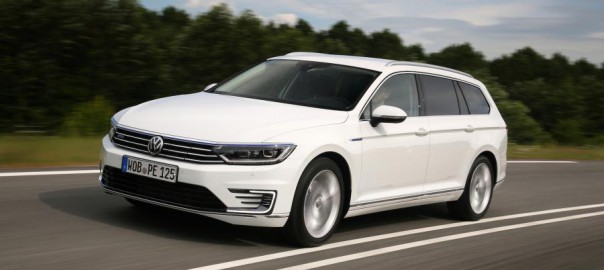
A pretty positive review overall
The Volkswagen Passat GTE is the latest in a burgeoning number of ultra-low-emission mid-size plug-in petrol-electric hybrids to be launched in recent times.

To be sold in the UK in both saloon and, as driven here, estate bodystyles, the Passat GTE shares various elements of its high-tech driveline with the recently introduced Golf GTE. As with the smaller hatch, the plug-in Passat has the capability to run exclusively on electric propulsion for extended distances or on a combination of petrol and electric power.
Overall refinement in electric mode is superb, with a smooth delivery and silent running traits making it a pleasurable steer
Set to rival the Volvo S60 Plug-In Hybrid and BMW 340e, the new Passat GTE sports a specially tuned version of Volkswagen’s turbocharged 1.4-litre four-cylinder petrol engine that develops 164bhp and 184lb ft as its primary form of propulsion.
The transversely mounted combustion engine is supported by an electric motor sited within the forward section of a standard six-speed dual-clutch automatic gearbox, from where it produces 113bhp and 243lb ft. The disc-shaped unit can operate on its own in zero-emission electric mode or in tandem with the petrol engine for added performance
Volkswagen quotes a combined system output for the Passat GTE of 215bhp and 295lb ft, giving Wolfsburg’s latest plug-in petrol-electric hybrid a subtle 14bhp and 37lb ft more than the smaller Golf GTE.
The driver can choose between four different driving modes: E-mode, Hybrid, Battery Charge and GTE. Volkswagen claims an electric range of up to 31 miles at speeds up to 81mph in the default E-mode, in which the Passat GTE always starts. In the GTE mode, the efforts of the petrol and electric motor are pooled to provide a claimed 0-62mph time of 7.6sec and a 140mph top speed.
Read more: Autocar
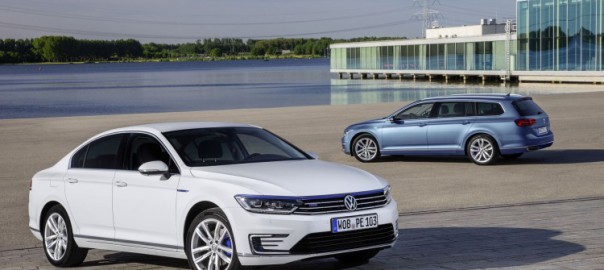
The long-awaited launch of the PHEV version of a very popular car
Volkswagen announced the official launch of its second plug-in hybrid model after the Golf GTE – the Passat GTE (available in a longer Variant version too).
Sales in first few countries already began (in Germany from €44,250), while the rollout in Europe will take a few months.

Volkswagen is getting ready to begin sales in Asia this year too.
“The Volkswagen continues to electrify! Following the Golf GTE*, comes the next high-volume model with a plug-in drive system: this time the German carmaker is electrifying the new Passat GTE. Its launch marks the debut of a new generation of business and family cars – zero-emission vehicle and long-distance touring car all in one. A Volkswagen that combines the present and the future. A car that boasts not only one of the most progressive drive systems of our time, but also an array of innovative assistance and infotainment systems that is ground-breaking in the segment of large family cars.”
Read more: Inside EVs