Monthly Archives: April 2015

Plug yourself in and enjoy the ride

The Outlander PHEV is a plug-in hybrid SUV that gives Mitsubishi a real edge in this corner of the market.

We liked the Outlander diesel when we tried it recently but the PHEV uses very different mechanicals. This one features a 2.0-litre petrol engine and a pair of electric motors on each axle, giving all wheel drive and a combined power output in the region of 220bhp. So as you might imagine, it’s pretty sprightly when you bury the throttle, although Mitsubishi’s quoted sprint to 62mph of 11 seconds sounds strangely slow. Driven in full electric mode, you’ll feel the huge torque of the motors and be able to cruise at motorway speeds on electric power alone, although not for too far. Refinement is very good, even without the sound of an engine to drown out wind and tyre noise.

There’s a very handy feature included where you can request the battery holds a particular level of charge and you can also use the petrol engine as a generator, to drive battery power back up to 70% of its capacity. There is also a sophisticated five-level regenerative braking system that the driver can select using the wheel-mounted paddles or what you would otherwise take to be the gear lever.

You might well need to be the judge when it comes to the Outlander’s styling. We’re not fans of the beaky front end and slab sides but there will be some who doubtless feel that the sharp suit makes a welcome change to the usual cuddly Nissan Qashqais and Mazda CX-5s. The front and rear overhangs are quite long as well, so don’t be to tempted to go charging off road just because you’ve got drive going to each axle.

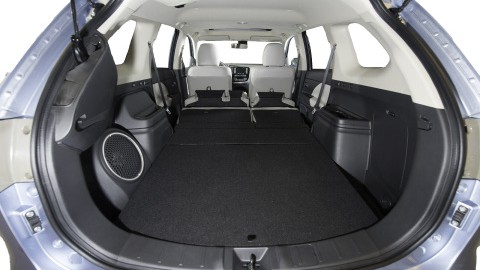
The cabin is very nicely executed. Mitsubishi is usually a company you can rely on for old-school hard grey plastics and mismatched fonts but this Outlander has clearly had some thought put into look and feel. Although you won’t think you’re in an Audi Q5, the Outlander offers plenty of soft-touch finishes and a clean, architectural fascia design. There’s a small increase in the vehicle’s weight due to the floor-mounted battery pack, a paltry reduction of 14-litres in boot space and rear legroom is a touch more pinched due to the raised floor height. The 577-litre boot is still more than adequate for most requirements and the luggage bay is well shaped.

0514Int2_Mitsubishi_OutlanderPHEV_unk

Prices look very competitive, starting at just over £28,000 after subtraction of the government grant – so the same money as a conventional Outlander GX3 diesel auto. That’s for the entry-level GX3h version: there are also two other PHEV models, the GX4h costing about £33,000 and the top GX4hs costing about £35,000. Expect a decently high spec to come as standard across the range, with a tally that’ll run to dual-zone air-conditioning, power-folding mirrors, privacy glass, alloy wheels, cruise control, four powered windows, remote locking, seven airbags and stability control. Niceties include things like leather and dual-zone climate control, satellite navigation, a parking camera and a high-end audio system, along with advanced safety systems including lane departure warning, radar cruise control and a collision mitigation system (which applies the brakes automatically if it senses an impending crash).

The official fuel consumption figure of 148mpg merely serves to remind us that we have an urgent need for a new European fuel consumption test which more closely mirrors everyday driving conditions.

Likewise, the 44g/km emissions figure the Outlander PHEV records won’t be something you’ll be managing day in, day out. As an exercise in taking advantage of a flawed testing procedure, it’s remarkable.

This plug-in hybrid can drive for over 32 miles on a full electric charge and can be fast charged to 80% in 30 minutes. This means that for some drivers, they’ll be able to pop the car on charge in the evening, do the commute and bring it home without using any petrol at all. Mitsubishi reckons that if you cover more than 100 miles between charges, the diesel is going to work out more cost-effective. Charge the Outlander PHEV more frequently and the numbers swing in its favour. Residual values ought to be strong, as the trade has quite taken to the Outlander and this plug-in hybrid is the first example of its type in the sector.

As long as you get on with the styling and don’t have a pressing need to seat seven people, we’ve got nothing but good things to say about the Mitsubishi Outlander PHEV. It’s one of those rare vehicles that is massively better than you expect it to be. The calibration of the hybrid powertrain, the options it gives its driver and the sheer depth of engineering that’s apparent in the way it’s been built all point to a car that deserves all the acclaim it’s now getting.

Being first to market improves the chances of success. Being first with a product so strong that it will have many rivals going back to the drawing board ought to guarantee success. This one deserves a big stage.

Source: Aberdeen Press and Journal
Business Car Reviews Volkswagen e-Golf – Video

Here the Volkswagen e-Golf review is prepared by BusinessCar, who describes the German EV as being without unnecessary show.

According to the article, the electric version exudes all the usual Golf qualities in terms of cabin quality and classy understated looks.

85 kW of motor power is called reasonable, although the vehicle’s weight makes it less nimble than its petrol and diesel siblings.

Read more: Inside EVs

BMW i3 Wins One More Award (Image: Wheels)

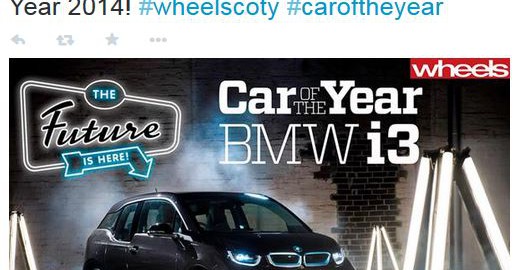
BMW i3 Wins One More Car Of The Year Award

The awards just don’t stop coming for the BMW i3.

The latest, from Wheels Australia, is one more “Car of the Year” award for 2014.

BMW i3 Wins One More Award (Image: Wheels)

This adds to numerous awards the i3 has received over the past year and a half.

Deservedly so, the i3 is quickly becoming one of the most awarded electric cars of all time.

Source: Inside EVs

The zero emission fleet will help Dundee's air quality

Dundee electric taxi fleet enters service

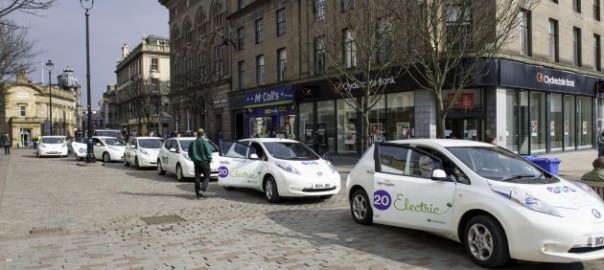
One of the UK’s largest electric taxi fleets has entered service for the first time in Dundee. The fleet of 30 electric Nissan LEAFs operated by 203020 Electric – part of the Tele Taxis Group – is now in 24-7 service in and around the City of Discovery.

Offering zero emissions mobility, the Nissan LEAFs will make a significant contribution to improving air quality in the city and will further enhance the city’s reputation as a leader in green transport.

And the significance of the occasion was emphasised when the historic first journey was taken by Derek Mackay MSP, the Scottish Government’s Minister for Transport and the Islands, around City Square.

He was joined at an official launch event by executives from Transport Scotland, the Energy Saving Trust, Dundee City Council and Nissan – organisations that have all invested and advised on the project.

Transport Minister Mr Mackay said:

“The Scottish Government is committed to improving air quality in our towns and cities – that is why we have been delighted to support this ambitious project as part of our overall investment of £17 million in a range of ultra low emission vehicle initiatives over the past two years.

“Bold initiatives such as this offer a visible demonstration that this transformation is already happening and I am delighted to be able to experience these vehicles at first hand by taking a ride in one today.

“A journey in one of these taxis may well be the first encounter many members of the public will have with an electric vehicle, helping to raise awareness that there are viable alternatives to petrol and diesel cars.”

With 30 vehicles all entering service at the same time, it’s one of the UK’s single largest electric vehicle fleet deals. But the deal will soon become even bigger as Tele Taxis / 203020 Electric plans to replace its entire 60-vehicle fleet with more Nissan LEAFs and the larger Nissan e-NV200 Combi over the next 12 months.

The move will save Tele Taxis Group hundreds of thousands of pounds in fuel each year. The LEAF and e-NV200 costs from just two pence per mile to run.

The zero emission fleet will help Dundee's air quality
The zero emission fleet will help Dundee’s air quality

A bank of five rapid chargers, capable of charging a LEAF from zero to 80% in just 30 minutes has been installed at the taxi company’s HQ in Isla Street to keep the new fleet topped up and in constant service around the clock.

The chargers, funded by Transport Scotland’s ChargePlace Scotland project, are all available for public use and currently free to charge from.

David Young, owner of 203020 Electric, said:

“There are big financial benefits to operating a fleet of electric taxis but that is not the main driver behind our decision to go down this route.

“Dundee is a city with some of the worst air pollution in the country and this initiative puts us at the forefront of efforts to improve that. The environmental benefits of running these pure electric vehicles will make a real difference for the people of Dundee.”

Source: Newspress

Southern goes electric – car park users to plug in while they take the train

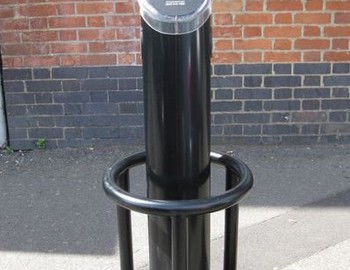
As the trend for alternative fuels for cars continues to grow – particularly with electric vehicles, Southern is installing 50 Electric Vehicle Charging Points (EVCPs) in station car parks across the Southern network at a cost of £375,000 funded by the Office of Low Emission Vehicles (OLEV)as part of a South East-wide initiative to install more points to connect with the Energise network.

2522_EVCP_Railway_Southern

Sales of electric vehicles are on the increase and the provision of EVCPs at stations supports Southern’s strategy to encourage more sustainable travel. EVCPs at our stations will help electric vehicle drivers to complete a door to door sustainable journey and reduce their carbon footprint even further. Southern already has ECVPs at 10 stations with 13 more stations planned to have charging points over the next couple of months.

Southern’s Head of Environment, Sandra Norval said:

“We’re on target for installation of most of the 50 ECVPs by the end of March, with the final few to come soon after. Who knows – the installation of these charging points may even encourage more electric car sales. If that happens, everyone wins!”

EVCPs have been installed at:

  • Purley (two charging points)
  • South Croydon (one)
  • Coulsdon South (one)
  • Whyteleafe (one)
  • Norbury (one)
  • East Grinstead (three)
  • Dorking (four)
  • Redhill (three)
  • Eastbourne (three)
  • Brighton (three)

Planned for installation:

  • Three Bridges (five)
  • Horsham (two)
  • Ashtead (two)
  • Lingfield (two)
  • Crawley (three)
  • Crowborough (two)
  • Ham Street (one)
  • Hove (two)
  • Chichester (three)
  • Barnham (two)
  • Hassocks (two)
  • Arundel (one)
  • Rye (one)
Nissan 7 seat e-NV200 (Image: Nissan)

Nissan Launches 7-Seat e-NV200 In Europe

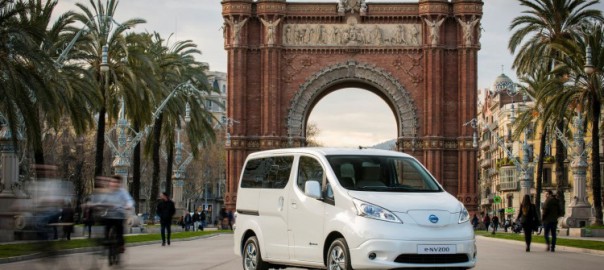
Nissan is introducing at the 2015 Geneva Motor Show a new 7-seat version of the all-electric e-NV200, which will go on sale in Europe in April.

Previously, e-NV200 was only available in a 5-seat version or cargo van (at last in Europe).

In the new 7-seat version, the second row has three seats, while the third row has two, and both can be folded down to increase capacity if needed to 2.94 cubic metres.

Luggage capacity with all 7 seats up is 443 liters under the tonneau cover or 870 liters when measured to the roof line.

“Thanks to growing requests from companies and fleets alike, Nissan has announced it is bringing forward the introduction of the latest iteration in its electric vehicle line-up – a seven seat version of the all-electric e-NV200.

Since its inception, a seven seat version of the revolutionary van has always been part of Nissan’s plans, fulfilling an unmet need for an electric vehicle that can move a larger number of people. From taxi fleets to shuttle services and even to large families, the seven seat e-NV200 Evalia offers a zero-emission solution. For those with a more regular need to move cargo and an occasional need for seven seats, the Combi version of the e-NV200 can also be specified with the larger seating capacity.”

Nissan Europe’s director of electric vehicles, Jean-Pierre Diernaz stated:

“We have always planned to offer a higher-seating capacity version of the Nissan e-NV200. Marketplace demand has meant we have moved this introduction forward by several months to satisfy this need. Nissan has had requests from taxi companies, VIP transfer services, hotels and private motorists who are interested in buying this uniquely flexible and capable vehicle.”

Read more: Inside EVs

2015 BMW i3 Interior

2015 BMW i3 Video Road Test


If there were ever a brand-reset button in the automotive business, the BMW i3 electric car is it.

It’s both a compact hatchback and an all-electric car, from the brand that claims to build ultimate driving machines.

How does it measure up to that lofty standard? Hi, I’m Joel Feder, and I’ll give you our verdict on the BMW i3 in our latest video road test.

Strip away the simulated twin-kidney grills and roundel badges, and you’d really never know the i3 is a BMW. It has skinny tires, and an odd side view with a dipped window line.

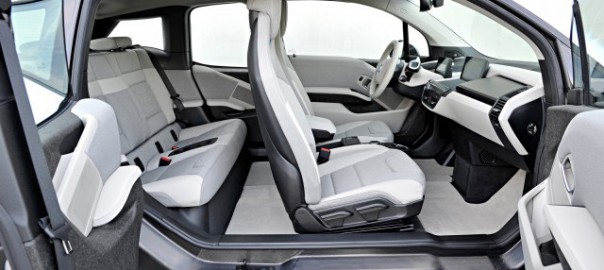
Inside, it’s unlike any BMW you’ve seen before—it’s more like a loft living room than a cockpit.

It’s dominated by a big screen that displays infotainment functions, controlled via the iDrive knob on the console. A smaller screen behind the steering wheel provides all the other driving information, including the speedometer.

Overall the interior is elegant and well put together, except for the renewable-fiber kenaf material. It’s fine on the far part of the dashboard, but the door panels look like they’ve been stripped of their covering. It’s the one sour note in the car.

This interior is far more spacious than you’d think. While the front seats have extremely thin backs, they’re comfortable and bolstered well. The seating position is upright and higher than some other small cars, and you get good view of the road.

The rear seats are a bit tight for full-sized adults, and it’s awkward getting in and out because the rear passengers can’t open their own doors. The front-seat passenger has to open the front door first.

The i3 breaks completely new ground in its drivetrain. It’s a battery-powered electric car with a 22-kilowatt-hour lithium-ion battery pack mounted under the floor. That powers a 125-kilowatt (170-horsepower) electric motor in the rear that sends up to 184 pound-feet of torque to the rear wheels.

The EPA rates the i3 at 81 miles of electric range with an efficiency rating of 124 MPGe. That makes it the most efficient car of any kind sold in the U.S. today. BMW says you’ll see a real-world range of 75 to 90 miles.

Have range anxiety? Want another 80 miles as a safety net (give or take)? You can opt for the range-extending REx engine, as fitted to our test car. It’s a little two-cylinder gasoline-powered generator in the rear of the i3, next to the electric motor.

It kicks in to act as a generator when you deplete the battery, but it’s not connected to the drive wheels. You should know that opting for the REx model drops your battery range rating to 73 miles – and it’s only rated at 34 mpg while the range extender is on.

Read more: Green Car Reports

Go Ultra Low members boast 15 ULEVs across a range of segments (Image: OLEV)

Plug-in Electric Car Sales Surge in UK

Plug-in electric car sales have undergone a huge rise in many key European markets according to figures released by the European Automobile Manufacturers Association (ACEA).

The biggest gains came in the UK, where a 300 per cent rise in electric cars has taken place compared to this time last year.

In total 75,331 new electric cars have been registered according to the ACEA, with Norway leading the way with just under 20,000 new registrations.

In Germany electric car registrations are up by 70 percent, while in France they had climbed by almost 30 per cent compared to the 2013 figures.

Read more: Electric Vehicle News

Car exhaust (Image: BBC)

The Health Care Industry Has A Moral Obligation To Divest From Fossil Fuels

Hospitals, health-oriented nonprofits, and other members of the health sector need to divest from fossil fuels because of the risk they pose to human health, according to a new report.

The report, published this week by multiple U.K.-based health care organizations, called on the health sector commit to cutting its investments in the world’s top 200 fossil fuel companies in the next five years. The report compared the choice to divest from fossil fuels to the decision made by many hospitals and health care providers to divest from tobacco companies in the 1990s.

“It is arguably both immoral and inconsistent for the health sector to continue to invest in industries known to harm health, given its clear responsibility to protect health,”

the organizations write of fossil fuel investments in the report.

“Continued investment in these companies runs directly counter to the health sector’s repeated calls for action on climate change.”

The report outlines the impacts continued reliance on fossil fuels have on human health. Changes in temperature and rainfall are already contributing to the spread of some vector-borne diseases, especially those spread by mosquitos, since the insect lays its eggs in standing water, and standing water can increase as humidity and rainfall increases. In the Southwestern U.S., an increase of incidence of valley fever — a disease that’s found in desert soil — has been blamed by some experts on climate change. And climate change’s impact on crops around the world will also likely worsen hunger, which can take a toll on a person’s health.

Then there are the more direct health impacts of fossil fuels. Exposure to air pollution has been tied to myriad health effects, including ADHD, kidney disease, heart attack, stroke, and death. Fossil fuel extraction and production can cause major health problems too: coal miners are at risk of developing deadly black lung disease, and oil and gas wells have been found to emit toxic, cancer-causing chemicals, making living near these wells risky.

“People worldwide are already dying as a result of the health impacts of fossil fuels, but tomorrow’s doctors will have to cope with the full extent of climate change’s health cost,”

Alistair Wardrope, one of the report’s co-authors, told the Guardian.

“We have a responsibility to our future patients to ensure that health organisations are not funding the biggest global health threat of the 21st century.”

Last year, a group of U.K. doctors called on the World Health Organization to declare climate change a public health emergency, saying that it could end up killing more people than ebola. U.K. doctors also wrote in the British Medical Journal last year that doctors should push their hospitals and universities to divest from fossil fuels.

“Those who profess to care for the health of people perhaps have the greatest responsibility to act,” the doctors wrote.

The British Medical Association — which publishes the British Medical Journal — divested from fossil fuels last year.

Health care organizations in the U.S. have also called for fossil fuel divestment. One of them, Health Care Without Harm, has also compared divesting from fossil fuels to divesting from tobacco, and has said it’s a a way for hospitals and other health care providers to stand up for health and wellness.

So far, according to 350.org, 24 universities and university systems around the world have pledged to divest from fossil fuels, along with multiple other cities, foundations, and organizations.

Source: Climate Progress

Volkswagen Releases Series Of e-Golf Videos

[January 2015]

https://www.youtube.com/watch?v=pbVgP8nwkLo

Would you like an overload of info on the new Volkswagen e-Golf? These multiple videos will provide you with more info on the e-Golf than you likely care to know.

The first video discusses different driving and regenerative braking modes.

Check out this e-Golf commercial. e-Golf is 2015 Motor Trend Car of the Year.

https://www.youtube.com/watch?v=LCCHcZabs_s

Like the other BEVs, you can control your e-Golf with a sophisticated smart phone app.

https://www.youtube.com/watch?v=kSZRsi5CG-g

Read more: Inside EVs