Monthly Archives: April 2015

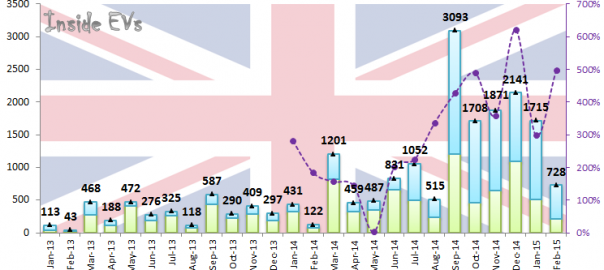
Plug-in Car Registrations in UK – February 2015 (Image: Inside EVs)

Electric Car Sales In UK Up Almost 500% In February

February was the 36th consecutive month of car sales growth in UK – registrations went up by 12% year-over-year to 76,958.

The numbers themselves are low as February is one of the slowest sales months of the year ahead of a number plate change in March.

Plug-in Car Registrations in UK – February 2015 (Image: Inside EVs)

Despite this, electric cars grew like crazy by 497% year-over-year to 728 new registrations. Market share was 0.95%.

There were 216 BEVs (up 167%) and 512 PHEVs (up 1,066.7%).

As previously mentioned, February is a slow month, so now we look forward to what we hope to be a record-setting March. 5,000? Maybe 7,000? We’ll find out soon enough.

Source: Inside EVs

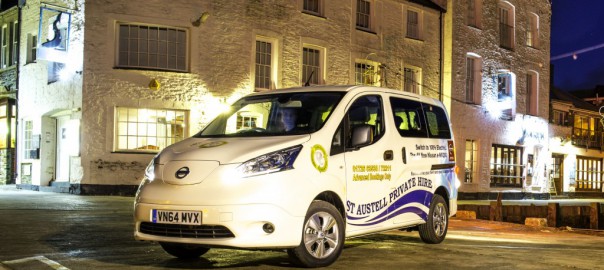
C&C's Nissan e-NV200 Electric Taxi (Image: Nissan)

Greening taxis gets £45m boost

A £20 million fund will be made available to local authorities to support the rollout of ultra-low emission taxis across the UK. The money will be available to reduce the upfront cost of purpose built taxis and to install charging infrastructure for taxi and private hire use.

A further £25 million has been set aside specifically for the Greater London Area to help taxi drivers cover the cost of upgrading to a greener vehicle.

All taxis will also qualify for the government’s plug-in car grant, which currently offers up to £5,000 off the cost of an eligible low emission vehicle.

The news follows Geely’s announcement outlining plans for a new £250 million state of the art facility to produce the next generation of low-emission London Black Taxis.

Geely, who owns the iconic London Taxi Company, was awarded £17 million from the government’s Regional Growth Fund to build this facility, which will create 1,000 local jobs and ensure the London black taxi continues to be designed, developed and made in the UK.

These new taxis will comply with the new regulations being introduced by the Mayor of London that will require all London taxis to be zero-emission capable from January 2018.

Transport Minister Baroness Kramer said:

“The low emission vehicle sector is going from strength to strength with demand in the UK up by over 300% last year, making the UK a leading market for this technology.

“Today’s announcement means ultra low-emission taxis will be the smart choice for more taxi drivers and everyone will benefit from improved air quality and greener travel.”

The Mayor of London, Boris Johnson, said:

“As London strives towards the greenest taxi fleet from 2018, it is essential to support the taxi trade in the transition to cleaner vehicles.

“With the additional funds announced today, more help is on the way for taxi drivers to upgrade to the latest technology in zero-emission capable cabs.

“Alongside the world’s first Ultra Low Emission Zone from 2020 these measures will boost jobs and growth in the development and manufacturing of ultra low emission technologies, secure the long-term future of the taxi industry, and ensure everyone who lives, works in, or visits our city has the cleanest possible air to breathe.”

Source: Newspress

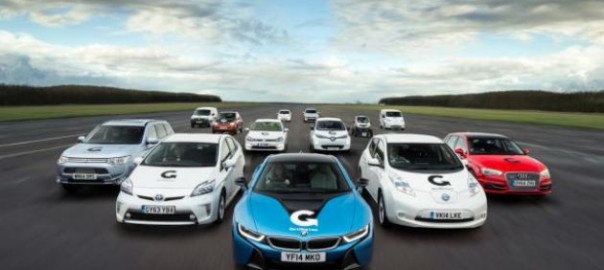
Go Ultra Low members boast 15 ULEVs across a range of segments (Image: OLEV)

Automakers race to double the driving range of affordable electric cars

Global automakers are readying a new generation of mass-market electric cars with more than double the driving range of today’s Nissan Leaf, betting that technical breakthroughs by big battery suppliers such as LG Chem Ltd will jump-start demand and pull them abreast of Tesla Motors Inc.

At least four major automakers — General Motors, Ford, Nissan and Volkswagen — plan to race Tesla to be first to field affordable electric vehicles that will travel up to 320 km (200 miles) between charges.

That is more than twice as far as current lower-priced models such as the Nissan Leaf, which starts at $29,010. The new generation of electric cars is expected to be on the market within two to three years.

To get a Tesla Model S that delivers 265 miles (427 km) on a charge requires buying a version that starts at $81,000 before tax incentives. Most electric cars offered at more affordable prices can travel only about 75 to 85 miles (121 to 137 km) on a charge – less in cold weather or when drivers have the air conditioning on.

Automakers need to pump up electric vehicle demand significantly by 2018. This is when California and eight other states will begin to require the companies to meet much higher sales targets for so-called zero emission vehicles — in other words, electric cars — and federal rules on reducing fuel consumption and greenhouse gases become much stricter.

BATTERY BREAKTHROUGHS

Tesla Chief Executive Officer Elon Musk said last week that

“200 miles is the minimum threshold” to alleviate consumer concerns over EV range. There is “a sweet spot around 250-350 miles that’s really ideal,” he said.

Musk has promised a more affordable Tesla, the Model 3, which will sell for around $35,000 and provide a driving range of 200 miles or more. That car is slated to begin production in mid-to-late 2017.

However, GM says it plans to field a 200-mile electric car, the Chevrolet Bolt, by late 2016.

The Bolt will use an advanced lithium-ion battery pack developed by Korea’s LG Chem, which also supplies batteries for the Chevrolet Volt hybrid. The newer batteries are said to have much higher energy density and provide much longer range between charges, thanks to breakthroughs in battery materials, design and chemistry, according to a source familiar with LG Chem’s technology.

“Several factors are at play that are landing at this 200-mile range” for a vehicle priced between $30,000 and $35,000, LG Chem Chief Executive Prabhakar Patil said in an interview. “We’ve been talking to several OEMs (automakers) regarding where our battery technology is and where it’s going.”

LG Chem also supplies standard lithium-ion batteries to the Ford Focus Electric and may supply the longer-range batteries to a new compact EV that Ford is tentatively planning to introduce in late 2018 or early 2019, according to three suppliers familiar with the program.

Compared with the 2015 Focus Electric, which has a range between charges of 76 miles, the new compact electric model would have a range of at least 200 miles, the suppliers said.

Nissan and VW both have battery supply deals with LG Chem, and both are working on longer-range EVs for 2018 and beyond.

Nissan is planning to introduce a successor to the Leaf in early 2018, according to a source familiar with the program, and that model is expected to offer significantly greater range than the current Leaf, the best-selling electric car in the United States, which can go 84 miles (135 km) between charges.

The 2015 Leaf uses batteries made by a joint venture between Nissan and supplier NEC. It is not clear if the future model will shift to LG Chem, although Nissan CEO Carlos Ghosn has identified LG Chem as a potential battery supplier.

VW plans to expand its current range of electrified vehicles, including a successor to the battery-powered e-Golf in 2018 with much longer range, according to two sources familiar with the program. The current e-Golf uses batteries made by Panasonic and has a range between charges of 83 miles.

Volkswagen plans to decide in the first half of this year whether new battery technology under development at U.S. startup QuantumScape Corp, which may expand an electric vehicle’s driving distance between recharges to as much as 700 kilometers (430 miles), is ready for use in its electric cars.

Source: Electric Vehicle News
Better Place Battery Swapping

Tesla Navigation Update Echoes Better Place System Of 3 Years Ago

It was another typically hyperbolic statement from Tesla Motors CEO Elon Musk.

A simple tweet on a Sunday afternoon claimed that Tesla was “About to end range anxiety … via [over-the-air] software update. Affects entire Model S fleet.”

As usual, the media erupted with wild speculation about what Musk could do to “end range anxiety” in cars the company had sold more than two years ago.

But when the actual announcement came, it seemed to disappoint a number of people: route planning and an alerting system didn’t sound so exciting.

So why do I think there is much more to this announcement than do other commentators?

A truth universally acknowledged by electric-car owners is that people who’ve never lived with a plug-in vehicle don’t really understand how they work in real life.

Range anxiety is largely a mythical bogeyman. I view it as something that petrolheads tell other petrolheads to keep the cult of liquid fuel alive.

Electric-car owners know the range capabilities of their cars. They drive on regular routes, day in and day out, using similar amounts of electricity, and they know what their cars can and can’t do.

Planning an out-of-the-ordinary trip, however, requires some help. Especially one that hasn’t been made before and when the overall trip, including return, is close to or beyond the car’s range.

What Musk actually announced on Thursday sounds quite similar to what failed battery-switching startup Better Place delivered several years ago in Israel (and Denmark).

In fact, I predicted as much last week.

Musk spoke about two integrated systems, “Range Assurance” and “Trip Planner,” that would work together.

Back in 2012 when I picked up my Better Place Renault Fluence ZE, I had capabilities remarkably similar to those Tesla announced.

Whenever my battery dropped below 12 percent, I would get a phone call from an actual person. He or she would ask if I knew where I was going – and would, if necessary, remotely re-route me to a charge spot or battery-switching station.

I filmed a video of the trip planning feature, including the system working out a 220-mile route from Tel Aviv to Eilat involving multiple battery switches along the way. Effortlessly.

Both of these features also took into account the real-time status of the infrastructure.

Better Place was aware of the status of everything in their network–switch stations, Level 2 charging stations, and cars–and if a switch station wasn’t working, drivers would be alerted and re-routed.

Read more: Green Car Reports

The Shale Debt Redux

Shale debt, falling prices and slack demand has tight oil producers in trouble. And yet, there is still burgeoning production. Why? Well, we’ve seen this before. It’s the shale debt redux.

Operators did it a few years ago in natural gas and prices have yet to recover. Unfortunately cheap money in the form of debt can mean poor investment choices for businesses and for investors. But it can also lead to an aberrant market because operators deep in debt won’t curtail production even though it is glutted. Debt coupons simply have to be met.

The shale revolution has always been funded by massive debt. Operators who were drilling for gas back in 2009-2011 used debt extensively. And just like now, they overproduced. By 2011, supply exceeded demand by four times. Then prices tanked. It is curious that so few asked the questions: why did they produce so heavily and glut the market; and why did they continue to produce into a glutted market? The answer is really quite simple. Many couldn’t afford to pull back production to help stabilize prices. Had they done so, they would not have been able to meet their debt payments. So they kept pumping…and pumping…and pumping.

And now they’ve done it again.

When interest rates are kept artificially low for extended periods of time, investors and businesses begin to take risks. They invest in stocks and high yield bonds, or they issue debt to get more money. In a normal functioning market such investments might not have been considered because reasonable returns would be available in more conservative areas. Some analysts argue that low interest rates encourage bubbles because investors begin chasing the most hyped sectors thinking they will get a better return. And nothing has been more hyped than shales. Low interest rates did indeed create the perfect environment for taking on heavy debt loads by companies and increasing the appetite on the part of investors for junk debt. Neither scenario, however, is ideal. Both can put you behind the eight ball very quickly.

Much of the debt issued by shale operators has been high yield or what is commonly referred to as junk. According to the Wall Street Journal:

“Junk bonds have financed the U.S. shale boom, and now the sharp drop in oil prices could lead to a massive wave of defaults on that high-yield debt.”

JP Morgan Chase estimates that as much as 40% of this junk debt may be defaulted on by shale companies in the next two years if prices stay below $65/bbl. Yeah, you read that right…40%! Prices are currently trading around $45/bbl and operators are still pumping huge amounts of crude into the market so a $20/bbl price rise would seem unlikely.

This picture is complicated enormously by the overwhelming need for cash by shale operators. Energy was the fastest growing sector of junk debt in 2014 and is the largest chunk of the high yield market. Energy junk debt rose from about 14% at YE 2013 to 19% by YE 2014. Prices began tanking, however, in 2014 driving up the yields on these bonds to nosebleed heights. Some big investors took a risk in early 2015 and started buying up this distressed paper. Unfortunately, the markets turned against them again and losses are mounting. According to Oil Price:

“The high-yield debt market is being overrun by the energy industry. High-yield energy debt has swelled from just $65.6 billion in 2007 up to $201 billion today. That is a result of shaky drillers turning to debt markets more and more to stay afloat, as well as once-stable companies getting downgraded into junk territory. Yields on junk energy debt have hit 7.44 percent over government bonds, more than double the rate from June 2014.”

The shale monster eats cash for breakfast, lunch and dinner. Desperate for cash, operators are now turning to equity issuance in addition to their mountains of shale debt to fund operations. Equity is the most expensive form of cash because it dilutes existing shareholders. Many, however, no longer have access to more debt having maxed out their ratios. So energy equity issuance has exploded in 2015 growing at the fastest clip in a decade. Approximately $8B in new equity was issued in the first quarter 2015 though prices continue to fall and shares are being hammered. Further, large investment banks have been left with rotting shale debt on their books that they can’t unload. A recent transaction saw these loans picked up at 65 cents on the dollar.

The shale debt redux is yet another indication that this business model has problems. The shale game cannot be kept going without continuous and breathtaking amounts of cash. Kepler Chevreux recently stated that US shale and Canadian oil sands account for about 18% of global production. They also account for approximately 50% of global CAPEX. So if shales and oil sands really are our energy panaceas, then hold on because prices are going through the roof for anything using crude or natural gas in the coming decades. Costs have simply gotten too high and there is no reason to think that they will abate.

So those non-OECD countries that are choosing to leapfrog hydrocarbons and spend their money on renewable infrastructure may certainly be on to something. With hydrocarbon costs skyrocketing, can the U.S. really afford to be dependent on oil and gas for decades to come? Because it sure would be nice to have energy without fuel costs.

Source: Energy Policy Forum

Goldilocks zone for oil prices is gone for good

Five years ago, I wrote an article for Reuters titled “Goldilocks and the Three Fuels.” In it, I discussed what I call the Goldilocks price zone for oil, natural gas  and coal, a zone in which prices are “just right” — high enough to reward producers but low enough to entice consumers. Ever since the start of the fossil- fuel era, such a zone has existed. Sometimes price boundaries were transgressed on the upside, sometimes on the downside, but it was always possible to revert to the zone.

But now, the Goldilocks zone for oil has ceased to exist. This will have staggering consequences throughout the economy for the foreseeable future.

During the past decade, the Goldilocks zone for oil steadily migrated higher. As conventional crude reservoirs depleted and production rates leveled off, drillers had to spend proportionally more to develop the capacity to pump the next marginal barrel. Oil prices soared from $30 a barrel in 2005 to nearly $150 a barrel in 2008, collapsed during the economic crisis, then clawed their way back to roughly $100 a barrel, a price that was maintained through mid-2014. But the economy did not do well during this period. Despite massive bailouts, stimulus spending and low interest rates, the recovery following the 2008 crash was anemic.

However, at $100 a barrel, the oil price was high enough to incentivize fracking. Small, risk-friendly companies leased land and used expensive drilling techniques to free oil from rocks that geologists had previously described as too impermeable to bother with. This entailed a tenuous business model that required not only high oil prices but easy money as well, as low interest rates enabled producers to pile on enormous amounts of debt.

Oil production in the United States rose sharply as a result, and this eventually had an impact on prices. Since mid-2014, the oil price has declined by half, settling around the historic, inflation-adjusted mean price of $50 a barrel. Consumers are much happier than they were with oil at $100 a barrel, but producers are wilting. The American petroleum industry has seen more than 75,000 layoffs, the balance sheets of fracking companies are bleeding and drilling rigs are being idled by the score.

For consumers, experience suggests the acceptable oil-price zone is $40 to $60 a barrel in today’s dollars; higher than that, goods and services, particularly transportation, become more expensive than current spending patterns can handle. For producers, the acceptable zone is more like $80 to $120 a barrel; lower than that, upstream investments make little sense, so production will inevitably stall and decline — eventually making consumers even less happy.

You will have noticed that there is no overlap. An oil price of $70 a barrel would not be high enough to give the industry a rebound of confidence sufficient to inspire another massive round of investment. Clearly, consumers would be happier with $70-a-barrel oil than they were with $100-a-barrel oil, but if $70 isn’t a high enough price to incentivize production growth, then it’s not really in the Goldilocks zone.

According to the narrative emanating from most mainstream energy economists, oil production rates will soon slow, prices will rebound and everyone will be happy. That narrative misses the all-important news that Goldilocks is dead. There is no longer a price that everyone can live with. And that’s a recipe for price volatility.

For oil traders, price volatility may offer opportunities for profit. But for everyone else, it is treacherous. Price volatility only hints at the real extent of our peril: We have built an economic system overwhelmingly reliant on a nonrenewable, depleting resource. This is not a sustainable situation. Unless our dependency on oil somehow magically disappears, we are in for a wild ride on an unmapped road.

Source: Reuters

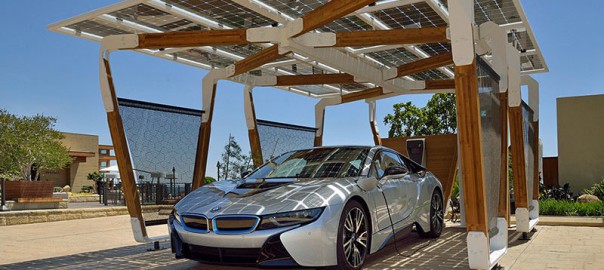
BMW i8 and Solar Car Port (Image: BMW)

Rethink the Grid: Personal Power Stations

Rethinking the grid is quickly emerging as one of the hottest topics. The concept of our own personal power stations can be seductive…and just might save us a whole lot of money too.

“Get big or get out!” Those were the famous, and controversial, words of Earl Butz, Secretary of Agriculture in the seventies. Considering the combination of renewable technology and battery storage, a new popular mantra may emerge: get small and be free.

Much ado about all things renewable together with the objections that technologies can never fully replace fossil fuel generation is popular among a certain set. Here in Texas, among arch conservatives, Solyndra lives on…and on…and on. But the truth is that Solyndra is ancient history. New technologies are ramping up and have been highly successful and may change the way we use the grid forever. Perhaps most interesting of all, however, is the way in which new ways to think about the grid and electricity are prompting entrepreneurs worldwide to rethink, remake and reuse. For instance, what if we all had the ability to transform our homes into micro personal power stations?

The grid is an interesting beast. It typically operates using several different power options together with some back up reserve. Oddly, it runs with virtually zero storage capacity because large amounts of electricity are difficult to store. So nobody really addressed that problem. Until now.

What if we decided to think outside our box and imagine that instead of myriad wires joining each of our houses, there were solar panels on the roof. These in turn pumped electricity into an array of batteries in our garages next to the work bench. Or into our EV which could also act as a storage vehicle. No pun intended.

Large scale storage is a problem because it is large scale. The needs of a utility are vastly different than the needs of an individual home. So tackling the problem of storage would seem to make the most sense if done on a small scale. GTM Research expects home battery storage to grow into a billion dollar a year money generator by 2018. That’s only three years away. Solar City, a large solar installer, is already offering battery storage for home use. They describe their system as:

“…a cost-effective, wall-mounted storage appliance that is small, powerful and covered by a long lasting full 10 year warranty.”

So our homes become a micro-grid. Having said all this, there will still be a need for large scale utility generation. Industrial users for instance would probably be better off using the grid system. This is where the larger scale storage solutions currently being tried and offered are coming into their own.

Electricity supply is never constant. It fluctuates throughout the day. To use renewable energy on a large scale, battery storage is needed. While lithium ion batteries have taken center stage, other less sexy technologies are being employed with success. If lithium ion batteries are the Tesla’s of the energy storage world, then flow batteries are the pick up trucks: hard working and reliable. Lead acid batteries too are gaining traction. All of these technologies perform different functions which are critical to grid reliability.

Navigant Research stated:

“Flow batteries have been shown to excel at long-duration energy storage applications and advanced lead-acid batteries have proven to be excellent performers in power-intensive applications.”

Further, these markets are expected to grow quickly. Navigant forecasts:

“…the annual revenue of cell sales for advanced batteries for utility-scale applications will grow from $221.8 million in 2014 to $17.8 billion in 2023.”

And equally interesting, Navigant projects:

“…the annual energy capacity of advanced batteries for utility-scale energy storage applications will grow from 412 megawatt-hours (MWh) in 2014 to more than 51,200 MWh in 2023, at a compound annual growth rate of 71 percent.”

Other aspects of storage are also being proactively addressed. One of the most common arguments heard is “what do we do with the spent automotive batteries”? Interestingly enough, BMW, and others, are working on that. Apparently an EV battery can have as much as 70% of its storage capacity still intact after its automotive life. So BMW has partnered up with Bosch and Vattenfall, a Swedish company, to repurpose used battery packs into grid storage. Home storage is also a possibility. So rethink, remake and reuse is really happening.

Another example of rethink is the recent announcement by Nissan that they have entered into a deal with Endesa, a Spanish utility behemoth. This arrangement would allow motorists to sell the unused power stored in their EV’s back to the grid. Such access to additional power could potentially provide extra stability for the utility and thereby the grid.

The grid doesn’t have to be run the way it has always been run. We can innovate. And innovation is precisely what is occurring. Perhaps the most important “rethink” of all is in our own heads as we learn to open our minds to using the grid in a whole new way.

Personal pizzas, personal computers, personal trainers…and now our own personal power stations.

Source: Energy Policy Forum

(Image: D. Bacon/Shutterstock/Economist)

Wall Street Losing Millions From Bad Energy Loans

Oil companies continue to get burned by low oil prices, but the pain is bleeding over into the financial industry. Major banks are suffering huge losses from both directly backing some struggling oil companies, but also from buying high-yield debt that is now going sour.

The Wall Street Journal reported that tens of millions of dollars have gone up in smoke on loans made to the energy industry by Citigroup, Goldman Sachs, and UBS. Loans issued to oil and gas companies have looked increasingly unappetizing, making it difficult for the banks to sell them on the market.

To make matters worse, much of the credit issued by the big banks have been tied to oil field services firms, rather than drillers themselves – companies that provide equipment, housing, well completions, trucks, and much more. These companies sprung up during the boom, but they are the first to feel the pain when drilling activity cuts back. With those firms running out of cash to pay back lenders, Wall Street is having a lot of trouble getting rid of its pile of bad loans.

Robert Cohen, a loan-portfolio manager at DoubleLine Capital, told the Wall Street Journal that he declined to purchase energy loans from Citibank.

“We’ve been pretty shy about dipping back into the energy names,” he said. “We’re taking a wait-and-see attitude.”

But some big investors jumped back into the high-yield debt markets in February as it appeared that oil prices stabilized and were even rebounding. However, since March 4 when oil prices began to fall again, an estimated $7 billion in high-yield debt from distressed energy companies was wiped out, according to Bloomberg.

The high-yield debt market is being overrun by the energy industry. High-yield energy debt has swelled from just $65.6 billion in 2007 up to $201 billion today. That is a result of shaky drillers turning to debt markets more and more to stay afloat, as well as once-stable companies getting downgraded into junk territory. Yields on junk energy debt have hit 7.44 percent over government bonds, more than double the rate from June 2014.

An estimated $1 trillion in loans were provided to the energy industry over the past decade, with most of that passed off to other investors. The practice is common, but starts to fall apart when the quality of loans starts to deteriorate. Banks like Citi have been sitting on bad loans, hoping for a rebound. But with oil prices dipping once again, big banks are starting to eat the losses. Some bad loans were sold off in mid-March at 65 cents on the dollar, the Wall Street Journal reported on March 18.

Souring debt comes at a time when oil and gas firms are also issuing new equity at the fastest pace in more than a decade. Drillers are desperate for cash, and issuing new stock, while not optimal because it dilutes the value of all outstanding shares, is preferable to taking on mountains of new debt. An estimated $8 billion in new equity was issued in the first quarter of 2015 in the energy sector, the highest quarterly total in more than ten years. But, falling oil prices have caused share prices to tank, reducing the value of new shares sold, and ultimately, the amount of cash that can be raised.

Big Finance’s struggle to unload some bad energy loans will ripple right back to the energy industry. If financial institutions cannot find buyers, they will be a lot less likely to issue new credit. That means that oil and gas companies in need of new cash injections may have trouble finding willing partners. Once access to cash is cut off, the worst-off drillers could be forced into a liquidity crisis.

Source: Oil Price

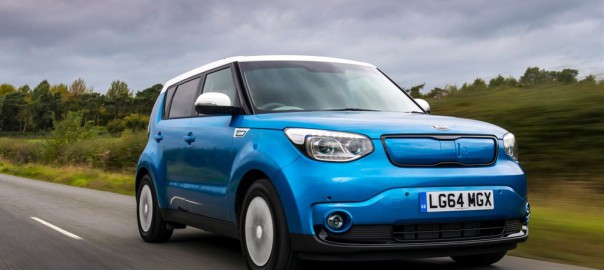
Kia Soul EV

Kia Soul EV Claims Top Honours as the First CANADIAN GREEN CAR OF THE YEAR

What is a Green Vehicle?
It is a vehicle which, for its size and purpose, provides the Canadian consumer with environmentally-friendly returns that compare favourably with other vehicles in its class.

VANCOUVER, March 24, 2015 /CNW/ – In an early afternoon press conference at the opening ceremonies of the Vancouver International Auto Show, the Kia Soul EV claimed top honours when the car was declared the 2015 Canadian Green Car of the Year by the Automobile Journalists Association of Canada (AJAC).

The Canadian Green Car of the Year award, in its preliminary season, was presented by Kevin Corrigan, Chair of the Canadian Green Car Committee at the Vancouver International Auto Show from a finalist list of four (4) vehicles. The top four (4) finalists, the Honda Fit, the Kia Soul EV, the Subaru Legacy and the Toyota Camry Hybrid, were announced at the opening ceremonies of the Canadian International Auto Show in Toronto back in February. The 4 finalists were “crowned’ with green car toppers for the duration of the Toronto show – and will subsequently wear these same crowns in Vancouver – which showcase their place in the running for the Canadian Green Car of the Year Award.

“Kia Canada is thrilled that the all-new 2015 Kia Soul EV has been recognized by AJAC as the Canadian Green Car of the Year “,

said Maria Soklis, Vice President and Chief Operating Officer, Kia Canada Inc.

“This acknowledgement is testimony to Kia’s ongoing commitment to deliver environmentally friendly automotive solutions and diverse powertrains to consumers without compromising on design or comfort.”

7 vehicles became eligible for this top honour after being tested in the annual “TestFest” event that AJAC’s Canadian Car of the Year Awards program hosts annually in October. These four (4) finalists represent the back to back, same day testing and vote results compiled by the largest group of Canada’s best-known automotive journalists, who gather every year for a 5 day testing program, in late fall. KPMG, the accounting firm, tabulates all vote results and presents AJAC with the top 3 – or in this case, the top 4 due to a tie – in 15 different categories. Acura, Cadillac and Mercedes-Benz (smart), were also in the running.

Mr. Corrigan explains,

“While an electrically-propelled sub-compact, thought of as green, may well suit those living within the city limits, is it not also true to view a fuel-efficient 6 cyl luxury hybrid product likewise, when compared to a V8 gas-powered vehicle in its relative segment of the market? Yes, the Canadian consumer requires environmentally-friendly transportation which meets their needs, whether it be a small city runaround, or a fuel-efficient luxury product for their airport limousine business. So when it comes to vehicle transportation, any & every vehicle which offers both fuel-efficiency and addresses environmental concerns is worthy of our attention, and praise, where due”.

Source: Automobile Journalists Association of Canada

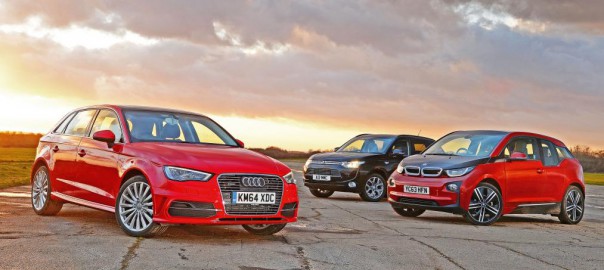
Audi A3 e-tron, Mitsubishi Outlander and BMW i3 plug-ins

Electric vehicles sneaking up in the race for global car dominance

The age of electric vehicles, those quirky cars that have been perennially stigmatized as lacking range, reliability and affordability, is finally here. If you don’t believe that statement, you probably haven’t driven one recently. Or attended a Formula E auto race. Or taken a look at some of the sales numbers.

Or all of the above.

For the first time in a century, the electric vehicle (EV) is on the road to becoming a serious competitive challenge to its petroleum nemesis. That’s not to say that the world’s billion-plus “conventional” cars are ready to be dragged en masse to scrap yards with big cranes and magnets. Nor do a smattering of all-electric Teslas and BMWs suggest that the petroleum industry will easily surrender its headlock on the global transportation market. But at a minimum, today’s EV renaissance does strengthen the case that long-term forecasts for world oil consumption are overstated. And depending on the speed of technological advances in batteries and electric power trains, there are scenarios where EV adoption rates could surprise.

The most exciting place to witness EV advances is at an FIA Formula E racing event. All-electric Formula E (fiaformulae.com) is a newbie on the world racing circuit, but has attracted some of the same legendary names that have made its raucous Formula 1 cousin famous. For example, Williams Advanced Engineering is championing batteries; McLaren is involved with the motors; and founding partner Renault is integrating all the systems into sleek vehicles that look like mechanical doppelgangers for F1 race cars.

A couple of weekends ago, I attended the first North American Formula E race, the Miami ePrix, held just north of Biscayne Bay. Lineups and shoulder-to-shoulder crowds amplified the sense that this fresh event was more than just about seeing who would spray champagne at the finish line. Teal-coloured banners everywhere reminded the crowds that they were there to “Drive the Future.”

Race time arrived. Four o’clock. The announcer called the drivers to their starting positions. No one else seemed to notice, but I smiled at the absence of the obviously antiquated, “Start your engines!” command. Suddenly, off the mark, 10 cars lurched down the caged, 2.2-kilometre circuit with tires squealing. And for the rest of the one-hour race, that was it for loud noise. At every lap, the Formula E cars swished by with a satisfying, almost calming, smooth whine. Unlike a deafening Formula 1 race, a large part of the thrill was not having to silicone my ears shut.

Technological advances from the extreme engineering of the Formula E sphere will trickle down to mainstream cars, just as petroleum-powered cars have benefited from seven decades of F1 racing. To be sure, electric powertrains still need more work before mainstream EVs can be a compelling substitute for gas, gears and grease. But the race is on. EV sales figures from early laps of commercialization show that market penetration is worth a glance over the shoulder – especially if you’re driving for the oil team.

Our feature chart (Figure 1) this week gives an updated monthly sales snapshot of pure battery electric vehicles (BEVs) and plug-in hybrids (PHEVs). The latter still use a small gasoline-powered engine as a blanky for range, but primarily rely on a battery. Gasoline prices are overlain on the chart as a reference for the incumbent competition.

Adoption of EVs in the U.S. market began a steady rise in 2011. Conditions were favourable when average gasoline prices were in the range of $3.75 to $4.00 a gallon. Sales numbers of almost 10,000 a month still pale compared to overall U.S. auto sales of over a million a month; however it’s the uptrend of early adoption that’s noteworthy. Over the past six months, U.S. sales momentum appears to have fallen in tandem with gasoline prices; this is not surprising as there is less incentive for consumers to plug in when the price spread between the pump and the wall socket narrows. But like a race, it’s too early to call a downtrend.

For one thing, don’t confuse adoption with seasonality: EV sales have traditionally had a dip during the winter months; 2014 and 2015 were especially harsh in the eastern US. Globally, sales of EVs – four-wheeled and two-wheeled varieties – are on an upswing in Europe and Asia. The International Energy Agency reports that there are now 230 million electric bikes in China. Global car sales (battery electric vehicles and plug-in hybrid electric vehicles) are tracking 25,000 a month, and growing 50 per cent per year if the trend line is extrapolated.

Diesel- and gasoline-powered cars will still have the pole position for many years to come. Nevertheless, the EVs are off to the races, quietly sneaking up on their competition.

Source: Globe and Mail