Monthly Archives: February 2015

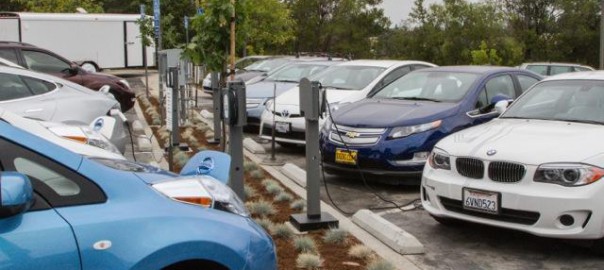
Workplace charging (Image: J. Kalb/Plug In America)

Workplace Charging – The Goldilocks Approach

Many companies are considering providing workplace charging for their employees and finding they are in new territory with many options to consider. We at Plug In America would like to share what we have learned having been involved for over 10 years in both using charging infrastructure as drivers and advising site hosts of all types in how to provide effective charging facilities.

Goals

There are many reasons a company may be considering providing workplace charging. It could be to attract and retain forward-thinking employees, to enhance a company’s “green” image, to gain points toward LEED certification, or to raise awareness of electric vehicles.

Our analysis and recommendations are based on the goal of using workplace charging to increase the adoption of electric vehicles, which ties in with many of the reasons we find companies are considering making charging available in the workplace. Even when this is not an explicit goal at a given company, understanding the issues presented here may be helpful in evaluating charging options.

We also want to minimize the cost to the employer while meeting the goal of encouraging increased use of electric vehicles. These considerations include infrastructure costs, operating costs, maintenance costs, and efficient use of employee time.

There is certainly no one-size-fits-all approach that meets the goals and needs of every company. The ideas presented here are meant to serve as a starting point, a baseline plan that can be used to inform the analysis of corporate goals, infrastructure considerations, and employee interests.

Terminology

Level 1 refers to charging at 120V. This can be from an ordinary outlet using a portable charging device or from a dedicated Level 1 station that has the proper electronics and plug to connect directly to a plug-in electric vehicle. For long term loads, like charging a vehicle, the current drawn is generally limited to 12A, which yields 1.44 kilowatts (kW) of charging.

Level 2 refers to charging at higher voltage, 208V to 240V. This can also done from a 240V outlet (NEMA 14-50, for example) using a charging cord, but is more typically done with a dedicated charging station. The current limit for these stations is typically 30 to 32 amps (~7 kW), but can be anything from 15A to 80A (up to 19.2 kW).

DC Quick Charge This charging method bypasses the vehicle’s on-board AC charging equipment and sends high voltage (300V to 400V) DC directly to the battery, at rates between 20 and 130 kW. These are expensive to install and operate, and are typically used for road trips or other situations where extra charge is needed in a hurry, not for a workday charging session.

The “Just Right” Fee

Problem: Free Reduces Availability

Free charging sounds like the best incentive to get people to consider electric vehicles, but the cost of electricity is not a barrier to EV adoption. An exact comparison with gas depends on a number of factors, but think of driving on electricity as equivalent to getting gas for less than $1 per gallon. Free charging makes the cost benefit more apparent, but has a couple of problems. First, it sets an expectation that charging will always be free, something that generally isn’t sustainable. A short-term pilot with free charging can be very effective in kickstarting awareness of electric vehicles, and some companies may want to continue to provide free charging even as EVs rise in popularity.

However, if free charging drives demand to a level that can’t be met, the resulting oversubscription can create problems that reduce EV adoption. Free charging motivates everyone to charge at work because it’s cheaper than charging at home. Charging that is oversubscribed is undependable and therefore people who can’t charge at home won’t find it a viable option. The only people who can use free charging are those who don’t need it because they have a more reliable alternative. This creates conflict between drivers who need charging to get home and others who just want to charge because it’s free. This built-in conflict can even create a hostile environment at work. Who wants to get into a shouting match over fueling their car so they can get home?

When free charging leads to oversubscription and reduces charging availability for those who need to charge, it discourages EV adoption among those who could most benefit from charging at work.

Problem: Overly Cheap Charging Shifts Off-Peak Use to On-Peak

Like free charging, billing at a rate that’s below the market price for electricity incentivizes shifting charging from overnight at home to charging at work during the day. As EV adoption increases, this puts extra strain on the grid and increases energy costs.

Problem: Overly Expensive Charging Can Hurt Adoption Or Usage

Paid charging billed far above the cost of electricity erases the economic advantage of driving electric. People who can’t charge at home thus can’t use this as a way to make driving electric financially viable. This therefore will not increase EV adoption. Likewise it can’t substantially increase use of EVs if it makes driving electric cost more than burning gas.

Solution: Charge a Little Over Market Price

The solution is to provide charging billed at just a little above local home rates. This extends the economic advantages of driving electric to those who cannot charge at home. It also eliminates the incentive to shift charging from home to work, reducing the number of stations needed to satisfy demand. Together these benefits minimize the infrastructure cost of providing charging at work and focus the benefits on those who need it the most.

Note that billing for public charging is different; other issues are at play there.

Read more: Plug In America
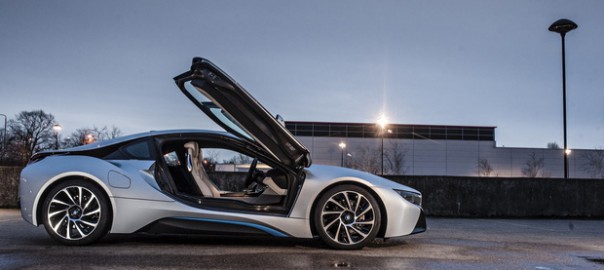
On the road: BMW i8 (Image: The Guardian)

BMW i8 – car review

‘You really have to be cut out for the kind of attention this car will garner: it’s like being famous overnight’

The BMWi8 is sleek, fast, futuristic and, most of all, defiant. The rules are, if you want to be green, you have to be crap. These were laid down in stone by eco-friendly cleaning products, and reinforced by decades of dirty hippies. The i8 is flash, showy, outrageously fast – and the future: one day, all cars will be like this – lighter, run on batteries – or cars will have ceased to exist.

The hybrid electric motor drives the front wheels, the turbo-charged petrol-triple engine the back. Sure, it plugs into the mains now, but as soon as they perfect the solar battery, this car is going to be first in line to run on sun. The frame is carbon-fibre reinforced plastic, somewhat lighter than aluminium, tonnes lighter than steel.

The resulting drive is, in any of the modes – SPORT, COMFORT or ECO-PRO (I’m not shouting; this is what BMW calls them) – more like driving in a video game than driving a car: silent, smooth, otherworldly. The speed dial is projected forwards into space, so only the driver can see it. This is handy, I imagine, if your passenger habitually tells you to slow down. Mind you, in this car, your passenger is going to tell you to slow down anyway. I defy you, feeling so protected (a high window line makes the world seem quite far away) and so omnipotent (thanks to the crazy raw power), not to go too fast, or at the very least accelerate in an ostentatious fashion.

Before you drive the i8, though, you have to get in; the doors open upwards in a gull-wing fashion. My kid asked me if it could fly. There is always someone taking a picture of it, if not as you approach, certainly by the time you’ve got the key out of your pocket. One time, walking purposefully toward it, then suddenly exhausted by the effort of explaining why I had it, even though it wasn’t mine, I just took a photo with my phone and walked away. You really have to be cut out for the kind of attention this car will garner: it’s like being famous overnight.

The cabin is swish and intuitive; in the dark, it comes alive with illuminated blue piping. The seatbelts are bright blue and heavily redolent of the professional pitstop. The posture is low and luxurious in a Swiss-watch-advert kind of way (“I’m reclining like this because I can afford to, not because my back’s gone”).

The motorway is where it gets to show off. It can make a decent noise, for a start, some of it simulated (people like that). More relevant is the ease with which it takes everything, and its remarkable fuel efficiency: at speed, something like 50mpg, roughly the same as a Prius, which feels like you’re pushing it along with your own buttocks.

The prototype for the i8 was in Mission Impossible: Ghost Protocol. I can’t figure out how Tom Cruise swung out of the low driver’s seat on his tiny little legs, but I can’t conceive of a more Hollywood-ready car.

Source: The Guardian

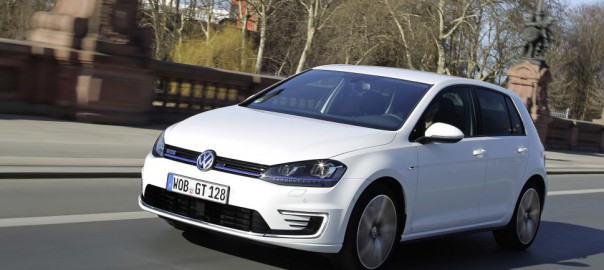
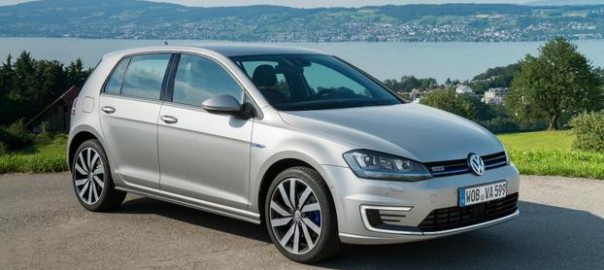
Volkswagen Golf GTE (Image: Evo)

Volkswagen Golf GTE Plug-in Hybrid

Volkswagen’s versatile 2015 Golf GTE plug-in hybrid has officially gone on sale in the UK.

Designed on the same Volkswagen MQB platform as the rest of the seventh-generation Volkswagen Golf family, the 2015 Golf GTE combines a 75 kilowatt electric motor mounted inside the gearbox and 8.8 kilowatt-hour lithium-ion battery pack with a 1.4-litre, TSI direct-injection gasoline engine capable of producing 148 horsepower.

Complete with a six-speed DSG gearbox designed specifically for use with hybrid drivetrains, Volkswagen says the Golf GTE is capable of producing a total power output of 201 horsepower (150 kilowatts) and a maximum available torque of 350 Nm (258 lbs ft) when both engine and motor work in concert.

In all-electric mode, Volkswagen claims a range of up to 31 miles per charge are possible, although based on previous brief drives with the Golf GTE we’d suggest a real-world range of between 20 and 25 miles per charge is more realistic.

Unlike some plug-in hybrids however, the Volkswagen Golf GTE operates in all-electric mode at speeds of up to 81 mph, with the gasoline engine only kicking in under extremly heavy acceleration. Due to its small size, the battery pack can be recharged from empty too full in just under four hours with a domestic power socket, or two and a quarter hours from an appropriate 16-amp charging station.

On power up, the Golf GTE’s default is to enter into all-electric mode, using up the energy in its battery pack first before switching on its gasoline engine. It can also be entered at any point during the trip after engaging anther mode by pressing the mode switch.

Like most other plug-in hybrids on the market today however, it’s possible to enter into ‘Battery Hold’ mode, which allows the driver to reserve their car’s battery charge for later use in the trip.

There’s also a ‘Battery Charge’ mode, which makes it possible for the Golf GTE to use excess energy from its internal combustion engine to recharge the battery pack as it is driving along. While this will result in temporarily dropping fuel efficiency, it does make it possible to drive in all-electric mode more than once in a trip although any driving made in electric mode using power generated by the engine has obvious emissions implications from an environmental standpoint.

Read more: Transport Evolved

Everything Has Changed: Oil, Saudi Arabia, and the End of OPEC

Saudi Arabia’s decision not to cut oil production, despite crashing prices, marks the beginning of an incredibly important change. There are near-term and obvious implications for oil markets and global economies. More important is the acknowledgement, demonstrated by the action of world’s most important oil producer, of the beginning of the end of the most prosperous period in human history – the age of oil.

In 2000, Sheikh Yamani, former oil minister of Saudi Arabia, gave an interview in which he said:

“Thirty years from now there will be a huge amount of oil – and no buyers. Oil will be left in the ground. The Stone Age came to an end, not because we had a lack of stones, and the oil age will come to an end not because we have a lack of oil.”

Fourteen years later, while Americans were eating or sleeping off their Thanksgiving meals, the twelve members of the Organization of the Petroleum Exporting Countries (OPEC) failed to reach an agreement to cut production below the 30 million barrel per day target that was set in 2011. This followed strenuous lobbying efforts by some of largest oil producing non-OPEC nations in the weeks leading up to the meeting. This group even went so far as to make the highly unusual offer of agreeing to their own production cuts.

The ramifications of this decision across the globe, not just in energy markets, but politically, are already having consequences for the global landscape. Lost in the effort to understand the vast implications is an even more important signal sent by Saudi Arabia, the owner of more than 16% of the world’s proved oil reserves, about its view of the future of fossil fuels.

Since its formal creation in 1960 the members of OPEC, and specifically Saudi Arabia (and in reality the Kingdom’s control over global oil markets is much larger than that 16% of reserves implies as its more than 260 billion barrels are among the easiest and cheapest to extract and before enhanced recovery techniques accounted for a much larger share of global reserves) have used excess oil production capacity to influence crude prices. The primary role of OPEC has been to support price stability. There are notable exceptions – like the 1973-1974 oil embargo and a period of excess supply that undermined prices and crippled the Soviet Union in the 1980s (though whether this was a defined strategy or serendipity remains in some question), but at its core the role of OPEC has been to control oil prices. As recent events show, OPEC’s role as the controller of crude oil pricing is coming to an abrupt end.

In acting as global swing producer, OPEC relied has heavily on Saudi Arabia, which can influence global prices by increasing or decreasing production to expand or reduce available global supply. Saudi Arabia can do this not only because it controls an enormous portion of global reserves and production capacity, but does so with crude oil that is stunningly inexpensive to produce compared to the current global market. A change, however, has occurred in Saudi Arabia’s fundamental strategic approach to the global oil market. And this new approach – to refuse to curtail production to support global prices – not only undermines OPECs pricing power, but also removes a vital subsidy for global oil producers provided by the Saudi’s longtime commitment to price support.

Read more: The Energy Collective

New Climate Change Study

New Climate Change Study Just 400 Pages Of Scientists Telling Americans To Read Previous Climate Change Studies

WASHINGTON—Co-authored by several dozen of the nation’s top climatologists, a new climate change study released Wednesday by the U.S. Global Change Research Program reportedly consists of 400 pages in which scientists just tell Americans to read previous climate change studies.

“Not sure if you saw this one from the Intergovernmental Panel on Climate Change from 2012 about how rising sea levels are putting billions of people in coastal cities at risk, or L.G. Thompson’s 2009 paper on the loss of Kilimanjaro’s glaciers, but really, you should check them out,”

read the study in part, which is titled “The Global Climate At Risk: A Broad Survey Of Climate Change Reports That We’ve Been Publishing For Decades And That You Should Actually, Seriously Read.”

“Look, there are hundreds of studies on Greenland’s rapidly melting ice sheet alone. If you could just skim the abstract of one of those—just one, that’s it—that would be great. They’re all online, and our JSTOR password is USGCRP90, so you can go and check one out right now.”

The report is said to conclude with a single exasperated 28-page run-on sentence urging people to

“just come on and look at these damn things, for the love of God—what more do you want from us—Jesus, this is ridiculous.”

Source: The Onion

Car exhaust (Image: BBC)

Why cheap gas can’t kill the electric car

From 2010 to 2014, U.S. electric car sales surged from almost nothing to about 120,000 per year. But the haters and doubters persist. Analysts and investing forums are buzzing about a coming stagnation. After all, in the past seven months the price of oil has collapsed from $115 a barrel to below $50. Gasoline prices have plummeted, too, fast approaching $2 per gallon nationally, and commuters are rejoicing. That means a key selling point for electric vehicles — low fuel costs — is gone. The electric car appears to be in trouble.

Surprisingly, it is not. This past week, the floor of the North American International Auto Show in Detroit was stacked with glitzy new electric cars, from the BMW i3 to the Chevrolet Bolt to SUVs and micro-cars. That’s because today’s electric car boom isn’t really about oil prices at all; it’s about clean air. Under the leadership of California, a group of environmentally progressive states (Oregon, New York, Maryland, Massachusetts, Vermont, Rhode Island and Connecticut) has created market-based mandates that set a floor under the electric-vehicle market. In other words, they’re forcing automakers to sell electric cars. The goal is to have 3.3 million of them on their roads by 2025. Thanks to clever policy design, the survival of electric cars doesn’t depend on the vagaries of the global oil market.

For more than a century, electric cars have repeatedly lost out to oil. As early as the 1890s, electric taxi fleets were stealing market share from horse-and-buggy drivers in New York, Philadelphia and Atlantic City. Even Thomas Edison was in on the game, spending more than a decade — and $1 million of his own fortune — developing a battery technology aimed at electric cars.

Electric cars, however, couldn’t keep pace with the fast-improving internal combustion engine. Its range, power and portability were all superior, thanks to oil. By 1910, Henry Ford (a former Edison Illuminating Company employee) had effectively crushed the early electric car. By 1927, half of all American families owned an oil-fueled car. Electric cars were no longer serious contenders.

But between 1969 and 1979, oil prices spiked, reviving interest in electric cars. In 1975, Congress took up a bill called the Electric and Hybrid Vehicle Research, Development, and Demonstration Act, which included $30 million for studies and deployment. A year later, Congress overrode a presidential veto to authorize $160 million for electric-vehicle research and testing over a five-year period. But when oil prices plummeted in the 1980s, policymakers retreated, halting funding for research.

Today, pessimists see a depressingly familiar pattern: Energy prices spike; huge sums of capital flow from the government and the private sector into oil alternatives; energy markets crash; those funds vanish and industries wither. And, of course, the electric car dies.

What makes California different is that its electric-car program isn’t tied to oil prices — because the project predates the oil shocks by more than two decades. After World War II, a mysterious pall of smog strangled Los Angeles. California’s response was to build a potent architecture for researching and regulating air pollution. This eventually became the California Air Resources Board (CARB), a body that rapidly outpaced the federal government in the science and policy of pollution control.

By 1970, California’s regulatory infrastructure was so developed that the national Clean Air Act allowed the state to set its own standards for emissions — and gave other states the option to follow its strict guidelines in lieu of those set by the federal government. If automakers wanted to sell cars in California — or in other states with similar regulations — their vehicles had to adhere to California’s emissions standards. These efforts accelerated in 1975 when Gov. Jerry Brown installed a new, aggressive chairman, Tom Quinn, at the state Air Resources Board. For a decade, CARB focused on cleaning up the exhaust from combustion engines. In 1990, with oil prices around $20 a barrel, CARB went even further, setting its sights on a car that didn’t pollute at all: a zero-emissions vehicle, an electric car.

California mandated that a certain percentage of cars sold in the state had to be electric — initially 2 percent by 1998 and escalating to 10 percent by 2003 — and then set about building a long-range strategic plan to help automakers fulfill the mandate. One key element was creating a market for car companies to buy and sell zero-emissions vehicle (ZEV) credits issued by the state for electric vehicle sales. If one automaker failed to sell electric cars, it could buy credits from a competitor who had succeeded. While building electric cars was expensive, so was buying credits; it also took a toll on a company’s reputation and deprived manufacturers of the technological insights they would gain by developing the cars. The incentives for automakers to push forward were in place.

Implementing the mandate was a long, iterative process, and the regulators’ initial goals proved to be overly ambitious. Over the decades CARB muddled through lawsuits and high-stakes policy brawls with automakers and the George W. Bush administration. Carmakers grumbled that California could not simply mandate innovation. “I wish that, instead of zero-pollution vehicles, CARB had mandated a cure for cancer,” Automotive News sneered. Then, for years, the Bush administration refused to grant California regulators a federal waiver for emission standards that until then had been practically pro forma.

But California kept going. Because the state was America’s largest auto market, it was too big for carmakers to abandon.

In 2010, automakers began selling a new generation of truly mass-produced electric vehicles, starting with the Nissan Leaf. California’s market for credits rewarded companies such as Tesla and Nissan that got out in front. These companies have reaped hundreds of millions of dollars from selling credits to laggards that did not fulfill their quotas. In the third quarter of 2014, Tesla Motors earned $76 million on ZEV credits alone.

California has also rewarded buyers of electric cars. It granted cash incentives to early adopters and gave them access to high-occupancy vehicle lanes so they could bypass the daily crush of rush hour. And California helped other states design their own incentive programs, which include perks such as rebates, free city parking and in some places free charging. The benefits make electric cars more attractive financially, particularly since the upfront costs of purchasing one might not be offset by fuel savings for years.

Today America is the world’s largest market for electric cars, and about 90 percent of them are sold in states following California’s program. The project took time to develop, but it finally broke the link between innovation policies and the capricious commodity cycle. The electric-car effort is just the kind of strategic planning that will be needed to transition away from fossil fuels, avoid the next oil shock and drive America toward a clean-energy economy.

Electric-vehicle sales may sag for a month or a quarter, but will cheap oil kill the electric revolution? Don’t bet on it. Electric cars are here to stay.

Source: Washington Post

Volkswagen Golf GTE (Image: VW)

Golf GTE order books open

The Volkswagen Golf GTE is available to order from today [published 14 January], costing £28,035* RRP.

And unlike Volkswagen’s other electric vehicles (the e-up! and e-Golf) which are sold through a network of 25 e-Retailers, the GTE will be available through all of the company’s franchised sales outlets.

The name of Golf GTE reflects its standing in the line-up alongside the petrol-powered GTI and diesel GTD, while its pricing also reinforces this position. The new car is driven by two engines: a 1.4-litre 150 PS TSI direct-injection petrol engine and a 102 PS electric motor. Together, they produce a maximum power of 204 PS and a theoretical range of 580 miles, while maximum torque is 350 Nm (258 lbs ft). A six-speed DSG gearbox developed for hybrid vehicles is standard.

The electric motor is integrated into the gearbox housing, while further hybrid components include power electronics and a charger. An electro-mechanical brake servo and an electric air conditioning compressor make for energy-efficient braking and air conditioning. There are five operating modes: ‘E-mode’, ‘GTE mode’, ‘Battery Hold’, ‘Battery charge’ and ‘Hybrid Auto’. In pure electric mode (activated at the press of a button), the Golf GTE can travel up to 31 miles. Electric power can also be saved – for example when driving to a zero-emissions zone – and in electric mode, the GTE is capable of speeds of up to 81 mph.

With the TSI engine engaged as well, the Golf GTE can sprint from zero to 62 mph in 7.6 seconds and on to 138 mph, yet returns a combined cycle figure of 166 mpg and CO2 emissions of 39 g/km. As such it is expected to be exempt from VED and the Congestion Charge.

The Golf GTE’s 8.8 kWh lithium-ion battery can be charged in 3.75 hours from a domestic mains outlet, or 2.25 hours from a domestic wallbox.

The Golf GTE is available in five-door bodystyle only and in one highly-specified trim level. Visually, it combines elements of the e-Golf and Golf GTI, with C-shaped LED daytime running lights (e-Golf) and aerodynamic horizontal ‘fins’ (GTI). Where the GTI features red, the GTE has blue accents, including across the radiator grille and into the headlights (which as on the e-Golf are LED), while 18-inch ‘Serron’ alloy wheels are fitted as standard.

Inside too, the GTI’s red highlights are turned to blue – including the stitching on the steering wheel, gear lever gaiter and seats, and a blue stripe in the tartan pattern on the sports seats. Touchscreen infotainment system with DAB radio and Bluetooth is standard, while optional navigation includes bespoke EV features such as the ability to identify potential destinations on electric range, and charging points.

The GTE also has an e-manager which allows the driver to preset vehicle charging, as well as interior cooling or heating and these functions can be operated remotely using the Car-Net app on a smartphone; a three-year subscription is standard in the UK. The speedometer and tachometer are familiar, and the latter is supplemented by a power meter in the central display, which shows the status of the battery, whether or not power is being used and the intensity of any regeneration.

(*RRP OTR after £5,000 Government plug-in car grant has been deducted)

Source: Diesel Car Magazine