Monthly Archives: September 2014

Volkswagen Golf GTE (Image: T. Larkum)

Car review- GTE is an electric dream

Creating a hot hatch used to be simple. Shoehorn the most powerful engine you can find into a small hatchback. Add some stiffer suspension, garnish with bigger brakes, flavour with large alloys and finally sprinkle with ‘GTI’ badges. This tried-and-tested formula has worked ever since the Golf GTI first appeared back in 1976.

Volkswagen Golf GTE (Image: T. Larkum)

However, Volkswagen didn’t stop there. Over the years the German firm has constantly pushed the boundaries of what a hot hatch is. From a turbo-diesel to four-wheel drive, fast V6 engines and even a small petrol with both a turbo and a supercharger, there has been no end to their hot-hatch tweaking. But nothing yet, has been as ambitious as this new Golf GTE plug-in hybrid.

Looking like a pumped-up GTI, the plug-in hybrid Golf doesn’t look all that different in the metal, but make no mistake this car is out to rewrite the hot hatch rulebook. Under the VW’s skin is the same hybrid powerplant as the Audi A3 e-tron that we tested on these pages back in July. That means it packs the same 150bhp 1.4-litre turbo petrol as well as a 75kw electric motor that pumps the overall output up to an impressive 204bhp.

That’s enough to give it a brisk 0 to 60mph time of just 7.6 seconds and onto a 137mph top speed while returning an 188mpg average fuel economy and just 35g/km emissions. Anyone lucky enough to run one as a company car will face an ultra-low 5 per cent Benefit-in-Kind tax bill – the kind of level that even company car drivers of conventional frugal cars can only dream of. Perhaps the most impressive aspects of this high-tech hybrid are its 31-mile electric-only range and the fact it takes just three and a half hours to charge from flat using a domestic plug socket. It can also travel at up to 81mph in electric mode alone.

All that means you could commute in the GTE without using a single drop of petrol all week, says Volkswagen. Which is why engineers had to use a petrol engine that could go for weeks without turning over. But if you do need to venture out of town at the weekend, the petrol engine will kick in and extend your range to a very reasonable 580 miles. So far, so revolutionary.

But what’s it actually like behind the wheel? Unsurprisingly, it feels like a Golf. Aside from an extra gauge where you’d normally find the rev counter (that shrinks and sits below it), the fit, finish and layout is just like the regular hatch. The only drawback we could find is that the battery cells have shrunk the boot capacity by almost a third and the rear seats no longer fold completely flat – but if you can live with that, you’re in for a treat once you’re on the move.

Read more: Sunday Express

Road test: Volkswagen e-Golf

Sparky: Under the bonnet, there’s a 113hp electric motor with a top speed of 87mph and a single-speed automatic gearbox (Image: LES)

At first glance, VW’s latest model looks like an ordinary Golf. Then you notice C-shaped LED front lights, aerodynamic alloy wheels and the lack of a tailpipe, which add up to the all-electric e-Golf.

Under the bonnet, there’s a 113hp electric motor with a top speed of 87mph and a single-speed automatic gearbox, plus some clever tweaks to increase the range to a claimed 118 miles. To drive, it feels like an almost silent version of a conventional Golf, with a sprightly pick-up which accelerates the car to 62mph in 10.4 seconds (much the same as in a 1.6-litre Golf BlueMotion turbodiesel), although using Eco and Eco+ modes will restrict the power and throttle response to increase the range.

You can further extend the mileage by using five different states of brake regeneration, which means you can drive most of the time using just the throttle.

A standard full charge for the lithium ion battery takes 13 hours, but you can fast-charge it to 80 per cent in 35 minutes.

Volkswagen e-Golf
Top speed: 87mph
Emissions: 0g/km
Economy: 12.7kWh/100km
Price: £25,845, including government grant

Source: London Evening Standard

Electric Highway use quadruples in nine months

Nissan Leaf: The Electric Highway covers 90% of the UK's motorway services (Image: Ecotricity)
Nissan Leaf: The Electric Highway covers 90% of the UK’s motorway services (Image: Ecotricity)

The Electric Highway rapid charging network has had almost a four-fold rise in the number of vehicles plugging in over the last nine months, according to green utility company Ecotricity, which is responsible for running it.

A total of 4,080 cars used the network in the last quarter of 2013, more than doubling to 8,891 in the first quarter of this year, and 15,152 in the second quarter – a 271% rise, as plug-in car registrations in the UK continue to climb.

The network, which now spans 90% of all UK motorway service stations and includes 170 charging points, has so far provided 250,000 kWh of 100% renewably sourced electricity, or over a million miles of electric driving, for free.

By the end of the year, Ecotricity expects to have rapid chargers at all service stations in the UK, giving an 80% charge in under half an hour, with many sites gaining a second unit with the new Combined Charging System connector, compatible with BMW and Volkswagen’s electric vehicles.

As a result, the company estimates that it will have reached two million miles of free electric driving to its membership base, which is gaining 800 registrations each month.

Dale Vince, founder of Ecotricity and the Electric Highway, said: ‘Fast chargers are a massive turning point for electric cars in Britain, knowing you can recharge a car in 20 minutes, or about the time it takes to have a cup of coffee, and travel the length and breadth of Britain if you want to – is a massive boost.’

Source: EV Fleet World

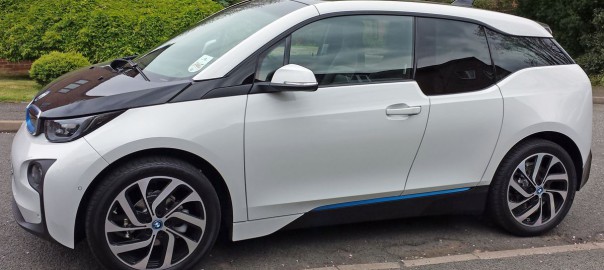
Plugged in to our new quick-and-quirky BMW i3

quick-and-quirky BMW i3 electric car (Image: Consumer Reports)

Futuristic, extended-range car reveals a whole different side to the German automaker

After a nine-month wait, we’ve just taken delivery of the futuristic-looking BMW i3, a tall, rear-drive, electric-powered hatchback. This is a quick-and-quirky little car with a driving experience quite unlike anything else, for better and worse.

While the base car is a pure EV, the i3 is also available with a range-extending gasoline engine meant to eliminate range anxiety. As with the Chevrolet Volt, the gas engine is only used to generate electricity. The engine only kicks in when the 22-kWh lithium-ion battery is near depletion.

The electric drive produces 170 hp and the REX adds a 34-hp, 650cc two-cylinder motorcycle engine. We opted for the REX in midtrim Giga World version. The EPA rates the electric range at 72 miles, and it estimates that the gas engine will supply another 78, for a combined 150-mile range. The starting price for the gas-assisted car is $45,200, but with options such as heated seats and navigation, our car came in at $50,450. Thankfully, it qualifies for a $7,500 federal tax credit.

The i3’s novel lightweight architecture uses carbon-fiber body structure and roof, plastic body panels, and earth-friendly plastics in the cabin. The leather bits are even “tanned” with olive tree extracts.

We took a brief stint behind the wheel of an i3 in Los Angeles in November but now we’re experiencing it on our home turf, in anticipation of a full test once the break-in miles are complete.

Read more: Consumer Reports

James May on his new BMW i3

James May on his new BMW i3 (Image: TopGear)

I am very, very excited about my new electric BMW i3. 
In the interests of accurate journalism, I ought to point out that it’s still not here, despite what I said a month or two back, but that’s probably because it’s being recharged somewhere on the way from Germany. Badoom tsch!

But I’m still very excited. Why, though? Why would I be so sleepless over a car that’s going to traumatise me with this new syndrome of ‘range anxiety’, a very polite name for ‘battery tyranny’? Why, when I’ve recently driven La Ferrari LaFerrari 
– a car that harnesses the wonder of electricity in a very intelligent and sustainable way – am I worked 
up about humming around in an overpriced battery-powered aircon unit? It troubles me.

I’m taking a lot of stick about this car. A number of people have pointed out that buying an electric car but continuing to work on Top Gear is somehow not very ecological. But who said it was? I’m not interested in the ecology, I’m buying it because I’m a car enthusiast, and I’m really not going to sleep better in the knowledge that Nick Clegg is pleased with me. Quite the opposite, to be honest. Doesn’t explain why I’m jumpin’ about it, though.

Someone on Twitter was also having a pop at 
my credentials as a car fan. How could I deny the passion of driving, they asked?

Well, look. There’s more than one way to be excited by cars. I love daft supercars, but I also like 
a Rolls-Royce Ghost for its serenity and sense of detachment. A whisper-quiet electric car may expose a new facet to this thing that used to be called ‘motoring pleasure’. We’ll have to see.

I’ve said it before, but the electric car thing is a bit of a public experiment, and I’m keen to take part in it. But, having said that, I never got very excited about taking part in experiments in the chemistry lab at school, except the one where I heated up Clive Kingston’s metal ruler in a bunsen burner and then left it on his desk. So that still doesn’t explain it.

What intrigues me is that the electric car has been around almost as long as the car itself. Even within my own lifetime, it’s been kicking around on the 
back burner (an analogy that needs work, because obviously it would be on an electric ceramic hob) 
in the form of milk floats and meals-on-wheels delivery vans. But I never considered anything like that for a moment.

But all of a sudden, an electric car 
is a bit cool. Why? I suppose because the environmental pretence makes it quite fashionable. Driving an electric car is being the change you want to see in the world, or whatever hipsters say, and sneaking around town in complete silence, mowing down unsuspecting pedestrians, places you in that sector of society 
that embraces change instead of resisting it. 
It’s the fuzzy edge, the avant garde. And that’s 
me. You should see some of the shapes I throw 
out on the floor.

But there’s something else. For decades, an electric car was simply that – a car powered by a useless battery and an electric motor, but in every other respect just like a car. The only other thing anyone ever recharged was a toothbrush.

Now, though, we recharge everything, even vacuum cleaners, so it seems perfectly humdrum. Not only that, the act of plugging in your car has become part of the culture of being connected. It’s not just about electricity, it’s about intelligent devices.

To put it another way, an electric car used to be like Richard Hammond. You fed him some baked beans, and he carried on being another irritating Brummie bloke. Now it’s more like Professor Brian Cox. You ply him with exotic French wines, and he explains stuff about quantum physics.

This, I’ve now realised, is what it’s all about. I’m 
sad enough to sleep with the i3 order form next to 
my bed, and looking at it last night, I noticed that 
I’d held back on posh trim and phat alloys, and spent all my money on things like satnav, jam assist, driving assistant plus, internet capability, online entertainment, smartphone compatibility, DAB, and so on and so on. I can play computer Battleships in a traffic jam and watch YouTube clips from Battle of Britain in the privacy of my own car.

That’s why it seems to be, suddenly, a thing of wonder. It’s not really a car at all. It’s a giant iPad. Being a car is just one of its apps.

Source: Top Gear

BMW, Nissan, Renault And Volkswagen Join Forces For EV Charging

UK Rapid Charge Network

UK Rapid Charge Network (RCN) project, through the European Union’s Trans-European Transport Network (TEN-T) program, attracted four automakers – BMW, Nissan, Renault and Volkswagen, which will join forces to build a network of a multi-standard fast chargers in Ireland and Europe.

According to the latest news, 10 out of 74 of the multi-standard chargers are already installed and a further 28 have been commissioned.

All of them will be 44kW CCS, 44kW CHAdeMO and 43kW AC systems, so no EV will be left without a charge option.

“Nissan is joined in the project by BMW, VW and Renault: it’s the first time leading BEV companies have united to accelerate the growth of EV charging infrastructure, seen as a key enabler towards making zero-emission mobility a market reality. The project, managed by Zero Carbon Futures in Sunderland also draws on the network expertise of ESB, one of Ireland’s foremost energy company and leader of a previous TEN-T project completed this summer, and Newcastle University.”

“When complete, the UK Rapid Charge Network (RCN) will comprise more than 70 multi standard rapid chargers covering some 1,100km of major trunk routes and providing EV-friendly links to five seaports and five international airports.”

“Running on two priority road axes on the mainland of the UK, the RCN will link major ports and cities including Stranraer, Liverpool, Holyhead, Birmingham, Felixstowe, Leeds and Kingston upon Hull. There will also be networks embracing Dublin, Ireland and Belfast, Northern Ireland.”

“The UK RCN is part of the European Union-financed Trans European Transport Network (TEN-T) and represents a substantial partnership investment of €7,358,000, half of which is being funded by the EU.”

Baroness Kramer, UK Minister of State for Transport stated:

“We are serious about plug-in vehicles and have a comprehensive package of measures to help consumers and industry make the switch to electric. The UK now has the best rapid charging network in Europe. Projects like this highlight how industry is showing its confidence in the rapidly growing market.”

Source: InsideEVs

Formula E all-electric racing championship starts this weekend

Formula E_ Venturi Team at Donington (Image: A. Warner/GCW)

It is finally here! The long-awaited Formula E electric car racing championship gets underway this weekend, kicking off in Beijing.

The new FIA-approved racing championship will race in ten locations over its first season, in each location racing on temporary street tracks, based in the heart of the city. FIA Formula E Fifth Test 19th August 2014. Donington Park Race Circuit Derby, England Tuesday 19 August 2014.

Key to the new championship are the single-seat, fully electric Spark-Renault SRT_01E race cars which each of the ten teams will use. These cars achieve performance nearing that of their more famous Formula 1 sisters, with a top speed of around 150mph top speed (compared to around 240mph for an F1 car) and a 0-62mph time of less than 3 seconds (compared to 2.5 seconds for a F1 car).

Teams taking part include Venturi, backed by Hollywood film star and well-known environmentalist, Leonardo DiCaprio and Virgin Racing, backed by venture capital conglomerate, Virgin. Broadcast on BT Sport and ITV4, each leg of the racing series will run over the course of a weekend to maximise public exposure, with the finale set to take place at Battersea Park in London on June 27, 2015.

Other host cities will include Putrajaya in Malaysia, Los Angeles, Monte Carlo in Monaco, Buenos Aires and Berlin, Germany. The first round kicks off this Saturday (September 13, 2014), and is broadcast live from 8am (UK time) on ITV4, with the day’s highlights shown from 6pm.

Source: Green Car Website

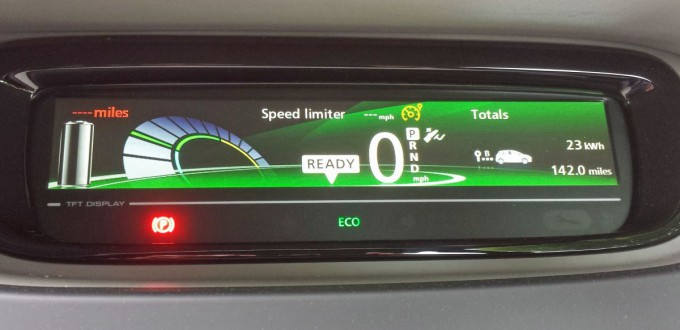
Renault ZOE Dashboard after range record (Image: T. Larkum)

Renault ZOE Range Record: 142 Miles

Renault ZOE Dashboard after range record (Image: T. Larkum)

It’s a year since I managed to persuade my ZOE to go 122 miles on one charge so, with the weather being mild, it seemed like a good time to try for another range record. Previously I had aimed for driving to work and back (typically 38 miles round trip) twice, and then driving around locally to make up the distance. This time I was more confident so I charged up last Tuesday night then drove to work and back on Wednesday, Thursday and Friday.

This time I chose a more convoluted route (about 42 miles round trip) so I could avoid long stretches with speeds above 40mph, instead travelling mostly on back roads, through villages and an industrial estate, to keep my average speed down. I had prepared by inflating the tyres to 38psi, but otherwise the car was unmodified in any way. The air conditioning was on but since I was in Eco mode it was pretty feeble as usual.

Read more: MyRenaultZOE: ZOE Keeps Her Promise