Category Archives: Opinion

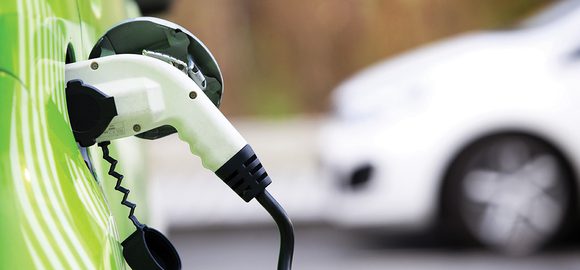
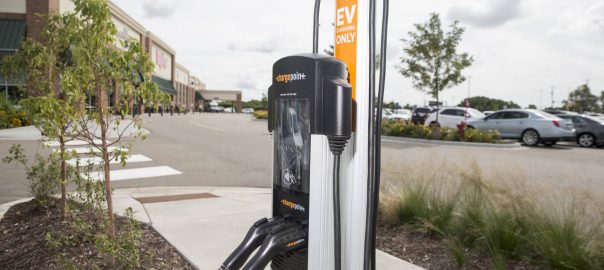
Hy-Vee, a Midwestern grocery chain, installs charging stations at all its new locations. The number of commercial charging stations is growing quickly. (Image: A+G/WSJ)

Why Electric Cars Will Be Here Sooner Than You Think

Adoption of electric vehicles will not be gradual, because the factors required to unlock demand for them are in place

Hy-Vee, a Midwestern grocery chain, installs charging stations at all its new locations. The number of commercial charging stations is growing quickly. (Image: A+G/WSJ)

In 2015, about one in every 150 cars sold in the U.S. had a plug and a battery. But mass adoption of electric vehicles is coming, and much sooner than most people realize.

In part, this is because electric cars are gadgets, and technological change in gadgets is rapid.

One big leap is in batteries. A typical electric vehicle today costs $30,000 and will go about 100 miles on a charge, if that. Within a year, you’ll be able to get double that range for just a little more money.

Tesla Motors Inc. is the standard-bearer, promising a Model 3 vehicle meant to appeal to the masses at $35,000 without incentives and more than 200 miles of range. By comparison, the average new car in the U.S. today sells for about $33,000.

But Tesla is hardly alone. Later this year, Chevrolet will roll out its $37,500 Bolt EV. It, too, boasts more than 200 miles of range, which appears to be the new goal for eliminating “range anxiety”—the fear that a vehicle will run out of juice—among potential electric-vehicle buyers.

And that is just the start. Pasquale Romano, chief executive of ChargePoint Inc., the world’s largest maker of electric-car charging stations, says he works with, and talks to, most major car companies.

“We have seen their internal plans to just electrify everything,” he said.

In the short run, many of these cars will be plug-in hybrids, with both electric motors and gasoline engines. It makes sense to lump them with electric vehicles because most new models have enough battery power to get the average U.S. commuter to work and back without using any gasoline.

Steve Majoros, a marketing director at General Motors Co.’s Chevrolet unit, says that 90% of trips and 65% of miles driven in its Volt plug-in hybrid are on electric-only mode. The Volt can go 53 miles on a charge.

Every plug-in hybrid is effectively an electric car that is carrying a “range extender,” just in case. They will help electrify a large share of the miles Americans drive. They’ll also help ease consumers into electric vehicles, overcoming any remaining fear about being stranded after running out of juice.

Competition among electric vehicles and plug-in hybrids will be intense, which will drive down prices. Volkswagen AG has pledged to make every model available as a plug-in hybrid by 2025. BMW AG has made the same promise. Hyundai Motor Co. promises eight plug-in hybrid models by 2020, plus two all-electric vehicles. Toyota Motor Corp.’s overhaul of the plug-in Prius, boasting twice the range, arrives before the year is out.

Read more: Wall Street Journal

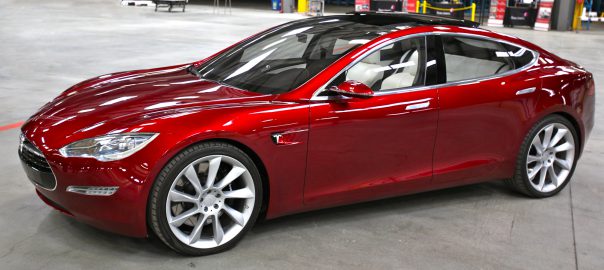
Tesla Model S

Mass adoption of electric vehicles is “much sooner than most people realize”

Blink and you missed the announcement. But last Friday, the UK’s much criticised energy supply grid system entered what is being seen as a “new era” with the announcement that eight large battery systems are being built to cope with the growing influx of wind and solar power.

Tesla Model S
Tesla Model S

The deal – the largest of its kind in Europe – will see seven companies, including Sweden’s Vattenfall and UK-based Renewable Energy Systems, install eight lithium-ion battery systems around Britain.

“This is the single largest contract in Europe we’ve ever seen for storage and the largest of its kind globally since August last year,”

said Logan Goldie-Scot, head of energy storage at the Bloomberg New Energy Finance research group told the Financial Times.

Storing electricity in batteries has long seen as the “holy grail” for renewables as battery storage of electricity helps to supply power on the days that the wind is not blowing or the sun is not shining.

And the move is aimed at helping the UK cope with the growing prevalence of renewables, which now account for a quarter of UK electricity generation, up from 9 per cent in just five years.

If renewables can provide electricity to the grid which can be stored when demand is needed it will help the electric car revolution that is taking place. Just as the electricity supply network needs storage in batteries so do electric cars, and it is a shortage of batteries which is threatening to keep the price of electric vehicles high for the time being.

But Tesla is changing the game on electric vehicles, a subject explored in today’s Financial Times, which asks what it calls a profound question: “Could electric cars ever cut the world’s thirst for oil enough to depress crude prices significantly?”

And the short answer is: Yes.

Read more: Price Of Oil

At these prices, who can refuse? (Image: G. Osodi/Bloomberg)

Fuel Subsidies Are the World’s Dumbest Policy

Many things have gotten harder as the world settles into a protracted spell of low oil prices and sluggish growth — from avoiding deflation to creating jobs. One thing has gotten easier, as well as more urgent: eliminating fossil-fuel subsidies.

At these prices, who can refuse? (Image: G. Osodi/Bloomberg)

Governments have long paid lip service to this idea. The G-20 has been promising to phase out fuel subsidies since 2009, but the measures remain widespread and resilient.

Nations from the U.S. to the U.K. to Russia continue to spend billions on tax breaks and other subsidies for the production of oil, gas and coal. Japan, South Korea and China support massive fossil-fuel projects outside their borders. For years, many countries — including some of the world’s biggest energy producers — have also used subsidies to lower gasoline and diesel prices, supposedly to help the poor.

The sums involved are huge. The International Energy Agency estimates that countries spent $493 billion on consumption subsidies for fossil fuels in 2014. The U.K.’s Overseas Development Institute suggests G-20 countries alone devoted an additional $450 billion to producer supports that year.

These ridiculous outlays would be economically wasteful even if they didn’t also harm the environment. They fuel corruption, discourage efficient use of energy and promote needlessly capital-intensive industries. They sustain unviable fossil-fuel producers, hold back innovation, and encourage countries to build uneconomic pipelines and coal-fired power plants. Last and most important, if governments are to have any hope of meeting their ambitious climate targets, they need to stop paying people to use and produce fossil fuels.

Read more: Bloomberg

Rapid rise in electric vehicles to ‘reverberate through wider economy’

Falling costs of renewables and batteries will boost EV market over next 20 years and have huge impact on wider global economy, BNEF paper argues

580x358_electric_car_bg

The rapid rise in electric vehicle numbers expected across the world over the next two decades will reverberate throughout all business sectors and make a huge impact on the global economy. That is the…

Read more: Business Green

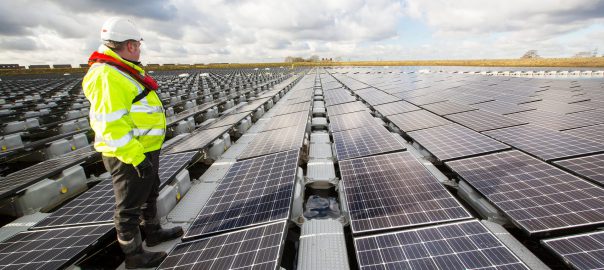
The floating solar farm on Godley Reservoir near Manchester (Image: A. Cooper/Guardian)

If wind and solar power are cheaper and quicker, do we really need Hinkley Point?

Nuclear energy’s cost, and a focus on alternative technology, including research on a new generation of hi-tech battery storage, is leading observers outside the green lobby to question the project’s value

Should Theresa May take the axe to the troubled Hinkley Point nuclear project, it will propel wind and solar power further into the limelight. And for renewable technologies to become really effective, Britain and the rest of the world need breakthroughs in electricity storage to allow intermittent power to be on tap 24/7, on a large scale and for the right price.

Cheap, light and long-life batteries are the holy grail, and achieving this requires the expertise of people like Cambridge professor Clare Grey. The award winning Royal Society fellow is working on the basic science behind lithium-air batteries, which can store five times the energy in the same space as the current rechargeable lithium-ion batteries that are widely used today.

The floating solar farm on Godley Reservoir near Manchester (Image: A. Cooper/Guardian)

She is also focusing on sodium-ion and redox flow batteries; the latter store power in a liquid form, contained in vats or tanks that in theory can easily be scaled up to power-grid sizes.

“There has been an amazing transformation in this field. There is an explosion of interest and I am extremely lucky to have decided early on to concentrate on this area,”

she says, although she is keen to play down the idea that a eureka moment is just around the corner.

She is also thankful for Hinkley – if only because of the government’s long-term funding deal with EDF Energy that it gave rise to.

“It has put a price on [future] electricity in the market which is high, and this has potentially opened up further commercial space for new technologies such as batteries. But independent of Hinkley we do need better batteries and my chemistry will hopefully help find them,” she says.

The wisdom of bringing in the Chinese to help EDF, the French state-owned utility company, construct the proposed new Somerset reactors has been highlighted as a key factor behind the government’s reluctance to push the go button.

But ministers are also aware that, in the last 18 months, many experts in the field have concluded that the biggest argument against the plant is not that it is too expensive, at £18.5bn, but that the kind of “on-all-the-time” power it delivers is no longer what is required.

Read more: The Guardian

“You Can’t Handle the Truth!”

Movie buffs will recognize this title as the most memorable line from “A Few Good Men” (1992), spoken by the character Colonel Jessep, played by Jack Nicholson (“You can’t handle the truth!” is #29 in the American Film Institute’s list of 100 top movie quotes).

I hereby propose it as the subtext of the recently concluded Republican and Democratic national conventions.

At this point most people appear to know that something is terribly, terribly wrong in the United States of America. But like the proverbial blind man describing the elephant, Americans tend to characterize the problem according to their economic status, their education and interests, and the way that the problem is impacting their peer group.

blind_menelephant-itcho

So we hear that the biggest crisis facing America today is:

  • Corruption
  • Immigration
  • Economic inequality
  • Climate change
  • Lack of respect for law enforcement
  • Institutionalized racism
  • Islamic terrorism
  • The greed and recklessness of Wall Street banks
  • Those damned far-right Republicans
  • Those damned liberal Democrats
  • Political polarization

The list could easily be lengthened, but you get the drift. Pick your devil and prepare to get really, really angry at it.

In reality, these are all symptoms of an entirely foreseeable systemic crisis. The basic outlines of that crisis were traced over 40 years ago in a book titled The Limits to Growth. Today we are hitting the limits of net energy, environmental pollution, and debt, and the experience is uncomfortable for just about everyone. The solution that’s being proposed by our political leaders? Find someone to blame.

The Republicans really do seem to get the apocalyptic tenor of the moment: their convention was all about dread, doom, and rage. But they don’t have the foggiest understanding of the actual causes and dynamics of what’s making them angry, and just about everything they propose doing will make matters worse. Call them the party of fear and fury.

The Democrats are more idealistic: if we just distribute wealth more fairly, rein in the greedy banks, and respect everyone’s differences, we can all return to the 1990s when the economy was humming and there were jobs for everyone. No, we can do even better than that, with universal health care and free college tuition. Call the Democrats the party of hope.

But here’s the real deal: a few generations ago we started using fossil fuels for energy; the result was an explosion of production and consumption, which (as a byproduct) enabled enormous and rapid increase in human population. Burning all that coal, oil, and natural gas made a few people very rich and enabled a lot more people to enjoy middle-class lifestyles. But it also polluted air, water, and soil, and released so much carbon dioxide that the planet’s climate is now going haywire. Due to large-scale industrial agriculture, topsoil is disappearing at a rate of 25 billion tons a year; at the same time, expanded population and land use is driving thousands, maybe millions of species of plants and animals to extinction.

Read more: Post Carbon Institute

The welcoming entrance of Disney’s magic kingdom (Image: L. Larkum)

How Far Behind is the US in General, and Disney in Particular?

Culture Shock

With apparently ever-increasing globalisation most of us have an expectation that we can travel to other Western countries and find facilities and a culture similar to our own – after all, a McDonald’s Big Mac bought in Paris is recognisably the same as one from New York.

Occasionally, though, we find things to be suddenly different from what we expect. The difference is marked because it is not just a different food or architecture. It is marked – a culture shock – because it arises from very different assumptions about how a culture should be. I had such a feeling twenty-five years ago when, as a member of the British armed forces, I moved into married quarters in Germany. For the first time ever I encountered a culture with sustainability as a core value – we found recycling facilities all along our street, and were given full instructions on how to recycle our waste as part of moving in.

Such an approach was entirely absent in the UK, there we were still wondering whether we should consider starting to recycle some waste, and so returning to the UK felt like going back in time. Of course, since then the UK has caught up, at least to a large extent. For example, there are weekly collections of plastic and metal/can containers, of paper and cardboard, of glass, and of food waste, plus fortnightly collections of garden waste.

I write this as I approach the end of a vacation in Disney World and Florida, having experienced another such step back in time. Things are so far behind here it has been another culture shock. We last visited twenty-five years ago and it seems that the culture in general and Disney World in particular are virtually unchanged over that time.

Conspicuous Consumption and Pollution

It began with our accommodation – a lovely rented villa in a community estate in Davenport, half an hour outside Orlando. It’s huge and well-appointed with a very nice small pool and patio. However, it feels like living in a ‘consumption machine’. I write this in the open-plan kitchen/lounge area. Behind me upstairs the air conditioning system rattles away providing welcome cooling throughout the house – but it seems to be on permanently, 24/7, set to a temperature of 76°F (24°C). The energy consumption must be enormous, but its controls are locked away so we don’t have the choice to turn it off and save energy.

Behind me just outside the wall is the monstrous pump and filter system for the pool, whirring away. In front of me is a massive fridge which almost never goes quiet. Later today we’ll have men coming round making noise along the road (strimmers, leaf blowers, etc.). This evening we’ll have the sprinklers coming on to disturb our sleep. Not just carbon pollution, but noise pollution seems to be an accepted part of life here.

Even the cars of our neighbours coming and going seem inordinately loud, and why must they beep their horns every time they lock the doors? Everything is just so noisy (in this house we even watch TV in the same large living space as the dishwasher, washing machine and tumble dryer). The whole concept of noise pollution seems alien here, as though it were something to be embraced rather than avoided. I can’t imagine how hard it would be to try and get some peace and quiet. Yet in the UK people put a premium on quietness whether it’s buying a quiet car (such as an electric) or a house in the country – here the preference seems to be for cars and houses that are as big and noisy as possible.

The big irony, of course, is that the massive carbon footprint of this house is entirely unnecessary. A big chunk of it is for air conditioning because of the powerful sunshine here, yet it is precisely that excess of solar power that could be powering the house with solar energy for free. Instead, it is using fossil fuels and their associated carbon emissions to try and offset the energy being dissipated on the roof. I’ve only seen one house in the area with solar panels, and I noticed that precisely because it was an isolated example in a sea of blank rooftops.

Part of that irony is that we have solar panels on our home in England, even though we are at a much higher latitude than Florida and so get correspondingly less solar energy. Nonetheless, even with our supposedly cloudy and rainy climate the panels produce more than half the energy used by the house over the course of a year. In Florida a similar setup could potentially power the entire house, and with some left over going into the grid to reduce its overall footprint, or used to fuel an electric car.

It was good to see that our housing estate had a weekly recycling collection, even if it was just a mixed box (and many of our neighbours’ wheelie bins were overflowing with cardboard boxes and other items that could have gone in recycling).

No Leadership From Disney

So on to Disney. Over the last two weeks we have visited Magic Kingdom, Hollywood Studio and Animal Kingdom twice each, and Epcot and the Typhoon Lagoon water park once each. We had a good time on the roller-coaster and other rides, and at the various shows. However, it felt like very little had changed in the last quarter century.

A tram with its diesel exhaust just a few feet from waiting passengers (Image: T. Larkum)

After parking up we were transferred to the park entrances via vehicles referred to as ‘trams’. While in Europe that name implies electric trolley buses, and given their workload and fixed routes these vehicles could have been electric, it was immediately obvious they were not. You didn’t have to get very close to them to hear the roar and smell the nauseous and toxic fumes that gave away that they were powered by massive diesel engines. And this, in the 21st century, and with half the passengers being young children.

Read more: Linked In
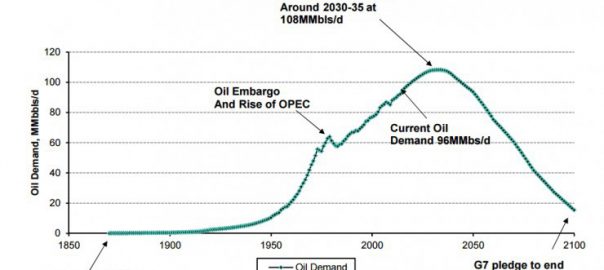
Peak Oil Could be in 15-20 Years (Image: Bernstein Research)

Big Oil Is Terminal

“Peak oil demand” is the new “peak oil supply” because of climate change and plummeting costs for electric car batteries.

It’s increasingly clear that we’re not going to move off of oil because we run out of supply. Rather, we’re going to move off of oil because it is both the economic and moral thing to do.

The research firm Bernstein notes that two “existential threats to the oil industry” exist — “climate change” and “advances in battery technology and computing power, which have resulted in a surge in interest in electric vehicles and autonomous driving.” They project the peak in oil demand could come as soon as 2030–2035:

Peak Oil Could be in 15-20 Years (Image: Bernstein Research)

Read more: Think Progress

The Pain You Feel is Capitalism Dying

1-pPDKvJZiZH5uEz3QTkSSUg_hang_head_unk

It can be very confusing to know that you won’t find a decent job, pay off student loans or put in a down payment on a house in the next few years — even though you may have graduated from a top-tier university or secured glowing references from all those unpaid internships that got you to where you are today.

Even if you are lucky enough to have all of this going for you, you’ll still be one among hundreds of applicants for every job you apply for. And you’ll still watch as the world becomes more unequal, with fewer paid opportunities to do what you feel called to do in your work or for your life path.

What’s more, you won’t find much help from your friends because most (if not all) of them are going through the same thing. This is a painful and difficult time that is impacting all of us at once.

There will be people who tell you it’s your fault. That you aren’t trying hard enough. But those people are culprits in perpetuating a great lie of this period in history. The standard assumptions for how to be successful in life a few decades ago simply do not apply anymore. The guilt and shame you feel is the mental disease of late-stage capitalism. Embrace this truth and set yourself free.

To see how broken things have become you’ll have to think systemically. Take note of the systems built up to create this situation and understand how it came to be — so you’ll see why it cannot possibly continue on its current path.

First, a diagnosis of the problem:

A Global Architecture of Wealth Extraction has been systematically built up to rig the economic game against you. This is why a tiny number of people (current count is 62) have more wealth amongst them than half the human population.

Read more: Medium

(Image: Y. Yin/Greeenpeace)

The Tesla dream: Sustainable Transport

How much will electric vehicles slow carbon emissions?

(Image: Y. Yin/Greeenpeace)

Each passing month breaks modern temperature records, citizens perish in 51°C heat in India, unseasonal fires rage in the Canadian tar sands, methane escapes from arctic permafrost, Earth approaches the +1.5°C Paris Accord “goal,” and hoping to stop at +2°C appears increasingly naive.

As we observe these trends, we feel an urgent desire for solutions to global warming unleashed by human CO2 emissions. Automobile companies have finally adopted the electric vehicle (EV), led by Tesla Motors and founder Elon Musk, cult hero for technology-inspired optimism.

As serious ecologists, we may reasonably ask: Will EVs slow carbon emissions, and by how much? A genuine answer requires rigorous investigation, calculation and analysis. The general public may be forgiven for avoiding any such analysis, but as ecologists, we are obliged to know what we’re talking about. Good scientists observe the principle to “beware congenial conclusions.”

As we investigate this analysis, we will find that genuine solutions exist, although they may not be the easy solutions we hope for.

Source: Greenpeace