An audio-heavy video of the e-Golf to give the experience of driving it – it’s different!
What Winding Road does well in its video reviews is to capture what it feels and sounds like while sitting in the driver’s seat of the car being reviewed. These videos showcase the Volkswagen e-Golf in Winding Road style.
Per the video description:
Wear headphones! The audio in this video was recorded with in-ear binaural microphones. With headphones or earbuds on, you’ll feel like you’re actually sitting in the driver’s seat.
Some consolidation is happening in the charging point market
A 70-strong business headquartered in Hereford has been acquired by a manufacturer of charging points for electric vehicles.
GB Electrical, which installs electric vehicle charging points across the country, has been bought by Chargemaster, a Luton-based business that designs, develops and manufactures the equipment.
To date, the company has used a number of external subcontractors for its installation work and this acquisition will enable it to increase its capacity and quality of installation service.
Chargemaster chief executive David Martell said: “We are delighted to be able to offer our customers a seamless end-to-end service. GB Electrical has many years’ experience in the EV market and offer a national footprint enabling us to provide the highest level of service while offering customers unrivalled value for money.”
Terry Pickering, managing director of GB Electrical, added: “We have been working with Chargemaster for some years now and, as market leader, we have been impressed with the reliability of their equipment and the ease of installation.
“This deal means we can benefit from being part of a leading UK firm, both financially and from an administrative point of view. We’ve been impressed with the help and commitment by sales and back office staff, and I’m excited that my entire workforce has a guaranteed future with the company due to its unique market position.”
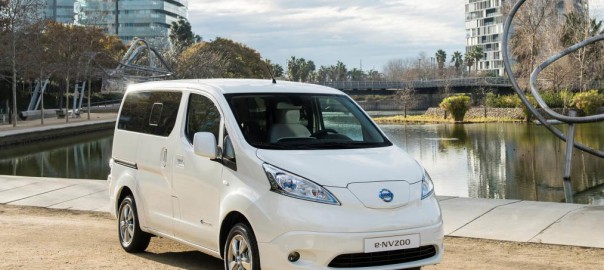
The Nissan e-NV200 electric MPV makes more sense with seven seats but is that enough to make you buy it?
Nissan isn’t only a market leader in electric cars but electric vans as well. Its e-NV200 small van has been leading the electric LCV market since December 2014, becoming a top choice for companies looking to make zero emission deliveries. Available as a panel van and a five-seat combi, there’s now a more practical people carrying version sporting seven seats.
It’s taxi companies, private hire firms, fleets and hotels Nissan is targeting with its e-NV200 7-seater as it’s these groups of people who have been haranguing Nissan to build one. Up until now they’ve had to rely on more conventional seven-seaters like the Ford Galaxy or put up with carrying just five in e-NV200 five-seater models if they wanted to be ‘green’.
…
for companies who undertake short trips, have reliable access to charging points and are committed to embracing electric motoring, the e-NV200 is in a class of its own.
Go Ultra Low, backed by several carmakers, released a humorous video on electric cars, which sometimes are described as a bit “boring”.
The main goal of the campaign is of course to raise awareness of ultra-low emission vehicles, and to encourage British motorists to consider one when choosing their next car.
https://youtu.be/WcuFcfQz4aE
“Electric cars – they’re a bit boring, aren’t they?
Why would anyone want one of those plug-in things? Meet the dad who’s about to learn that whoever you are, there’s an electric car for you. *Watch* the video to find out what makes these seven ultra low emission vehicles so desirable, practical and fun to drive.
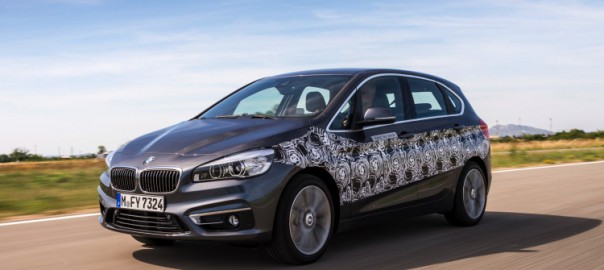
The newest niche to be conquered by BMW is filled by the 2 Series Active and Gran Tourers.
These front-wheel drive hatchbacks mark a couple of firsts for BMW, namely the front-wheel drive and transverse engine mounting. These two cars aren’t going over very well with enthusiasts, but are doing great in sales in Europe. Well, BMW has decided that the new 2 Series Active Tourer is doing well enough that it wants to give it a new model. An eDrive plug-in hybrid model.
The 2 Series Active Tourer eDrive will feature BMW’s 1.5 liter three-cylinder TwinPower engine, transversely mounted powering the front wheels through a six-speed automatic, and an 88hp / 136 Nm/100 lb-ft of torque electric motor, powering the rear wheels through a two-speed transmission. This essentially makes the 2 Series Active Tourer eDrive a backwards i8, as the i8 uses a similar setup, but with the engine at the rear and motor at the front. Compared to a 225i xDrive model, this adds some 150 kg or 330 pounds. The gasoline engine produces 100 kW/136 hp and 220 Nm/162 pound-feet of torque/electric.
Like the i8, the 2 Series AT eDrive will deliver its power instantaneously, thanks to the torque fill effect of the electric motors adding power while the turbocharger gathers boost. This will shuttle the 2 Series AT eDrive from 0-62 mph in 6.5 seconds. Not bad for a front-wheel drive hybrid.
BBC One’s new primetime drama The Interceptor is the first large-scale production to pioneer the use of electric cars.
As well as the production gaining a three star rating by industry sustainability certification scheme albert+, the use of electric cars saved on carbon dioxide emissions, fuel costs and congestion charges.
On-screen, viewers follow an undercover team on the hunt for Britain’s most ruthless criminals, but off-screen the production has become the first large-scale TV drama to use only electric cars behind the scenes.
By using electric vehicles as unit and production cars during the making of the show, eight tonnes of carbon dioxide emissions were saved – enough to drive 50,000 miles or twice around the globe – as well as saving the BBC over £10,000 in fuel and congestion charges.
…
Nick Leslie, BBC Sustainable Production Project Manager, says:
“The cast and production thought it was important to use electric cars to help lower the overall CO2 emissions for the show. Initially there were some reservations about the electric cars from the unit drivers, as there is pressure for making sure unit cars run smoothly and on time.
“However, once they started driving the cars, all the unit drivers said that they were happy with the performance of the vehicles. In fact a competition developed between the drivers to see who could make the energy in their batteries last longest.
“Some of the drivers said that using these cars had opened their minds to fuel efficiency when driving, as the vehicles had a dashboard display showing how their driving impacted upon the battery charge. One of the drivers even said they were planning on buying an electric car when it was time to change their personal vehicle.”
A report from the National Academy of Sciences looks at barriers and adoption.
One of the more challenging jobs the auto industry has right now is explaining to consumers that the future isn’t going to be like the past. We desperately need to reduce vehicle carbon emissions in order to avoid turning the planet into a hellscape, and that means turning to cars with some kind of energy storage other than hydrocarbons we’ve dug up from the ground and then distilled. That’s where people get confused and the message stalls, a problem laid out in a recent report from the National Academy of Sciences.
For many decades cars have been simple things with internal combustion engines. They burned gasoline or sometimes diesel and occasionally even liquified natural gas. Sometimes they had turbochargers or superchargers to ram more air into the combustion chamber, and very occasionally that combustion chamber was something odd like a Wankel rotary engine. Now, the need to reduce carbon emissions and improve air quality means many more options when it comes to a vehicle’s powertrain.
…
One surefire way to get that message across is to give people an EV experience, according to Pam Fletcher, the chief engineer for EVs at General Motors (GM):
“The people that have owned and lived with EVs can understand it, they’ve seen how the vehicles work for them, It’s part of the learning curve and more people will understand it over time,” she said. “It’s hard to explain to people the benefits if they haven’t had that experience.”
Renault’s Summer Season continues the heat with new ‘65’ registration plate
£5,060 manufacturer deposit contribution on all-electric ZOE Dynamique Nav
0% APR and nil deposit offers on selected models
With the release of the new 65-registration today, motorists on the lookout for a new car can take advantage of the latest special offers available on selected models across the dynamic and exciting Renault range with the brand’s hot Summer Season.
The French carmaker has a suite of deals designed to offer car buyers financial flexibility and to make owning a new Renault more affordable.
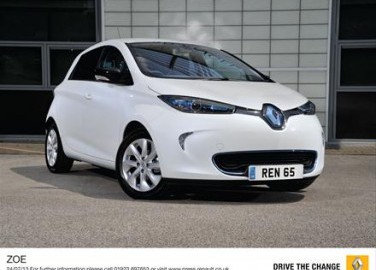
Those looking to experience the fuel savings and environmental benefits of electric vehicle ownership, will find the 100% electric Renault ZOE – named Best Electric Vehicle in the Auto Express Driver Power 2015 survey and Best Electric Car Less Than £20,000 2015 by What Car? – with an exceptional offer.
Until 30th September, Renault will make a £5,060 deposit contribution on top of the existing Government £5,000 Plug-in Car Grant (PiCG)1 on the ZOE Dynamique Nav.
This means a ZOE – which has an official NEDC range of 149 miles and can cover between 71 and 106 real-world miles – can be driven away for as little as £89 per month (plus monthly battery rental)2 and with a deposit of just £599. Buyers can enjoy the added convenience of a free fully-installed domestic charging wall box from electric infrastructure market leaders, Chargemaster3.
…
A selection of alternative finance options are also available across the wider Renault range.
Whichever option a customer chooses, they will benefit from the Renault 4+ warranty and Renault assistance scheme which provides the ultimate peace of mind for four years or 100,000 miles5.
1 Government Plug-in Car Grant (PiCG) subject to availability and eligibility.
The trend towards cheaper home energy storage shows no sign of slowing down
London startup tailors smaller, cheaper battery for UK households to use more of their own generated solar energy
When Elon Musk, the chief executive of Tesla, took to the stage in California in April to launch a solar battery for the home, the audience hollered and whooped at every detail. On the other side of the Atlantic, a more modest, quieter challenger plans to take on the US electric car giant.
Based within a railway arch, with the sound of trains running overhead from nearby London Bridge station and surrounded by other ecologically minded startups, the offices of Powervault are a far cry from Tesla’s showpiece Californian stage. The similarity lies in the product – the Powervault battery, which stores energy from domestic solar panels.
“Some people, especially if they don’t have solar panels, just assume solar panels come with a battery,”
says Joe Warren, Powervault’s managing director. They don’t.
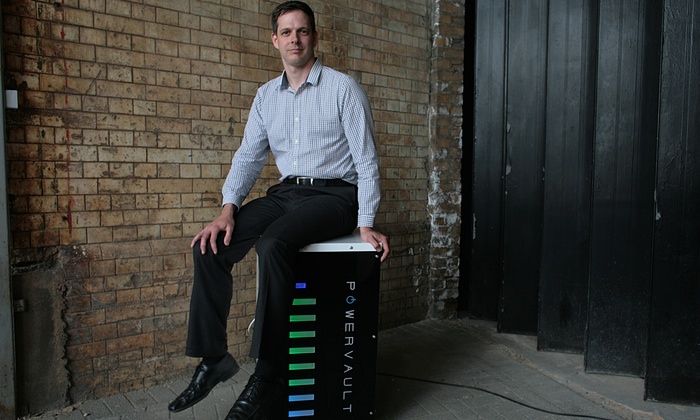
Joe Warren and his Powervault domestic solar power battery (Image: M. Godwin/Guardian)
Home energy generation has blossomed in the UK over the past four years, with an estimated 650,000 homes fitted with solar panels. In 2010, the government introduced the feed-in tariff scheme to pay householders who produce and supply energy. The scheme aims to push renewable energy in the UK towards 15% of total energy by 2020. In 2009, the figure stood at 2%.
Powervault, Tesla and other players in the emerging solar battery market aim to supply the means for householders to store energy produced during the sunniest part of the day for use at peak times, when more people are at home but the sun is down.
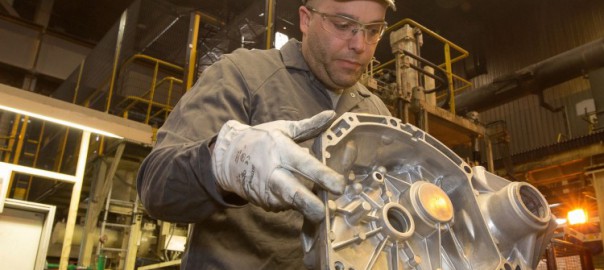
ZOE’s new electric motor, unveiled at the Geneva Motor Show, is a 100% Renault motor manufactured at the French site of Cléon, already specialized in highly technical powertrain production.
The launch, benefitting from a part of €300 million investment announced by the plant in 2011, is an integral part of Renault’s electric strategy aimed at improving motor and battery technology to optimize the performance and range of electric vehicles, while supporting the development of the corresponding infrastructure.
Mendi Ammad, Director of the Cléon plant says:
“We aim to become the leading powertrain plant for the Alliance”