Category Archives: Electric Taxis

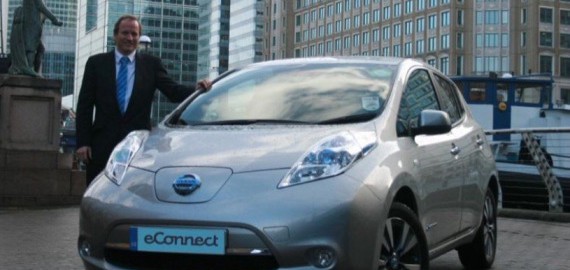
Nissan Leaf taxi (Image: eConnect)

Paddington Trainriders Now Have Option Of EV Taxis

Those that often take the train from Paddinton (in London) now have a new means of getting to and from the stations — and a new, electric means at that — according to recent reports.

Thanks to a new partnership between the taxi service eConnect cars and First Great Western services, travelers will now be able to pre-book taxi transfers to + from the train stations in a Tesla Model S or a Nissan LEAF.

For those that can’t afford to actually own a Model S, but still love the things, this might be a good way to get your fix, I suppose.

“This is the first time a train operator has partnered with an electric vehicle operator in London to create a transport solution that truly represents smarter, greener travel for those coming to and from London,” stated Alistair Clarke, owner and managing director of eConnect cars.

For a bit of background here, eConnect cars was established just last January (in 2014) in London, and has, to date, provided more than 10,500 customers with taxi service and traveled over 93,000 miles doing so. All in electric vehicles of course.

According to the company, the use of an all-electric fleet for such service resulted in the prevention of 40 tonnes of carbon dioxide emissions last year.

All in all, if I take that route anytime in the near future, I think that I’ll probably have to give the service a try. Probably beats a gas taxi pretty handily.

Source: EV Obsession

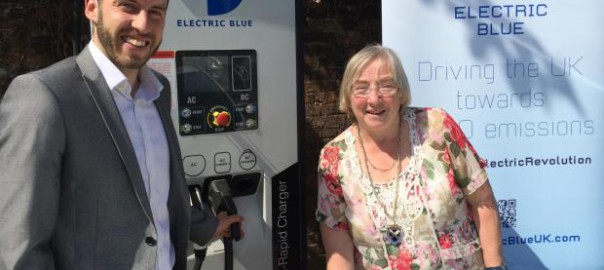
The Deputy Mayor of St Albans, Gill Clark, is pictured with the MD of Electric Blue, Alex Calnan, who is from Redbourn

St Albans switches on the Electric Revolution

The first fully electric taxi and rapid charging point has been unveiled in St Albans.

A new scheme, run by St Albans based business, Electric Blue, is introducing the city’s 300 licensed taxi drivers to the benefits of switching to all-electric cars, which are emission free and more cost-effective to operate than current cars.

The Deputy Mayor of St Albans, Gill Clark, is pictured with the MD of Electric Blue, Alex Calnan, who is from Redbourn

Powered by 100 per cent renewable energy, Electric Blue has also unveiled the first Rapid Charger point in the city centre, located in Adelaide Street, which allows a driver to recharge his cab fully in 25 minutes.

In partnership with St Albans District Council, local Nissan dealer Glyn Hopkin, and other electric infrastructure partners, such as Evalu8 and APT Controls, Electric Blue offers taxi drivers the complete package and the opportunity to trial a taxi before they make the switch.

The first Nissan Leaf EV taxi will take to the streets of St Albans next week, according to Managing Director of Electric Blue, Alex Calnan, from Redbourn, who started the business in 2014.

He said: “Today marks an important step forward in the city’s ambitions to improve air quality for residents, as well as helping to reduce carbon emissions by harnessing electric power on our busy streets.

“We’ve received an extremely positive response from drivers so far and once the first taxi is operational, we expect take up to increase exponentially, as owners and customers see the benefits.”

Last month saw the launch of a Rapid Charger and the first all-electric taxi in Watford and Electric Blue will be expanding its network across a number of major UK towns and cities during 2015.

A recent nationwide consumer survey highlighted St Albans as the worst UK city outside of London for vehicle emissions.

Confused.com surveyed 2,000 motorists and ranked cities on a league table based on average emissions produced by each registered car across the UK, using data from a given postcode.

Source: St Albans Review

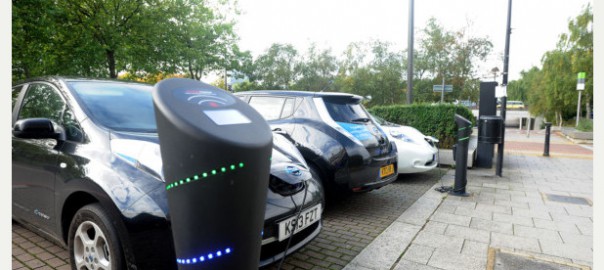
Electric cars charging in Central Milton Keynes

‘Electric taxis’ could now join the electric buses in Milton Keynes

DEPUTY Prime Minister Nick Clegg has announced Milton Keynes will receive government funding of £1,875,000 towards installing a network of 50 rapid charge units for electric vehicles, capable of fully charging a vehicle in 30 minutes or less.

[From January 2014] The faster speed of charging opens up electric vehicle charging as a possibility for private-hire vehicles for the first time.

As private-hire vehicles can cover very high daily mileages, they would need several re-charges during the working day.

But the speed of rapid electric vehicle charging posts makes recharging ‘electric taxis’ a practical possibility.

Building on the recent launch of the UK’s first wirelessly charged all-electric bus route, Milton Keynes Council is working with organisations including Arup and ChargeMaster alongside local private hire companies as plans are developed to make sure the new rapid charge posts are installed in the best places for use by taxi drivers.

Electric cars charging in Central Milton Keynes

Private motorists will also be able to use the 50 rapid charge posts, which are expected to be installed in Milton Keynes by mid-2015.

There are currently 170 different types of electric vehicle charge posts in Milton Keynes which provide more than 4,000 charges to vehicles each year and this is growing more than steadily and has doubled this quarter since the end of the last quarter.

The rapid charge project will be delivered by a consortium in partnership with Milton Keynes Council, with funding coming from consortium partners and government.

Councilllor Keith McLean, Milton Keynes Council’s cabinet member responsible for transport, said:

“This funding is more good news for Milton Keynes.

“We’re already leading the way on electric transport, having launched the UK’s first all-electric bus service this month, and being among the first places to introduce an electric vehicle charging network.

“These faster charging posts will be appealing to electric car drivers and commercial users, and we’ll continue to work with partners to introduce new and innovative transport schemes locally.”

Source: MK Web

First London Customers Review All-New Metrocab – Video

A pilot fleet of Metrocab plug-in hybrid taxis developed by Frazer-Nash Research Ltd and Ecotive Ltd has been tested in London since November 2014.

Developers just released video showing first customer reactions, which seem very positive.

Metrocab chairman, Sir Charles Masefield, said:

“This is the first purpose-built Range-Extended Electric taxi to be licensed in any metropolitan area in the world and we are thrilled with our customers’ reactions to it, as shown in the film. It’s comfortable, quiet, spacious, has a panoramic glass roof affording unrivalled views of our great city, day or night, and our drivers love it too. I am delighted with the pilot fleet’s success, it allows us to gather invaluable operational, customer and driver data before committing the vehicle to volume production.”

Source: Inside EVs

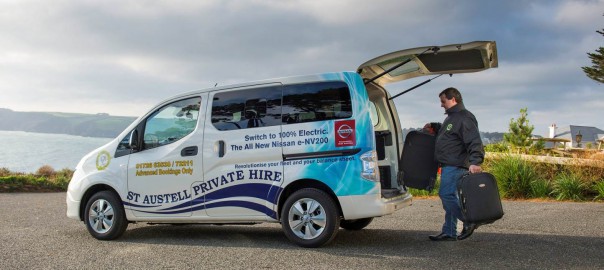
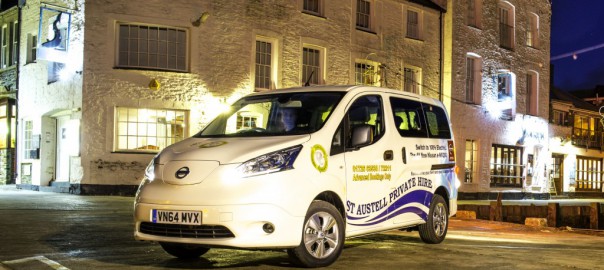
C&C Taxis’s Nissan e-NV200 Combi

Nissan e-NV200 Taxi Like Getting A License To Print Money

Nissan e-NV200 Taxi Saves Fleets So Much Cash That It’s Like Getting A License To Print Money

British taxi company C&C Taxi from St. Austell was already featured by Nissan as one of the LEAF and e-NV200 pioneers.

Now, it turns out that by switching to EVs, C&C acquired a license to print money (no, not really), saving over €79,000 in 18 months on fleet costs.

According to the press release, the annual savings per car on fuel alone in the UK stands at €11,374 (£8,500) or over $12,000.

To make savings like that you need to drive a lot, and to drive a lot you need to charge a lot, and to charge a lot you need to do it fast so C&C installed two DC quick chargers – one at its office and one in an industrial estate. The result is 77,000 miles (123,000 km) in just 12 months for one of the cars, which translates to some 6,400 miles (10,250 km) a month!

Neither C&C Taxi nor Nissan provided the total payback period for the cars (including fast chargers) compared to conventional cars, which maybe would convince more taxi companies to switch to EVs.

Nissan’s Director of Electric Vehicles, Jean Pierre Diernaz explains the significance of C&C’s experience, commenting:

“C&C Taxis proves once again that Nissan electric vehicles work extremely well as taxis with huge cost savings for the business and big benefits to CO₂ emissions and air quality. These cars work hard, averaging 40 taxi fares and 240 km (150 miles) per day with zero reliability issues. It just works!”

C&C Taxi Fleet Manager Mark Richards commented:

“We have had such a positive experience with our Nissan LEAF fleet, even the drivers, who were anxious to start with are now very happy to drive a 100 percent electric car. They tell us a 10 hour shift is less tiring with an EV and the e-NV200 we have now means we can extend that experience to the drivers who were previously in diesel minibuses.”

“People often say that electric cars are just for cities, but we are in one of the most beautiful and rural counties of England with no cities or even motorways and they are working amazingly well for us. We are a family owned business and this is not a vanity project, this is something that is that is saving us money and getting us extra business.”

Source: Inside EVs

C&C's Nissan e-NV200 Electric Taxi (Image: Nissan)

Greening taxis gets £45m boost

A £20 million fund will be made available to local authorities to support the rollout of ultra-low emission taxis across the UK. The money will be available to reduce the upfront cost of purpose built taxis and to install charging infrastructure for taxi and private hire use.

A further £25 million has been set aside specifically for the Greater London Area to help taxi drivers cover the cost of upgrading to a greener vehicle.

All taxis will also qualify for the government’s plug-in car grant, which currently offers up to £5,000 off the cost of an eligible low emission vehicle.

The news follows Geely’s announcement outlining plans for a new £250 million state of the art facility to produce the next generation of low-emission London Black Taxis.

Geely, who owns the iconic London Taxi Company, was awarded £17 million from the government’s Regional Growth Fund to build this facility, which will create 1,000 local jobs and ensure the London black taxi continues to be designed, developed and made in the UK.

These new taxis will comply with the new regulations being introduced by the Mayor of London that will require all London taxis to be zero-emission capable from January 2018.

Transport Minister Baroness Kramer said:

“The low emission vehicle sector is going from strength to strength with demand in the UK up by over 300% last year, making the UK a leading market for this technology.

“Today’s announcement means ultra low-emission taxis will be the smart choice for more taxi drivers and everyone will benefit from improved air quality and greener travel.”

The Mayor of London, Boris Johnson, said:

“As London strives towards the greenest taxi fleet from 2018, it is essential to support the taxi trade in the transition to cleaner vehicles.

“With the additional funds announced today, more help is on the way for taxi drivers to upgrade to the latest technology in zero-emission capable cabs.

“Alongside the world’s first Ultra Low Emission Zone from 2020 these measures will boost jobs and growth in the development and manufacturing of ultra low emission technologies, secure the long-term future of the taxi industry, and ensure everyone who lives, works in, or visits our city has the cleanest possible air to breathe.”

Source: Newspress

The zero emission fleet will help Dundee's air quality

Dundee electric taxi fleet enters service

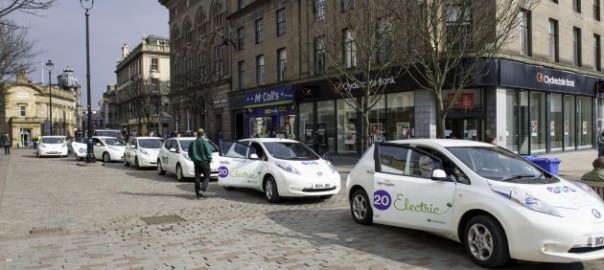
One of the UK’s largest electric taxi fleets has entered service for the first time in Dundee. The fleet of 30 electric Nissan LEAFs operated by 203020 Electric – part of the Tele Taxis Group – is now in 24-7 service in and around the City of Discovery.

Offering zero emissions mobility, the Nissan LEAFs will make a significant contribution to improving air quality in the city and will further enhance the city’s reputation as a leader in green transport.

And the significance of the occasion was emphasised when the historic first journey was taken by Derek Mackay MSP, the Scottish Government’s Minister for Transport and the Islands, around City Square.

He was joined at an official launch event by executives from Transport Scotland, the Energy Saving Trust, Dundee City Council and Nissan – organisations that have all invested and advised on the project.

Transport Minister Mr Mackay said:

“The Scottish Government is committed to improving air quality in our towns and cities – that is why we have been delighted to support this ambitious project as part of our overall investment of £17 million in a range of ultra low emission vehicle initiatives over the past two years.

“Bold initiatives such as this offer a visible demonstration that this transformation is already happening and I am delighted to be able to experience these vehicles at first hand by taking a ride in one today.

“A journey in one of these taxis may well be the first encounter many members of the public will have with an electric vehicle, helping to raise awareness that there are viable alternatives to petrol and diesel cars.”

With 30 vehicles all entering service at the same time, it’s one of the UK’s single largest electric vehicle fleet deals. But the deal will soon become even bigger as Tele Taxis / 203020 Electric plans to replace its entire 60-vehicle fleet with more Nissan LEAFs and the larger Nissan e-NV200 Combi over the next 12 months.

The move will save Tele Taxis Group hundreds of thousands of pounds in fuel each year. The LEAF and e-NV200 costs from just two pence per mile to run.

The zero emission fleet will help Dundee's air quality
The zero emission fleet will help Dundee’s air quality

A bank of five rapid chargers, capable of charging a LEAF from zero to 80% in just 30 minutes has been installed at the taxi company’s HQ in Isla Street to keep the new fleet topped up and in constant service around the clock.

The chargers, funded by Transport Scotland’s ChargePlace Scotland project, are all available for public use and currently free to charge from.

David Young, owner of 203020 Electric, said:

“There are big financial benefits to operating a fleet of electric taxis but that is not the main driver behind our decision to go down this route.

“Dundee is a city with some of the worst air pollution in the country and this initiative puts us at the forefront of efforts to improve that. The environmental benefits of running these pure electric vehicles will make a real difference for the people of Dundee.”

Source: Newspress

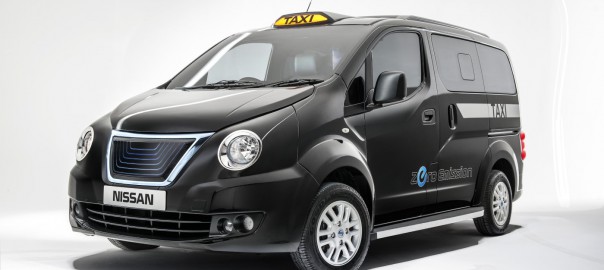
Nissan e-NV200 Black Taxi Cab for London (Image: Nissan)

Nissan e-NV200 Electric London Taxi Revealed

[From January 2014]

You might be unfamiliar with the name LTI TXII, but if you’ve ever visited London you’ve probably traveled in one at some point.

It’s best known as London’s black cab or ‘Hackney Carriage’, and it’s known the world over for its iconic shape. Nissan has incorporated the black cab’s famous face onto its new London taxi–with limited success. But the real story is the electric version, which makes its debut in 2015.

Current London cabs already have a strong connection to Nissan. Towards the end of its life, the old Austin FX4 cabs used 2.7-liter Nissan diesel engines to power them around the city, and until recently a Nissan unit also powered the existing TXII. But all have been diesel, and in its crackdown against inner-city emissions–London is one of the most polluted in Europe–diesel taxis are falling out of favor.

The NV200 van, also used in New York as the ‘Taxi of Tomorrow’, will debut in London with a 1.6-liter gasoline engine and automatic gearbox to reduce oxides of nitrogen and particulates. The cab also includes some of the features found in the New York version, such as a panoramic glass roof to let fares admire the scenery.

It should be more pleasant to drive, too–current London cabs aren’t designed for a comfortable driving environment. London versions are unique among NV200s, getting an extra-tight 25-foot turning circle. This is required for all Hackney Carriages and is based off the tight entrance roundabout at the Savoy Hotel.

In 2015, an electric version of the cab will appear, based on the e-NV200 Nissan has showcased over recent years. Using a Leaf-derived drivetrain, it’ll cut those local emissions down to zero, and reduce running costs. The electric taxi will hit the streets five years before the London Mayor’s target of 2020.

Nissan e-NV200 Black Taxi Cab for London (Image: Nissan)

Whether residents will get used to the new taxi’s face though is another matter. The NV200 is already an acquired taste–one New Yorkers will have to get used to replacing the iconic Crown Vic taxis. But equipped with a chrome grille and round headlights, designed to echo the existing cabs, we aren’t sure London’s streets will be easier on the eye…

Source: Green Car Reports

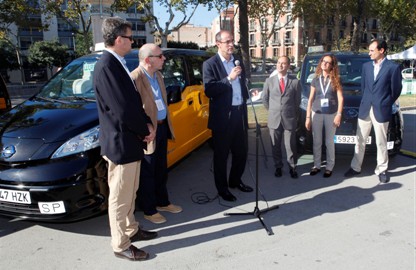
Nissan delivers first all-electric taxi to Barcelona (Image: Nissan)

Nissan delivers first all-electric taxis to Barcelona and Madrid

[From October 2014]

NISSAN DELIVERS FIRST ALL-ELECTRIC TAXIS TO BARCELONA AND MADRID

  • Delivery marks significant milestone in the expansion of zero-emission transportation to Europe’s city centres

Madrid and Barcelona (Tuesday 21st October) – The era of the 100% electric taxi has arrived to Spain’s two largest cities, as Nissan delivered its first 100% electric taxis to Madrid and Barcelona. The introduction the Nissan electric vehicles – the Nissan LEAF to Madrid’s taxi fleet, and the e-NV200 taxi for Barcelona – brings the option of quiet, zero-emission travel to these bustling city centres.

The Barcelona deliveries served as an important step in the execution of an agreement between Nissan, the City of Barcelona, and the Barcelona Metropolitan area which brings the Barcelona-built e-NV200 to the streets of the city where the revolutionary electric van is produced.

Jean-Pierre Diernaz, Director of Electric Vehicles for Nissan Europe, welcomed the news, commenting:

“Declining air quality levels are a top concern across Europe and it’s great to see Madrid and Barcelona taking such positive steps in improving air quality through the incorporate of Nissan’s all-electric cars into their taxi fleets. These taxi bring a huge benefit not only residents but also for the drivers – thanks to the ultra-low running costs only an electric car can offer. This scheme demonstrates that sustainable transportation is easy and affordable for everyone.”

These initiatives reinforce Nissan’s continued commitment to electric vehicles as the market continues to develop. September was also the month in which 2014 sales of the pioneering family hatchback passed the 2013 total, with three months still to go.

Madrid:

Madrid has now its first 100% electric Nissan LEAF taxi, the best-selling electric vehicle in the world with more than 142,000 units sold globally. The event was held at Puerta del Sol in Madrid, where the “Zero KM” the measuring starting point of all the Spanish roads is located.

Antonio Berzal Prieto, the first 100% electric taxi driver in Madrid to choose electric technology for his business, declared

“When I heard that the Nissan LEAF had been approved as a taxi for the city, I quickly looked into all the options it offered me. In addition to the environmental benefits, the costs of ownership are highly competitive and the car’s performance is excellent.”

Barcelona:

The delivery of the first three Nissan e-NV200 Taxis took placed during the Expo-electric Formula-e event, one of the most important meetings on sustainable mobility in Europe. Marco Toro, Nissan Iberia Managing Director and Antoni Vives, Deputy Mayor for Urban Habitat at Barcelona City Council, attended the event

The development and introduction of these first three e-NV200 Taxis units is part of the Memorandum of Understanding signed last year between Nissan, the Barcelona City Council and the Barcelona Metropolitan Area, which set out a number of different and significant measures to promote and to sustain the rollout of sustainable mobility in Catalonia Region. The e-NV200 began production in Barcelona in May, with the Catalan city building the electric commercial vehicle for the global market.

Source: Nissan Newsroom
Nissan e-NV200 Electric Van (Image: Nissan)

Taxi Electric is first to use Nissan’s e-NV200 taxi in Amsterdam

[From May 2014]

  • This summer Taxi Electric becomes the first taxi company in Amsterdam to adopt the zero-emission Nissan e-NV200
  • Taxi Electric first 100% Nissan LEAF fleet since November 2011
  • Pioneering Amsterdam-based company have covered 1.5 million km demonstrating Nissan EVs’ quality and reliability

AMSTERDAM, Netherlands – Taxi Electric will be the first private taxi company to add the new 100-percent electric Nissan e-NV200 taxi to its green-energy zero-emission fleet.

The combination of Nissan’s innovative zero-emission technology, in the form of the 100-percent electric Nissan LEAF, and Taxi Electric’s ground-breaking city transportation model have been a recipe for success since the start of operation in 2011. Now the two companies have teamed up again to build on this success and take the next step forward by introducing the game-changing all-electric Nissan e-NV200 taxi this summer.

Nissan e-NV200 Electric Van (Image: Nissan)

Amsterdam-based Taxi Electric operates a fleet of 25 Nissan LEAF vehicles. It was the first private taxi service to switch to a fleet of 100% electric taxis in 2011. The Dutch company’s fleet of Nissan LEAFs has now amassed a trouble-free 1.5 million km in taxi operations – proof of the electric vehicle’s high quality and reliability.

Andy Palmer, EVP Nissan said:

“Taxi Electric was one of the first electric taxi companies in the world, and I’ve been impressed with their progress since their launch two years ago. They were the first to prove that zero-emission taxis – in the form of Nissan LEAFs – are a viable alternative. They have covered an astonishing distance in their fleet in such a short time and have shown just how reliable our electric technology is in a demanding environment. Their pioneering spirit closely matches ours, and we are certain they will continue their success with the ground-breaking Nissan e-NV200.”

Ruud Zandvliet, founder of Taxi Electric added:

“Two years ago we started with 10 Nissan LEAFs. Each of these travelled well over 100,000 km and proved to be extremely reliable. Since last summer demand for our taxis is growing rapidly, which allowed us to double our fleet. We are very excited about the e-NV200 as it is designed to be a taxi. This will improve our offering and open new business opportunities for us.”

Taxi Electric will not be alone in making the Nissan e-NV200 part of their taxi fleet, with the city of Barcelona having signed a memorandum of understanding with Nissan to promote it as a taxi for the Spanish region. Global production of the Nissan e-NV200 begins in May this year, with sales starting in the summer.

Source: Nissan News