Interesting times in the electric vehicle market, as more and more carmakers try to position themselves in what looks like a second phase of growth.
In the luxury market segment, the announced launch of Tesla’s Cybertruck has galvanized a market that, in the United States, buys two million vehicles each year. What at first looked like a prototype of a prototype, has turned out to be a completely revolutionary design that combines a unique-looking vehicle with much lower manufacturing costs than expected. With more than half-a-million orders on its books, the company is now prioritizing its production over the Roadster.
Tesla Cybertruck (Image: Tesla)
The reason is simple: the Roadster appeals to a relatively marginal market and, from a target audience point of view, does not contribute much to the segments in which the brand already had significant appeal, whereas the Cybertruck, if successful, could allow it to dominate a very important and iconic part of the market that is fundamental to achieving mass popularity in a country like the United States.
In the economy segment, Volkswagen has announced plans to launch a family of electric vehicles priced at below $22,000, targeting city dwellers and not originally designed for the US, which was originally going to be launched under the Seat brand. Affordable mobility is an important segment that could shift a lot of units.
If you would like to know more about Solar Panels and the PowerBanx range of home battery systems, and get a free instant quote, please complete our online form:
Battery-electric car sales in Europe are holding up well, even as regular internal combustion engine (ICE) demand crashes around them, but forecasters are scaling back much stronger pre-coronavirus predictions.
Projections may yet take a hit if the year’s most important battery electric vehicle (BEV) launch – Volkswagen’s designed-from-the-ground-up to be electric ID.3 – is delayed beyond its promised summer debut date. Delays in software development had threatened that launch, but VW said it still expects an August start to sales.
Volkswagen ID.3 electric car (Image: Volkswagen.com)
And there is a variation on the old adage at work here – it’s an ill-wind that blows nobody any good.
Manufacturers like Audi and Porsche had whipped up a formidable demand for their new electric cars, but shortages of batteries would have led to failures to deliver on time. The fact that the edge has been taken off new BEV demand has spared manufacturers the embarrassment of disappointing these well-heeled customers.
2020 was supposed to be the year when European BEV demand finally accelerated into an unstoppable high gear. These sales are crucial because of European Union (EU) regulations, forcing manufacturers to ratchet up the number of electric cars, with massive fines for those failing to do this. But despite the horrendous market conditions in Europe, where sales of regular ICE vehicles in April might be barely perceptible and most forecasts now reckon overall sales for the year may be down about 20%, BEVs are holding up well.
If you would like to know more about Solar Panels and the PowerBanx range of home battery systems, and get a free instant quote, please complete our online form:
Experts are predicting that 2020 will be the year of the electric car as sales continue to rise.
Figures released today by the Society of Motor Manufacturers and Traders (SMMT) show that the number of battery-electric vehicles registered in November increased by 228.8 per cent compared to the same month in 2018 – with over 4500 new EVs hitting the roads.
So far this year, nearly 14,000 electric cars have been registered in the UK, compared to 38,500 plug-in hybrids and nearly 80,000 hybrids. Mild hybrids have also seen a dramatic increase in popularity, with registrations of mild-hybrid diesels increasing by more than 450 per cent last month.
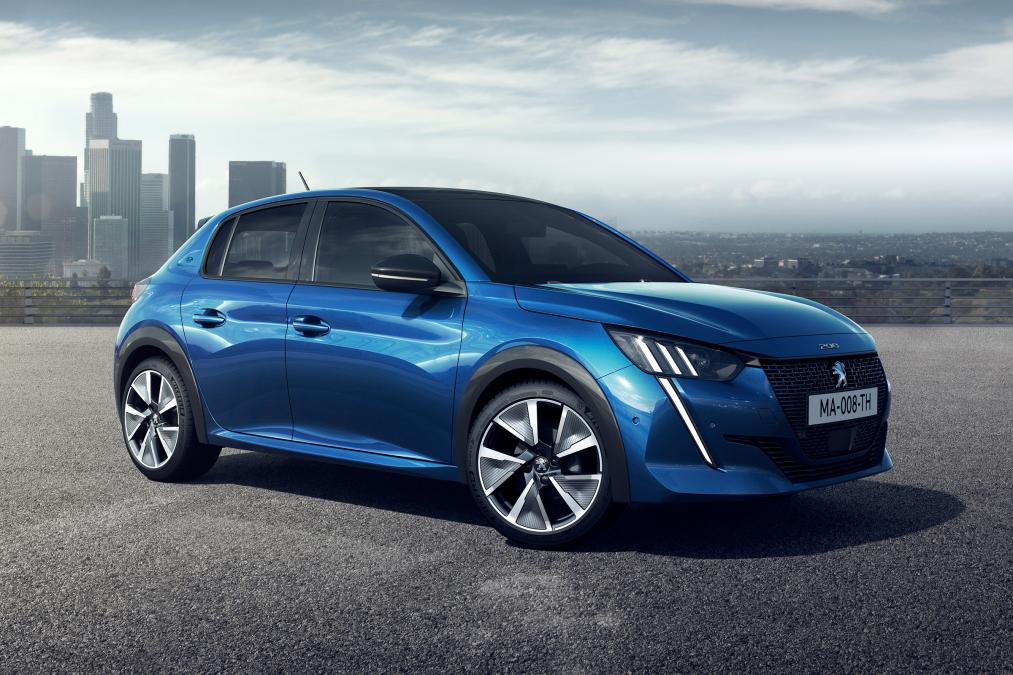
Peugeot e-208 (Image: Peugeot)
Car manufacturers are rushing to launch new electric cars in a bid to meet new emission targets set by European Union legislators. By 2021, they face strict fines if their average CO2 emissions for each car exceed 95g/km. By selling more electric vehicles (with zero tailpipe emissions) and hybrids (with reduced tailpipe emissions), average CO2 emissions will drop.
Kia recently admitted that it has 3000 customers on a waiting list for the e-Niro – something it says it intends to clear in the first half of 2020, despite previously having to halt orders as it couldn’t keep up with demand.
Volkswagen is set to launch its new electric ID range with the ID.3 hatchback, while the Volkswagen Up, SEAT Mii and Skoda Citigo city cars are also going electric-only for 2020. Vauxhall’s new Corsa is available as a pure-electric model, as is the closely-related Peugeot 208.
If you would like to know more about Solar Panels and the PowerBanx range of home battery systems, and get a free instant quote, please complete our online form:
Volkswagen, Tesco and Pod Point are determined to provide shoppers with free charging points as motorists increasingly turn to electric vehicles as they become more and more convenient to run
Electric car drivers can now charge their vehicles for free while doing their weekly shop at over 100 supermarkets across the UK.
Volkswagen has partnered with Tesco and Pod Point to provide shoppers with free charging points – with a further 2,000 units in the pipeline.
Volkswagen ID.3 electric car (Image: Volkswagen.com)
It is estimated a typical EV driver who spends 50 minutes shopping each week could get more than 1,000 miles of free electricity for their car over a 12 month period.
The free charging points are a response to the growth of electric cars in the UK, with sales up by 125 per cent this year according to the Society of Motor Manufacturers and Traders.
And demand is set to rise, with Volkswagen’s survey of 2,000 UK motorists revealing 41 per cent are considering leasing or owning an EV as their next vehicle. This figure increases to 61 per cent among the 25-34 age group.
If you would like to know more about Solar Panels and the PowerBanx range of home battery systems, and get a free instant quote, please complete our online form:
Charging an electric car with £5 of energy will see it travel almost double the distance of a petrol or diesel motor using a fiver’s worth of fuel.
Electric vehicles carry drivers 40 miles further than the closest competing transport type, according to new research.
Surprisingly, one in five motorists think the low-emission vehicles are pricier to run than other cars.
The study found that a VW e-Golf could be driven for 102 miles on a £5 charge.
VW e-Golf (Image: Volkswagen.co.uk)
A comparable diesel Golf travelled 56.5 miles with £5 of fuel, while a petrol equivalent clocked just 49.6 miles.
Spending £5 on a bus or train ticket would see travellers covering only a fifth of the distance reached by electric cars.
Regional electricity prices were used to work out the price per kilowatt hour to charge a VW e-Golf’s battery before being compared with regional fuel and public transport costs.
Distances travelled using public transport from 10 different major cities were then averaged.
An electric car owner in London can travel as far as Bristol or Worcester on a £5 charge, while a diesel driver would only get as far as Oxford or Winchester.
A petrol car would reach Basingstoke or Milton Keynes, whereas spending a similar amount on a bus or train would barely get you out of the M25.
If you would like to know more about Solar Panels and the PowerBanx range of home battery systems, and get a free instant quote, please complete our online form:
The highly-anticipated 2020 Volkswagen Golf Mk8 is finally out and the really big news is that it comes with five hybrid drivetrains.
The regular TSI engines are now paired to 48-volt systems, but Volkswagen also offers two proper hybrids with electric motors. One of them is basically similar to the old Mk7-generation GTE, but the new Mk8 GTE is a wild one and packs more punch than the outgoing GTI. I bet you didn’t expect that.
Volkswagen Golf Mk 7 GTE (Image: T. Larkum)
While the regular gasoline Golfs are now fitted with 48-volt systems that don’t add much performance-wise but improve on efficiency, the GTE features an electric motor, just like its predecessor. But Volkswagen now offers two versions. There’s a base model with 204 PS (201 horsepower) that’s identical to the Mk7 GTE, but the Germans also crafted a beefed-up variant that generates a solid 245 PS (242 horsepower). That’s 18 horsepower more than the outgoing GTI! Granted, the GTI equipped with the Performance Pack is just as powerful, but it’s still incredible to have a hybrid Golf with similar power ratings.
Before you bring out the tar and the feathers, I have to say that the new GTE probably doesn’t sound as mean as the GTI under full throttle. But apart from that and the red body accents that make the GTI look cool, the GTE is the better car in every department. Not only is the new GTE a bit more powerful, but it’s probably just as fast as well. Volkswagen has yet to reveal performance figures, but the new, 242-horsepower GTE should be notably quicker than the old model and just as quick as the GTI.
If you would like to know more about Solar Panels and the PowerBanx range of home battery systems, and get a free instant quote, please complete our online form:
A little disclaimer before we start this article. I don’t consider myself an environmentalist and I don’t constantly talk about things like sustainability or my carbon footprint.
As a lifelong gearheard, I’m also not one of those who feels like every drop of fuel burned in the name of fun is a crime. Nor am I a tech-obsessed Tesla fanboy who kneels at the altar of Elon Musk and praises all things the company does. But after driving about 50,000 miles behind the wheel of EVs, I’m fully sold on electric cars for daily life and I want to tell you why.
I’ve been obsessed with cars of all shapes and sizes since I was a toddler. I love the sounds of engines, the feeling of shifting through the gears and the distinct ways different types of cars deliver their power. I dig big V8s, loud turbos, built engines screaming to redline and fuel-sucking carbs—and I always will.
VW e-Golf (Image: Volkswagen.co.uk)
I’m also a person who is constantly annoyed by the oppressive emission laws in my home state of California, especially the ones that have no real impact on emissions but make it difficult or impossible to enjoy the automotive hobby the same way people in other states do.
But despite all of this, I’ve become a convert of the EV movement, and after half a decade of driving electric vehicles day-in and day-out I’m at the point where I can’t really imagine myself not having at least one of them in the garage.
For me it all started back in the summer of 2014 when I heard from some friends about how cheap you could lease the Fiat 500e EV for. With all of the upfront discounts and post-purchase rebates people were telling stories of driving a brand new electric car for less than they were paying for their cable bill each month.
If you would like to know more about Solar Panels and the PowerBanx range of home battery systems, and get a free instant quote, please complete our online form:
VW has officially started production of the ID.3, its first electric car on the new MEB platform, and it marks the start of the conversion of its massive Zwickau factory from gasoline-powered car production to EV production.
The German automaker unveiled the ID.3, a small electric hatchback, in September earlier this year.
It is offered in different variants, with between 300 and 500 km of range starting at “under $33,000 (€30,000).”
Volkswagen ID.3 electric car (Image: Volkswagen.com)
Today, VW announced the official start of production of the ID.3 at its Zwickau plant in Germany.
Volkswagen Group CEO Herbert Diess said at the ceremony for the production start:
The ID.3 will make an important contribution to the breakthrough of e-mobility. It makes clean individual mobility accessible to millions of people and is a milestone for our company on the road to becoming climate-neutral by 2050.
Thomas Ulbrich, Volkswagen Brand Board Member for E-Mobility, added:
The ID.3 is a high-tech car from a high-tech factory. With some 1,700 robots, driverless transport systems and fully automated manufacturing processes, Zwickau gives a contemporary insight into the shape of forward-looking high-volume production of EVs. Ultimately, though, it is the people who build the cars who are the key to success: Our team in Saxony mastered the two-year conversion phase culminating in today’s SOP with much know-how and dedication. An outstanding team achievement!
Before the conversion, the Zwickau factory was producing several variants of the VW Golf, as well as bodies for the Bentley Bentayga and Lamborghini Urus.
The practical reasons against electric are disappearing – and now councils are stepping in to help
This feels like one of the “You’re the expert” questions that appear in Guardian Money every week. I have an old-ish petrol-fuelled car, sitting parked outside my terraced home, which I use only at weekends. And I have a brother-in-law who is evangelical about his Nissan Leaf. I’d like to be more like him. Yet the closest charging point for me is a 10-minute walk away, and often busy. Is it just too early to ditch my old car and go electric?
The question marks over electric vehicles used to be about battery technology and the cost. But “range anxiety” has largely been conquered. The first Nissan Leaf batteries took you about 80-85 miles without needing a charge; the latest ones do 150 miles. The new Kia e-Niro family car manages 300 miles, while at the Frankfurt Motor Show, Mercedes was showing off its Vision EQS model with a “comfortable” range of 435 miles. Given that the average car journey in the UK is just 10 miles, according to the RAC, fears over the usability of electric cars are fading fast.
Kia e-Niro EV (Image: Kia)
Sadly, prices for new electric cars remain higher significantly higher than for petrol or diesel, with the eGolf at about £30,000 compared with petrol ones starting at about £20,000. But as we highlight this week, a used market is now developing in electric vehicles, with entry-level prices as low as £5,000 – with no annual tax, and low servicing charges to boot. What’s more, driving costs are a fraction of the cost of petrol, without even mentioning the enormous benefit to the environment, especially in cities.
So why aren’t we all switching over? The knee-jerk response is now about charging times, for city dwellers like me without the luxury of a drive or garage. Who in their right mind is going to spend half an hour queuing for a charge point, then sit there for an hour or so while it fills up? Or faff around finding the only on-street overnight charge point available, then walk home in the rain for half an hour? It’s not going to happen.
The correct response is that the climate crisis means we will have to live without the hyper-convenience we became accustomed to. If the average journey is just 10 miles, why not take the bus or use an e-bike? And if you must insist on a private car, is a 10- or 15-minute walk to a charging point really such a sacrifice to save the environment?
The 2019 Frankfurt Motor Show, IAA (Internationale Automobil-Ausstellung), was a strange and different experience compared to the last time I was there.
The road trip in itself was a +1000 mile long and very satisfying experience in my Tesla Model 3, which I will dedicate another post to cover. In the following article, though, I will try to put into words the puzzling buzz of change in the realm of passenger cars from a consumer perspective.
Quick IAA 2017 Recap
I wrote about my trip to the IAA in 2017 on EVObsession, and apart from apologizing deeply that I drove in my son’s knackered 1994 VW Golf, because it would have been a nightmare to drive my own 1st-gen BMW i3 with what would have been around 30 charging stops in total, I also had this thought on the long drive home:
“When the German brands start offering a wide range of fully electric models, that are comparable to the current fossil fuel models, German EV sales will explode. The question is, will the German auto industry make the transition fast enough, and will they be able to keep up with demand? These heavyweight companies probably think they have a loyal customer base, but what if these people get tired of waiting and begin ordering Teslas? Or even Chinese models? The clock is ticking.”
Well, German auto giant Volkswagen Group may just make it in the nick of time, because what I think I saw at IAA 2019 was a whole lot of people ready to spend money on electric cars!
Pending Avalanche In The Electric Compact Segment
How was IAA 2019 different from 2017? When I entered the large exhibition hall housing VW, Porsche, Audi, Seat, and Skoda, it was very clear something had changed. I mean, there was an actual waiting line to enter the hall! And inside it was mayhem. This was Saturday, midday, and it seemed every German family, their kids included, was in that hall. Kids? Sure, it’s not unusual to see an occasional parent bring a child that has an interest in cars, but this was like Disneyland!
Slowly it dawned on me what was going on. The VW brand occupied half the hall, with all the I.D. vehicles center stage, which in itself was grand and sparkly, but not so many people were pushing to get to see the models on stage. No, because VW had cleverly placed several ID.3s all over the place and this is where the pushing and shoving was taking place, mostly by kids!
Volkswagen ID.3 electric car (Image: Volkswagen.com)
I recently had my Tesla Model 3 at a local town fair, and about 30 kids where crawling inside and out of my car, playing video games on the center screen and looking for buttons to push, all the while shouting at their father: “Buy one dad!” Father was glancing at mother, who was whistling through her teeth: “No!” (Because nobody has realized the Model 3 is considerably cheaper than the Model S). But here these ID.3s were filled with kids crawling all over and pushing all the buttons (yes, it has more buttons than the Model 3), and parents where nodding at each other and clearly thinking: “Yes, this could work!”
It was like the ketchup effect, propelled by the neighborhood effect. The last time I was here, I heard people who where looking at the prototype EVs and going: “Yeah, maybe it’s the future, but hey look, the new VW T-Roc is cool!” As if it would be embarrassing to even suggest the next family car could be electric. This time around everybody was fondling and probing the affordable compact electric vehicles, hardly noticing their internal combustion ancestors glooming in the corners.