Category Archives: Volkswagen

News and reviews of Volkswagen electric cars (including plug-in hybrids).

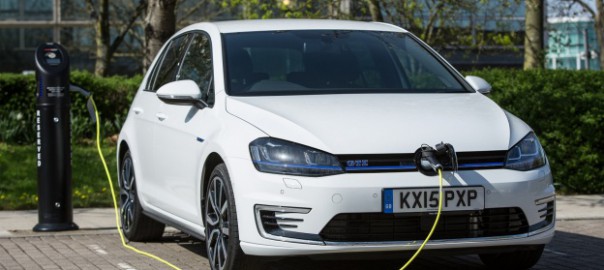
Volkswagen Golf GTE (Image: T. Larkum)

Volkswagen Golf GTE first drive: Hotting up the hybrid

You’ve heard of the Golf GTi. Now say hello to the Golf GTE. That’s E for electric, in case you were curious.

To readers of a certain age, GTE in the context of a performance car might be associated with another brand. When Pocket-lint was still in baby grows, it was Vauxhall that owned the GTE moniker, as seen stuck on the back of cars like its hot Astras.

Volkswagen Golf GTE (Image: T. Larkum)

But Vauxhall’s loss is clearly Volkswagen’s gain, as it gives the German maker a neat and easy-to-understand badge strategy for its range of performance cars. So in Golf world, it’s GTi for (injection) petrol, GTD for diesel, and GTE for plug-in hybrid electric – although this isn’t a purely battery powered Golf (you’ll need an e-Golf for that).

The Golf GTE mates together a chunky battery pack that you can plug in and recharge (unlike a regular hybrid like, say, a Toyota Prius) with a 1.4 TSi petrol engine. This engine sometimes keeps itself quiet and lets the battery do all the work, sometimes works together with the battery and (if the battery’s drained) can propel the car on its own. It depends on what mode you put the car in, state of charge and so on.

The benefit to you of all this? Well, 31 miles of range on the battery alone – which VW figure is enough to get most of us to work and back each day. But then the sort of performance you get from the regular GTi when the battery and petrol motor are working together and producing their combined total power output of 204hp. In between times – and depending how often you charge the battery up, the GTE promises much greater economy than its petrol equivalent – officially, 166mpg and 39g/km of CO2.

We could bore you at length about the GTE’s numerous modes (pure electric, GTE, charge battery etc) and various degrees of super cleverness. Instead we’ll simply talk about how it drives.

Set off with e-mode pressed, and the Golf travels under the power of just its battery, so long as you keep the speed below 81mph. It’s quiet, serene and nippy without feeling outright fast in a way that so many electric cars do. Both the electric motor and engine drive through the standard 6-speed DSG automatic gearbox, but in electric mode it’s very difficult to discern any real kind of stepping, gear-changing feel. And that’s all part of the appeal. It’s a fuss-free experience.

Read more: Pocket Lint

VW Golf GTE Driven: Is It Really The GTI’s Hybrid Brother?

Imagine the lovechild of a Golf GTI with the all-electric e-Golf and you would be right on the money. The VW Golf GTE is exactly that car, offering a plug-in hybrid powertrain and the thrills of a GTI combined, at least on theory.

What’s what

As a true lovechild of its parents, the Golf GTE combines the C-shaped LED daytime running lights from the e-Golf with the GTI’s horizontal fins at the front with every detail painted blue instead of the GTI’s red, even on the iconic tartan pattern of the seats. A standard set of 18-inch wheels dressed with 225/40 tyres complete the sporty appearance of this tech-infested Golf.
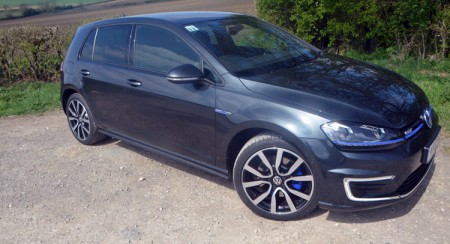
1625_2015-VW_GolfGTE_Carscoops

Under the bonnet we find a turbocharged 1.4-litre 148hp (150PS) TSI engine paired to a 101hp (102PS) electric motor integrated into the specially developed for hybrids six-speed DSG transmission. The combined output reaches 201hp (204PS) and 258lb-ft (350Nm) of torque which propel the VW Golf GTE to 62mph in 7.6 seconds and on to 138mph. But the most impressive figures claimed are about the efficiency of it: 166mpg UK (with the use of the battery, naturally) on the combined cycle and CO2 emissions of just 39g/km.

Plugged-In Details

The 8,7kWh lithium-ion battery is mounted underneath the rear seat and needs three hours and 45 minutes to be fully charged from a domestic mains outlet or two hours and 15 minutes from an optional fast charge wallbox. Depending on conditions, the all-electric range can reach up to 31 miles with the top speed limited to a more than sufficient 81mph.

The driver can choose from five different modes: E-mode, Hybrid Auto, Battery Hold, Battery Charge and GTE. As you might have guessed, the latter is the most aggressive of them all, tuning the powertrain for the best possible performance, while the Hybrid Auto mode proves to be the golden ratio between efficiency and performance.

Just Like A Tesla (Sort of)

When in E-mode, the Golf GTE feels brisk enough to tackle the usual city driving; put your right foot down and the 101hp electric motor pulls strongly the GTE in total silence, thanks to its instant torque reserves which are rated at a maximum 243lb-ft (330Nm) from a standstill with a continuous 125lb-ft (170Nm) on offer. Combine this with the direct steering and you have a fun zero-emissions car around the city. The real-world electric range is closer between 20 to 25 miles with the petrol engine stepping in when the battery levels are running low.

It’s when you take it outside the city limits that you start to really notice how smooth the driveline and how refined the collaboration between the two motors is, that makes the Golf GTE feel almost conventional, despite the crazy tech that goes under the skin. And that’s a compliment.

During our short drive on a mix of country roads and city driving we managed an average of 74mpg UK (equal to 61.6 mpg US and 3.8l/100km), which is a long way from the 166mpg UK (138mpg US or 1.7l/100km) official figure, but still remains an impressive result.

Does It Drive Like a GTI?

Not quite. Although it gives you the same, great confidence Golfs are known for, the GTE is unfortunately not the hybrid alternative of the GTI, but that’s not necessarily a bad thing. You can drive it fast and have a good time behind its wheel, especially with the GTE-mode engaged, enjoying the most balanced Golf chassis of the range due to the rear-mounted battery pack but the handling never comes close to that of the GTI’s. And there is one good reason for it: weight.

There is no escape from the inertia created by the GTE’s 1599kg kerb weight (including a 75kg driver). The battery pack alone adds 120kg to the sum, albeit it sits low in the chassis. But for the nature of it, the Golf GTE is a fun car to drive, certainly the most entertaining of the hybrids, with direct steering, solid performance and a nice ride too. You even get a miniature rev-counter for the petrol engine inside that always weird tachometer which shows whether you are draining or charging the batteries, going up and down like crazy during spirited driving.

To Sum Up

If you are looking for the same driving thrills of the Golf GTI, you’d be disappointed, but that’s more the marketing’s fault than the model itself. Because the VW Golf GTE offers one of the most capable hybrid powertrains in this price bracket, coupled with top levels of refinement and solid performance. It makes a great choice for those who want to try an electric vehicle but don’t want to suffer from the inevitable range anxiety and the usual bluntness. The main negative point is the price, with the VW Golf GTE starting at £33,085 in the UK which goes down to £28,035 after the £5,000 UK Government’s grant for plug-in vehicles and comes packed with kit, including adaptive cruise control, a 5.8-inch multimedia system and LED headlights.

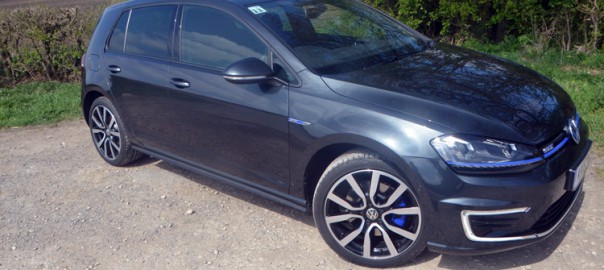
This car uses green technology, not just to reduce emissions, but to go faster

Driving the hybrid Volkswagen Golf GTE

Volkswagen finally makes a hybrid, but will it electrify you?

The Pitch

The Golf GTE is Volkswagen’s first – ha-ha! – charge into hybrid driving, a short 18 years after Toyota’s Prius first apologised onto our streets. They’re late to the party, certainly, but with a compelling sell.

The GTE pairs an 8.8kWh lithium-ion battery powering a 102PS electric motor (bolted cleverly inside the gearbox housing) with a 1.4-litre, 150PS TSI direct-injection petrol engine. Together this somehow adds up to a combined power of 204PS – hmmm – and a theoretical range of 580 miles.

The Battery

Giving a relatively titchy range of 31miles, the battery is charged via a nubbin under the front badge and should take around 3.75 hours from a domestic mains outlet, or 2.25 hours from a bespoke wall box. And here’s the big ticket number: 166. Volkswagen claims a combined cycle figure of 166mpg, while CO2 emissions should be zero in all-electric mode and 39g/km all round, so it’s expected to be exempt from VED and the Congestion Charge.

VW is desperate to position this in the same bracket as its GTi hot hatch. Hence the G and T up front. Indeed, they’re so serious about its GTi credentials they’ve even tailored the seat cloth with the brand’s iconic tartan bum-fondlers. Only in blue. Because blue’s “electric”, right?

This really is the best of all worlds: an electric runabout that’ll whizz you silently and cheaply to work – if you work reasonably nearby – while also an immensely fun hot hatch a spit off GTi performance when you marry the two engines. Wrapped in VW comfort, design skills and build quality. If the complicated engineering combination boasts VW’s legendary reliability, this is an enormously compelling vehicle.

Plus, with a £5k government electric vehicle rebate it’s £4,435 cheaper than a GTi. We know which one we’d rather have.

Read more: T3

10 Best ‘Eco Friendly’ Cars Of 2015

The 10 best ‘eco friendly’ cars of 2015 — as determined by the editors over at the noted vehicle valuation and information source Kelley Blue Book — were recently outlined in an interesting new list.

The top spot for the year was (not completely surprisingly) nabbed by BMW’s all-electric i3 model — following on the i3 grabbing other such honors elsewhere as well, and sitting at the top of all cars in the US in terms of “fuel” efficiency.

image24-e1429804688958_Green_Cars_Kelley

The new list from Kelley Blue Book is part of its yearly practice of compiling a ranking of the most efficient vehicles for the year, across all price ranges and power train variabilities.

“The list of ‘green’ vehicle standouts continues to blossom, and with strict Corporate Average Fuel Economy (CAFE) requirements coming down the pipeline, auto manufacturers are making stronger advancements each year in creating more environmentally friendly vehicles,” stated Jack R Nerad, executive editorial director and executive market analyst for Kelley Blue Book’s KBB.com.

“Topping this list for the second year in a row is the BMW i3 – an electric car that can sprint to 60 mph in just over 7 seconds, and is made in a factory powered entirely by four wind turbines. And if 81 miles of electric range doesn’t work for you, the i3 can be had with a small gas generator that lets you go as far as there are gas stations.”

Other vehicles that were ranked highly by the list include: the Volkswagen e-Golf (2nd); the Nissan Leaf (3rd); the Toyota Prius (4th); the Honda Accord Hybrid (5th); the Tesla Model S (6th); the Chevy Volt [Vauxhall Ampera] (7th); and onwards through the rest of the top 10.

Overall, a pretty ‘safe’ ranking arrangement — the e-Golf, the Leaf, and the i3 all got due recognition, as many other lists have been providing them. I suppose you could always contest Tesla’s position further on down the list, but all things considered, I’d say it’s probably fair. Myself, I’m heavily biased towards the Leaf, and would have placed it higher.

Source: Clean Technica

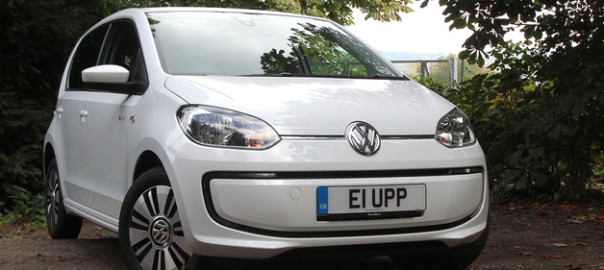
Volkswagen e-Up! review: Up against it

Say it quickly: “ee-up”. That Volkswagen feels happy to call its smallest electric car after the Yorkshire phrase for “hello” shows that Germans do truly have a sense of humour. We jest, of course – Yorkshiremen and women don’t say “ee up”, they say “ay up” – as Volkswagen’s press sheet for this car wryly points out.

Yorkshire greetings aside, the e-Up! poses a question: should you go electric? It’s been difficult to make a like-for-like choice between petrol, diesel and electric models, as most electric cars to date have tended to be standalone – the Nissan Leaf, BMW i3, Tesla Model S are all electric-only models. You can’t have a petrol version.

However, a few ranges are starting to appear which offer like-for-like choice – and Volkswagen has recently added electric versions of both Up! and Golf to its range. Bar some badges and wheel trims, you really won’t be able to spot the difference between them and their internal combustion-powered counterparts, so they could be the perfect option for electric car fans who don’t want to shout about their propulsion choice.

But taking the electric plunge will take some getting your head around, especially when it comes to price. At £19,270 – and that’s after the £5,000 UK government rebate – the e-Up! is one pricey small car. By way of comparison, the higher trim level version of the petrol Up! – on which the e-Up! is based (and that’s enough of the unwarranted exclamation mark after its name, by the way) – starts at £11,760 in five-door form, and although Volkswagen would point out there’s a host of extra kit that comes with the electric version, you’re still looking at the chunky end of a seven grand premium just to go battery powered. Perhaps more troubling for VW will be the fact that the larger, stand-alone Renault Zoe kicks off at a little over £14k.

So even before you’ve got in the driver’s seat, the e-Up is, er, up against it. Is it really worth so much cash?

Electric benefits

To save that seven grand you’re going to have to be doing an incredible amount of driving over the car’s life – at current prices, 10,000 miles in a petrol Up is likely to cost you about £1,000 in fuel.

Either that, or be extremely committed to the green cause, which isn’t entirely clear cut – electric cars aren’t truly zero emission because their electricity is most likely produced by a gas or coal power station.

From our perspective then, where the e-Up is going to make most sense is in the experience it provides. If it provides something better, extra or different over a petrol Up, then you shouldn’t rule it out.

And after jumping into the car and heading off down the road, there are some obvious benefits: the most obvious being performance. We love the 3-cylinder petrol engines in the regular Up, but they’re never what you’d call fast. And while the e-Up is still no race-car, step out of the petrol version and it does feel like a rocket.

In part that’s to do with the characteristics of the electric motor, which can deliver its full quota of torque from zero rpm. So it rips off the line and zips into gaps. In the context of city driving, which where we’d expect most e-Ups to spend their lives, it makes for a really great ally. It’s relaxing and easy in traffic – and really quite zippy and fun if you get the bit between your teeth.

Read more: Pocket Lint

Volkswagen e-Golf Video Review

Alex L. Dykes from the Alex on Autos channel released an in-depth review of Volkswagen e-Golf.

If you’re considering the e-Golf among other EVs and have a spare 25 minutes, this is the review you should check out.

Presentation includes exterior, engine motor, charging options, seats, interior, infotainment, cargo area capacity, drive including regenerative braking, comfort and price. The detailed review will appeal especially to the customers new to the EV world.

In the summary, Alex compares some of the features and prices of the e-Golf to the Nissan LEAF and Kia Soul EV. As always, every car has its strong and weak points, so you must decide which needs are most important for you.

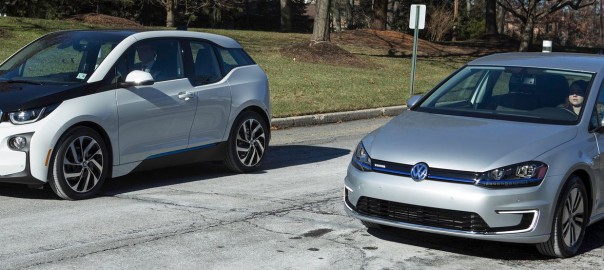
BMW i3 and Volkswagen e-Golf

Kelley Blue Book Announces Best Green Cars For Earth Day – BMW i3 Declared Winner

April this year, Kelley Blue Book (KBB) compiled a list of the most efficient stand-out cars of the year that are chosen based on efficiency, price, practicality and powertrain, just in time for Earth Day.

KBB’s “Best Green Cars of 2015″ list includes 10 vehicles, 5 of which are plug-in electric cars.

For 2015, the BMW i3 is the repeat winner. It captured the top spot from KBB last year too.

BMW i3 and Volkswagen e-Golf

In #2, we find the Volkswagen e-Golf, followed by the Nissan LEAF in third. The two other plug-ins to make the cut are the Tesla Model S in sixth and the Chevrolet Volt [Vauxhall Ampera] in seventh.

And here’s the ranking:

KBB.com’s 10 Best Green Cars of 2015

Rank 2015 Model-Year Vehicle

1 BMW i3
2 Volkswagen e-Golf
3 Nissan Leaf
4 Toyota Prius
5 Honda Accord Hybrid
6 Tesla Model S
7 Chevrolet Volt
8 Toyota Camry Hybrid
9 Ford C-Max Hybrid
10 Volkswagen Jetta TDI

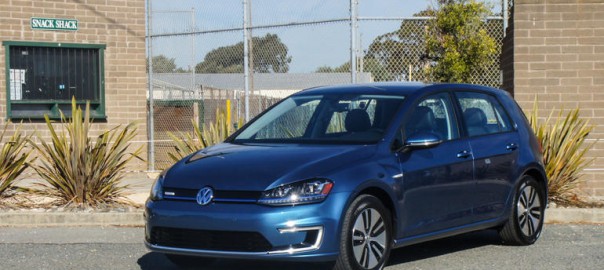
e-Golf is an attractive new electric from VW (Image: CNet)

Review: 2015 Volkswagen e-Golf (With Video)

Because I live in California, it seemed only fitting that my first taste of the new Golf arrived in electric form: the 2015 VW e-Golf. (Why e-Golf? Because “Golfe” just sounded silly.) The Golf isn’t just the first Volkswagen EV in the US, it’s also the first VW built on the new MQB platform which promises reduced weight and lower development costs. While MQB isn’t a dedicated EV platform like Nissan’s LEAF, it was designed to support electrification from the start rather than being converted like the Fiat 500e. While that may sound like a quibble, the difference is noticeable as the e-Golf feels like a regular VW that happens to be electric. The e-Golf also demonstrates just how rapidly EVs have evolved since the LEAF launched in 2010.

Exterior

Volkswagen has always been a company that prefers restrained elegance when it comes to design and the new Golf is no different. While some described the look as boring, I generally appreciate design evolution more than design revolution because the latter leads to products like the Aztek. The downside to VW’s design evolution is that the Golf doesn’t look all that different from the last Golf, but VW owners tell me that’s how they like it. Park it next to the last VW hatch and you will notice a difference. The 2015 model is longer, wider and lower than its predecessor with a longer hood and a shorter front overhang. The result is a more grown-up hatch than ever before that also schleps more stuff than ever before.

For EV duty, VW swaps in their first US-bound LED headlamps, and (according to a product announcement released when we had the e-Golf) will swap them back out if you opt for the new starting trim of the e-Golf which is coming soon. We also get a revised DRL strip of LEDs curving around the front bumper that gives the electric version a distinctive look in your rear-view mirror. Finishing off the transformation are blue accents here and there, EV specific wheels and unique badging. From a functional standpoint, the electrically heated windshield (ala Volvo and Land Rover) helps reduce energy consumption by heating the glass directly instead of heating the air and blowing it on the glass.

Interior

Changes to the new interior are as subtle as the exterior. It was only after sitting in a 2012 Golf that I realized that parts sharing appears to be somewhere near zero. Although the shapes are similar, everything has been tweaked to look more cohesive and more up-scale. The console flows better from the climate controls, infotainment screen and knick-knack storage all the way to the armrest. The dashboard design is smoother and more Audiesque and the door panels have improved fit and finish with slightly nicer plastics. Keeping in mind that the Golf competes with the Hyundai Elantra GT, Ford Focus, Mazda3, Chevy Sonic, and Fiat 500L, this is easily the best interior in this class.

When it comes to the e-Golf things get murky. Since most auto companies have just one EV model, the electric Golf competes with a more varied competitive set spanning from the Spark EV and 500e to the BMW i3 and Mercedes B-Class Electric. In this competitive set, the VW still shines with an interior that isn’t that far off the B-Class or the i3 in real terms. The only oddity here is that the e-Golf does not offer leather in any configuration. The new base model gets cloth seats which are comfortable and attractive but the top end trim we tested uses leatherette which is attractive but doesn’t breathe as well as leather or cloth. Breathability is a problem the Spark’s leatherette seats also suffer from and is especially important in an EV where you frequently limit AC usage to improve range. Kia’s Soul EV is a stand-out in this area by offering real leather and ventilated seats which consume less power than running the AC.

Read more: The Truth About Cars

Automotive Fleet Reviews Volkswagen e-Golf – Video

Paul Clinton from Automotive Fleet takes the new Volkswagen e-Golf for a spin, providing both a video & article.
Volkswagen e-Golf.

The short video above discusses most of the e-Golf’s features: charging & range, price, etc.

As you will hear in the video, the e-Golf is not available in all 50 states. Why? Wish we knew…It’s time for Volkswagen to stop dragging its feet.

However, for those who live in one of the states where the e-Golf is available, than it definitely should make your list of contenders, as it stacks up well against other short-range BEVs.

AF stated that the e-Golf handles & performs precisely like the Golf’s with gas & diesel engines. That would be because it is the same basic vehicle, but with a different propulsion setup. AF adds this:

“Volkswagen may dominate the diesel passenger car market, but the e-Golf, the automaker’s first fully electric vehicle, could help establish an equally strong and deserved foothold in the electric vehicle market.”

Source: Inside EVs

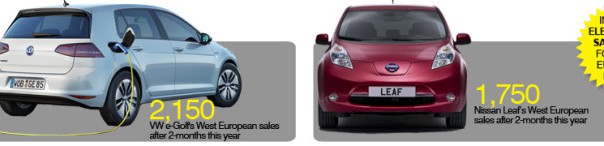
Volkswagen e-Golf Knocks Nissan LEAF Out Of #1 Electric Car Sales Spot In Europe (Image: EagleAID)

Volkswagen e-Golf Knocks Nissan LEAF Out Of Number 1 Spot

EagleAID thunders that Volkswagen e-Golf dethroned Nissan LEAF as the best-selling electric car in the first two months of 2015 in Europe.

2,150 e-Golfs to 1,750 LEAFs.

Volkswagen e-Golf Knocks Nissan LEAF Out Of #1 Electric Car Sales Spot In Europe (Image: EagleAID)

Seems bold, but data from 17 West European markets is not saying the whole story.

Volkswagen e-Golf is booming in Norway, where they sold 80% of the total – 1,718 registrations.

In the same two-month period, Nissan had 556 registrations of LEAFs in Norway, which must mean that sales are more diversified – or at least that Nissan doesn’t see cramming the country with inventory ahead of the potential tax incentive expiration (at 50,000 EVs sold) a necessity.

On the 16 other markets e-Golf / LEAF ratio is different: 432 / 1,194.

According to the latest report on EV Sales Blog, Nissan sold worldwide almost 7,000 LEAFs in the first 2 months of 2015, while Volkswagen soldjust over 2,350 e-Golfs.

Anyway, competition continues and we now looking forward to March data to see how the situation progressing.

Source: Inside EVs