Category Archives: Tesla

News and reviews of Tesla electric cars (including plug-in hybrids).

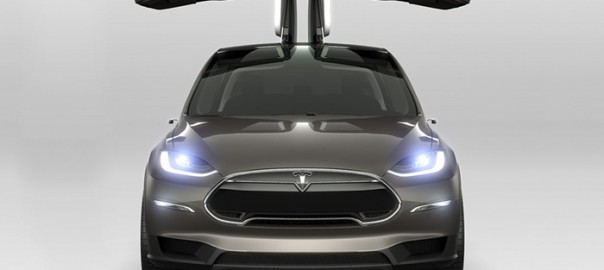
The Tesla Model X is the electric car company’s third car, designed to appeal to the SUV-crossover market (Image: Tesla Motors)

Tesla’s Model X available from September

Elon Musk’s third electric car will be delivered to customers in the US after three years of delay, with over 20,000 pre-orders

Tesla’s much delayed electric sports utility vehicle is due to finally reach customers, starting in September, Elon Musk has announced.

The Tesla Model X is the electric car company’s third car, designed to appeal to the SUV-crossover market (Image: Tesla Motors)

The Model X was originally unveiled in 2012 alongside the first deliveries of the Model S sedan and was expected to go into production in 2013. Musk announced two subsequent delays as the company struggled to meet demand for the Model S and the motoring company’s expansion plans.

The Model X has a higher ride height, all-wheel drive and can seat up to seven, making it the largest vehicle available from Tesla Motors. More than 20,000 people have already paid a $5,000 deposit to reserve one of the new models. Pricing is expected to be similar to the Model S, which starts at £50,000 in the UK.

Musk confirmed that the company’s Model X car configurator would be available online in the next three weeks and that customers will start recieving new cars by 30 September.

The Roadster, Tesla’s first car, the Model S, and now the Model X, are being used to pave the way for Tesla’s Model 3, which is Musk’s vision of a mass market electric car.

Read more: The Guardian
Electric Car Tipping Point Within 10 Years

It’s encouraging to hear this kind of optimisim made public!

Tesla Motors CTO JB Straubel was the headliner at Intersolar North America last week. He talked about the transition to lithium-ion batteries and how that opened the floodgates for electric cars and stationary storage (eventually); the synergy between EVs, solar, and grid storage; the growth of solar power and grid storage; blah blah blah.

I know, I actually love all that stuff as much as the rest of you — it’s what I read, edit, & write about every day(!) — but it’s basically all general history and trends we know all about. But then JB dropped the awesome-bomb:

“I think we’re at the beginning of a new cost-decline curve, and, you know, this is something where there’s a lot of similarities to what happened with photovoltaics. Almost no one [would have predicted] that photovoltaic prices would have dropped as fast as they have, and storage is right at the cliff, heading down that price curve. It’s soon going to be cheaper to drive a car on electricity — a pure EV on electricity — than it is to drive a gasoline car. And as soon as we see that kind of shift in the actual cost of operation in a car that you can actually use for your daily driver, you know, from all manufacturers I believe we’re going to see electric vehicles come to dominate the whole transportation fleet.

“Also, that same battery cost decrease is going to drive batteries in the grid. There’s going to be much faster growth of grid energy storage than I think most people expected. You suddenly get to have energy that’s 100% firm and buffered from photovoltaics that’s cheaper than fossil energy. And we’re within sort of grasping distance of that goal, which is very, very exciting.

“Because once we get to that, and there really is no going back, it will make sense to do this economically without any environmental consideration whatsoever. So that’s the amazing tipping point that’s going to happen within I’m quite certain the next 10 years.

Read more: EV Obsession

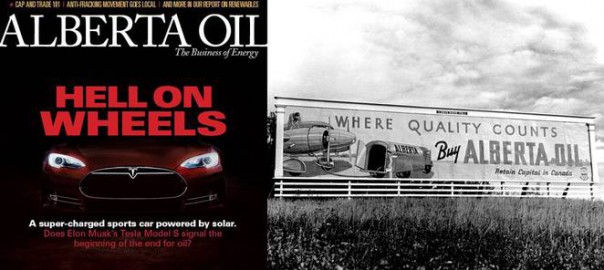
Tesla on industry magazine - end for oil? (Image: Wikipedia)

Tesla is the beginning of the end for oil?

A good find by our friends at EV Obsession, apparently a trade magazine from the oil industry, Alberta Oil, has put a Tesla Model S electric car on its cover (“Hell on wheels”) and published an article with this title and sub-title: “Is Tesla’s Model-S the Beginning of the End for Oil? Why battery technology could drive the electric vehicle to new heights – and disrupt the fossil fuel industry in the process”.

You get the feeling that the thinking of many inside the oil industry is starting to change; for the longest time, most of the comments and official forecasts from the industry basically said that, yes, electric vehicles are coming, but they won’t be a big deal for many decades, and that maybe in 30-40 years they’ll represent a few percents of the vehicles out there.

Tesla on industry magazine - end for oil? (Image: Wikipedia)
Tesla on industry magazine – end for oil? (Image: Wikipedia)

This reassuring (for them) prognostication about the status quo was repeated like a mantra until even most people who heard it over and over in the media accepted it as truth. But that’s not how things work. We can’t know that far in advance how things will be, and if you had asked someone in 2006 whether billions of people were going to own super-powerful internet-connected smartphones within less than a decade, they’d have thought you were crazy. What looks obvious in hindsight isn’t obvious at all looking forward. Why? Because change is non-linear. Things move slowly for a long time, and then you reach a special tipping point where change accelerates. For example, solar power adoption was relatively slow until the price per watt of solar started getting close to other sources (first with incentives, and now without). That changed the game and things shifted in a higher gear. And as we get close to solar being cheaper than all other sources of energy, things will shifter in even higher gear…

Read more: Treehugger

Tesla and i3 are Top Two Cars of 2015

CNET has recognised the Tesla Model S and the BMW i3, giving them the top two spots in its Top 5 Cars of 2015.

Both vehicles are deserving of their rank. The Tesla Model S P85D redefines the electric car segment due to its sheer power and speed, while the i3 makes its mark by being the world’s most efficient electric car and perhaps the most exotic electric car out there today with its use of carbon fiber, available REx and more.

Source: Inside EVs

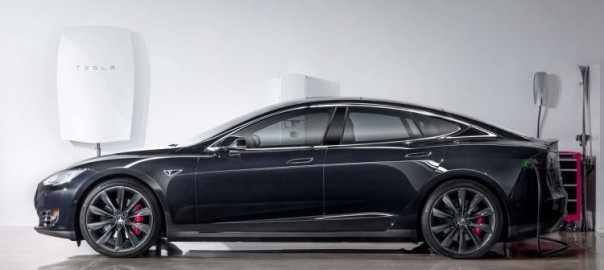
The Tesla Model S And The Powerwall (Image: Tesla)

Tesla Reveals Battery Storage Solutions

Late Thursday night [30 April] in Hawthorne, California, Tesla revealed its “missing piece to building a sustainable future,” which the company says puts the world on the road to “enabling zero emissions power generation.”

Tesla notes that the world currently uses 20 trillion kWh of energy annually, which is:

“Enough energy to power a single family home for 1.8 billion years or supply energy to a nuclear power plant for 2,300 years (or launch the Falcon 9 rocket seventeen million times).”

The company says that the Tesla Energy products launched today will help to start to wean the world off fossil fuels.

The Tesla Model S And The Powerwall (Image: Tesla)

More specifically the company is offering “a suite of batteries” for residential, business and utility use. Those solutions are outlined below.

As for what was available before today, Tesla CEO Elon Musk was very candid, “The issue with existing batteries is that they suck. They are expensive, unreliable and bad in every way.”

The Tesla CEO said that the first residential units will start shipping in about three months, but that the initial ramp will be slow, as early batteries will be built at the company’s Fremont factory.

However, next year production will switch to Tesla’s Nevada Gigafactory, and things will quickly speed up.

As a special bonus, the whole presentation made from California was done off the grid, via the company’s new utility grade “Power Packs”.

Read more: Inside EVs

10 Best ‘Eco Friendly’ Cars Of 2015

The 10 best ‘eco friendly’ cars of 2015 — as determined by the editors over at the noted vehicle valuation and information source Kelley Blue Book — were recently outlined in an interesting new list.

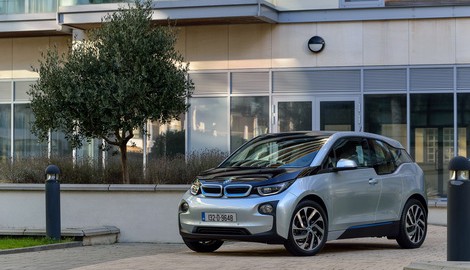
The top spot for the year was (not completely surprisingly) nabbed by BMW’s all-electric i3 model — following on the i3 grabbing other such honors elsewhere as well, and sitting at the top of all cars in the US in terms of “fuel” efficiency.

image24-e1429804688958_Green_Cars_Kelley

The new list from Kelley Blue Book is part of its yearly practice of compiling a ranking of the most efficient vehicles for the year, across all price ranges and power train variabilities.

“The list of ‘green’ vehicle standouts continues to blossom, and with strict Corporate Average Fuel Economy (CAFE) requirements coming down the pipeline, auto manufacturers are making stronger advancements each year in creating more environmentally friendly vehicles,” stated Jack R Nerad, executive editorial director and executive market analyst for Kelley Blue Book’s KBB.com.

“Topping this list for the second year in a row is the BMW i3 – an electric car that can sprint to 60 mph in just over 7 seconds, and is made in a factory powered entirely by four wind turbines. And if 81 miles of electric range doesn’t work for you, the i3 can be had with a small gas generator that lets you go as far as there are gas stations.”

Other vehicles that were ranked highly by the list include: the Volkswagen e-Golf (2nd); the Nissan Leaf (3rd); the Toyota Prius (4th); the Honda Accord Hybrid (5th); the Tesla Model S (6th); the Chevy Volt [Vauxhall Ampera] (7th); and onwards through the rest of the top 10.

Overall, a pretty ‘safe’ ranking arrangement — the e-Golf, the Leaf, and the i3 all got due recognition, as many other lists have been providing them. I suppose you could always contest Tesla’s position further on down the list, but all things considered, I’d say it’s probably fair. Myself, I’m heavily biased towards the Leaf, and would have placed it higher.

Source: Clean Technica

Tesla Model S Test Drive

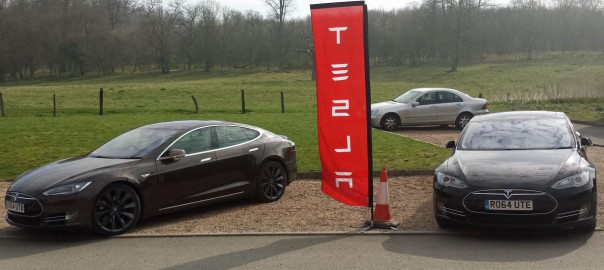
In April we organised a test drive of the Tesla Model S for a group of drivers. There was a Tesla Event scheduled for Warwick so we booked in for that. On the morning of the big day we headed over there in my ZOE.

Our very own Tesla Model S – for a while anyway (Image: T. Larkum)

We arrived a little early and they were still setting up so we waited with a coffee and Danish pastry before having a brief presentation on the Model S. Then we headed out with our guide, Adrian. We each took a turn of 10-15 minutes driving before swapping over, and overall took in a large loop around the local area.

The Model S touchscreen system (Image: T. Larkum)

I was very impressed with the car, both with the driving and the technology. It really does accelerate very hard and fast, yet quietly and smoothly. It feels a little unnerving, a bit like holding a loaded gun, as it can just take off at any moment. And this was only a standard performance model, the P85, not the new higher performance 4WD version, the P85D.

The boot – with the lift-up panel for the rear jump-seats just visible (Image: T. Larkum)

I very much liked the media system with its large 17” touchscreen. It seemed very futuristic, and was intuitive to use. Certainly I can appreciate the attraction of having such a large display for your satnav, or the option of the satnav and media player each having half the screen.

The famous ‘frunk’ (front trunk) since the motor is between the rear wheels (Image: T. Larkum)
The famous ‘frunk’ (front trunk) resulting from the motor being between the rear wheels (Image: T. Larkum)

The time to return the car came only too quickly. After a quick debrief we headed back to Northampton in the ZOE. I very much enjoyed the test drive, and I know it definitely opened the eyes of a group of petrol-heads to the possibilities of driving on electricity – the Tesla grin was evident. One of the drivers has since bought a Leaf. Roll on the UK launch of the more affordable Tesla Model 3!

A classic Tesla grin (Image: T. Larkum)
Tesla Model S P85D (Image: AutoExpress)

Norway to review electric car subsidies as sales soar

Norway is reviewing its subsidies for electric vehicles after generous government incentives made the country the biggest user of battery powered cars in the world, hurting state revenues, the finance ministry said.

Norway registered its 50,000th electric car on Monday, almost three years earlier than expected thanks to government schemes that have cut taxes and provided a plethora of benefits, including an exemption from tolls and parking fees, free recharging stations and the use of bus lanes.

A fifth of all new cars sold in Norway have been electric so far this year and tiny Norway, with just 5.1 million people, accounted for a third of all European battery powered car sales last year, official data showed.

“Our goal is to present a final agreement on the review of the future of automotive and fuel taxes,” the finance ministry said. “The outcome of the review will be announced in the revised budget (due in May).”

The current incentive scheme has been in place since 2012, but it came under criticism last year when sales of the Tesla Model S, a luxury sedan, soared and the budget lost 3 to 4 billion crowns ($380 to $510 million) in expected revenue.

Teslas, starting at about $70,000 and retailing for about$100,000 with extras, accounted for three percent of sales last year, prompting calls to end subsidies for wealthy buyers. Sales of the Nissan Leaf and Volkswagen e-Golf have also risen.

The Norwegian Electric Car Association argues that the benefits need to be maintained longer as only two percent of the cars on the road are electric, still a relatively small figure even if Norway leads the rest of the world by a wide margin.

Norway generates nearly 100 percent of its electricity from hydropower so the shift to battery powered cars results in a net reduction in greenhouse gas emissions — part of the country’s plans to reduce emissions by at least 40 percent by 2030 compared to the 1990 level.

Norway is also Western Europe’s biggest oil and gas producer with about 3.7 million barrels of oil equivalents per day and its offshore energy sector accounts for a fifth of the economy.

Source: Reuters

Warm Silver Tesla Model S 70D

Automobile Magazine Test Drives Tesla Model S 70D

Automobile Magazine released one of the first reviews of the Tesla Model S 70D.

Overall, the review basically states that the 70D is just a better entry-level Model S that’s slightly less capable than 85D.

The new Tesla 70D that jumps in place of 60 has 10 more kWh of battery capacity and more range (increase from 208 to 240 miles EPA). Because there are two motors instead of one and more total power, acceleration from 0-60 mph now takes 5.2 seconds (60 kWh Model S does it in 5.9). Top speed for 70D is 140 mph.

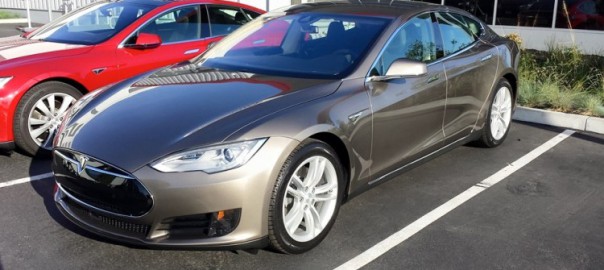
Warm Silver Tesla Model S 70D

There are new standard features and finally the price is higher by roughly five grand ($76,200).

The most significant change influencing the driving experience compared to the previous Model S 60 is all-wheel drive:

“Like every Tesla Model S, the 70D’s acceleration is instantaneous and unending. With no shift points or drops in torque, planting your right foot forces your passengers into their leather seats as the numbers on the digital speedometer soar. All-wheel drive now comes standard on the base Tesla Model S, as the 70D replaces last year’s rear-wheel-drive Model S 60 at the bottom of the food chain. The extra traction helps our car hustle away from a stop on rain-slicked pavement with no drama.”

We probably could assume that Tesla replaced 60 with 70D because the automaker believes that the combination of better performance/range and new standard features at slightly higher price will improve sales of the entry-level version.

“As much as we enjoy driving the Model S, we also like that it makes life easy for its driver and passengers. The Model S boasts super-intuitive controls on the touchscreen (only the hazard lights, transmission, windshield wipers, and power windows have physical switches), build quality rivaling a Lexus, and a comfortable ride that soaks up the worst potholes we can find. Fitting five people into the Model S reminds us how easily the Tesla could work as a family sedan, especially given the generous sizing of the front and rear trunks.”

“The Tesla Model S blew us away when we first drove it three years ago, and the magic continues today. From minor software updates to the addition of all-wheel drive, Tesla has continued to tweak and refine its pioneering electric sedan into something any car shopper would lust after. Its blend of efficiency, a super-futuristic driving experience, and a luxurious cabin helps the car appeal to a far greater swath of car shoppers than just tech-savvy Silicon Valley residents. With all those virtues and a competitive starting price, the 2015 Tesla Model S 70D makes a serious case for switching from a gas-powered luxury sedan.”

Automobile Magazine’s associate web editor Joey Capparella said:

“More than any other Tesla before it, the 70D strikes me as a legitimate competitor to cars like a BMW 5 Series or a Mercedes-Benz E-Class. Before, it seemed like a pie-in-the-sky early-adopter’s toy, but now I can see many more buyers considering a Model S.”

Senior editor David Zenlea said:

“This cabin is airy, spacious, and thoughtfully packaged. The center console is scooped out in the back to provide more room for the middle-seat passenger, and there is no transmission tunnel to eat up his or her legroom. Small details, but it’s part of what makes the Model S special.”

Source: Inside EVs

BMW i3 and Volkswagen e-Golf

Kelley Blue Book Announces Best Green Cars For Earth Day – BMW i3 Declared Winner

April this year, Kelley Blue Book (KBB) compiled a list of the most efficient stand-out cars of the year that are chosen based on efficiency, price, practicality and powertrain, just in time for Earth Day.

KBB’s “Best Green Cars of 2015″ list includes 10 vehicles, 5 of which are plug-in electric cars.

For 2015, the BMW i3 is the repeat winner. It captured the top spot from KBB last year too.

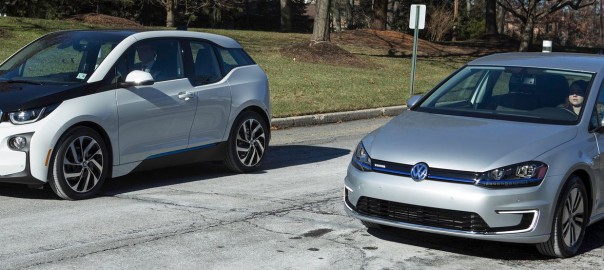
BMW i3 and Volkswagen e-Golf

In #2, we find the Volkswagen e-Golf, followed by the Nissan LEAF in third. The two other plug-ins to make the cut are the Tesla Model S in sixth and the Chevrolet Volt [Vauxhall Ampera] in seventh.

And here’s the ranking:

KBB.com’s 10 Best Green Cars of 2015

Rank 2015 Model-Year Vehicle

1 BMW i3
2 Volkswagen e-Golf
3 Nissan Leaf
4 Toyota Prius
5 Honda Accord Hybrid
6 Tesla Model S
7 Chevrolet Volt
8 Toyota Camry Hybrid
9 Ford C-Max Hybrid
10 Volkswagen Jetta TDI