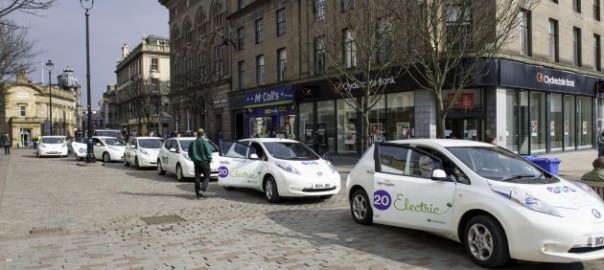
One of the UK’s largest electric taxi fleets has entered service for the first time in Dundee. The fleet of 30 electric Nissan LEAFs operated by 203020 Electric – part of the Tele Taxis Group – is now in 24-7 service in and around the City of Discovery.
Offering zero emissions mobility, the Nissan LEAFs will make a significant contribution to improving air quality in the city and will further enhance the city’s reputation as a leader in green transport.
And the significance of the occasion was emphasised when the historic first journey was taken by Derek Mackay MSP, the Scottish Government’s Minister for Transport and the Islands, around City Square.
He was joined at an official launch event by executives from Transport Scotland, the Energy Saving Trust, Dundee City Council and Nissan – organisations that have all invested and advised on the project.
Transport Minister Mr Mackay said:
“The Scottish Government is committed to improving air quality in our towns and cities – that is why we have been delighted to support this ambitious project as part of our overall investment of £17 million in a range of ultra low emission vehicle initiatives over the past two years.
“Bold initiatives such as this offer a visible demonstration that this transformation is already happening and I am delighted to be able to experience these vehicles at first hand by taking a ride in one today.
“A journey in one of these taxis may well be the first encounter many members of the public will have with an electric vehicle, helping to raise awareness that there are viable alternatives to petrol and diesel cars.”
With 30 vehicles all entering service at the same time, it’s one of the UK’s single largest electric vehicle fleet deals. But the deal will soon become even bigger as Tele Taxis / 203020 Electric plans to replace its entire 60-vehicle fleet with more Nissan LEAFs and the larger Nissan e-NV200 Combi over the next 12 months.
The move will save Tele Taxis Group hundreds of thousands of pounds in fuel each year. The LEAF and e-NV200 costs from just two pence per mile to run.
The zero emission fleet will help Dundee’s air quality
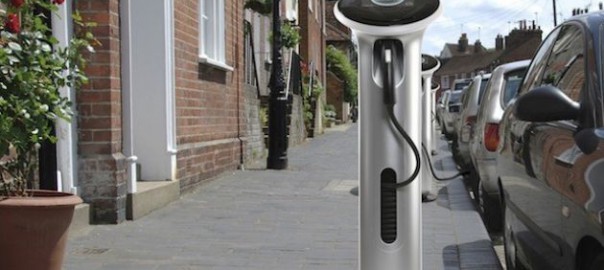
A bank of five rapid chargers, capable of charging a LEAF from zero to 80% in just 30 minutes has been installed at the taxi company’s HQ in Isla Street to keep the new fleet topped up and in constant service around the clock.
The chargers, funded by Transport Scotland’s ChargePlace Scotland project, are all available for public use and currently free to charge from.
David Young, owner of 203020 Electric, said:
“There are big financial benefits to operating a fleet of electric taxis but that is not the main driver behind our decision to go down this route.
“Dundee is a city with some of the worst air pollution in the country and this initiative puts us at the forefront of efforts to improve that. The environmental benefits of running these pure electric vehicles will make a real difference for the people of Dundee.”
As the trend for alternative fuels for cars continues to grow – particularly with electric vehicles, Southern is installing 50 Electric Vehicle Charging Points (EVCPs) in station car parks across the Southern network at a cost of £375,000 funded by the Office of Low Emission Vehicles (OLEV)as part of a South East-wide initiative to install more points to connect with the Energise network.
Sales of electric vehicles are on the increase and the provision of EVCPs at stations supports Southern’s strategy to encourage more sustainable travel. EVCPs at our stations will help electric vehicle drivers to complete a door to door sustainable journey and reduce their carbon footprint even further. Southern already has ECVPs at 10 stations with 13 more stations planned to have charging points over the next couple of months.
Southern’s Head of Environment, Sandra Norval said:
“We’re on target for installation of most of the 50 ECVPs by the end of March, with the final few to come soon after. Who knows – the installation of these charging points may even encourage more electric car sales. If that happens, everyone wins!”
If there were ever a brand-reset button in the automotive business, the BMW i3 electric car is it.
It’s both a compact hatchback and an all-electric car, from the brand that claims to build ultimate driving machines.
How does it measure up to that lofty standard? Hi, I’m Joel Feder, and I’ll give you our verdict on the BMW i3 in our latest video road test.
Strip away the simulated twin-kidney grills and roundel badges, and you’d really never know the i3 is a BMW. It has skinny tires, and an odd side view with a dipped window line.
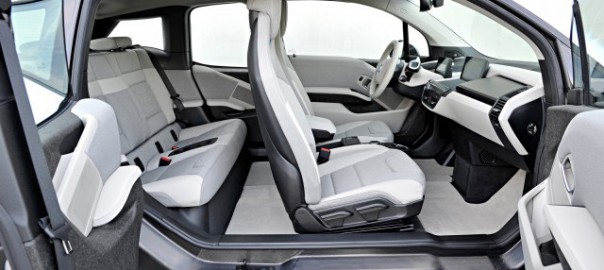
Inside, it’s unlike any BMW you’ve seen before—it’s more like a loft living room than a cockpit.
It’s dominated by a big screen that displays infotainment functions, controlled via the iDrive knob on the console. A smaller screen behind the steering wheel provides all the other driving information, including the speedometer.
Overall the interior is elegant and well put together, except for the renewable-fiber kenaf material. It’s fine on the far part of the dashboard, but the door panels look like they’ve been stripped of their covering. It’s the one sour note in the car.
This interior is far more spacious than you’d think. While the front seats have extremely thin backs, they’re comfortable and bolstered well. The seating position is upright and higher than some other small cars, and you get good view of the road.
The rear seats are a bit tight for full-sized adults, and it’s awkward getting in and out because the rear passengers can’t open their own doors. The front-seat passenger has to open the front door first.
The i3 breaks completely new ground in its drivetrain. It’s a battery-powered electric car with a 22-kilowatt-hour lithium-ion battery pack mounted under the floor. That powers a 125-kilowatt (170-horsepower) electric motor in the rear that sends up to 184 pound-feet of torque to the rear wheels.
The EPA rates the i3 at 81 miles of electric range with an efficiency rating of 124 MPGe. That makes it the most efficient car of any kind sold in the U.S. today. BMW says you’ll see a real-world range of 75 to 90 miles.
Have range anxiety? Want another 80 miles as a safety net (give or take)? You can opt for the range-extending REx engine, as fitted to our test car. It’s a little two-cylinder gasoline-powered generator in the rear of the i3, next to the electric motor.
It kicks in to act as a generator when you deplete the battery, but it’s not connected to the drive wheels. You should know that opting for the REx model drops your battery range rating to 73 miles – and it’s only rated at 34 mpg while the range extender is on.
Plug-in electric car sales have undergone a huge rise in many key European markets according to figures released by the European Automobile Manufacturers Association (ACEA).
The biggest gains came in the UK, where a 300 per cent rise in electric cars has taken place compared to this time last year.
In total 75,331 new electric cars have been registered according to the ACEA, with Norway leading the way with just under 20,000 new registrations.
In Germany electric car registrations are up by 70 percent, while in France they had climbed by almost 30 per cent compared to the 2013 figures.
Would you like an overload of info on the new Volkswagen e-Golf? These multiple videos will provide you with more info on the e-Golf than you likely care to know.
The first video discusses different driving and regenerative braking modes.
Check out this e-Golf commercial. e-Golf is 2015 Motor Trend Car of the Year.
https://www.youtube.com/watch?v=LCCHcZabs_s
Like the other BEVs, you can control your e-Golf with a sophisticated smart phone app.
The government has pledged to continue its support of plug-in vehicles and their integration into the mainstream. This means that grant schemes in place such as the plug-in car grant and the EV Homecharge scheme will continue to run.
Importantly, the guidelines for these grants are being revised by the government, so there are some differences.
Plug-in car and van grant
From 1st April 2015, buyers of eligible electric cars will be able to claim 35% of the vehicle’s OTR price as opposed to the 25% currently offered. The grant cap of £5,000 remains, however.
To take account of rapidly developing technology, and the growing range of ULEVs on the market, the criteria for the Plug-in Car Grant is also being updated.
From April 2015, eligible ULEVs must meet criteria in one of the following categories depending on emission levels and zero-emission-capable mileage:
Category 1: CO2 emissions of <50g/km and a zero emission range of at least 70 miles;
Category 2: CO2 emissions of <50g/km and a zero emission range between 10 and 69 miles;
Category 3: CO2 emissions of 50-75g/km and a zero emission range of at least 20 miles.
EV Homecharge Scheme
The cap on the Homecharge scheme will be reduced on 13th April to £700. Eligible applicants will be able to get a grant to cover 75% (capped at £700) of the installation costs for a domestic charging point.
So far, the UK government has attributed almost £1 billion of funding to plug-in vehicles up to 2020, cementing their support for the uptake of electric vehicles into the mainstream.
Today, government announced details of 12 UK cities shortlisted to share £35 million of funding to promote ultra-low emission vehicles (ULEVs).
Bidding to be the UK’s first ‘Go Ultra Low Cities’, the shortlisted authorities have until 31 August 2015 to finalise their submissions, with the winning cities announced in the autumn.
Set up by The Office for Low Emission Vehicles (OLEV) and the Department for Transport (DfT), the £35 million Go Ultra Low City Scheme will deliver a step-change in the uptake of ultra-low emission vehicles. The programme will reward cities that demonstrate most potential to achieve ‘exemplar status’ – becoming internationally outstanding examples for the adoption of ULEVs in a local area.
The 12 cities and authorities shortlisted for official Go Ultra Low status and a share of the £35 million funding are: City of York Council; Department for Regional Development of Northern Ireland; Dundee City Council; Greater London Authority; Leicester City Council; Milton Keynes Council; North East Combined Authority; Nottingham City Council; Oxford City Council Sheffield City Council; West of England; West Yorkshire Combined Authority.
Minister of State for Transport Baroness Kramer said,
“This funding is an unequivocal signal from government that we are committed to making ultra-low emission vehicles a practical and viable choice for more people.
“Today’s shortlist of 12 Go Ultra Low Cities from across the country is an important part of our effort to improve air quality and establish the UK as a global leader in the uptake of low and ultra-low emissions vehicles. This can help to transform people’s quality of life in their cities and is an important step towards our 2050 vision when almost every car, bus and van in the UK will be an ultra-low emission vehicle.”
The scheme rewards cities that show how their plans could be rolled out across the UK, and how their initiatives complement other schemes in their city, such as wider transport policies like the Low Emission Bus and Taxi Schemes.
Those cities that address local air quality issues, particularly in relation to NO2 and other particulate matter, will also be considered favourably.
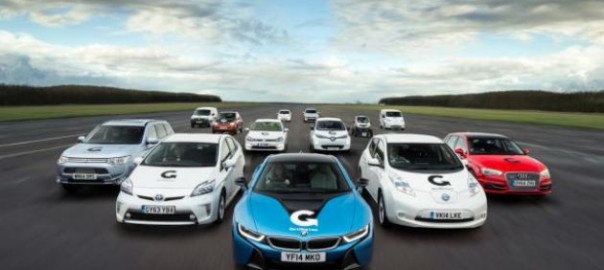
The Go Ultra Low campaign is the first of its kind, bringing together the Department for Transport (DfT), the Office for Low Emission Vehicles (OLEV), the Society of Motor Manufacturers and Traders (SMMT) and a consortium of seven car manufacturers – Audi, BMW, Mitsubishi, Nissan, Renault, Toyota and Volkswagen.
The BMW i8 is sleek and stunning, but it’s no V-8-powered supercar. Is it the car that will give plug-in hybrids sex appeal?
First, you need to know what makes the i8 go. This is no straightforward supercar: The i8 gets power in a complex way–it can be front-wheel drive, rear-wheel drive, or all-wheel drive, depending on the situation.
Here’s how: Between the front wheels there’s a 96-kilowatt electric motor–the equivalent of 131 horsepower. It sends power to the front wheels through a two-speed transmission.
That electric motor taps into a 5.1-kilowatt-hour lithium-ion battery mounted in the tunnel between the seats. It can run the car’s front wheels in its electric-only “Max e-Mode” up to 75 mph.
In the back, there’s a turbocharged 1.5-liter three-cylinder gasoline engine producing 231-horsepower. That power goes to the rear wheels through a six-speed automatic transmission.
Combine them, and you have 362 horsepower, and a 0-62 mph time of 4.4 seconds when using both powertrains together.
Put the BMW i8 into Comfort mode, and the i8 behaves like a hybrid, blending gas and electric power as needed. Go faster than 40 mph, and it sends power to every wheel, for all-wheel drive.
Flip into Sport mode, and the gauges glow red, a tachometer replaces the power meter, and the powertrains go into beast mode.
Can the i8 really be an eco-friendly sports car? The EPA says it can run in pure electric mode for 15 miles; in hybrid mode, the i8 earns ratings of 28 mpg combined and 76 MPGe.
Drive it like a sports car, and you might only see 50 mpg on average. But when you do, you’ll get attention. A lot of it.
Let’s be clear: The i8 really isn’t a track car. It strikes a nice balance between sporty performance and high efficiency. It has really neutral handling, and precise electric power steering with decent simulated feedback.
It also has what we call “engineered” noise: BMW pipes in simulated power noises to make the i8 sound more sporty. Those noises get louder in Sport mode…but the i8 never is really, truly, blindingly fast. It’s just quick.
The drivetrain is exotic, but the i8’s shape is truly outrageous. Sure, there’s a BMW grille and something like a 6-Series shape, but it’s all swept up in huge futuristic swoops and scoops and wings–which all help smooth out its aero profile.
It’s something of a chore to get into the i8, but once you’re in, the usual iDrive controller and infotainment screens will be familiar.
The climate control and stereo both feature actual knobs, which is nice, and the gauge cluster is an LCD screen, which reconfigures itself based on the driving mode you’ve chosen.
These front seats are very comfortable, with heavy contouring. You sit low in the car, but visibility is just fine. BMW may say the i8 is a 2+2, but don’t expect to put average-sized humans back there if an actual adult sits up front.
The BMW i8 hasn’t been crash-tested yet, and frankly we want to see it happen–its bodyshell is made of carbon-fiber-reinforced plastic on an aluminum rolling chassis, and little crash-test data exists for cars made that way.
The i8 gets the standard suite of safety tech, from six airbags to the usual electronic safety systems, plus such active safety systems as a forward-collision warning system and surround-view cameras.
Priced from about $135,000, the i8 comes well-equipped, with iDrive and a 10.2-inch screen, navigation, BMW’s i Remote App, six-way power front seats, heated seats, LED headlights, and satellite radio. There are few options other than color.
So what’s the bottom line with the BMW i8? It’s a ground-breaking sports coupe with an advanced hybrid powertrain that has super economy and style, if not quite supercar performance.
Outside of Norway and the Netherlands, electric vehicle market share remains under 1 percent, even in environmentally progressive countries such as Iceland and Sweden. While the benefits of wider electric-car adoption — including reduced urban air pollution and a lower long-run cost of vehicle ownership — are well known, researchers in Britain have put some numbers behind the economic effects of battery-powered transport.
Assuming a much broader acceptance of electric cars than exists today in Britain, researchers concluded that the country’s dependence on oil imports could drop by 40 percent, saving drivers 600 British pounds ($905) a year in fuel costs, which would eventually offset the higher upfront price of electric cars. At the same time, the overall economic impact of a broad shift toward electric cars would yield a modest national economic benefit. The implications in the report go beyond Britain, suggesting that countries that depend on oil imports and use more renewable energy have the most to gain economically from investing in electric-car infrastructure.
“Based on the current body of evidence, we conclude that a transition to low carbon cars and vans would yield benefits for U.K. consumers and for the environment (both in terms of reduced greenhouse gas emissions and reductions in local air pollution), and have a neutral to positive impact on the wider economy,”
said Cambridge Econometrics, an independent consultancy, in the study that was released Monday. But in order to get there, governments and the private sector will have to greatly increase infrastructure investment — and soon.
In order to greatly reduce the harmful pollutants emitted by internal-combustion engines by mid-century, the report estimates Britain would have to grow electric-car use from less than 20,000 vehicles today (out of about 35 million vehicles last year) to more than six million by 2030 and 23 million by 2050. This wouldn’t be an easy task.
To get tens of millions of electric cars on Britain’s roads over the next 15 years, the government and private sector would have to build out the charging-station infrastructure to allay consumer concern about running out of power before finding a place to plug in, a phenomenon known as “range anxiety.” According to a report last week from the Human Factors and Ergonomics Society, an organization based in California, range anxiety lessens over time among electric-car owners. However, it’s commonly understood in the industry that electric-car skeptics aren’t going to get over their concerns until they see a combination of longer electric-car ranges (most electric cars travel less than 100 miles per charge), faster charging times (it can take 20 minutes to “fill up” an electric car to 80 percent at a fast-charging outlet) and more charging stations.
“There will be a transition in the next five to 10 years but you won’t see a sudden shift to electric vehicles until consumers have got over their ‘range anxiety’ concerns — and that will only happen with infrastructure spending,”
Philip Summerton, one of the report’s authors, told the Guardian in a report published Tuesday.
In January 2013, the European Commission proposed a $10.7 billion program to build out electric-car charging stations across the European Union. In Britain the plan would have boosted the number of these outlets from 703 in 2012 to 1.22 million by 2020. Other European Union states would have seen similar increases, but by the end of 2013, EU member states, including Britain, successfully delayed the measure, citing the high costs.