Category Archives: Electric Cars

News and reviews of the latest electric cars (full electrics and plug-in hybrids).

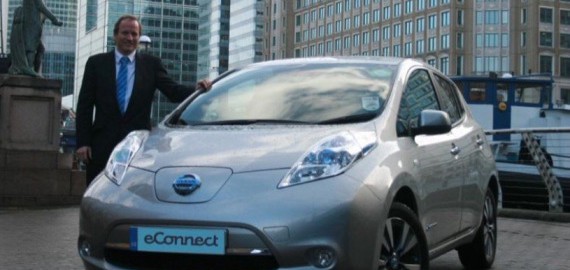
Nissan Leaf taxi (Image: eConnect)

Paddington Trainriders Now Have Option Of EV Taxis

Those that often take the train from Paddinton (in London) now have a new means of getting to and from the stations — and a new, electric means at that — according to recent reports.

Thanks to a new partnership between the taxi service eConnect cars and First Great Western services, travelers will now be able to pre-book taxi transfers to + from the train stations in a Tesla Model S or a Nissan LEAF.

For those that can’t afford to actually own a Model S, but still love the things, this might be a good way to get your fix, I suppose.

“This is the first time a train operator has partnered with an electric vehicle operator in London to create a transport solution that truly represents smarter, greener travel for those coming to and from London,” stated Alistair Clarke, owner and managing director of eConnect cars.

For a bit of background here, eConnect cars was established just last January (in 2014) in London, and has, to date, provided more than 10,500 customers with taxi service and traveled over 93,000 miles doing so. All in electric vehicles of course.

According to the company, the use of an all-electric fleet for such service resulted in the prevention of 40 tonnes of carbon dioxide emissions last year.

All in all, if I take that route anytime in the near future, I think that I’ll probably have to give the service a try. Probably beats a gas taxi pretty handily.

Source: EV Obsession

2015 Kia Soul EV first drive

Kia is set to launch its first electric car in the UK. The Soul EV looks great, but high-tech typically brings high prices. Can this stylish EV really ever add up?

[From November 2014] According to figures compiled by Kia, the fastest growing segment in the car market is electric vehicles, so it’s not surprising that the Korean giant has chosen to make it’s popular mini SUV, the Soul, available as an electric-only version. The Soul EV goes on sale in the UK before Christmas.

Far from simply ditching the conventional engines in favour of an electric motor and a battery, the Soul has undergone a fairly radical rethink in order to go zero-emission. With Kia also working on hybrid, plug-in hybrid and hydrogen technologies, it is fair to say that the firm is hedging its bets a little, but the Soul is its first attempt in the UK, at least, to push something that doesn’t run on petrol or diesel.

Kia is going to appoint a selection of its dealers to sell and service the EV, but it has modest sales expectations, with around 170 units a year expected to find homes. As a result, only one trim level and two colour schemes are available.

What’s the 2015 Kia Soul EV like to drive?

The standard Soul drives pretty neatly anyway, but it would reasonable to expect the extra weight of the batteries and electric motor to dull things dynamically. Oddly, that is not really the case. From behind the wheel, the Soul feels more than eager enough, as many electric cars do, thanks to instant availability of torque from rest. It can sprint to 60mph in around 11.5 seconds which is around a second slower than 1.6 diesel models, but the EV does so in virtual silence. The claimed range for the EV is 124 miles on a single charge and the top speed is 90mph, which mirrors the official figures of the Soul EV’s natural predator, the Nissan Leaf.

In order to take the additional weight of the batteries, the floor of the Soul has been beefed up with extra steel crossmembers, which has the effect of making it more rigid than the standard car. There’s also some 277kg of batteries beneath the floor, although if you are going to add weight anywhere, between the wheels and low down is not a bad place to do it. Aerodynamic improvements have also been made to make the EV slip through the air as cleanly as possible and this has reduced the wind noise at speed.

The effect of all this is that the Soul EV drives really very well. For town driving, there is a mode with extra regenerative braking to keep the batteries topped up, which allows one-pedal operation, where backing off the accelerator pedal essentially applies enough braking force. For most conditions, the standard drive mode requires less thought.

Refinement is usually a strong point of any electric car and so it is here. The ride is a touch firm, but is never uncomfortable, even over poor road surfaces.

What’s the 2015 Kia Soul EV like inside?

At a glance, the interior of the EV looks much like the standard Soul’s, but there are a few key differences. First up, Kia is keen to ensure that buyers know the EV is as green as it can manage, which means a lot of the interior materials are greener versions than those seen on the standard car. Items such as the dashboard panel, headlining and various plastic panels are made using bio- rather than petroleum-based plastics with a view to the car being more recyclable at the end of its life. It is nice place to be, though, regardless of what it is made out of.

There is only one interior finish available, and no options, because it’s already very well equipped with a large colour touch-screen infotainment and nav system. The cabin is finished in light grey with light blue piping; despite the floor being 80mm higher than in the standard car, to accommodate the batteries, the EV has reprofiled seats which ensure headroom is just as good as in the very roomy normal Soul. Both front and rear seats are comfortable and there’s plenty of room for four adults.

Boot space is also slightly reduced by the need to house all the electric paraphernalia under the floor, reducing the regular capacity by 30 litres, at 324 litres with the seats in place. All told, though, the boot is big enough for a car in this class and easily eclipses the BMW i3’s.

One thing that Kia is very proud of in the Soul is the hyper-efficient heating system. Typically, running the heater or air-conditioning in an electric car has a devastating effect on the range. Kia has developed two key technologies to mitigate this as much as possible. First is a setting which heats or cools only the occupied part of the cabin when there is one person on board. This means considerably less energy is expended and there is no detriment to the comfort of occupants.

The other clever development is that, rather than having an electric heating element to put a bit of warmth in the car on a cold morning, the Soul harvests warm air from around the car’s complex electronic systems, and from the ‘back end’ of the air-conditioning system, to ensure that no warm air is wasted when it might be put to good use. Kia reckons this system gives the car a significant advantage over rival cars, which lose considerable range in order to keep the cabin comfortable in hot or cold conditions.

Should I buy one?

Maybe.

Kia suggests the price is likely to be around £30k, with the government grant for plug-in cars dropping that to around £25k. That puts it at a slight disadvantage to the Nissan Leaf, which costs £23,590 after the grant when comparably equipped, and assuming you want to own the batteries – which is your only option with the Soul.

Nissan also offers the option of leasing the batteries for a monthly cost with the Leaf, which means you won’t be responsible for any maintenance, and also brings much lower initial purchase costs, with the top-spec Leaf Flex costing £18,590. Renault offers the an even cheaper rival to the Soul – the Zoe, which is smaller and can only be had if you lease the batteries from £70 per month, but will still seat four comfortably and be practical to live with, and costs from just £13,995.

Viewed in isolation, the Soul EV is a very appealing, technically clever and nice to drive electric vehicle but even with the government discount for plug-in cars, it is still likely to be too pricey for the majority to consider as a stylish second car. If you like the Soul, a petrol version in a comfortable trim level will be £10,000 cheaper, and that buys you a lot of petrol.

That said, if an electric car fits into your lifestyle, the Soul EV is a very likable, practical addition to the market and should be considered a genuine rival to the Nissan Leaf, Renault Zoe and even the BMW i3.

Source: What Car

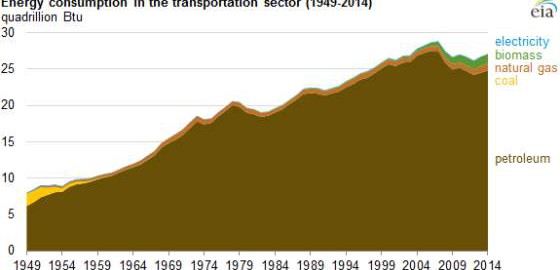
Energy consumption in the transportation sector, 1949-2014 (Image: US EIA)

How The Transportation Sector Is Moving Away from Petroleum

More than 8% of fuel used by the transportation sector came from non-petroleum sources in 2014

The transportation sector is moving away from oil slowly but surely. Driven by growth in the use of biofuels and natural gas, non-petroleum energy now makes up the highest percentage of total fuel consumption for transport since 1954, according to a new report from the U.S. Energy Information Administration (EIA).

In total, 8.5% of fuel used by the transportation sector came from non-petroleum sources in 2014. Biomass from corn-based ethanol—still supported by generous government subsidies—represented the largest non-petroleum energy source and was used primarily to fuel cars and other light vehicles. Use of natural gas to operate pipelines followed close behind. The report also shows smaller but still significant increases in the use of electricity, biodiesel and natural gas in vehicles.

Climate change and fluctuating oil prices has made moving away from petroleum when possible a priority for governments and corporations alike. But it’s still uncertain which fuel will be the best and greenest replacement, according to Christopher R. Knittel, an MIT professor of energy economics . Ethanol, natural gas, hydrogen and electricity are all possibilities.

“We don’t know where we’ll be 50 years from now,” said Knittel. “There are four potential replacement for petroleum, and, ultimately, we don’t what’s going to win out.”

Energy consumption in the transportation sector, 1949-2014 (Image: US EIA)

While the overall trend away from petroleum is encouraging—petroleum accounts for over a third of global greenhouse gases—the newfound reliance on biomass might be seen as a double-edged sword. Using ethanol, which is currently mixed with petroleum and represents around 10% of the gas sold for most cars in the U.S., provides only “marginal benefit” over petroleum in terms of greenhouse gas emissions, according to Knittel. Using electricity in the transport is generally better and cleaner, but the technology is still in its early stages. Where it does exist, as in Tesla cars, it’s often expensive and impractical for large-scale use.

Source: Time

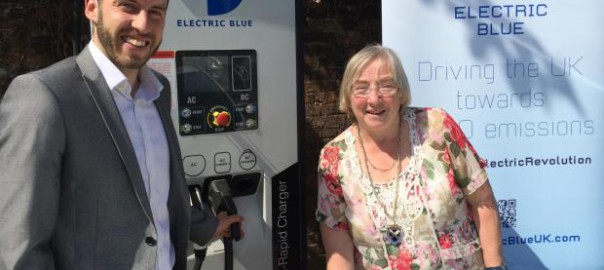
The Deputy Mayor of St Albans, Gill Clark, is pictured with the MD of Electric Blue, Alex Calnan, who is from Redbourn

St Albans switches on the Electric Revolution

The first fully electric taxi and rapid charging point has been unveiled in St Albans.

A new scheme, run by St Albans based business, Electric Blue, is introducing the city’s 300 licensed taxi drivers to the benefits of switching to all-electric cars, which are emission free and more cost-effective to operate than current cars.

The Deputy Mayor of St Albans, Gill Clark, is pictured with the MD of Electric Blue, Alex Calnan, who is from Redbourn

Powered by 100 per cent renewable energy, Electric Blue has also unveiled the first Rapid Charger point in the city centre, located in Adelaide Street, which allows a driver to recharge his cab fully in 25 minutes.

In partnership with St Albans District Council, local Nissan dealer Glyn Hopkin, and other electric infrastructure partners, such as Evalu8 and APT Controls, Electric Blue offers taxi drivers the complete package and the opportunity to trial a taxi before they make the switch.

The first Nissan Leaf EV taxi will take to the streets of St Albans next week, according to Managing Director of Electric Blue, Alex Calnan, from Redbourn, who started the business in 2014.

He said: “Today marks an important step forward in the city’s ambitions to improve air quality for residents, as well as helping to reduce carbon emissions by harnessing electric power on our busy streets.

“We’ve received an extremely positive response from drivers so far and once the first taxi is operational, we expect take up to increase exponentially, as owners and customers see the benefits.”

Last month saw the launch of a Rapid Charger and the first all-electric taxi in Watford and Electric Blue will be expanding its network across a number of major UK towns and cities during 2015.

A recent nationwide consumer survey highlighted St Albans as the worst UK city outside of London for vehicle emissions.

Confused.com surveyed 2,000 motorists and ranked cities on a league table based on average emissions produced by each registered car across the UK, using data from a given postcode.

Source: St Albans Review

Living with the Kia Soul EV

ECO FACTS

Model/Engine size: Soul EV

Fuel: Electric

Fuel economy combined: N/A

Green-Car-Guide rating: 9/10

INTRODUCTION

We’ve already driven the Kia Soul EV at its UK launch, but what is it like to live with, and does it have a more practical range than rivals in real-life?

SUMMARY

• All the normal electric car qualities: very refined, quiet, strong acceleration

• Attractive benefit in kind company car tax and low running costs

• Reasonably spacious, practical shape for an EV

• Limited range may not suit everyone, and subjective styling

BACKGROUND

Having some degree of electrification on our cars is the only way to achieve our emission reduction targets. Plug-in hybrids provide a practical overall driving range, but a small electric range, but pure EVs mean zero-tailpipe emissions – if you can cope with the limited overall driving range. A number of manufacturers are bringing EVs to market, even with the prospect of small sales numbers; the Soul EV is Kia’s offering, and it promises a longer range than rivals, with an individual shape and styling.

DESIGN & ENGINEERING

Two distinct types of electric cars are now emerging – ones that are designed from the ground up as electric cars – such as the Nissan LEAF and BMW i3 – and ones that are standard models with the petrol engine replaced by an electric powertrain – such as the Volkswagen e-Golf, and now the Kia Soul EV, which is built on the same production line as the petrol and diesel Souls.

006-low-res_Kia_Soul-EV_GCG

So this is a regular Soul, but with a 275kg lithium-ion polymer battery bolted underneath the floor and the electric motor (producing the equivalent of 109bhp) under the bonnet.

The rest of the interior and exterior is virtually the same as a petrol or diesel Soul, apart from aerodynamic features such as the blanked-off front grille and special lightweight alloy wheels (the basic Soul body is not the most aerodynamic of shapes). There are also super-low rolling resistance tyres, which can reduce energy consumption by as much as ten per cent compared with regular low rolling resistance tyres.

The electric powertrain has no impact on space inside the car apart from an 80mm higher floor for rear seat passengers, and luggage capacity is reduced by 31 litres to 281 litres to accommodate charging cables under the boot floor.

The Soul EV’s interior heating controls can just be used by the driver only, to save energy. It also has an intelligent heating, ventilation and air conditioning (HVAC) system which includes a heat pump to recycle air that has already been heated or cooled within the cabin. The interior can be heated or cooled while the car is plugged in, so saving battery power on the move.

Kia claims that its battery has a class-leading energy density of 200 Wh/kg and an energy storage capacity of 27 kilowatt-hours, and there’s a heating and cooling system to keep it at an ideal operating temperature.

The Soul EV can be recharged using a standard domestic socket, a wallbox supplied as standard with the Soul EV, a public fast charger, or a public rapid charger. Using a UK 230-volt domestic power supply, the Soul EV can be fully recharged in 10 to 13 hours. With the wallbox or a public fast charge point, the time can be reduced to around five hours. Using a public rapid charger the batteries can be topped up to 80 per cent of capacity in 33 minutes.

KIA SOUL EV DRIVING EXPERIENCE

We previously drove the Kia Soul EV on its launch on a fairly short route in London, and initial impressions were good, but what is it really like to live with over a longer period, as part of everyday life?

We drive a range of different cars every week, including petrol, diesel, hybrids and EVs, and it’s always the EVs that provide the best experience in urban driving. They’re virtually silent, very refined, have great response when accelerating, and with no gears or clutch, they’re easy to drive. However these are qualities that are common to all EVs, so how does the Soul differ?

The key difference is that the Soul does genuinely appear to have a longer driving range than most rivals. We’re not talking about a huge difference, but when you need to cover 80 miles in one day, in a car that has a range of around 80 miles in real-life driving, an extra 10 miles range makes a big difference.

You notice this most when keeping an eye on the remaining range during driving – the range displays of other EVs have a habit of plummeting under many driving conditions, whereas the indicated range left on the Soul EV remains much more constant.

The outcome of the range not plummeting is that you find yourself not having to recharge the car every night – you can go two to three days without charging.

Another practical benefit of the Soul EV is its spaciousness. Although based on a supermini footprint, because it is essentially a square box, it does have more room inside for people and luggage than most other EVs. Having a compartment under the boot floor for cables may reduce some of the official luggage space, but it’s a neater solution than having cables lying in the boot. It has a very clearly laid out dashboard which features an excellent reversing camera.

The Soul EV has a comfortable ride and decent handling, helped by the low centre of gravity due to the batteries, and the steering is well-weighted, but the brakes, due to focusing on regenerating energy, have a different feel to conventional petrol or diesel cars and take a bit of getting used to.

The main issue with the Kia Soul EV is its styling. The ‘normal’ Soul looks perfectly acceptable, however the EV version has features such as the blanked off grille, flat wheel covers, high profile, energy efficiency tyres, and in the case of our test car, blue bodywork and a white roof. Overall this gives the impression of a ‘cartoon car’. This contrasts to the likes of the BMW i3, which has super-cool styling. We would suggest that Kia needs to look at the styling of the Soul EV and make it less ‘eco’ and more desirable for both private and business buyers.

KIA SOUL EV ECONOMY AND EMISSIONS

The whole point of living with the Kia Soul EV for a week was to find out what its range was in real-life, and to see if that was sufficient to live with. The official range of the Soul EV is 132 miles on one charge. Just like the discrepancy between official and real-life mpg figures, the same discrepancy also exists between official electric range and real-life electric range. On average over a week we achieved a range of 82 miles between charges. This is obviously less than the official 132 miles, but is better than some other EVs that we’ve tested, which have only managed around 64 miles in real-life.

We would stress that this range was achieved after typical driving; we’ve achieved a 40% improvement on the official range of an electric car on the RAC Future Car Challenge event, so with very careful eco-driving, we’re fully confident that you could achieve a range of over 100 miles in the Soul EV (in an urban environment rather than in any higher speed driving). The trouble is, there’s usually not the time, the inclination or the traffic situation to drive in an eco-fashion consistently.

Of course the big idea behind pure electric cars is that they have zero tailpipe emissions. It’s impossible to have missed all the stories in the media over recent months about the air quality problems in our cities, with diesel engines being responsible (particularly old diesel buses, taxis and trucks rather than modern diesel cars). Pure electric cars such as the Kia Soul provide a solution to this problem.

However EVs can be accused of just moving the emissions problem from the tailpipe to the power station, so ideally electric car owners would charge their cars using a renewable energy source, which would mean both the car and its energy would be zero CO2.

PRICE, EQUIPMENT AND MODEL RANGE

There’s only one Soul EV model and it costs £24,995 after the £5,000 government Plug-in Car Grant. You can choose between two colours, blue (with a white roof) or silver. Kia will also install a recharging point at your home if you buy a Soul EV – as long as you have suitable off-road parking. The Soul EV is no different from any other Kia in terms of the reassurance offered; it comes with a seven-year, 100,000-mile warranty.

CONCLUSION

So, after a week of living with the Kia Soul EV, would we buy one?

The first consideration has to be whether a pure EV is suitable for your driving needs. Pure EVs are ideal for use in urban areas, where they can help combat issues of air pollution. However off-street parking to allow charging is often a challenge in urban areas. Although an infrastructure of public charge points is being built up, all the statistics show that people mostly charge at home or work.

So although the ideal is that a pure EV such as a Kia Soul is a person’s only urban mode of transport, the reality is that many EVs are bought as a second car, when there is also typically a decent-sized, diesel-powered estate car in the household. In this scenario cars such as the Soul EV are ideal for shorter journeys. The issue is whether the whole life costs stack up, which may be an issue if only low mileages are covered.

From a business perspective, the Soul EV would be ideal for regular short journeys, and the company car BIK tax rate from April 2015 is just 5% (it was zero prior to this date). Although the purchase price is high compared to conventional cars in this class, running costs are very low – around one-fifth of a petrol car.

So, if you think a pure electric vehicle would be suitable for you, should you choose a Kia Soul EV? It has a better real-life driving range than some rivals, and it’s a practical shape. It drives equally as well as other EVs. On the downside, the styling may not be to everyone’s tastes.

So after a week living with the Soul EV, overall it remains a perfectly acceptable car to live with if it’s suitable for your driving requirements, and it offers another choice in the fairly limited pure EV market place; it maintains its original Green Car Guide rating of 9 out of 10.

Source: Green Car Guide
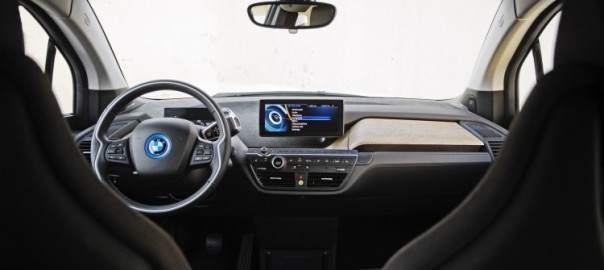
BMW i3 interior

BMW i3 Wins Ward’s 10 Best Interior Award

Only one plug-in vehicle was selected by Ward’s Auto for its “10 Best Interior Award” and that vehicle is the BMW i3.

BMW i3 interior
BMW i3 interior

Here’s why Ward’s deems the i3 worthy of this award:

The i3 electric vehicle comes across as the type of interior seen in concepts at auto shows, often followed by production versions that lose some of the far-out edginess.

The i3 boldly goes where many automakers have yet to tread: deeply into the future. WardsAuto editors pick the i3 for its utility, use of recycled materials and for breaking ground with clever new interior design elements.

From a materials perspective, editors consider the i3 an absolute moonshot, not only for its carbon-fiber tub and thermoplastic exterior body panels but also for the recycled pop bottles and hemp used extensively throughout the cabin and the leather tanned with olive-leaf extract.

It’s a wild, surprisingly roomy interior that manages to be beautiful while fitting with the offbeat exterior

Source: Inside EVs

Renault Cléon announces 100 new jobs to accompany the launch of the alliance’s new electric engine

The Renault Cléon plant will create 100 jobs with open-ended contracts in 2015 as part of a plan announced by Carlos Ghosn on February 12. The plan involves the hiring of 1,000 people in 2015, including 500 in French plants.

More than 50 years after it was built in 1958, the Cléon plant is taking on the production of the all-Renault electric engine, the R 240. Combined with optimised battery management, this engine extends the ZOE’s range to 240 kilometres[1] – a boost of 30 kilometres.

To enable the launch, €50 million were invested from the €300 million earmarked for the plant in 2011. This new technology is part of the Alliance’s electric strategy and will also benefit Renault partners.

100 jobs created

By creating 100 new jobs, the Cléon plant is reinforcing its skills to meet high commercial demand from the Alliance partners. These permanent positions will go to candidates in a range of occupational categories and having varied qualification levels, from vocational training certificates to two-year post-baccalauréat diplomas.

This job creation program follows a training plan developed in 2012, which features approximately 6,000 hours of training in preparation for the production of the R 240. The plan includes general theoretical training on the electric engine for all players involved in the project as well as technical training on the machines, in cooperation with the suppliers, for operators and maintenance staff.

Renault’s acquired electrotechnical expertise serving the alliance

Cléon has been leveraging its experience for a little more than two years with the production of the ZOE Junction Box, the system developed by Renault Technocentre engineers that manages the car’s energy transfers. The Cléon plant has mastered the assembly of electronic modules and gained invaluable experience for the production of the powerful R 240 electric engine. This expertise has made it possible to extend the ZOE’s range to 240 kilometres[1] – a boost of 30 kilometres – and will also benefit Alliance partners.

For the comparable common components of Renault and Nissan engines, the engineering and operating teams drew inspiration from Nissan’s experience in producing the LEAF engine. Cléon also gained from the expertise of local businesses that manufacture electric engines for other purposes.

Recognised industrial activity

The engines and gearboxes produced at the Cléon plant have been a true success which, in the first quarter of 2015, translated into an overall increase in activity and proportionally more business from partners (Nissan, Dacia, Samsung, Daimler, General Motors). These partners accounted for 43% of the plant’s engine and gearbox production in Q1 2015 compared to 37% at end-2014.

In addition to this burst in activity to meet high demand from Renault, Nissan and Daimler, the Cléon plant is also gearing up for several launches. The plant, which already supplies engines and gearboxes for the Trafic, recently delivered the first engines for the Opel version of the van. New vehicles in the Renault range such as the Espace and the Kadjar also benefit from powertrain components produced at Cléon. And the ZOE already features the Alliance’s brand new electric engine, the R 240. These recent and upcoming launches should help increase the site’s manufacturing volumes.

“This is fantastic news for the Cléon plant. These new hires will reinforce Renault’s skills in terms of designing and manufacturing electric vehicles. This activity in France, at the heart of the European market, is part of the Alliance’s electric strategy and will benefit its partners as well.” Stefan MUELLER, Executive Vice-President, Chairman of the Europe Region

Source: Renault Media

Ultra-low emission registrations up 386% on first quarter of 2014 (Image: OLEV)

£5,000 green car grant could go after Government says it will review subsidy

£5,000 green car grant could go after Government says it will review subsidy to avoid ‘exhausting the budget too quickly’

  • Motorists wanting to go ‘green’ with electric cars may need to move quickly
  • £5,000 green car subsidy could soon be phased out, say motoring groups
  • Government will be reviewing grants to avoid ‘exhausting the budget’
  • RAC Foundation said this is likely to spark a rush of orders for plug-in cars

A £5,000 subsidy for motorists wanting to go ‘green’ with an electric car could be phased out imminently, according to motoring groups.

The Government has said it will be reviewing the level of grants for ultra-low-emission vehicles over the coming months to avoid ‘exhausting the budget too quickly’.

It is likely to spark a rush of orders for plug-in cars before any changes from the shake-up come into effect, according to the RAC Foundation.

Over 25,000 claims have been made since the grant was introduced four years ago in a bid to spark a boom in emission-free cars.

The latest electric car grant eligilbiity guidance from the Government’s ‘Office for Low Emissions Vehicles’ spells out:

‘In May 2015 we will commence a review of plug in grant levels.

‘Following this review, new levels of grant will be available per category. We will communicate the changes as soon as they are agreed.’

The Government said:

‘We will announce the new grant levels following our market review, which we will start in May.

‘We will be observing the market over the next few months so we can set the grants at a level that will support the market as effectively as possible without exhausting the budget too quickly.’

For customers ordering an electric or ulta-low emissions vehicle during the ‘transition period’, the Office for Low Emissions Vehicles says:

‘The date that the dealership enters the claim onto our online claim system determines whether the terms of the current scheme or the new scheme will apply.’

Ministers first hinted at a phasing out of the subsidies back in September 2013 but insisted that support in some form would continue until 2020.

Read more: Daily Mail

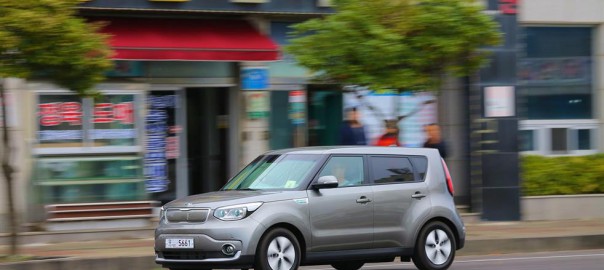
Kia Soul EV (Image: Kia America)

2015 Kia Soul EV + Long-Term Arrival

Mr. Toad’s Wild Ride

“So the question is — what next? I’ve driven the Tesla for so long that returning to a gas car feels like backward time-travel. Do I say giddyap to these things?”

That’s a line I wrote late in my 38,000-mile odyssey at the wheel of our long-term Model S P85+. Which, when it was recently returned — rolling silently (and cruelly) away without me in it — left me feeling as if my beloved starship from the future had abruptly dropped me back in the ordinary-old circa 2015. Plunk, there I am on the ground — amid a small puff of dust.

And there I bewilderedly sat, an alien from Elon Musk’s future returned to the primitive present.

No more giant multi-touch screen? No more magical over-the-air updates? No Superchargers? Back to driving mere ordinary cars? Never!

But even the irrepressible Mr. Toad in me had to face the fact that I needed a way to get around. So I started typing emails.

After coming up goose eggs in my attempts to coerce either Hyundai or Toyota into letting me sample their hydrogen fuel cell wares (the first, stymied by internal corporate barriers, the second, just premature timing), I made a list of available battery-electric cars. Based on what? One thing, baby. Range.

My round-trip commute is a minimum of 76 miles (a bit more when the 405 is closed for late-night construction, which it usually is). So, conservatively, let’s say its 80. Adding a 10 percent fear factor makes it 88. OK, now let’s run through the list of available non-Tesla BEVs out there:

  • Smart ForTwo: 68 miles — too short.
  • Ford Focus Electric: 76 miles — nope.
  • BMW i3 BEV: 81 miles — nope, but cool carbon-fiber tech.
  • Chevrolet Spark EV: 82 miles — nope.
  • Volkswagen e-Golf: 83 miles — nope, but certainly fun to drive.
  • Nissan Leaf: 84 miles — we’re inching closer.
  • Mercedes-Benz B-Class Electric Drive and Fiat 500e: 87 miles — ack, short by 1 crummy mile.
  • Kia Soul EV: 93 miles — eureka!

So the Kia is actually my one and only pure battery-electric choice since Toyota discontinued its slow-selling, 103-mile RAV4 EV ($49,800 — no wonder). The sole quasi-alternative was the BMW i3 with Extended Range, which would have amusingly punctuated my trips with brief firings of its two-cylinder engine-generator, needing refueling (with gas) every week and a half or so. Unfortunately, our slow-motion BMW-courting hasn’t resulted in a date; disappointing, but simplifying things.

Read more: Motortrend

Market share (new sales) of electric passenger cars (Image: Business Spectator)

Fuel price turbulence hasn’t pulled the plug on EVs

Among the biggest stories of 2014 was the crash in global oil prices. Just when it looked like the world had started to take $100/barrel oil for granted, prices plunged by 50 percent. Some speculated that lower oil prices would translate into reduced consumer enthusiasm for electric vehicles (EVs). Now that we have EV sales for 2014 tallied up, let’s look at how the story actually played out.

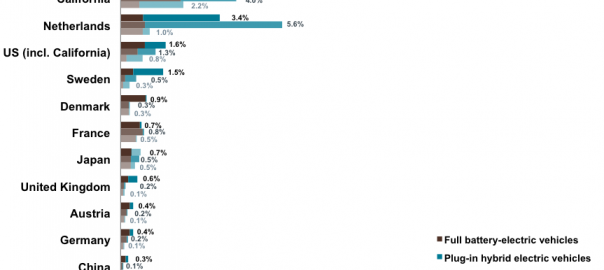
As it turns out, EVs, including battery electric vehicles (BEVs) and plug-in hybrid electric vehicles (PHEVs), continued to sell consistently around the world. The EV market share in Norway is still far ahead of other countries, at 13.8% of new car sales in 2014. However, in Sweden, the United Kingdom, Denmark, and China the EV market tripled, while in Austria and Germany the EV sales share nearly doubled. The Netherlands is the only country that saw a big drop in EV sales, from 5.6% to 3.4%, likely due to a decline in fiscal incentives. Electric vehicle market share in other countries, including the US, France, and Japan, remained consistent in comparison to 2013.

Further, compared to the first half of 2014, the dramatic drop in global fuel prices during the second half of 2014 did not have any measurable impact on EV sales, and some markets even saw EV sales spike towards the end of the year. There are two main reasons for this: (1) Savings from fuel/electricity costs are only part of all EV incentives, which mainly consist of a variety of fiscal or non-fiscal benefits, and (2) in some countries, particularly in the European Union, fuel taxes already account for a large share of total fuel price, so even during times of fluctuation in global oil price the price at the pump remains relatively stable.

Market share (new sales) of electric passenger cars (Image: Business Spectator)

Read more: Business Spectator