Nissan recently demonstrated the new 30 kWh LEAF to journalists in France.
Among the various media outlets was Fully Charged with Robert Llewellyn impressed by the longer range LEAF.
According to latest episode, it’s worth buying the 30 kWh version, as you’ll definitely notice the difference in range compared to 24 kWh – reasonably about 110-120 miles (107 miles EPA).
“A wonderful drive up a mountain in the South of France in the newly released 30kWh Nissan Leaf. No question, it’s a big improvement in terms of range and driver interface.
A bigger battery that’s not physically bigger, just 25% more energy dense.”
Renault believes in the strong potential growth for ZOE electric car sales, and as such is gearing up for increased production.
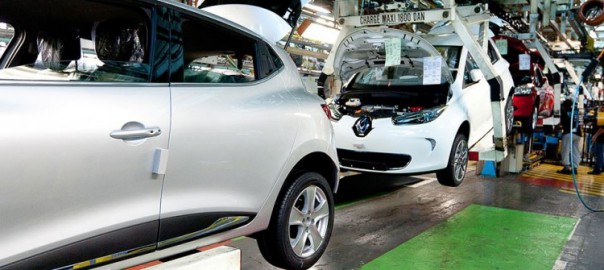
Renault ZOE Rolling Down Assembly Line
The Flins factory (in France) is already producing about 120 ZOE a day (up from 90 in the Spring, when the Superbonus was launched in France).
Now the company says that production will expand again – to 150 units a day by the end of November. The sudden change is probably adjusting for expected growth from the expanded diesel scrapping scheme in France next year and also higher demand throughout Europe.
To date, over 18,000 ZOE were sold in just France alone (nearly 7,000 in the first nine months of 2015) and 32,000 in total worldwide.
At 150/day, Renault would be able to deliver 3,000 ZOE a month (considering the French employees on the single shift working 20 days a month). Annual production would be ~36,000, a level of sales that the ZOE has never experienced such high volumes in the past.
Though sales of the Renault ZOE are far below the world’s #1 selling pure electric car (the Nissan LEAF), Renault is proud to report on a milestone achievement of having sold 30,000 ZOEs since it launch in 2012 through September. Actually, our tally had ZOE sales exceeding 30,000 back in August, but now Renault is making it official.
Surely sales world be higher if ZOE (or Renaults itself) were offered in the U.S., but for an electric car offered mostly (almost entirely in its early years) under a battery rental program, we consider 30,000 to be an exceptional figure.
The latest ZOE updates add more range to the car and it’s now being offered with the battery included in several countries, so we expect (and have already seen so far this year) a sales surge in the coming months.
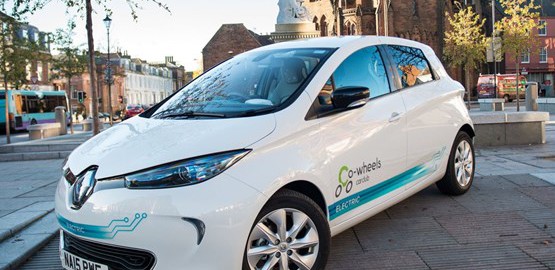
A 20-strong fleet of Renault ZOEs has been introduced across a number of new sites in Scotland by car sharing company Co-wheels, the most recent being in Aberdeen, Dumfries and Dundee.
The Co-wheels car club, which provides low emission, hybrid and electric cars on a pay-as-you-go basis for organisations and communities, has further locations for EVs in the pipeline with the ZOE confirmed as its electric car of choice. All of the club’s ZOEs have been bought outright or funded via Government grants.
Co-wheels customers can hire a Renault ZOE for £3.75 an hour or £22.50 for 24 hours. As part of the club’s drive to encourage electric car use, Co-wheels does not make an additional charge for mileage – making the ZOE its most affordable car to hire.
Pierre Fox, Director, Co-wheels, said:
“Feedback to the Renault ZOE has been excellent, customers liking how simple it is to drive and finding the controls to be very straightforward. It’s the ideal size too, and is the perfect vehicle for our car sharing model with 90% of customers’ journeys being local.
“Using the ZOE also fits with us operating as a social enterprise with a commitment to improving society and the environment. We aim to help our members save money, reduce car ownership and create a cleaner environment by making lower impact transport options available, and because we have received grants for some of the cars, we are able to pass this saving onto our customers.
“Everyone who has driven one of our ZOEs has been very positive about the experience, so much so that when it comes to adding more electric cars at new or existing locations, it will be our preferred choice of vehicle.”
Renault-Nissan Alliance CEO Carlos Ghosn published a post discussing the importance of the United Nation’s COP21 climate conference in Paris, which is supported by Alliance EVs.
Ghosn hopes for a new, broad global agreement on the climate change, strongly believing that we should deal with environment impact.
As an example for the automotive industry, Ghosn shows 800 million vehicles on the world’s roads, which will grow to more than 2 billion by 2050, according to expectations.
“We cannot continue to rely only on fossil fuels to power those vehicles and supply the bulk of our energy if we are going to avoid the worst effects of climate change.”
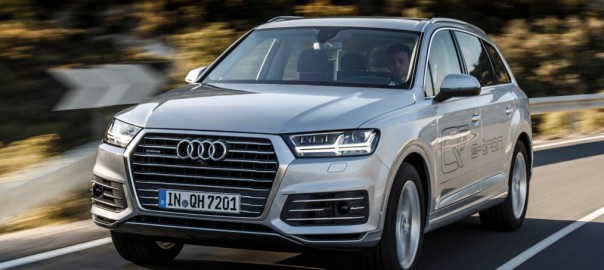
In future-proofing its big Q7 SUV, Audi has lost the 6th and 7th seats but, with an NEDC CO2 rating of 46g/km, has gained the Freedom the City of London for many years to come.
Audi Q7 e-tron PHEV
Losing the Congestion Charge involves charging a 17.3kWh liquid cooled lithium-ion battery that takes two and a half hours from a 400-volt industrial socket (or 8-12 hours from a domestic charging point).
But, driven sensibly, like the Volkswagen Passat GTE plug-in hybrid, it conserves and regenerates its energy very cleverly.
Depending on the circumstances, the Q7 e-tron can boost, coast and recuperate. The car drives off solely on electric power and normally most braking uses electric motor retardation that generates electricity. Set for hybrid mode, the MMI navigation system works with the hybrid management system using real time traffic data to become your “predictive efficiency assistant’ and compute an ideal driving strategy.
New plug-in hybrid Audi Q7 e-tron will cost a lot to buy, but not a lot to run
Verdict 4 stars
Like any plug-in hybrid, you’ll need regular access to a charge point to realise the efficiency claims of the Audi Q7 e-tron. That said, it’s unlikely to consume considerably more fuel than a standard 3.0-litre TDI even without charging the batteries. It still drives well and gets the same exquisitely finished cabin, meaning the only real sticking point is the price. For many, however, the lure of rock-bottom running costs in such a practical and well-engineered package will be too hard to ignore.
This is the plug-in hybrid Audi Q7 e-tron. Everyone’s at it: from pioneers Nissan to latecomers like Volvo, almost every manufacturer has an electric or hybrid model in its range.
Audi Q7 e-tron PHEV
It comes as no surprise, then, that Audi’s e-tron family is expanding. The popular A3 e-tron appeared only late last year, and there’s already an electric R8 supercar in the pipeline.
But the latest model to bear Audi’s plug-in moniker is the big and brash Q7 SUV. Using a 254bhp 3.0-litre TDI diesel engine mated to a 94kW electric motor, total power for the Q7 e-tron stands at 368bhp. It’s got a sizeable 700Nm of torque, too – which comes in handy when you’re lugging around 202kg of lithium-ion batteries.
From the outside, you’ll struggle to tell this apart from a standard Q7. Our car came with loud e-tron stickers down the side, but (sadly) these aren’t an option on customer cars. There are some subtle badges on the wings and bootlid, but aside from the additional filler cap it’s business as usual.
20 electric Renault ZOE superminis added to Co-wheels fleet
New Renault ZOEs drive growth of Co-wheels to over 50 UK locations
100% electric vehicle perfect for car sharing club model
ZOE is the most affordable car to hire from Co-wheels
Car sharing club chooses Renault ZOE (Image: Renault)
A 20-strong fleet of 100 per cent electric Renault ZOEs has enabled the only independently owned national car sharing club to expand its social enterprise-focused operation to over 50 UK locations.
Co-wheels has introduced the innovative Renault ZOE to a number of new sites in Scotland this year, the most recent being in Aberdeen, Dumfries and Dundee. The club, which provides low emission, hybrid and electric cars on a pay-as-you-go basis for organisations and communities, has further locations for EVs in the pipeline with the ZOE confirmed as its electric car of choice.
The club chose the Renault ZOE against other electric cars due to the value it represents and also its driveability. Co-wheels are finding the five-door hatchback very easy to use and ideal for members who have never driven an electric car before. All of the club’s ZOEs have been bought outright or funded via Government grants.
Co-wheels customers can hire a Renault ZOE for only £3.75 an hour or £22.50 for 24 hours. As part of the club’s drive to encourage electric car use, Co-wheels does not make an additional charge for mileage – making the ZOE its most affordable car to hire.
Pierre Fox, Director, Co-wheels, said:
“Feedback to the Renault ZOE has been excellent, customers liking how simple it is to drive and finding the controls to be very straightforward. It’s the ideal size too, and is the perfect vehicle for our car sharing model with 90 per cent of customers’ journeys being local.
“Using the ZOE also fits with us operating as a social enterprise with a commitment to improving society and the environment. We aim to help our members save money, reduce car ownership and create a cleaner environment by making lower impact transport options available, and because we have received grants for some of the cars, we are able to pass this saving onto our customers.
“Everyone who has driven one of our ZOEs has been very positive about the experience, so much so that when it comes to adding more electric cars at new or existing locations, it will be our preferred choice of vehicle.”
Ben Fletcher, Renault UK’s Electric Vehicle Product Manager, said:
“Co-wheels’ decision to use the Renault ZOE as its number one electric car perfectly illustrates how more and more drivers are finding the versatile hatchback ideal for their requirements and how Renault is rapidly increasing its share of the growing EV sector. We’re very pleased that the ZOE is proving so popular with Co-wheels customers and is helping them to lower their motoring costs and also do their bit to help preserve their local environment.”
The Renault ZOE is an all-electric, five-door family hatchback available in three trim levels that comes with a very high level of standard specification, despite its competitive price-tag, which starts from £13,445 after the Government Plug-in Car Grant. Standard specification includes items such as climate control and sat-nav.
ZOE is available with a number of features that make for seamless electric vehicle ownership including remote monitoring of the battery and pre-heating the cabin via your smartphone. ZOE also benefits from the patented Chameleon™ Charger that allows it to make the most of the widest range of power supplies and also keep charging times to a minimum – charging from zero to 80 per cent full in as little as 30 minutes. The official NEDC range is 149 miles – Renault estimates that in real-world driving conditions that this equates to around 106 miles in summer and 71 miles in winter. Retail ZOE customers also enjoy the free installation of a fast-charging 7kW wall box at home, giving a standard charge time from 0-100 per cent of just 3-4 hours.
Awarded the titles of What Car? 2015 ‘Best Electric Car for less than £20,000’ and ‘Best Electric Vehicle’ in the Auto Express Driver Power 2015 survey, the Renault ZOE is an affordable route to zero emissions in-use motoring.
In addition to the ZOE supermini, the Renault Z.E range also includes the Twizy urban runaround, an innovative open-sided two-seater vehicle, and the Kangoo Van Z.E that is perfectly suited to many commercial applications with its choice of four bodystyles and 106-mile range (NEDC).
In a UK electric car market up 54.5 per cent September year-to-date, sales of Renault electric vehicles in the UK were up by 92.4 per cent, to 1,316 vehicles, compared to the same period last year – dramatically outpacing the overall EV market of 54.4%. Renault Group UK sales for September YTD – comprising Renault cars, vans and Dacia vehicles – were up 17.4 per cent to 97,257 vehicles on the same period in 2014, again, significantly outpacing the overall market growth of 8.2 per cent.
A few months back I beat my previous record of driving our ZOE 300 miles in a day by taking it from Northampton to Falmouth and back in a weekend. The occasion was a friend’s 50th birthday party (which I confess took place just a month after mine).
Just about to finish at Cherwell (Image: T. Larkum)
I took notes of the various charging stops (timings, energy usage, etc.) but rather than give a blow-by-blow account I’ve put all the details in the table below. The consumption figures are from the ZOE’s dashboard, mpkWh is miles achieved per kWh used, and total kWh used. The charge percentage figures were before charging, each charge took this back to 99%.
Time
Location
Map Key
Distance
Charge
Consumption
1245
Northampton
A
1345-1420
Cherwell Services M40
B
32.0
59%
1440-1540
Kidlington (family visit)
C
10.5
4.88 mpkWh
1700-1750
Leigh Delamere Services M4
D
69.1
29%
4.49 mpkWh, 15 kWh
1915
Tiverton Services M5
E
70.0
28%
4.18 mpkWh, 16 kWh
2010
Exeter Services M5
F
Failed to charge
2115-2150
Cullompton Services M5
G
38
58%
3.58 mpkWh, 10 kWh
2340
Cornwall Services A30
H
83.6, 8 left
10%
4.24 mpkWh, 19 kWh
0100
Falmouth
I
29.8
55%
4.10 mpkWh, 7 kWh
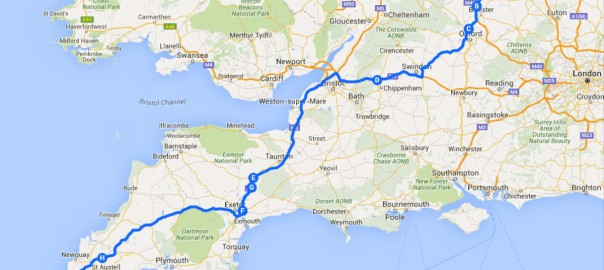
The Key letters in the table for each location relate to the map below.
Google Maps view of the route and stopping points (Image: T. Larkum)
On the whole the journey went pretty well. Although charging points are increasingly busy – for example, an orange BMW i3 was leaving the Cherwell charger just as we arrived – we never had to queue for a charge. However, reliability and availability are still an issue. To start with, the charges at Leigh Delamere and Tiverton started on the third and fourth attempts respectively.
Charging at Leigh Delamere (Image: T. Larkum)
As many EV drivers are aware, the south-west is a charging desert with very few opportunities for rapid charging after you come off the end of the M5. I knew in advance that it would be a stretch to get from Exeter all the way to the Cornwall Services at Victoria without a charge (73 miles) so when planning the route was only nervous about this part.
Topping up at Tiverton (Image: T. Larkum)
Unfortunately, it turned out to be worse than expected. We tried the charger at Exeter only to find it broken. Since I knew that going on was not an option we had to turn back and return up the M5 to Cullompton Services. We charged there fine, but of course we now had an even longer distance to get to Cornwall Services (84 miles).
Setting out I was pretty confident that we would be fine – I can generally coax 90-95 miles from the ZOE when needed. However, the weather deteriorated and we were soon driving into heavy rain, and driving on wet roads. Over the first half of the route it was very difficult to keep the consumption/mpkWh figure up high enough to be confident of arriving.
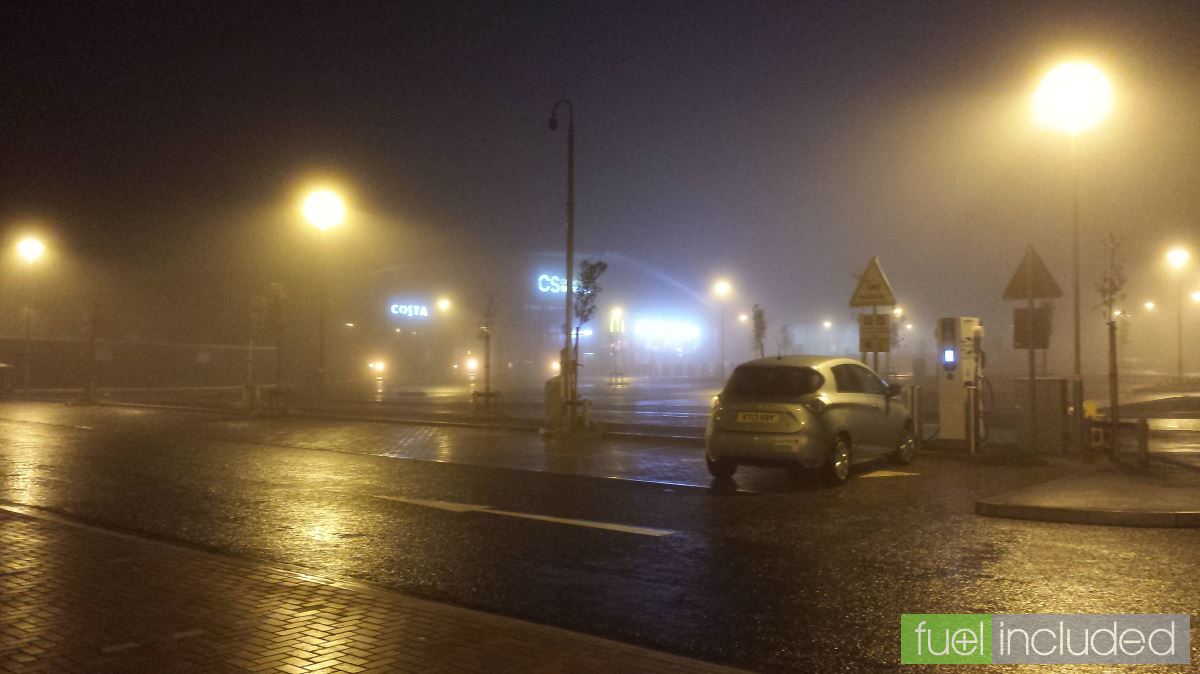
A miserable Cornwall Services late at night (Image: T. Larkum)
However, once past the half way point it started to improve – perhaps we had actually been climbing in altitude too and gone over a peak, and we actually arrived at Cornwall Services without incident. Having said that, we had gone 83.6 miles and the range predicter was showing just 8 miles left and was beeping in panic. It was a welcome sight to turn into the services after midnight despite it being cold, dark, wet and closed.
The view from our hotel window in Falmouth, ZOE in foreground (Image: T. Larkum)
The last leg of the journey was uneventful and we arrived at our hotel at 1am, with at least an hour of the journey time down to the broken charger at Exeter. Overall we had had 5 successful charges out of 6 attempted.
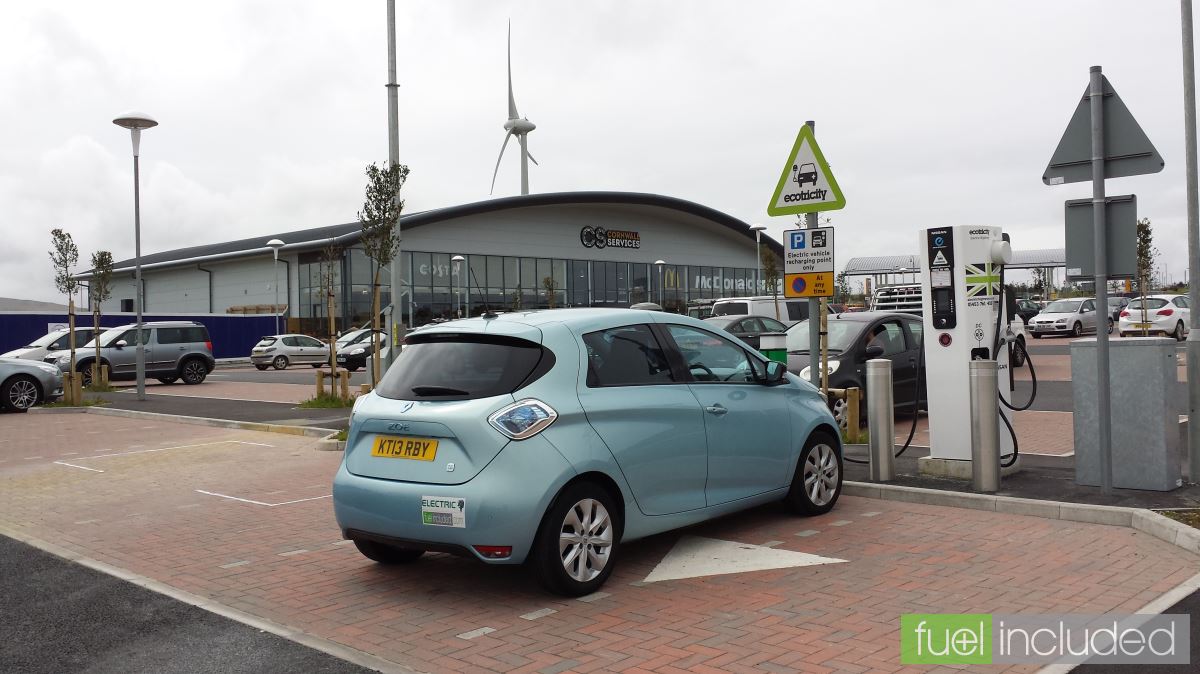
Cornwall Services looking better in daylight (Image: T. Larkum)
We had a good weekend in Falmouth and the party went well. We had a nice room at The Greenbank Hotel with a lovely view over Falmouth Harbour. Unfortunately neither Falmouth nor the hotel had facilities for charging so we had to explore the town on foot to conserve the charge for getting back to Cornwall Services on the return journey.
An extra stop at Sedgemoor (Image: T. Larkum)
The journey home was straightforward, the only issue being a broken charge point at Leigh Delamere East Services, forcing us to cross over to use the westbound services. Returning home is always easier than outbound trips since you know that there’s a working chargepoint at your destination, so you don’t need to charge once you’re within reach of it. We could have managed with four stops to charge, but in fact stopped an extra time (at Sedgemoor) for a toilet break having been stuck in traffic and made use of that with an extra charge.
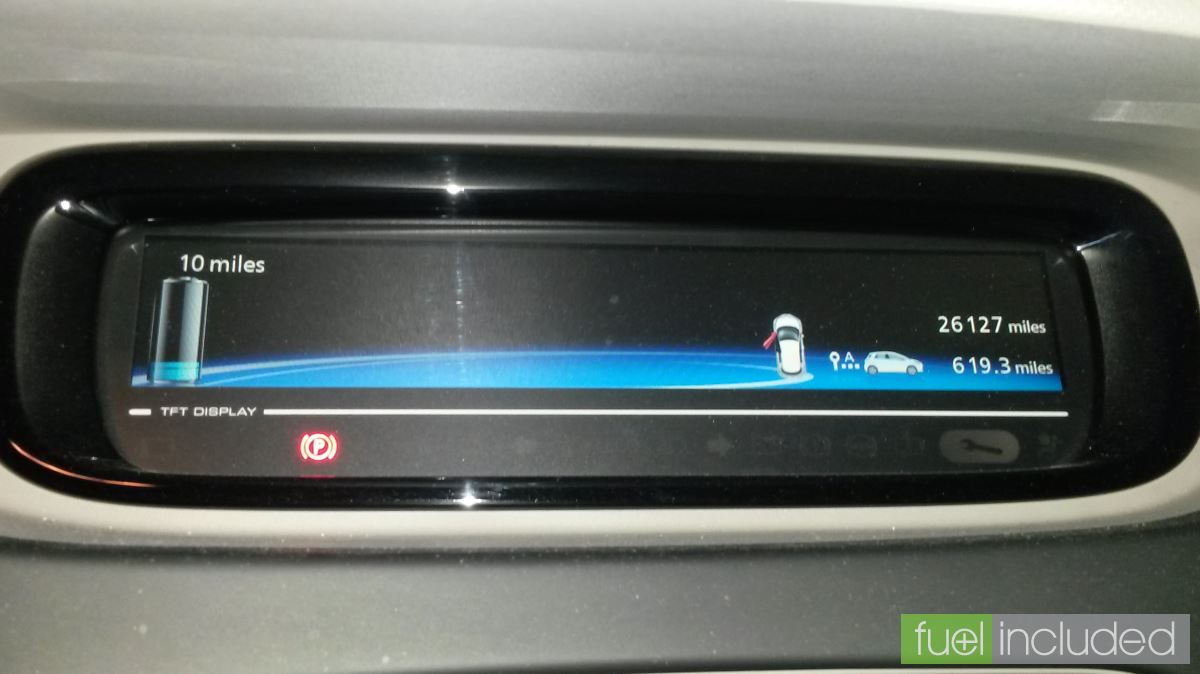
The dashboard display on arriving home (Image: T. Larkum)
On getting back home we found we had driven 619.3 miles between Friday lunchtime and Sunday evening.