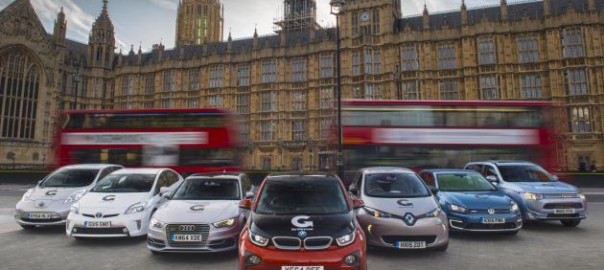
Sales of vehicles eligible for the UK Government’s Plug-in Car Grant (PiGC) have started the year strongly, taking 1.3 per cent of the overall market – the joint second highest market share ever. This is according to figures released by the Society of Motor Manufacturers and Traders (SMMT) today (Thursday 4th February).
There have been 2,176 PiCG eligible vehicles registered in January 2016, a 26.9 per cent rise compared with the same period last year. Of these 584 were pure electric vehicles (EVs), seeing a 14.1 per cent increase, while plug-in hybrid vehicles (PHEVs) increased sales almost by a third at 32.3 per cent. Since the launch of the Plug-In Car Grant in January 2011, there have been 49,866 eligible cars registered.
Plug-in registrations January 2016 (Image: SMMT)
The Alternatively Fuelled Vehicle (AFV) market, which includes models such as conventional hybrids and hydrogen fuel cell powered vehicles, saw 6,075 registrations in January which also represents a significant increase of 32.1 per cent against January 2015.
The AFV market share now sits at 3.6 per cent of the total 169,678 vehicles registered in January – itself an increase of 2.9 per cent – an improvement over last year’s 2.8 per cent.
Renault will provide used EV batteries to Connected Energy Ltd for second-life application in its E-STOR product
Renault is the electric vehicle market leader in Europe
E-STOR is a revolutionary energy storage system that can reduce costs and enable more flexible and efficient use of energy – including high capacity fast charging
E-STOR will be available in the UK from July 2016
2016 -Connected Energy Ltd E-Stor and Renault ZOE (Image: Renault)
Renault and Connected Energy are partnering to develop sustainable and efficient ways of using electric vehicle batteries at the end of their useable in-vehicle life in order to supply innovative and more affordable vehicle charging solutions.
At the end of their useful in-vehicle life, Renault EV batteries still have considerable remaining capacity, which means that they can continue to give great service in other applications before they are ultimately recycled. And with rapidly increasing EV sales – 97,687 EVs were sold in Europe in 2015, up 48% on 2014 – so is the requirement in energy to charge them.
E-STOR: a flexible and environmentally friendly energy management system
Through its award-winning E-STOR technology, Connected Energy is offering a highly innovative solution to this conundrum through use of ‘second life’ EV batteries.
This can be used, for example, to store energy generated from on-site renewable generation resources such as solar panels and wind turbines, and then release it as it’s needed at a later time. The system also allows the batteries to be charged via low-cost off-peak electricity tariffs, enabling users to reduce their energy costs.
The batteries used are Renault EV batteries, chosen by Connected Energy because Renault, as EV market leader with 23,000 units sold in Europe in 2015, has expertise in the technology, its lifecycle and impact on the environment.
The first E-STOR product is nominally rated at 50kW/50kWhr which could typically be used to support one rapid charger or a cluster of fast chargers but the system is fully scalable and higher capacity units will follow.
In practical terms, as well as allowing more efficient use of energy, the system can also enable installation of rapid electric vehicle charging in sites where electricity supply would traditionally only allow slower rates. Instead of charging vehicles via a high-capacity supply directly from the grid, E-STOR allows multiple batteries to be charged at a slower rate over a period of time, ready to release their energy and charge a car when an EV driver needs it.
Renault offers two concrete solutions with its electric vehicles and their batteries through E-STOR. First to the grid, by providing energy storage that prevents power grid overload and balances supply and demand. Second to the environment, because batteries not fitted for automobile use, but that still have considerable remaining capacity, can have a longer life and lower carbon footprint before they are actually recycled.
In June 2015, E-STOR was named winner of the innovation category in the prestigious British Renewable Energy Awards 2015, hosted by the Renewable Energy Association.
Matthew Lumsden, Managing Director, Connected Energy, said:
“E-STOR will enable the more cost-effective roll-out of electric vehicles in commercial and industrial settings, thus increasing the overall sustainability of this clean form of transport. With Renault we have secured the supply of second life batteries for future E-STOR installations.”
Eric Feunteun, Electric Vehicle Program Director, Renault, commented:
“The second life application of Renault electric vehicle batteries supports Renault’s commitment to the energy transition in the automotive industry. Through E-STOR, EV owners can charge their car at reduced costs with electricity that is less carbon-dependent. It makes driving an EV a smart and even more sustainable transportation solution. With this energy management technology, EVs and their batteries become an asset for the grid rather than create overload.”
Renault is a leader and pioneer in the emerging electric vehicle market and has sold electric vehicles since 2011, offering a range of 100 per cent electric cars and vans to suit most requirements. The ZOE supermini sits alongside the fun and distinctive Twizy urban run-around which is also available in a commercial vehicle version with a boot instead of a rear passenger seat – Twizy Cargo. Completing the Renault Z.E (Zero Emissions) line-up is the Kangoo Van Z.E. – the perfect compact van for urban deliveries and tradesmen and is available in a range of bodystyles.
In 2015, Renault was the best performing EV brand in Europe, with sales rising 49 per cent to 23,086 units, with a 23.6 per cent European EV market share. It was a similar story in the UK, with ZOE sales up 102 per cent in 2015 to 2,053 vehicles – significantly outpacing the UK electric vehicle market, which was up 48 per cent on 2014.
A longer range for one of the first electric cars on the market could be what it takes for buyers to conquer their EV anxiety
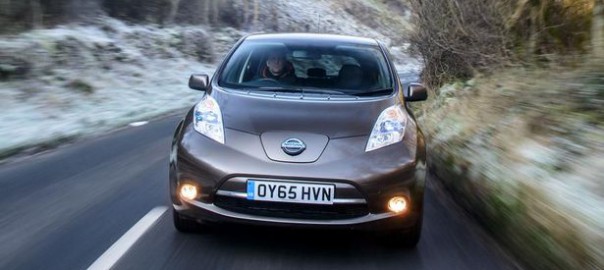
2016 Nissan Leaf 30kWh
As more and more electric vehicles come on to the market, Nissan has upped the Leaf’s game in terms of the thing that matters most – range.
This new 30kWh model runs a denser battery pack than the existing 24kWh version, giving it a claimed range of 155 miles. That’s a 25% improvement, and it gives the newcomer a place at the top of the Leaf range.
Available only in Acenta and Tekna trim, it costs from £30,935 – though that’s before the government’s EV grant contribution is taken off.
Our test vehicle was a Tekna, so it featured 17” alloys, heated seats, a premium stereo and more on top of the Acenta’s climate, rear-view camera, sat-nav and EV-specific telematic system.
Despite all the kit, though, the interior suffers from being trimmed out in plastics that are hard to the touch and all too often not very nice. That’s a shame, because it’s otherwise comfortable and, on the move, impressively refined.
Drivetrain noise is negligible, of course, but that just creates the risk of wind rustle and tyre roar taking its place. These are never offensive, however, even at high speed – and neither is ride quality, which was particularly good on every kind of road we could find.
As always with electric cars, initial pull is very strong indeed. But mid-range is a little lethargic, so it’s never much fun when you need to accelerate past a slower vehicle. Cars like the Leaf are most popular with people who do a lot of urban driving, however, and in this environment it’s in its element.
A longer range means this Leaf wants to tempt you out of the city, but it’ll take time before Motorway Man starts seeing such cars as a viable alternative to his mile-muncher.
Still, what we’re witnessing here is another step along that route. Dealing with range anxiety is a big issue for EV makers, and that’s what Nissan is doing with this new model.
They’ve addressed another kind of worry by upping the warranty on the Leaf’s batteries for eight years or 100,000 miles, too. All of which will help knock down the walls in people’s minds.
Dundee’s all-electric taxi fleet – the largest in Scotland – has clocked up more than a million miles within a year.
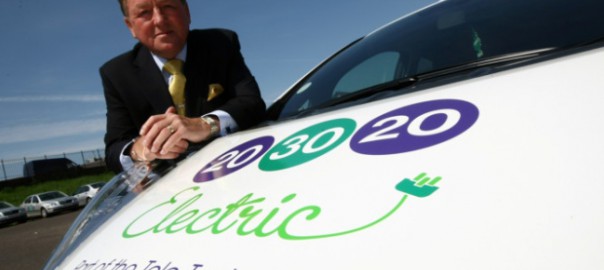
Dave Young of 203020 Taxis (Image: DC Thomson/D. Nicolson)
203020 Electric – part of the Tele Taxis Group – launched in Dundee last April with a fleet of 30 electric Nissan LEAFs.
The initiative, which was supported by Dundee City Council, the Energy Saving Trust and Transport Scotland, has hit the landmark mileage months ahead of schedule.
Each of the company’s LEAFs has clocked up in excess of 30,000 miles and the firm now plans to add 40 specially adapted wheelchair accessible cars by the end of 2016, making it the largest in Europe.
Company owner David Young believes Dundee could become the first city in the world where all taxis and private hire vehicles are fully electric. He said:
“We never expected to hit a million miles so soon but it’s terrific that we have.
“It just goes to show how well the people of Dundee have taken to the idea of electric taxis.
“And each driver is saving between £120 and £130 a week on fuel so they’re delighted.”
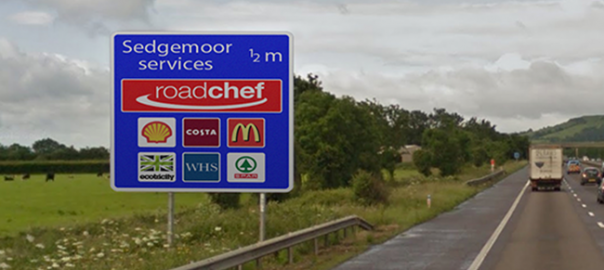
Motorway service area signs will now show where electric vehicle drivers are able to recharge batteries.
Ecotricity logos will now appear on Roadchef signs from this week, alongside signs from the likes of WH Smith, McDonalds and Costa.
The first Ecotricity sign appeared at Roadchef’s Sedgemoor services on Tuesday 26 January, with additional signs to be installed at Hamilton and Norton Canes over the coming weeks. Ecotricity signs will soon be installed across all 28 Roadchef motorway locations.
The firm currently has 260 charging points across the UK’s motorway network.
“We launched the Electric Highway in 2011 to kickstart the electric car revolution in Britain, and we can see that’s well and truly underway now,” said Dale Vince, founder of Ecotricity and the Electric Highway.
“There are now over 50,000 electric cars in Britain; that’s more than a tenfold increase in two years, and this exponential growth is reflected in the use of the Electric Highway, which powered 15 million miles of emission free driving last year – all powered from the wind and the sun.”
Plug-in hybrid version of our Car of the Year hits Britain
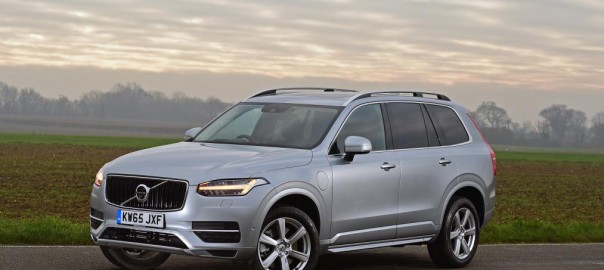
Volvo XC90 T8 PHEV
Verdict: 4 stars
The XC90 T8 is a technological showcase for Volvo, and the way it drives hasn’t been compromised at all. But like other plug-ins, you’re only going to make the most of its efficiency by charging it from the mains. While it’s a superbly refined and comfortable luxury SUV, as soon as you start using the petrol engine, economy figures plummet. If you don’t have regular access to a plug, the D5 diesel is likely to be a more efficient choice.
The Volvo XC90 has already made an impact here at Auto Express. It earned our coveted Car of the Year award last year, and it’s the first in a range of new models that the brand is launching to propel itself to the top of the luxury car market.
While Volvo is renowned for its safety features, it’s also making a concerted effort to demonstrate its eco-friendly credentials. On top of introducing more efficient diesels across the range, it’s ventured into plug-in hybrids – first with the diesel-electric V60 Plug-In estate, and now with this: the XC90 T8 Twin Engine.
The new model is based on technology from the V60, but it has been refined and updated for the SUV. Power now comes from a 320bhp 2.0-litre turbocharged and supercharged petrol engine, instead of the V60’s diesel, and it’s joined by an 87bhp electric motor. These combine to deliver a claimed total output of 376bhp (factoring energy losses in the drivetrain), although a rotary selector on the centre console allows you to choose how you use the energy of the petrol-electric set-up.
BMW expands their range of plug-in hybrids with the four-wheel drive 225xe. Does a 25-mile electric only range increase the 2 Series Active Tourer’s appeal?
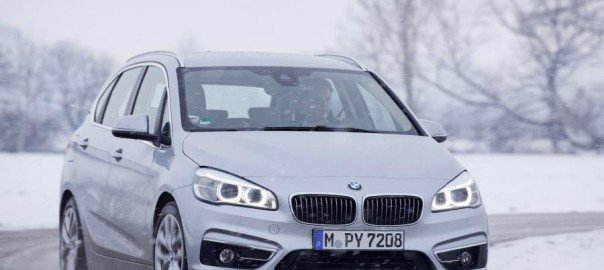
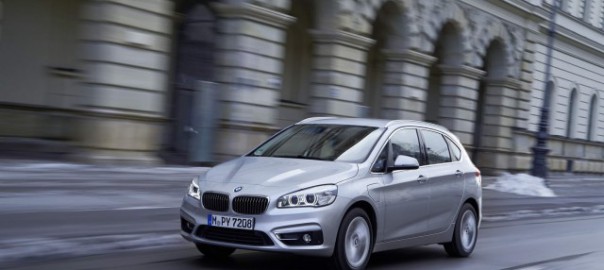
BMW 225xe Active Tourer PHEV
The plug-in hybrid has proved a popular choice for many in the UK.
Given the tax breaks and sizeable government grant plug-in vehicles receive, it’s no surprise to see BMW expanding their range of hybrids to include the 2 Series Active Tourer, particularly given that it’ll be one of the very few plug-in cars in this high-roofed, five-seat MPV class.
The 225xe has enough battery capacity to run for up to 25 miles on electricity alone before the 1.5-litre turbocharged petrol engine kicks in to give you just as much range as a standard petrol 2 Series.
Even this limited electric range gives it some impressive claimed fuel economy and CO2 emissions figures. The 225xe emits 46g/km of CO2 – meaning it falls into the lowest company car tax band – and has a combined fuel economy figure of 141.2mpg.
What is the 2016 BMW 225xe Active Tourer like to drive?
Driven carefully and with a fully charged battery, the 225xe acts just like an electric car. Around town, it’s easy to keep the engine from firing unless you either flatten the throttle or switch the car to battery save mode to preserve charge.
If you’re determined to run on volts alone, there’s an electric-only mode that will prevent the petrol engine from running even under harder acceleration. As you would expect, though, the quicker you gain speed and the higher your speed, the sooner the battery runs out.
Once the battery is fully depleted, the engine runs for much longer periods of time. This means the 141.2mpg figure is only achievable over short distances where the car can run in electric mode for much of the time.
Thanks to the relatively small capacity of the battery, charging doesn’t take too long even off a normal three-pin plug, which will charge the battery in 3.5 hours. A BMW supplied Wallbox charger will cut that to two hours and 45 minutes.
There are other benefits to the hybrid system; while the 1.5-litre turbocharged petrol engine produces just 134bhp, the rear-mounted electric motor produces another 87bhp. That means there’s 221bhp with both working together, enough for a 0-62mph time of just 6.7sec accompanied by a sporty sounding warble from the engine.
BMW’s expansion of its non-i hybrid portfolio continues, as hot on the heels of the 330e is the 225xe Active Tourer. Yes, that means it’s a petrol-electric version of Munich’s unusual mini-MPV, but a tour on mixed roads near the company’s Bavarian headquarters revealed a few surprises in the 2 Series’ armoury…
BMW marries hybrid and 4WD in new 225xe Active Tourer (Image: BMW)
What’s this?
A BMW 2 Series Active Tourer that has been given the drivetrain of the i8 sports car. Sort of. But turned through 180 degrees. So, for the 225xe you get all three modes of traction in one: in Auto eDrive, the car’s software chooses from and mixes up the 1.5-litre three-cylinder petrol’s 136hp and the rear-mounted electric motor’s 88hp, giving you all-wheel drive; switch to Save, and only the engine and the front axle are used, while the on-board lithium-ion battery pack is replenished by both the combustion engine and the regenerative brakes; and finally, in Max eDrive, providing you have charge, then the 2 Series becomes rear-wheel drive and fully electric with zero emissions.
This clever system, all packaged up in the practical if rather cumbersome Active Tourer body, makes this an ideal car for daily commuters with young families who live in cities where there are extremes of weather. Which might sound like a narrow window of opportunity, but actually there’s a bigger market for such a 2 AT than you might expect. BMW reckons that after the US and Japan, the UK, Holland and Germany will lap this thing up.
Prices are extremely competitive for the PHEV. It starts at £35,155, so with the £5,000 Government grant that brings it down to a little more than £30,000; cheaper than the 225i xDrive’s £32,010. However, from March 1 the rules change and the 225xe will be a Category 2 Ultra-Low Emissions Vehicle (ULEV), meaning the grant reduces to £2,500, making the 2 AT PHEV at least £32,655. Pricey, perhaps, but for that, you’ll get a part-electric, all-wheel drive, premium, five-seat MPV, which puts it in a class of… one, for the time being. And, visually, it looks like any 2 Series Active Tourer, save for the external ‘225xe’ and ‘eDrive’ badging, the ‘extra filler’ charging port flap on the front nearside wing and an interior that features a lot of blue lighting and stitching, a few extra hybrid-related screens in its digital displays and an eDrive button on the centre console. Pretty, the 225xe ain’t, but with regards to its primary purpose of shuttling people about, it is at least functional.
How does it drive?
On the face of it, marvellously well. It’s another blinding integration of electrification by BMW, as the 225xe feels superb on first acquaintance. The petrol-electric drivetrain is great at nipping what is a fairly hefty machine (1,660kg) through town and once the roads open out, the Two’s full punch is pretty impressive. The steering’s great, the six-speed Steptronic auto is an utter gem, the brakes are… well, they’re good, although the task of harvesting energy for the battery under deceleration always makes them feel just a little odd underfoot, but generally it proves to be a likeable, premium motor to cruise about in. The three-cylinder engine also makes a great noise under hard acceleration, which is a boon.
BMW’s plug-in hybrid extravaganza continues with its 225xe Active Tourer, offering practicality allied to tiny CO2 emissions and pure electric drive
BMW 225xe Active Tourer PHEV
What is it?:
The BMW 225xe Active Tourer takes the fundamentals of the petrol-electric hybrid driveline layout first unveiled on the i8 sports car and turns it 180deg, creating an intriguing four-wheel-drive hatchback-cum-MPV capable of travelling up to 25 miles on electric power alone.
This allows the new five-seater to claim combined cycle fuel consumption of 141mpg and average CO2 emissions of just 46g/km on the controversial EU test cycle – figures that see it qualify for the UK government’s OLEV grant and mean it is exempt from congestion charges such as that in place in central London.
The new BMW is based around the front-wheel-drive 218i Active Tourer. However, some significant engineering changes have taken place to turn it into the four-wheel-drive 225xe Active Tourer, which is planned to go on sale in the UK in March at a price of £33,055.
While the i8 boasts electric drive on the front wheels, the imminently more practical 225xe employs electric drive on the rear wheels via a BMW-produced electric motor mounted within its rear axle assembly that delivers 87bhp and 122lb ft and provides drive via a fixed-ratio gearbox acting as a rear differential.
A similar change in configuration is reserved for the combustion engine. The turbocharged 1.5-litre three-cylinder petrol unit employed by the i8 sits in an east-west position behind the cabin and channels drive to the rear wheels, but the similar configured powerplant in the 225xe is mounted transversely up front and directs its reserves to the front wheels.
The petrol engine boasts the same tuning as that of the 218i Active Tourer, serving up 134bhp and 162lb ft on a reasonably wide band of revs between 1250 and 4300rpm. As on the i8, the moderate reserves are channelled through a six-speed automatic gearbox with paddle shifts mounted on the steering wheel.
Altogether, there’s a combined system output of 221bhp and 284lb ft. It’s not the most powerful 2-Series Active Tourer model, though. That honor rests with the 225i, whose turbocharged 2.0-litre four-cylinder petrol engine makes 228bhp and 258lb ft.
Electrical energy used to run the electric motor is sourced from a 7.6kWh lithium ion battery mounted underneath the rear seat in the same space as the fuel tank is located in conventionally powered Active Tourers.
As a result, the fuel tank has been reduced in capacity by 15 litres to 36 litres. It’s now also made of steel rather than plastic and is pressurised to allow petrol to be stored safely over longer periods if the 225xe is used predominantly in electric mode. The rear seat has also been raised by 30mm to accommodate the battery, which uses the same cells as that employed by the new 330e.
Even so, boot capacity has been reduced by 70 litres to 400 litres owing to the packaging of the power electronics in the front section of the boot floor.
Aside from a flap integrated in the front left-hand wing, housing the socket for charging cable, the 225xe looks like any other 2-Series Active Tourer. Recharging time on regular mains electricity is claimed to take 3hr 15min, with an optional high-power wall box reducing this to 2hr 15min.