Category Archives: Electric Cars

News and reviews of the latest electric cars (full electrics and plug-in hybrids).

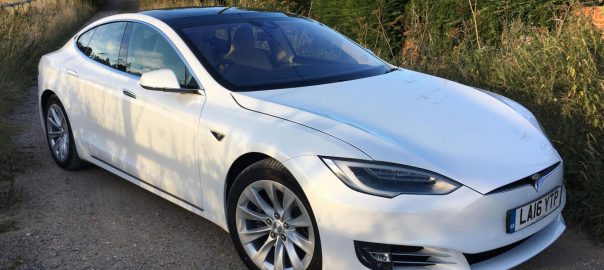
Tesla Model S 60D (Image: Top Gear)

Review: the entry-level Tesla Model S 60D

So, in the week Tesla announced its fastest Model S ever, you’ve driven the slowest one. How come?

Because this Model S 60D was our first chance to sample the lightly facelifted Model S, which you’ll spot thanks to the deleted nosecone (there’s now just a Model X-style moustache) and all-LED adaptive headlights. Fortunately, there’s more to it than that.

Tesla Model S 60D (Image: Top Gear)

How so?

Tesla badly needed an entry-level model. The Model 3 is coming, roared on by the 400,000 or so deposit-holders who’ve pre-ordered the new 3-Series-sized EV. But it won’t be ready until at least 2018, so the cheaper, less powerful 60kWh Model S has arrived to keep interest up and cash rolling in.

It’s actually a 75kWh in disguise, with the extra battery capacity available as a sort of optional tune-up extra after purchase if you’ve got the required £7,850.

Ouch. Besides that, how cheap are we talking? It’s still a big 5-Series sized luxury saloon, so I’m not expecting philanthropy.

The asking price for a 60kWh with rear-drive is £53,400, and does 0-62mph in 5.5 seconds. This ‘D’ version with dual motors and all-wheel drive adds £4,400 and subtracts 0.3 seconds.

Yes, that’s a mountain of money. But Tesla has got stuck into the murky world of monthly payments in an effort to take more chunks out of the mainstream posh saloon market. The result is you can get a Model S on a PCP deal for £395 a month, if you avoid ticking options.

That’s competitive with the likes of a BMW 330d, and when you factor in far cheaper servicing and running costs, plus free Supercharging and zero road tax, the 60kWh Model S starts to look awfully tempting.

Enough accountancy. Why would I be seen in the slow Tesla?

Because it isn’t slow. In fact, it’s extremely quick. Up until now the only Model S versions I’d driven had been the fastest at the time; first a P85, then a P85D, and most recently a P90D with Ludicrous Mode, which is to-date the only car I’ve ceased accelerating in because it was making me feel genuinely nauseous. So I wasn’t expecting much from the P60D’s 324bhp. Not when it’s saddled with 2.1 tonnes to haul.

Fact is, even this baby Tesla is an obscenely fast car, purely because of the instantaneous nature of the performance. I know you must be bored of reading about electric motors hitting max power from the get-go by now, but honestly, the way this supposedly base-spec Tesla rockets from 0-30mph would destroy a red-blooded super-saloon like an M5. This makes it a terrific urban car, despite the usual Model S girth.

Read more: Top Gear
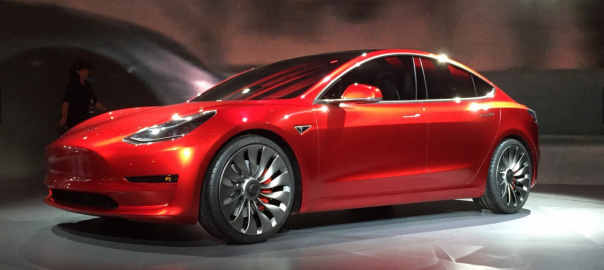
Tesla Model 3 (Image: Green Car Reports)

One in six new vehicles will need to be electric to meet global standards in 2020

Having one out of every six new vehicles be of the battery-electric variety? Heck, that’s California’s Silicon Valley in a nutshell, and that’s only if you count Teslas.

But the rest of the world will have to catch up in order to meet greenhouse-gas emissions standards set by the world’s largest governments.

Tesla Model 3 (Image: Green Car Reports)

That’s what Green Car Reports synopsized out of a World Energy Council (WEC) study, which said 16 percent of new vehicles sold in 2020 would have to be battery-electric to comply with US, European Union, and China greenhouse-gas emissions mandates. Specifically, 10 percent of Europe’s new cars would need to be electric by the end of the decade, while 11 percent of US new vehicles would be required to be electric. As for China, a whopping 22 percent of new-vehicle sales would have to be electric in order for the country to meet progressively stricter transportation-emissions limits.

The good news is that such an increase in electric-vehicle adoption would raise global electricity demand by just a half percent. The bad news is that US, Europe, and China would all have to build additional power-generating capacity in order to meet that 16-percent figure for electric-vehicle sales. Of course, power generation often involves using resources that spew emissions, but we’d prefer not to end up in a wormhole here.

To put that percentage into context, Navigant Research last year said Americans will buy 7.4 million plug-in light-duty vehicles between 2015 and 2024, or an average of 740,000 a year. Last year, Americans bought about 17.5 million vehicles, indicating that even Navigant’s optimistic forecast would still leave the US well short of that 11 percent of new-vehicle sales even while including plug-in hybrids.

Source: AutoBlog

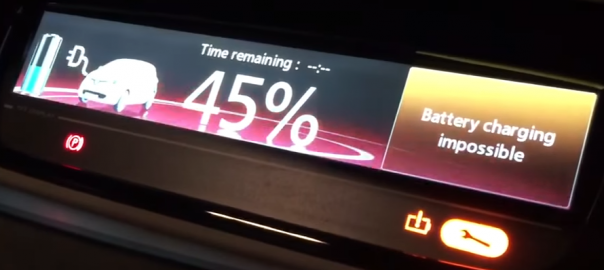
Renault ZOE: Battery Charging Impossible (BCI)

Early models of the Renault ZOE would quite often encounter problems with charging at public charging points and would show a message saying “Battery Charging Impossible” (BCI). The ZOE electronics were updated at about the time the new R240 version of the ZOE entered production to fix this issue – however, I’ve learned it can still happen with a new ZOE so let’s look at it in detail.

I had one of the early ZOE’s so i’m experienced with this error. The first thing to note is that in most cases it does not indicate that there is anything wrong with the car. The message simply means “Battery Charging Unsuccessful” and refers to the last charge attempted whereas the wording – perhaps a poor translation from the French – implies something more serious.

When a charge point (CP) is connected to the ZOE a communication takes place between the car and CP to agree a rate of charge. Also the ZOE checks the earth connection of the CP to make sure that it is securely earthed for safety reasons. A BCI error generally indicates that the ZOE found that the CP is not sufficiently well earthed to be safe and so it refuses to charge.

While this might seem to be obviously an appropriate response to a potentially dangerous situation the simple fact is that other electric cars are not so ‘fussy’ as the ZOE and quite often will charge at a CP that the ZOE has a problem with. Worse, the earth connection will vary with outside factors (e.g. weather and dampness of the ground) so that a ZOE can be happy with a CP one day but refuse to use it another day. While it might seem reassuring that the ZOE errs on the side of caution and refuses to charge with a CP that it can’t guarantee to be safe, the result is frustration for the driver when the car needs a charge.

The issue of a BCI from poor CP earthing is well documented. However, there may be another issue that causes BCI’s occasionally. There is a lot of circumstantial evidence that the ZOE charges more reliably – particularly with DBT rapid chargers – if the weight of the cable is taken off the connector when the connector is inserted into the car. It’s possible the cause is that the upper pins are not fully connecting during insertion. I suggest, therefore, a BCI may also be caused occasionally by the connector being pulled down by the weight of the cable when initiating the charge. This may be exacerbated if the spare cable is ‘tidily’ pushed under the nose of the car.

Since BCI in its simplest form is just a message to let the driver know that the last charge attempted didn’t succeed the obvious solution is just to try charging again. Unfortunately the BCI seems to be a ‘sticky’ error, in other words once it has happened it more likely to happen on subsequent tries – until a charge succeeds at which point it is completely wiped from the system. Therefore it is not unknown for follow on attempts to charge to produce a BCI even on a CP (e.g. at home) that has previously been fine.

In most cases, however, the BCI ‘stickiness’ will time out. Anecdotally, most people find that it only lasts 10-15 minutes, some people have found it lasts about an hour, and occasionally it can last until the car has sat overnight. In an ideal situation it is best to let the error time out and then try charging again – but it is not unknown for an attempt to charge while the error is still there to succeed, and for it to be cleared, before it has timed out.

Occasionally all attempts to clear a BCI fail and this indicates a hardware fault – it is, however, very unusual. The first thing to check would be the charging cable. If that is fine, then the car needs to be taken to a dealer to be checked.

So, let’s add that all together into a useful procedure.

What to do if you get a Battery Charging Impossible (BCI) message

renault_zoe_bci_google

  1. Don’t panic! In most cases it’s fixable by the driver and doesn’t indicate a long-term issue.
  2. Try charging at least 3 times before giving up:
    • Support the connector where it goes into the car to make sure the upper pins are fully connecting. Listen for a successful latching of the connector into the car (multiple latching sounds may indicate a problem).
    • If you’re at a location with multiple charge points, try a different one each time if possible.
  3. If that fails, shut down, lock up the car and leave it for 15 minutes, then repeat from 2.
  4. If that fails, shut down, lock up the car and leave it for at least 1 hour, then repeat from 2. However, if time is tight go to the next step.
  5. Drive to a different type of charge point and repeat from 2. If possible, it’s usually best to use your home CP as that’s the most reliable and forgiving type. Otherwise, if at a street 7kW charge point try a rapid charge point, or vice versa. Repeat from 2.
  6. If that fails (and that should be very rare) then it could be the cable. Borrow an alternative Type 2 cable and repeat from 2.
  7. If that fails then it looks like there may be a problem with the car – call your dealer and arrange for the car to be checked.

Making of: Gran Prix

Go Ultra Low enlists a Top Gear legend for the ‘Gran Prix’ challenge and reveals Britain’s most passionate female car fan aged over 60.

In this video we go behind the scenes as our winner, Helen Mary Jones, stars in her very own car review video at the iconic Brands Hatch racing circuit – with a little help from motoring TV presenter Quentin Willson.

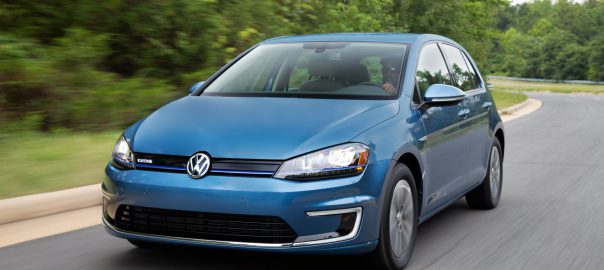
Helen swapped her own Aston Martin DB9 sports car for a pure-electric Volkswagen e-Golf for the day, but can electric cars be just as fun to drive – and which was quicker off the line?

https://www.youtube.com/watch?v=jl1ngWwDGOE

Top 5 best Electric Cars

Electric cars are getting better all the time, making them a more realistic proposition for more people. These are currently our experts’ favourite five

More and more people are coming to realise that an electric a car is a genuine proposition for 21st-centrury motoring.

With increasing amounts of us living in the city or the suburbs, and never needing to undertake long journeys by car, the relaxing drive and low running costs of an electric car are making them all the more attractive.

Of course, most are not without their limitations – most have a real-world range of no more than 100 miles; they’re comparatively dear to buy; and, you need easy access to charging facilities – but as long as you can live with those restrictions (and more people than will admit it, can…), an electric car is a very sensible choice.

The question is what to buy, but with more and more makers selling electric cars, you can find pretty much whatever you want – from city cars to sports cars, and all points in between. And, if you are tempted, let our experts guide you through the best of the current crop.

Nissan Leaf – the British-built one

More than any other, the Leaf is the car that convinced a sceptical public that an electric car was something to consider; and, even now, it’s a compelling proposition. Around town – which is the natural habitat of an electric car – the Leaf is smooth, comfortable and near-silent. Even in the heaviest traffic, the way it drives is supremely relaxing. Above all, apart from the range, there are no sacrifices to make: the Leaf is a decent five-seater, while the boot will take plenty of luggage. As with any electric car, everyday motoring can cost just pennies, and to cap it all, it even costs less to service than a comparable Pulsar.

Renault Zoe – the (relatively) cheap one

One of the main attractions of electric cars is that they cost so little to run, but the trouble with so many of them is that they cost so much to buy. Not so the Zoe, which is yours for little more than the price of a decently-specced Clio. The beauty of it is that, despite the fact that you’re not spending a million dollars, the Zoe is still a very smart-looking little thing. The blue accents on the outside are complemented by a hi-tech interior; and, as the car was designed from the ground up as an electric car, the batteries don’t limit the car’s practicality too much. It’s good to drive, too, and the icing on the cake is a five-star Euro NCAP crash test rating.

Read more: Autotrader

The Pleasure of Public Charging 

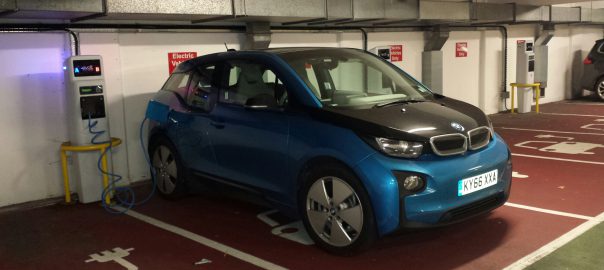
After the pain of public charging on our way to Stoke the rest of the trip went very well. We found the public charge points in the John Street car park easily (though only one had its light on).

Unfortunately they didn’t have any signage indicating what network they belonged to. On a whim I waved an old Plugged-in Midlands card at the charger and it started to work.

We left the car on charge for the rest of the day while we had lunch and then watched the gym displays. I was able to monitor the charging on my phone like last time, but this time it completed without a hitch.

At the end of the day we got back to a fully charged i3. With its long range we were able to get home, some 100+ miles south, without a single stop.

The Pain of Public Charging

I haven’t written one of these posts for some time as the public charging infrastructure has improved significantly in scale and reliability over the last three years. However, so far today has been a bit like returning to the bad old days.

We’re driving from Northampton to Stoke for one of our daughter’s regular gymnastics events. It’s fairly relaxed as with the new i3 94Ah we have plenty of range to get there without charging en route.

However as the family needed two comfort breaks on the way I took the opportunities to try charging. The results were disappointing.

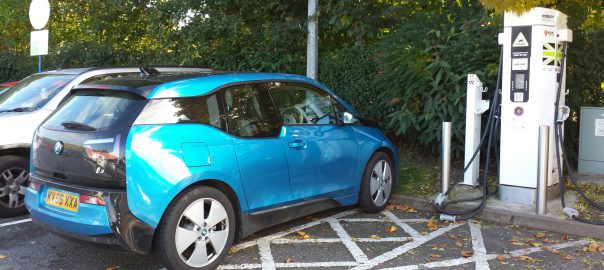
At Corley Services on the M6 there was a Leaf at one of the two Ecotricity charge points. Unfortunately it was the only one that had a CCS connector compatible with the i3 so I could see I wasn’t going to get a charge. In fact it looked like he was having problems and was on the phone to Ecotricity. However when I came back out of the building later I could see and hear he was charging.

I was more hopeful at Stafford services when pulling in as both charge points were vacant. However I had 3 failed attempts to charge using the Ecotricity app, with the message ‘Remote Start failed’.

At that point I gave up and we got back on the motorway. At least with the i3 94Ah we could get where we were going without needing to charge.

[Part 2]

Rapid rise in electric vehicles to ‘reverberate through wider economy’

Falling costs of renewables and batteries will boost EV market over next 20 years and have huge impact on wider global economy, BNEF paper argues

580x358_electric_car_bg

The rapid rise in electric vehicle numbers expected across the world over the next two decades will reverberate throughout all business sectors and make a huge impact on the global economy. That is the…

Read more: Business Green

New Life for Used EV Batteries as Stationary Storage

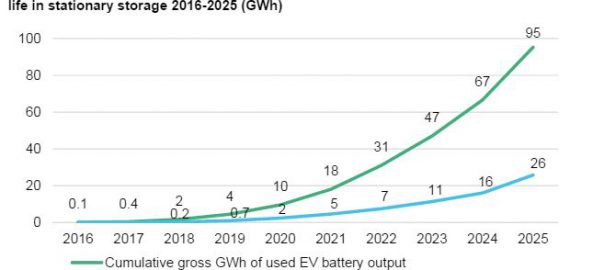
The electric vehicle market is set to grow quickly, but so far there has been no consensus on the ‘second-life’ of the used EV batteries.

In this report, senior analyst Claire Curry has compiled the first data and shows that low-cost energy storage could be here sooner than previously thought.

She projects:

  • There will be 29 GWh of used EV batteries coming out of cars in 2025. This far exceeds the size of the current stationary storage market.
  • Of this, almost a third will get a second life as stationary storage. (10GWh)
  • Today, a new stationary storage system can cost up to $1000/kWh. In contrast, repurposing used EV batteries could cost as little as $49/kWh in 2018, with an additional $400/kWh cost to convert to stationary.
  • The auto industry is divided on the issue. While Tesla won’t be involved in second life, BMW, Nissan and Mercedes Benz have second-life stationary storage projects in place.

batteries_fig1_storage_bnef

Source: BNEF.com

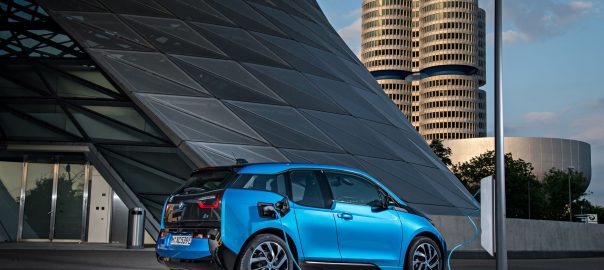
BMW i3 94Ah

BMW Notes Strong Demand For Plug-In Models, And 7,000 Pre-Orders For Upgraded i3

Recently, BMW announced its second quarter and half year sales results with record number of deliveries and revenues.

BMW i3 94Ah
BMW i3 94Ah

One of the strong points of that report was the high demand of plug-in electric cars, which are rapidly taking over production volumes at the company.

The German manufacturer expanded its lineup to seven electrified models in Q2, which resulted in total first half sales that were 87% higher than year ago.

In total BMW delivered 23,675 all-electric and plug-in hybrid cars in the first 6 months of 2016. BMW added that by the end of July, customers had placed more than 7,000 orders for new version of the BMW i3 with its upgraded 33 kWh battery.

The pre-order demand is three times higher as compared to the launch of the i3 in 2014, and suggests that we should pretty excellent results for BMW plug-ins going forward.

“The BMW Group currently offers seven electrified models including plug-in hybrids, such as the new BMW 740e or the recently launched BMW 330e and BMW 225xe Active Tourer, and the fully electric BMW i3.

Thanks to the expanded range of electrified models, sales of this type of vehicle in the first six months of the year were just under 87% higher than the same period last year: a total of 23,675 have been delivered to customers worldwide. Furthermore, to the end of July 2016, over 7,000 orders had been received for the additional BMW i3 model with significantly extended battery range, which only celebrated its market launch in July. This is more than three times the figure of orders received for the first generation BMW i3 at the equivalent launch period.”

Source: Inside EVs