Category Archives: Prepping and Collapse

Planning and preparing for global catastrophe

A background to survivalism and going off-grid – some of it rather depressing

Environmental catastrophe, economic collapse, global pandemic … does it feel like the world is ending? If you think Armageddon is near and are trying to get ready, you are not alone.

National Geographic Channel’s Doomsday Preppers – a reality TV series that profiles various “survivalists” readying themselves to survive a range of apocalyptic circumstances – is the network’s most-watched series. It has prompted a slew of similar programming such as Discovery Channel’s rival Doomsday Bunkers.

Of course, even after an apocalypse one needs a place to live.

Since it first aired in 2012, Doomsday Preppers has featured survival retreats ranging from pre-fabricated steel shelters and decommissioned missile silos, to hand-built forest cabins and buried shipping containers. What has emerged is a picture of the ideal survival retreat (or “bug-out location” to use prepper slang) as rural, secluded, self-sufficient and fortified.

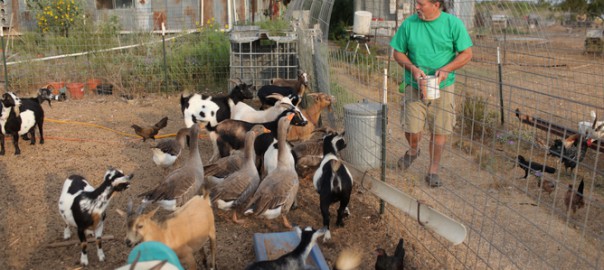
Floresville, Texas: Paul Range feeds his brood of livestock. Each can serve as a food source if things get bad. (Photo Credit: National Geographic Channel/ Sharp Entertainment)
Floresville, Texas: Paul Range feeds his brood of livestock. Each can serve as a food source if things get bad.
(Photo Credit: National Geographic Channel/ Sharp Entertainment)

Anthropologist Richard G. Mitchell’s Dancing at Armageddon (2001) is, I think, one of the most level-headed studies of survivalist culture. His work points to the way survivalism is rarely about extremist action. Rather, it is more often about tinkering with tools, exchanging ideas and creative storytelling.

We can see the design of the survival retreat as a wilder version of the more familiar impulse towards DIY and home renovation.

Survivalists use these projects as a focus for developing the personal skills, knowledge, and praxis needed to embrace a radically changing world. Potential chaos and crisis is embraced as the opportunity for developing personal autonomy.

Read more: The Conversation (November 2014)
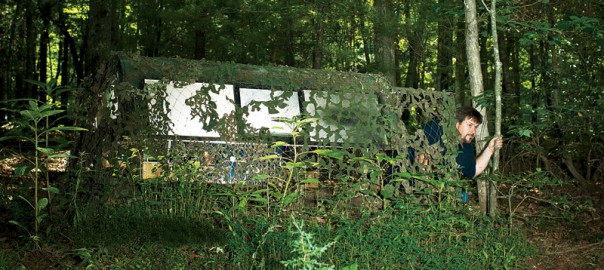
Bring it! Scott Hunt on his prepper property in South ­Carolina (Image: B. Finke)

Boom Times

An overview of the US prepping movement from 2012

Meet the preppers, a rattled, robust survivalist movement whose members just hate being called survivalists. Emily Matchar investigates the 21st century’s wildest new apocalyptic scene.

BEING PREPARED is just the sensible thing to do, Scott Hunt tells me. Power outage? Superstorm? Nuclear attack? He’ll be ready. That’s why he has a pickup truck that runs on wood.

Bring it! Scott Hunt on his prepper property in South ­Carolina (Image: B. Finke)

We’re standing by a toolshed in the backyard of Hunt’s home near Pickens, South Carolina, staring at a tall metal contraption that sits in the rusting bed of a Ford F-100. It’s a generator that can turn wood chips into wood gas, which, in turn, can run an internal combustion engine.

“I look at a tree, I see a battery,” Hunt says amiably, grabbing his yellow Bernzomatic Fat Boy torch and firing up the “gassifier.” He fans the flame with a gush of compressed air and the truck rumbles to life. “It’s my Mad Max backup.”

The 46-year-old Hunt, whose blue polo shirt and neat goatee say soccer dad more than road warrior, believes in backups. He’s got his water supply: a 1,600-gallon spring- and well-fed tank on a hill overlooking his property. He’s got power and heat: an enormous wood-fueled generator, a diesel generator, a propane generator, an old Army immersion heater, solar panels, a wood-burning stove, and solar ovens. There’s food: five rotating vegetable gardens backed by a basement full of canned salmon and refried beans, white and red wheat kernels, potatoes, and dried milk. To turn the wheat into flour, he’s rigged up an old Healthmaster 750 exercycle with a belt and grinding wheel.

“In a grid-down situation,” Hunt says, “I believe you need to be prepared to live like in the 1800s.”

Read more: Outside Online

Instead of Doomsday, How About ‘Now’ Day?

A view on Prepping from April 2014

While channel surfing a little while back, I stumbled across the National Geographic channel’s show Doomsday Preppers which follows people who have essentially made a lifestyle of preparing for what they believe is going to be a catastrophic disaster that will lead to the end of civilization as we know it.

Almost all of the people profiled appear to be gun-and-ammo-loving Americans, who stockpile decades worth of food and paper products and believe having gazillions of gallons of gas will be their new world’s currency — when they come out of hunkering in their bunkers.

images_doomsday_preppers_unk

I can’t claim to have seen every episode, but I saw enough to find it ironic how often its subjects are preparing for something like a collapse in the banking system or faith in paper currency, or for a dirty bomb, but no one ever seems to be preparing for global warming in this extremely fretful segment of society.

It’s an odd and unfortunate paradox that the people who seem most concerned about future threats to our way of life seem to disregard one of the most dangerous and obvious ones we face at this very moment, today.

A United Nations (UN) report has put the world on notice that climate change will force millions of people to relocate triggering famine, inciting conflict and losing trillions of dollars worth of economic gains. The irreversible consequences of climate change will lead to economic mass migration. Then, there is a risk of violence which will increase from protests triggered by international or civil conflicts.

While I don’t think it’s a good thing to scare people unduly, a healthy respect for something on this scale is warranted. It’s a good idea to get an emergency preparedness kit, decide on a plan, and have awareness of what to do in the event of a disaster. It’s doubtful you will need an underground bunker with a year’s supply of canned food; it is, however, common sense to have a weather radio, flash light, and some non-perishable food items and all your necessary medications on hand in case the power is knocked out by a storm for example.

Along with your emergency plans, find the time to discuss with your family where you would go if you needed to take shelter in your home or if you needed to leave town for an impending hurricane or earthquake. Are you are unsure of what disasters are likely in your area or where you should go during an earthquake or tornado? Do sensible research. There are a number of resources online to get informed about disaster preparedness.

CDC’s preparedness website and FEMA’s emergency strategies and solutions are excellent resources for reliable and credible information on how to look after yourself and your family. Share your research with your neighbors and other members of your community. Knowledge is powerful and life-saving, and should not be wasted in the selfish pursuit of only looking after number one.

I find the Doomsday Preppers resembling escapists more than survivalists. Focusing on how to abandon modern life with the motto of the SHTF scenario — when the “Shit Finally Does Hit the Fan,” alarming and void of any caring for mankind, outside their own families. We’re in this world together, and our responsibility to preserve this planet goes well beyond any single individual’s bunker’s walls.

Source: Huffington Post

Food Storage And Prepping Are So Important (Image: SurvivalistPrepper.net)

Doomsday Prepping for a Sustainable Future

An article from back in 2012 with an interesting take on Transition versus Prepping

Is the “end” near? If the pop-culture version of the Mayan calendar’s “apocalyptic” predictions turns out to be correct and the world ends on 12/21/12, then you will probably not be reading this blog. The fiscal “cliff” sounds dire, but luckily it is only an annoying metaphor. This latest round of end-of-the-world hysteria is part of an ongoing theme in American culture that includes the 20th century fears of Cold War nuclear Armageddon, the “Y2K” mania leading up to December 31, 1999, Dick Cheney’s obsession in the early 2000s of terrorists with suitcase nukes, and the constant stream of movies and television shows portraying the sudden dramatic end of civilization.

Americans consciously or subconsciously understand that the world as we know it could alter in an instant, and such TV shows provide cathartic relief to that tension. Notable among cable television’s recent boom in “end times” programming is National Geographic Channel’s “Doomsday Preppers.” The show profiles individuals and families as they build bunkers and compounds, can dry goods, and purchase paramilitary vehicles that can serve as mobile homes in which to survive amidst the teeming post-apocalyptic masses. Each “prepper” has their threat of choice, ranging from earthquakes, tidal waves, droughts, and food shortages, to super-volcanoes, nuclear holocaust, viruses, terrorists, and more. The show takes all apocalyptic scenarios seriously and provides an expert to evaluate the prepper’s actions and suggest improvements and additional preparations they can make in the basic categories of water, food, shelter, and security.

Food Storage And Prepping Are So Important (Image: SurvivalistPrepper.net)

To audiences concerned with sustainability and climate change, the show sends mixed messages. On the one hand, most preppers demonstrate an admirable understanding of where their food and water come from, the motivation to design resilient systems, and display actions consistent with basic emergency preparedness. On the other hand, the show tends to highlight the “lifeboat strategy” of saving one’s self, family, and perhaps a few friends, while allowing the rest of society to crash and burn, with an emphasis on guns instead of, say, community gardens.

Read more: Huffington Post

Be prepared … follow this guide and you could be the last one standing when it all goes really, really wrong (Image: S. Parsons/PA)

Is it time to join the climate change preppers?

(A tonque-in-cheek article from February 2014)

The floods and storms that have wreaked havoc across Britain this winter could be just the beginning, and now a growing number of people are making preparations for the end of the modern world. Here’s what you’ll need to do to stand a chance.

We are getting close to what might be called The Noah Scenario. Last month was the wettest January in Britain since records began in 1767. So far this month has been no different, and the Met Office expects the wind and rain to continue until March. Climate change may be a gradual process, but people who live on the Somerset Levels or the banks of the Thames are getting a very sudden education in the value of arks.

Be prepared … follow this guide and you could be the last one standing when it all goes really, really wrong (Image: S. Parsons/PA)

It’s unlikely that these floods will be the last such catastrophe, or the worst. Climate scientists expect bigger and more frequent extreme weather events throughout the coming century – not just wind and rain, but droughts as well. Nor is weather the only danger: pandemic flu, nuclear weapons, antibiotic resistance, environmental catastrophe and chronic food shortages could also offer dire threats to civilisation as we know it. You might not want to panic just yet, but you might decide that it is time to join the “preppers” – people who are secretly preparing to abandon modern life when the apocalypse, in whatever form, does arrive.

When do I abandon my home?

When you have no choice. When soldiers are on your street, your neighbours have begun to steal from you and plague-sufferers are camped in your drive – or perhaps slightly before all that. Preppers have a catch-all term for this moment: the SHTF scenario, in reference to the day when the Shit finally does Hit The Fan.

“It would be the last resort for me,” says Steve, a 57-year-old prepper from Essex, who runs ukpreppersguide.co.uk. “Some people seem to think it’s the first thing to do. The moment something happens, they grab their rucksack and off they go and live in the wild – but if you’ve ever tried that, it really isn’t easy. Where I am at the moment, I probably have enough provisions to survive for about nine months. That doesn’t include going out and getting your own food.”

When the moment comes, however, you may not have much warning, so it is important to keep what preppers call a “bug-out bag” ready at all times. Ideally, you’d leave at night, when you won’t be followed.

“The idea behind leaving your home is to get away from danger,” Steve explains, “which means getting away from everybody and going under the radar, off-grid, so you can’t be found – then just survive for however long is needed before you can come back to civilisation.”

Read more: The Guardian

See also: What Should I Stockpile For The Apocalypse?, Bug Out Bag List and Survival Fishing: How to Catch Fish When SHTF