In a surprise move, Chancellor George Osbourne has announced that the three per cent diesel supplement in company car tax will remain in place until 2021, cancelling plans to drop it next year.
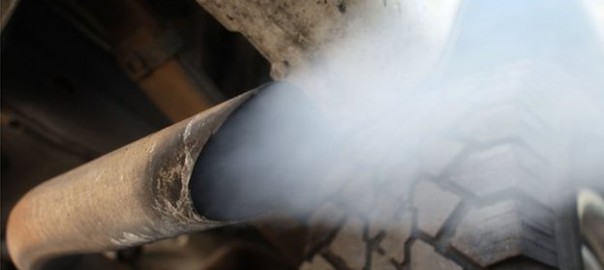
Car exhaust (Image: BBC)
The announcement was made in today’s (Tuesday 25th November) government Spending Review, which also confirmed that the Office for Low Emission Vehicles (OLEV) will not see cuts to its budget which provides subsidies for electric vehicles (EVs) and charging infrastructure.
The current company car tax system sees diesel cars subject to a three per cent supplement over petrol models, and there were plans to remove this in April 2016. This would bring BIK tax levels for petrol and diesel cars, with emissions in the same tax band, to the same level.
However, potentially in response to the recent VW emissions scandal, George Osbourne has decided to scrap the cut and the three per cent supplement will remain until spring 2021 – earning the Treasury an additional £1.36 billion over the course of five years.
The emissions scandal might have had a significant role to play in the change in decision, along with the need by the Chancellor to find extra resources after expected cuts in a number of sectors were not as bad as first thought. One factor that definitely helped change Osbourne’s mind though was the uncertainty as to when the new, more rigorous EU Real Driving Emissions (RDE) test comes into effect, and how strict it will be.
Osbourne said:
“The development and sale of Ultra Low Emission Vehicles will continue to be supported, but in light of the slower-than-expected introduction of more rigorous EU emissions testing, we will delay the removal of the diesel supplement from company cars until 2021.”
We had our carpets cleaned the other day, and when the cleaner guy found out what I did, the very first thing he said was, “I was going to get an electric car.” Then he looked at me almost apologetically. “But I heard they’re actually worse for the environment.”
It’s not the first time I’ve heard it. The media loves these stories. They’re counterintuitive, surprising, and best of all, show that those silly greens, with their idealistic yadda yadda, don’t know how to do math.
They’re also wrong, as a new report from the Union of Concerned Scientists conclusively demonstrates. The two-year study digs into the life-cycle greenhouse gas emissions of battery electric vehicles and gasoline cars, from materials to manufacturing to operation to disposal.
The four cars used in the comparison were a midsize and a full-size gasoline car, a midsize battery electric vehicle (based on the Nissan Leaf), and a full-size BEV (based on the Tesla S).
Long story short: Electric cars really are cleaner.
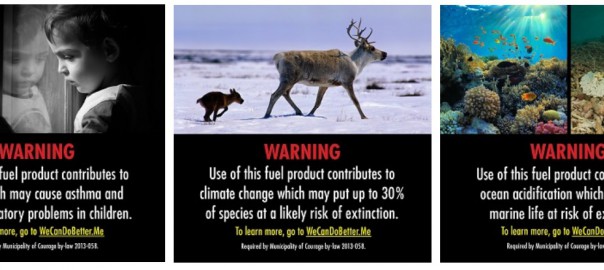
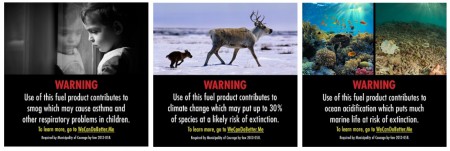
For the first time in the history of North America (and perhaps the world) a city has legislated that local gas pumps now need to affix climate change warning stickers to serve customers.
Coming Soon To A Pump Near You? (Image: Our Horizon)
Passed unanimously by North Vancouver (Canada) city councillors last Monday, the new program will take effect in early 2016.
North Vancouver Mayor, Darrel Mussatto said at the bylaw meeting that enacted the change:
“It is 2015 and we need to talk about how we are going to move forward as a society on a reduced carbon or carbon-free diet and it is going to be a challenge.”
They’re the costs of people’s actions on other people or communities–but the people taking those actions don’t have to pay for those costs, even though they harm others.
And the emissions from combusting fossil fuels are clearly a prime example.
While complaints about air quality in the Los Angeles Basin date back literally centuries, research more than 50 years ago established that vehicle emissions were the primary cause of photochemical smog.
That led the state of California to begin efforts to regulate tailpipe emissions–well before the U.S. Environmental Protection Agency even existed–which led in turn to the first catalytic converters in U.S. vehicles in 1975.
Catalysts spread throughout most of the automaking world over the next 20 years, hugely reducing emissions of carbon monoxide (CO), hydrocarbons (HC), and nitrogen oxides (NOx), all of them toxic in various ways.
The gradual recognition and scientific acceptance of climate change due to rapid and unparalleled human emissions of carbon dioxide (CO2) since the dawn of the Industrial Revolution around 1750 adds an entirely new problem.
Cambridge, England — IN January, researchers at King’s College London announced that pollution levels on Oxford Street, in central London, had exceeded limits set for the entire year in just the first four days of 2015.
Similarly alarming numbers have been recorded for other streets in the city — and yet the mayor, Boris Johnson, has delayed implementation of stricter air-quality measures until 2020.
Car exhaust (Image: BBC)
What’s happening in London is being played out in cities worldwide, as efforts to curtail the onslaught of air pollution are stymied by short-term vested interests, with potentially disastrous results.
Environment minister vows to make gasoline, diesel taxes even
Decline in diesel’s share of Europe car market may accelerate
France plans to end tax breaks for diesel, ending the special status long enjoyed by the fuel in the wake of Volkswagen AG’s emissions scandal.
Car exhaust (Image: BBC)
French Environment Minister Segolene Royal told journalists after a cabinet meeting on Wednesday:
“It’s obvious today that there’s an inconsistency between the advantages given to diesel and its drawbacks in terms of pollution.”
Officials agreed that, starting with the 2016 budget, diesel taxes will rise and those on gasoline will fall “to neutralize the difference” in the next five to seven years. The price advantage in France amounts 15 euro cents per liter (89 U.S. cents per gallon) of fuel, Royal said.
The move could help further accelerate diesel’s decline in Europe, where four of the five biggest car markets impose lower taxes than on gasoline. The favorable treatment has helped diesel become the dominant technology for cars in Western Europe. But health and pollution concerns had already begun to erode diesel’s popularity even before revelations last month that VW duped regulators about emissions for these cars.
European auto buyers have been attracted by both the lower pump price and better fuel consumption on diesel cars. About 68 percent of cars and light commercial vehicles on French roads as of Jan. 1 were using the fuel, according to the CCFA, the country’s carmakers’ association. The share had started to decline as cities, including Paris, blame smog on diesel exhaust.
The French government’s announcement comes after Volkswagen admitted that it installed technology in nearly 11 million of its diesel vehicles designed to fool emissions testers. The scandal may cause the technology’s market share to drop to as little as 35 percent of cars sold in Europe in 2022 from 53 percent in 2014, according to industry consultant LMC Automotive.
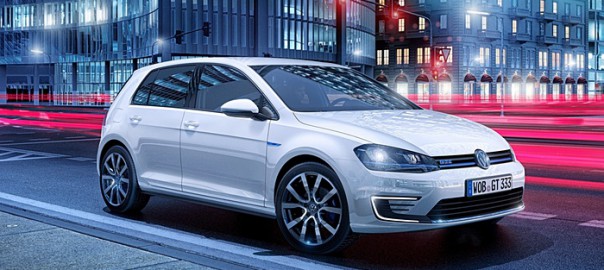
Volkswagen’s new electric hybrid Golf is as green as they come, but can VW ever clean up its ruined reputation?
Turn it on: Golf’s GTE is part electric and part petrol, with a promise of 166 miles to the gallon
After the scandals in sport, food and banking (doping, horse meat, Libor and the rest), only a fool would have bet against the motor industry not cheating the system, too. But no one would have fingered Volkswagen as the culprit. A byword for trust and decency for more than 75 years and the jewel of the German automotive industry, all reduced to lousy tricksters in the space of a single afternoon. That old adage that a good name takes a lifetime to win and a moment to lose has never been more true.
It was ironic, for me at least, that the day Michael Horn, VW’s US boss, stood up and said: “We’ve screwed up!” was also the day I found myself at the wheel of the new Golf GTE. The E in the title stands for Electric, while the GT is for Gran Turismo and tells new customers (and God knows they’re going to need them) that this isn’t just some dull electric buggy affair (a golf buggy!) but a full-on driver’s car that shares the same sporting DNA as the brand’s most famous performance badge – the GTi. It’s certainly a tricky balancing act for this VW to pull off as the car has to be both parsimonious and powerful. A sort of vegan Tarzan.
The car is a plug-in hybrid with both a 1.4 TSI petrol (no diesel here) and a snappy electric engine. It has five operating modes: pure electric, electric plus, battery hold, battery charge and auto hybrid. VW has made the technology that controls each option incredibly straightforward, but like many others, I suspect, after fiddling about with the various settings, I clicked on auto hybrid and let the car sort itself out. It seemed to know what it was about far better than me, anyway. Whichever mode you select the car always pulls away in pure electric and it takes a while to get used to that sudden, silent lurch.
All the extra gubbins associated with two engines and a large battery mean that the car is 300kg heavier than the standard model. That’s like driving everywhere with the Fijian rugby team’s front row sitting in the back. Despite all that heft the car still feels quick and agile around the park (rather like the Fijians themselves) which is testament to the raw power of the GTE. It does 0-62mph in 7.6 seconds with a top speed of 138mph.
Inside and out the car is almost identical to every other Golf on the road. One of VW’s e-mobility taglines is “The future is familiar” – and the GTE is certainly that. Within minutes of taking the wheel you feel completely at home. It’s one of VW’s great strengths that its cars can be totally fresh and yet familiar all at the same time.
Being a hybrid, the car’s eco credentials are clearly what sets it apart. It has a range of 31 miles using its fully charged electric engine alone (and most daily journeys are a lot less than that), and it will do up 580 miles on a single tank if both systems are engaged. VW claims an average of 166mpg (depending on how you drive, of course) with emissions of just 39g of CO2 per km. But, and a BUT could not be BIGGER, what’s the point of it?
How could one arm of VW be producing such a clever, clean machine while its other has sold more than 11m motors that knock out anything up to 40 times the pollution they claim? I fear that VW’s so-called “defeat device” will defeat a lot more than it was intended to.
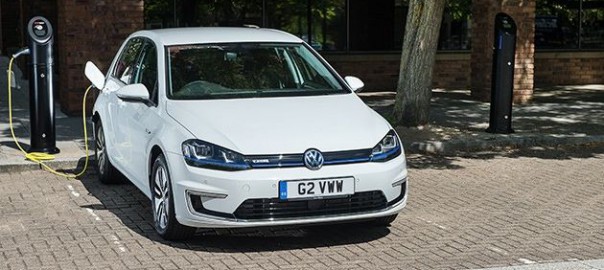
By now, I guess that everyone in the world has heard of how Volkswagen cheated consumers by falsifying the results of the emission tests from their diesel engines. It is a true witch hunt unleashed against Volkswagen. Maybe there are good reasons for it, but I think it is also something that should be taken with caution. A lot of it. Volkswagen e-Golf (Image: J. Ramsey/Autoblog)
I have been a consultant for the automotive industry for some 20 years and I think that I know the way they operate. And I can tell you that they are not equipped for “cheating”, intended as willingly ignoring or breaking the law. They just don’t do that, they understand very well that the result could be something like what’s happening to Volkswagen nowadays; something that could lead to their end as a car manufacturer. On the contrary, carmakers tend to be extremely legalistic and apply to the letter the current laws and regulations.
This said, it is also clear that car makers are there to make a profit and their managers are supposed to “get results”. So, if the laws and the regulations are not clear, or do not explicitly say that something is forbidden; then, if that something is supposed to provide some advantage to the company, it may be done.
How Will Emissions Scandal Affect The Future Of French Diesel?
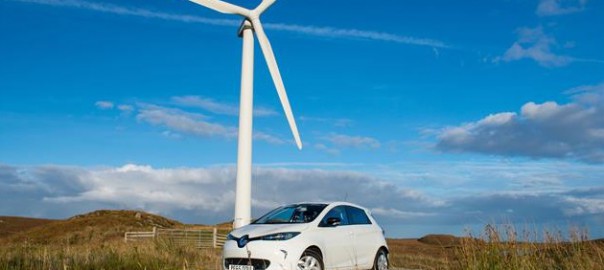
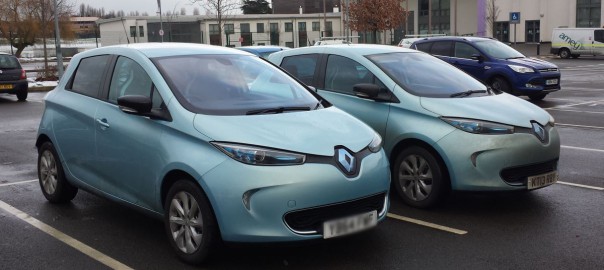
Renault’s electric car, the Zoe, accounted for half of all electric car sales in France in 2015. The car company, which traditionally produced diesel engines, has begun diversifying as the popularity of diesel wanes. (Image: T. Larkum)
Known for such cars as the classic Citroen Deux Chevaux and the luxury vehicles of powerhouse Renault, France has long been one of the largest and most recognizable car manufacturers in Europe — and indeed, in the world. But as its automotive market struggles to recover from lagging sales and more people grow skeptical of the environmental effects of diesel fuel (most French cars have diesel engines), a widening Volkswagen emissions scandal could mark a turning point for French auto manufacturing. A consumer shift to gasoline or alternative fuel would spell fiscal disaster for French car producers, unless they start diversifying engine fuels and looking to alternative energy, analysts said.
“I think it’s going to be negative; it’s very simple,” said macroeconomics analyst Jean Ergas, an adjunct assistant professor at the New York University School of Professional Studies. “This is going to be a big hit for them.”
While we marvel at Nasa’s discoveries, we destroy our irreplaceable natural resources – so we can buy pre-peeled bananas and smartphones for dogs
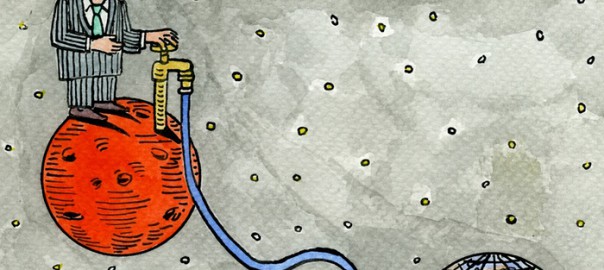
‘Think of what would change if we valued terrestrial water as much as we value the possibility of water on Mars.’ (Image: A. Krauze)
Evidence for flowing water on Mars: this opens up the possibility of life, of wonders we cannot begin to imagine. Its discovery is an astonishing achievement. Meanwhile, Martian scientists continue their search for intelligent life on Earth.
We may be captivated by the thought of organisms on another planet, but we seem to have lost interest in our own. The Oxford Junior Dictionary has been excising the waymarks of the living world. Adders, blackberries, bluebells, conkers, holly, magpies, minnows, otters, primroses, thrushes, weasels and wrens are now surplus to requirements.
In the past four decades, the world has lost 50% of its vertebrate wildlife. But across the latter half of this period, there has been a steep decline in media coverage. In 2014, according to a study at Cardiff University, there were as many news stories broadcast by the BBC and ITV about Madeleine McCann (who went missing in 2007) as there were about the entire range of environmental issues.
Think of what would change if we valued terrestrial water as much as we value the possibility of water on Mars. Only 3% of the water on this planet is fresh; and of that, two-thirds is frozen. Yet we lay waste to the accessible portion. Sixty per cent of the water used in farming is needlessly piddled away by careless irrigation. Rivers, lakes and aquifers are sucked dry, while what remains is often so contaminated that it threatens the lives of those who drink it. In the UK, domestic demand is such that the upper reaches of many rivers disappear during the summer. Yet still we install clunky old toilets and showers that gush like waterfalls.