Large amount of small-scale systems installed triggers 3.5 per cent fall in feed-in tariff subsidies for first time since 2012
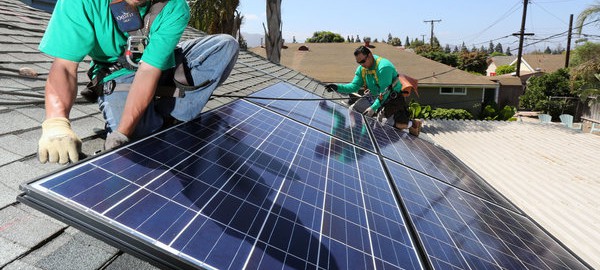
Solar panels were fitted on the roofs of more than 125,000 homes last year, according to government figures.
The numbers also show that 700MW of solar was installed on buildings and in ground-mounted solar farms under the Feed-in Tariff subsidy scheme over the course of 2014 – the equivalent of powering 212,000 homes.
Alongside the statistics, the government also confirmed sufficient solar systems were deployed in the last quarter of 2014 to trigger 3.5 per cent cuts in tariffs from April for installations smaller than 10kW and between 50kW and 5MW. About 124MW of smaller systems were added over the three months and 53MW of systems between 50kW and 5MW.
The Solar Trade Association (STA) said this was the first time since 2012 that the tariff will fall because of the number of systems deployed rather than because of the automatic drop that kicks in every nine months.
The industry body added that solar PV installations between 10kW and 50kW, often fitted on schools, village halls or business units, grew by more than 50 per cent between October and December 2014 compared with the previous three-month period. However, the 38MW added over that time fell short of the 50MW that would have triggered.
David Pickup, business analyst at the STA, said that while the industry is experiencing “healthy growth”, the tariff banding needs to be reconfigured to allow for more growth in larger rooftop and smaller or community solar farm projects.
“We are particularly pleased to see good levels of growth in the large rooftop market with 33MW of solar – 164 installations – installed in the last three months of 2014, more than double that in the previous quarter,” he added. “But this isn’t enough – we need to see more solar going up on roofs and more gradual reductions in the tariff to get to the industry’s goal of subsidy-free solar.”
The Renewable Energy Association announces the official launch of UK Solar and its first storage representation body UK Energy Storage
UK Solar will support and represent over 130 of its existing solar members and broadening its member base to become the trusted voice of solar power in the UK.
With nearly fifteen years of experience in supporting the growth of the solar sector, the REA has built a strong reputation within the government, with regulators and with industry stakeholders.
REA Chief Executive Dr Nina Skorupska said:
“The REA is excited to announce the launch of UK Solar. Solar power is one of the first major renewable energy technologies set to compete with traditional energy sources without subsidy. The integration of solar as a major player in the UK energy mix will transform the power market. Businesses, households and the public sector will see their energy bills reduced. It is the mission of UK Solar to support and drive the transition to this solar future”
The REA will be working with its existing solar members to develop a clear path to grid parity with wholesale and retail electricity prices across all sectors of the solar power market.
Further exciting news is that the REA is to represent renewable storage technologies with UK Energy Storage. UK Energy Storage is the trade body for all storage technologies across the UK.
Energy storage technologies offer huge potential for the UK’s energy supply mix. The ability to store renewable power which can then be used to meet demand when it is needed can deliver tremendous benefits for system stability and security of supply as well as decarbonising UK energy supplies.
Using the REA’s experience of successfully bringing new technologies to market, UK Energy Storage will ensure that storage technologies have a smooth path to commercialisation in the UK through delivering and developing effective policy.
REA Senior Advisor Ray Noble said:
“The potential for energy storage to transform the UK energy mix is immense. Through representing all types and scale storage technologies the REA will drive the commercialisation of viable storage solutions in the UK. The integration of storage technologies will bring down costs and increase the capacity of renewable energy available on demand, which could revolutionise the energy mix.”
The launch of UK Solar and UK Energy Storage will see exciting new developments in the REA, as it strengths and builds relationships with solar and storage members.
Despite an unpromising legislative landscape, storage is gaining momentum in the U.K.
The United Kingdom has no clear government policy on energy storage and offers no major incentives to companies and no subsidies at all to households to install energy storage. To date, only paltry sums have been invested in energy storage projects there.
And yet, many are feeling optimistic about where the storage industry is headed.
Several major manufacturers have either launched domestic solar-storage products in the U.K. in the last six months, or are planning to do so sometime this year. In the last week, the U.K. Renewable Energy Association has launched a new trade body dedicated to commercializing energy storage. The U.K. Electricity Storage Network is expecting a Minister from the Department of Energy and Climate Change (DECC) to participate in its annual meeting.
And to crown it all, the U.K. currently has the biggest battery in Europe.
So is storage really taking off? To date, according to the U.S. Department of Energy’s Global Energy Storage Database, the Brits currently have a grand total of 32 projects, providing 3,300 megawatts of storage, of which the vast majority comes from pumped hydro. Around 62 megawatts are (or soon will be) provided by batteries and 5 megawatts by mainly uninterruptible power supply flywheel systems. There are also experimental compressed air, cryogenic thermal and flow battery projects ongoing.
That 3,300-megawatt total compares quite favorably with 7,600 megawatts in Germany and 6,560 megawatts in California, a state with similar energy requirements to the U.K. But there’s a push for much more.
“Storing energy will become increasingly important in the move toward a low-carbon economy, and has the potential to save the energy system over £4 billion [$6 billion] by 2050,” said DECC Minister Greg Barker last year.
The DECC has also stated that the energy storage market is forecast to reach $17 billion in 2020, and to be nearly $30 billion in 2030.
Some argue that energy storage can help save consumers money by possibly reducing new grid buildout.
Anthony Price, director of the Electricity Storage Network, explains: “[The UK electricity and natural gas regulator] Ofgem has calculated that it will cost £50 billion [$76 billion] to rewire Britain. This will be to provide flexibility in the grid and allow the integration of more renewables, add resilience to the grid, and to improve energy efficiency across the grid. If you look at energy storage, it can help meet all three of those requirements. So we can spend £50 billion on rewiring the country, or we can have more energy storage.”
Price’s organization is lobbying for a minimum 2,000 megawatts of new network-connected electricity storage by the year 2020. A fairly modest figure, this represents less than 10 percent of the predicted increase in renewable generation capacity over the same time period. The question still remains whether the U.K. government will take investment in energy storage seriously. Price notes that while the current administration is happy to “pick winners” by promoting solar and wind, it refuses to do so in the case of storage.
On the other hand, it has provided a modest £50 million ($76 billion) in backing for research projects around the country. The most prominent of these is the Smarter Network Storage project, better known as the biggest battery in Europe. A 6-megawatt/10-megawatt-hour system, the battery is designed to explore alternative revenue streams for storage, while deferring traditional network reinforcement.
Numerous early-stage projects have emerged. Highview Power won funding for a demonstration of its liquid air storage technology. REDT is developing a vanadium redox flow battery for storing wind and wave power in Scotland. And Isentropic is building a demonstration project for its cryogenic energy storage technology.
Domestic solar-plus-storage is also taking off in the U.K. Last September, SMA launched its Sunny Boy Smart Energy PV inverter and battery system. Sharp followed suit at the end of last year by offering a solar-and-storage device that uses Samsung batteries. Bosch is hoping for certification of a solar-storage inverter next month, and various other solar players, such as ReneSola of China, seem to be clamoring to enter the U.K. market.
These companies could be looking to cash in on growth in U.K. solar installations. While much of the European solar market has suffered from a slowdown last year, Britain helped keep the overall picture a little rosier, with an estimated 3.2 gigawatts of PV installed in 2014.
One solution for boosting domestic supply of residential storage systems is to leverage vehicle battery manufacturers, said Frank Gordon of the newly launched energy storage section of the U.K.’s Renewable Energy Association.
“The U.K. is home to one of the only electric-vehicle battery plants in the world, the Nissan plant in Tyneside. These car batteries could offer good potential for small-scale energy storage applications,”
said Gordon.
In the meantime, storage supporters like Gordon are looking for clearer support signals from the government.
“As solar storage is still a developing technology, the need to establish a policy and technical framework for it to operate within is paramount,”
One of the things my readers ask me most often, in response to this blog’s exploration of the ongoing decline and impending fall of modern industrial civilization, is what I suggest people ought to do about it all. It’s a valid question, and it deserves a serious answer.
Now of course not everyone who asks the question is interested in the answers I have to offer. A great many people, for example, are only interested in answers that will allow them to keep on enjoying the absurd extravagance that passed, not too long ago, for an ordinary lifestyle among the industrial world’s privileged classes, and is becoming just a little bit less ordinary with every year that slips by. To such people I have nothing to say.
Those lifestyles were only possible because the world’s industrial nations burnt through half a billion years of stored sunlight in a few short centuries, and gave most of the benefits of that orgy of consumption to a relatively small fraction of their population; now that easily accessible reserves of fossil fuels are running short, the party’s over.
Yes, I’m quite aware that that’s a controversial statement. I field heated denunciations on a regular basis insisting that it just ain’t so, that solar energy or fission or perpetual motion or something will allow the industrial world’s privileged classes to have their planet and eat it too. Printer’s ink being unfashionable these days, a great many electrons have been inconvenienced on the internet to proclaim that this or that technology must surely allow the comfortable to remain comfortable, no matter what the laws of physics, geology, or economics have to say. Now of course the only alternative energy sources that have been able to stay in business even in a time of sky-high oil prices are those that can count on gargantuan government subsidies to pay their operating expenses; equally, the alternatives receive an even more gigantic “energy subsidy” from fossil fuels, which make them look much more economical than they otherwise would. Such reflections carry no weight with those whose sense of entitlement makes living with less unthinkable.
I’m glad to say that there are fair number of people who’ve gotten past that unproductive attitude, who have grasped the severity of the crisis of our time and are ready to accept unwelcome change in order to secure a livable future for our descendants. They want to know how we can pull modern civilization out of its current power dive and perpetuate it into the centuries ahead. I have no answers for them, either, because that’s not an option at this stage of the game; we’re long past the point at which decline and fall can be avoided, or even ameliorated on any large scale.
Folks who pay attention to energy and climate issues are regularly treated to two competing depictions of society’s energy options. On one hand, the fossil fuel industry claims that its products deliver unique economic benefits, and that giving up coal, oil, and natural gas in favor of renewable energy sources like solar and wind will entail sacrifice and suffering (this gives a flavor of their argument). Saving the climate may not be worth the trouble, they say, unless we can find affordable ways to capture and sequester carbon as we continue burning fossil fuels.
On the other hand, at least some renewable energy proponents tell us there is plenty of wind and sun, the fuel is free, and the only thing standing between us and a climate-protected world of plentiful, sustainable, “green” energy, jobs, and economic growth is the political clout of the coal, oil, and gas industries (here is a taste of that line of thought).
Which message is right? Will our energy future be fueled by fossils (with or without carbon capture technology), or powered by abundant, renewable wind and sunlight? Does the truth lie somewhere between these extremes—that is, does an “all of the above” energy future await us? Or is our energy destiny located in a Terra Incognita that neither fossil fuel promoters nor renewable energy advocates talk much about? As maddening as it may be, the latter conclusion may be the one best supported by the facts.
If that uncharted land had a motto, it might be, “How we use energy is as important as how we get it.”
1. Unburnable Fossils and Intermittent Electricity
Let’s start with the claim that giving up coal, oil, and gas will hurl us back to the Stone Age. It’s true that fossil fuels have offered extraordinary economic benefits. The cheap, concentrated, and portable energy stored in these remarkable substances opened the way, during the past couple of centuries, for industrial expansion on a scale previously inconceivable. Why not just continue burning fossil fuels, then? Over the long term that is simply not an option, for two decisive reasons.
First, burning fossil fuels is changing the climate to such a degree, and at such a pace, that economic as well as ecological ruin may ensue within the lifetimes of today’s schoolchildren. The science is in: either we go cold turkey on our coal, oil, and gas addictions, or we risk raising the planet’s temperature to a level incompatible with the continued existence of civilization.
Second, these are depleting, non-renewable sources of energy. We have harvested them using the low-hanging fruit principle, which means that further increments of extraction will entail rising costs (for example, the oil industry’s costs for exploration and production have recently been soaring at nearly 11 percent per year) as well as worsening environmental risks. This problem has been sneaking up on us over the last ten years, as sputtering conventional oil and natural gas production set the stage for the Great Recession and the expensive (and environmentally destructive) practices of “fracking” and tar sands mining. Despite the recent plunge in oil prices the fossil fuel party is indeed over. Sooner or later the stark reality of declining fossil energy availability will rivet everyone’s attention: we are overwhelmingly dependent on these fuels for nearly everything we eat, consume, use, and trade, and—as Americans started to learn in the 1970s as a result of a couple nasty oil shocks—the withdrawal symptoms are killer.
So while fossil fuel promoters are right in saying that coal, oil, and gas are essential to our current economy, what they omit mentioning is actually more crucial if we care how our world will look more than a few years into the future.
Well then, are the most enthusiastic of the solar and wind boosters correct in claiming that renewable energy sources are ready to substitute for coal, oil, and gas quickly enough and in sufficient quantity to keep the global economy growing? There’s a hitch here, which critics are only too quick to point out. We’ve designed our energy consumption patterns to take advantage of controllable inputs. Need more power? If you’re relying on coal for energy, just shovel more fuel into the boiler. But solar and wind are different: they are available on Nature’s terms, not ours. Sometimes the sun is shining or the wind is blowing, sometimes not. Energy geeks have a vocabulary to describe this—they say solar and wind power are intermittent, variable, stochastic, or chaotic.
More than 150 investors including local authorities and the Church of England have filed a resolution calling on oil giant BP to assess and manage climate change risks.
The shareholders, which include multibillion-pound pension funds, investors and insurers, have already filed an identical resolution to Shell.
They are calling on the oil companies to transparently “stress-test” their business model against the commitment made by governments not to let global temperatures rise more than 2C above pre-industrial levels – the threshold above which “dangerous” climate change is expected.
BP and Shell must also commit to reducing emissions and investing in renewable energy, and reform their bonus systems so they no longer reward activities which drive climate change, the resolutions urge.
The group, which includes the pension funds for local authorities such as Greater Manchester, Merseyside and Lambeth, as well as the Environment Agency, UK churches including the Church of England and the Methodist Church and charities and foundations, owns around 1% of the companies.
Overseas insurers, church investors and pension funds are also part of the group that has filed the resolutions, which can be voted on by shareholders at BP and Shell’s annual general meetings in April and May.
The group warns that climate change is a major business risk, already hitting physical assets through increasingly extreme weather, while stronger regulation of emissions as the world tries to curb rising temperatures will affect outdated business models.
It is the latest move by investors to put pressure on fossil fuel companies to face up to climate change. A number of institutions including charities and universities have chosen to “divest” their assets from fossil fuels.
Environmental lawyers ClientEarth and responsible investment movement ShareAction worked with the Aiming for A coalition, an investor group with a combined worth of £160 billion, to co-ordinate the resolutions.
James Thornton, ClientEarth’s chief executive, said:
“Climate change is a major business risk. BP and Shell hold our financial and environmental future in their hands.
“They must do more to face the risks of climate change. Investors can help them by voting for these shareholder resolutions.”
Howard Covington, former chief executive of New Star Asset Management and a trustee at ClientEarth, said:
“The financial risks of climate change are greater in scale and closer in time than most investors realise.
“These resolutions help contain those risks at minimal cost. Investors have every reason to support them.”
Oil prices slumped to a six-year low earlier this week. In response, oil companies around the world have been cutting jobs and exploration and production budgets.
Electric cars charging in Milton Keynes (Image: T. Larkum)
The situation has become worrying enough that the UK government today ordered a review into how low prices put the North Sea industry at risk.
For months, analysts have warned of the effect such a price dip could have on the industry.
This week, a number of companies, including fossil-fuel giants Shell and BP, announced they were reducing their budgets for 2015 and cutting hundreds of jobs as a consequence of the low oil price.
Carbon Brief looks at the cuts some of the industry’s key players are making in response to the oil price drop.
Cutting budgets and jobs
The oil price is currently around $48 per barrel, down from a high of about $115 last July. Lots of oil companies have had to adjust their budgets as a consequence. In particular, they’ve had to revise how much they’re going to spend on new projects, known as ‘capital expenditure’, or ‘capex’ for short.
Companies put jobs at risk when they reduce their capex budgets, as fewer projects mean fewer workers are needed.
Jeremy Grantham is not a believer in the shale fracking boom.
Back in November, we highlighted Grantham’s full quarterly letter to GMO clients, in which he said, among other things, that the US shale boom had been “a very large red herring.”
So while some say the fracking boom has helped keep oil prices low and aided the US on its path to energy independence, Grantham thinks it might have set us on a path to nowhere.
“Its development has been remarkable,”
Grantham writes.
“It will surely be seen in the future as a real testimonial to the sheer energy of American engineering at its best, employing rapid trials and errors — with all of the risk-taking that approach involves — that the rest of the world finds so hard to emulate. Similarly, it will always stand out as remarkable proof that, so late in the realization of the risks of climate change and environmental damage, the US could expressly deregulate such a rapidly growing and potentially dangerous activity.”
The overall thrust of Grantham’s letter is that the world will soon be devoid of the resources it is going to need to sustain our current economic model, which over the past 150 or so years has been predicated on cheap energy, namely oil.
A concern Grantham has with fracking is that the boom hasn’t been accompanied by any real concern as to the environmental damage it may be inflicting. But Grantham is also hugely skeptical on the potency of the shale boom because it doesn’t address the problem of our need for cheap oil.
Grantham writes:
Fracking “has not prevented the underlying costs of traditional oil from continuing to rise rapidly or the cash flow available to oil-producing countries like Saudi Arabia, Iran, and especially Venezuela from getting squeezed from both ends (rising costs and falling prices).”
And as we saw last week, OPEC announced that it would not impose production cuts despite the sharp decline in oil prices seen over the past few months, and it seems unlikely that Grantham would be surprised by this.
Because if your national economy is chiefly predicated on exporting oil, you have made your bed and therefore must lie in it as oil prices drop.
Dr. Robert I. Bell proposes that instead of Cap & Trade or taxing carbon, governments instead reward investment in renewable energy by removing taxes that penalize investors.
Although millions of persons obviously are aware of the magnitude of the climate crisis, no one seems to know how to get out of it. The current public discussion focuses on reducing the consumption of carbon. Entire UN conferences are held on it; international treaties, which are then either not ratified or ignored (or both) come out of these conferences. Wall Street financial companies set up markets to trade certificates to raise the price of carbon; and they don’t work, the price of carbon keeps falling, thereby encouraging its use. Why don’t these systems work?
They focus on a negative, reducing carbon consumption, and set extremely difficult objectives from a political standpoint—taxing existing activities, by imposing a carbon tax or a complex and essentially opaque cap and trade system. Cap and trade is simply open to too many abuses—including issuing too many permits from the get-go (often giving them away). It also has a conceptual mismatch which is a killer. Trading is inherently short term, buying and selling in fractions of a second, but global warming is ponderously long term, as it settles in over decades. The few cap and trade systems to deal with global warming which have been tried have been embarrassingly ineffective. Carbon taxes, so far, have been politically impossible; no significant carbon tax exists—nearly every political leader who proposes or institutes one either backs off or gets defeated in the following election. The evidence for the failure of these approaches is clear and compelling.
Both cap and trade and carbon taxes punish what we don’t want—carbon.
These systems have failed because the emphasis has been on the problem, carbon, and not on the solution—another source of energy. Roughly 80% of final energy consumption is now produced by fossil fuel. To replace it by nuclear (currently just under 3% of final energy consumption) would require, worldwide, increasing the existing 434 reactors by a factor of 30—to some 13,000 reactors! Considering problems of terrorism, and events such as Fukushima and Chernobyl, the nuclear path clearly could be as challenging, if not more so, than global warming itself. Shale gas, even if it were economically viable, which it certainly is not, even in the U.S.1, still produces carbon. By default, all emphasis should be put on driving massive investment in renewable energy.
LEVA’s Ed Benjamin enumerates the many reasons that plummeting oil prices will not only be short-lived, but that multiple other drivers will compel a shift to electric vehicles
As I write this, the price of Brent Light Crude is $51.35 / bbl. That is down from about $110 / bbl. 7 months earlier.
Filling a car, or an airplane, or a motorcycle, has become much more affordable.
It is easy to believe that this is a serious blow to electric vehicles. We have seen in the past that high fuel price helps move people, investment, and interest to electric vehicles of all sorts.
For many in the electric vehicle business, a high price for oil is a hoped for dream – that appeared to be occurring until last year.
Over the 150+ years of the world oil industry, there has been a repetitive cycle of rising and falling prices. Boom and bust for both oil men and their customers. It is easy to believe that 2014 was simply more of the same. That the high prices of 2008 would never come back, and that technology has solved the oil supply problems of the world. We can relax and keep on buying gasoline cars with confidence…
In my career, I have monitored the price of oil, read on the economics of the oil industry, and been oft surprised at the complex, seemingly mysterious events and contortions of the oil market due to the many forces that act on it.
So when the price of oil dropped so dramatically in 2014, surprising me once again, I looked a bit harder.
A premise that has been floated in the media, was that the Saudis had arranged to pull the price down to destroy the efforts of oilmen who were bringing oil sands, oil shales, and extensive fracking into production. These sources of oil (along with deep ocean wells) are MUCH more expensive sources of oil than the oil fields of the Middle East.
I have seen generalizations that it might cost $1-2 / bbl to find and extract oil from the Saudi wells compared to $70 / bbl for these more difficult sources.
So cheaper oil is still profitable to the Saudis, went the thinking, but discouraging of production, exploration and investment for oil sands, oil shales, fracking and deep ocean production.
Another idea that has some play is that advances in petroleum extraction technology have restored the USA to a nearly self sufficient level of production, and this, plus cheap natural gas, has pushed the price down.
These may be part, but not be the whole, or even the most important part of the story.
A key factor in oil price is the match between supply and demand.
Oil is produced in immense quantities, and then used in immense quantities.
Enough oil is produced every day to fill 600 average oil tankers. Add in the oil that is in motion at any one time…through pipelines, tankers, trucks, and there is a lot of oil requiring storage and transport. Think of it this way: If all oil moved by tanker (more moves by pipeline) and the average time for a tanker to make it’s destination and return was 20 days, then the world would need about 12,000 tankers plying the oceans just to keep the world moving. (But only about 4,000 tankers exist…)
The oil industry depends on smooth and reliable movement of oil from well to refinery to consumers at about the pace in which it is created and consumed. There is limited ability to deal with any sort of disruption, slow down, or sudden extra demand. (Since I live in Florida, I have had direct experience with this. When a hurricane caused shipments of oil to be postponed a few days, nearly every gas station in the southern half of the state was sold out of gasoline in about 30 hours.)
If the world is using 85 million barrels of oil per day…and the oil industry is producing very close to that amount per day….and then demand changes….the results can be dramatic.
If oil demand was only 1% less than production – the result would be about 850,000 extra barrels of oil EVERY day. There are not a lot of ways for the industry to store extra oil, and one way to think of this is that the extra oil would, in one month, fill about 150 average oil tankers swinging on their anchors with no place to take the oil. The oil storage facilities of the world are simply not big enough to handle such mismatches in production and demand.
Oil tankers anchored offshore (Image: EV World)
Such a mismatch exists today. Partly blamed on mistakes in projections of world use, partly due to the increased supplies coming in the USA.
Graphs of fuel consumption in the developed world show that, unlike expectations that there would be a steady growth in fuel consumption, today’s consumption is declining instead. This may have contributed to errors in planning of production.
This reduced consumption is attributed to cars with better gas mileage, reduced mileage being driven by Americans, and a less than stellar economy world wide.
Consumption in the developing world is both heavily affected by price, and is the primary driver of increased oil consumption world wide. Thus, high prices limit growth. Which combined with decreased consumption by the “high price” market, the slow down hit oil predictions hard.
So the oil price must drop until it is low enough to spur enough consumption to use all the oil being produced. Normally this would happen in combination with production being slowed and prices being kept relatively high – but in 2014, the Saudis did not decrease production, as they have in the past, keeping the mismatch going. So the price kept dropping. We can speculate that this will not continue for a long time, since every one in the oil business, including the Saudis, suffers from this big dip in revenue.
Something else to understand is that the world is currently using, mostly, oil that comes from huge oil fields that were discovered decades in the past. These fields could be tapped by drilling a well, and the pressure present in the oil field would push oil into the well in …. ever decreasing quantities as the field was depleted. And when the well was on land – even in a desert, it was vey convenient, and inexpensive to drill and transport. The discovery of such oil fields peaked in the 60’s and 70’s and the far fewer recent discoveries are in places that are… hard and expensive to reach.
The oil from such fields is what most refineries are designed to handle, and that is also very important. Refineries are designed to handle certain sorts of oil. When an oil is different, it may need to be shipped great distances to appropriate facilities. And refineries are multi billion dollar investments that are built rarely. (Most USA refineries were built in the 60’s and 70’s. )
These fields, near 1000 “giant” oil fields share some important characteristics. First, they are ALL in decline. Most of them are in politically unstable places. They have been worked as hard as technology and investment knows how, and there is probably not much that can be done to improve their decline in production. In the last decade, only about 75 new giant oil fields have been discovered, and except for the ones in the Arctic, they are in the same general areas as the existing fields.
New discoveries in oil supplies can be generalized as: Expensive, inconvenient, and often the wrong type of oil.
The USA consumers and much of the world are currently relaxing in the face of low gas prices. Overall, it is very good news as the vast amounts of money that are being saved by consumers is not only improving their lives, but is also being spent on goods an services instead of being stored in the accounts of sovereign wealth funds, or pockets of billionaires. This is a much needed help in today’s difficult economy.
But there are some issues that are not obvious.
Much of the increased oil production in the USA is lighter crude. Not only is that not the most useful or versatile oil, but is is refined by only a few plants.
Oil from oil sands and oil shales is energy intensive to extract and refine. While the technology changes all the time, at present there is avery large amount of energy required to extract oil from oil sands, as a percentage of the total energy that is created as usable fuels. There are some dramatic environmental costs associated with that. And this means that is is more expensive in many dimensions.
There is a dramatic increase in the production of natural gas in the USA. And the technology for this increase is expected to result in major increases in natural gas production world wide in coming years. NG is used in minor quantities for vehicle fuels, but very heavily for electrical generation. It has replaced some oil that was burned for electricity.
The extraction methods for this NG, and for the oil are controversial, with claims that there is substantial environmental damage – especially to water supplies.
New NG supplies have the primary effect of reducing the demand for coal. (And NG has fewer adverse environmental effects.)
Should we fear that the lower price of oil, no matter what the reason, will hamper the development and sale of electric vehicles?
My answer: Maybe a little.
I am not going to change my career, for I see this as a temporary factor, one that is good for consumers, and has limited long term effect on either human energy use, or on electric vehicles.
There are many reasons to expect a return to oil priced at more than $100 / bbl.
All the big oil fields are declining in production. This is not news, but is more and more apparent each year. This decline is substantial.
Discoveries do not keep pace with consumption
Newer sources of fossil fuels cost dramatically more to exploit than older ones. $70 / bbl is an oft citied floor for such sources. Many new discoveries will not be profitable until oil is even more expensive than that.
The expanded production in the USA is very light crude, and thought to be limited in quantity.
Many existing fields are in places that are in political turmoil, or bordered by such turmoil. War, sanctions, unrest, sabotage, neglected infrastructure, and other problems are found at the locations of perhaps half the world’s oil.
The economies of major oil producers (Russia is an example) depend on high priced oil. Russia is similar to Saudi Arabia in oil production quantity and they, and other producers, will strive to get the price back up. And even for the Saudi’s, higher oil prices are very good for their pockets.
The claimed reserves of any and all oil producers must be regarded as suspect. Over history, what the industry claims to have, often seems to be fiction.
They have had huge and sudden adjustments (usually downward) to what they claim to have available as taxes, quotas, and politics affect them. And in some cases (Saudi Arabia) their claims have never been audited by outside parties. Even the claims of USA oil and gas producers are controversial, with some voices predicting that the fracking and NG boom of today is going to be much shorter lived than the producers claim.
So, I predict, with confidence, that we will see $100/bbl oil again, and soon.
All of the oil producers are eager to see high priced oil as soon as possible. The economies of several nations depend on the revenues, and we can rely on them to find a way to increase the prices.
And the booms in energy production created by numerous new wells in existing fields, new methods of extraction and fracking are going to be short lived. Although it is hard to say exactly what that will mean. It could range from a few years to a few decades, but experts are saying it is more likely to be shorter than longer.
But…oil price is not the only driver for the electric two wheeler market. We do not depend on high priced oil as much as might be thought. (And keep in mind that $53.00 / bbl oil is low priced only compared to recent years. Not long ago (2000) we thought $12.00 /bbl was a reasonable price…)
I have come to believe that these drivers are much more important than the price of oil:
Humans all over the world are moving into bigger and denser cities. This is typified by 20 odd story apartment buildings standing a few meters apart, for many square kilometers. There is no need for a car since most daily services are within a short walk, and the workplace is reached by a metro or bus that can be reached on foot or bicycle. When 45,000 or more people live in a square kilometer, there is no room for big roads, no parking lots, no tolerance for noise or air pollution. Bicycles, electric bikes, and electric scooters are better choices.
People are starting to understand that electric vehicles are functional, affordable, reliable, and superior in many ways. This has been a lesson slow to be learned, but with Tesla the new status automobile, the Prius the suburban mom required vehicle, and electric vehicles of all sorts proliferating – the public gets it.
The world population is also aging. While we have some nations that are, on the average, quite young…many important nations have average ages that make them very interested in electric bikes as extenders of enjoyment and transportation.
Electric bikes for sport and recreation are now coming into their own. Electric mountain bikes, rental electric bikes at tourist destinations, touring on electric bikes instead of manual bikes are all important extensions of the product.
Government regulation encourages electric vehicles in many places, and in many ways.
Many people seek ways to reduce their personal carbon footprint. Electric vehicles are an affordable way for nearly anyone to do this.
As the developing world increases in wealth, many will buy cars. But many more will buy powered two wheelers. And today, the electric powered two wheeler is a viable competitor in many cases.
Air pollution is an important issue for much of humanity. Electricity for charging a two wheeler can easily come from a variety of renewable sources. Or from the existing grid. There is no “tail pipe” to dirty the air.