Category Archives: Energy and Climate Change

News and articles on climate change, vehicle pollution, and renewable energy.

Volvo XC90 PHEV (Image: GCR)

Hidden benefits of electric vehicles revealed

Electric vehicles are cool, research shows. Literally. A study in this week’s Scientific Reports by researchers at Michigan State University (MSU) and in China add more fuel to the already hot debate about whether electric vehicles are more environmentally friendly than conventional vehicles by uncovering two hidden benefits.

They show that the cool factor is real – in that electric vehicles emit significantly less heat. That difference could mitigate the urban heat island effect, the phenomenon that helps turn big cities like Beijing into pressure cookers in warm months.

Moreover, the cooling resulting from replacing all gas-powered vehicles with electric vehicles could mean city dwellers needing less air conditioning, another environmental win.

“It’s easy not to see the big picture on issues like electric cars and global warming, but when we look with a holistic approach, we find these unexpected connections,”

said co-author Jianguo “Jack” Liu, who holds the Rachel Carson Chair in Sustainability at MSU and is director of the Center for Systems Integration and Sustainability (CSIS).

“Heat waves kill, and in terms of climate change, even one degree can make a difference.”

The research was led by Professor Canbing Li of Hunan University in Changsha, China, who was a visiting scholar at CSIS. The electric vehicles’ benefits of reduced greenhouse gas emissions are countered by the expense and pollution from producing the vehicles, leading to debate on whether they are the best replacement for conventional vehicles.

In the paper, Li and his colleagues take a wider view to find new positives for plug-ins. Conventional vehicles and air conditioners are the two biggest contributors to the heat island intensity – the difference between urban temperatures and the cooler temperatures of rural areas. In that arena, electric vehicles are cooler – giving off only about 20 percent of the heat a gas vehicle emits.

The researchers used Beijing in summer of 2012 to calculate that switching vehicles from gas to electricity could reduce the heat island intensity by nearly 1 degree Celsius. That would have saved Beijing 14.4 million kilowatt hours and slashed carbon dioxide emissions by 11,779 tons per day, according to the paper “Hidden Benefits of Electric Vehicles for Addressing Climate Change.”

The authors caution that several factors can influence the urban heat island effect, not all of which were addressed in the study. For example, there are conflicting reports regarding the impact of reduced aerosol pollution on heat island intensity. These factors may need to be considered when weighing the benefits and disadvantages of replacing conventional vehicles with electric vehicles.

Read more: Phys.org

Climate change: UN backs fossil fuel divestment campaign

Framework convention on climate change says it shares aim for strong deal on fighting global warming at Paris summit

The UN organisation in charge of global climate change negotiations is backing the fast-growing campaign persuading investors to sell off their fossil fuel assets. It said it was lending its “moral authority” to the divestment campaign because it shared the ambition to get a strong deal to tackle global warming at a crunch UN summit in Paris in December.

“We support divestment as it sends a signal to companies, especially coal companies, that the age of ‘burn what you like, when you like’ cannot continue,”

said Nick Nuttall, the spokesman for the UN framework convention on climate change (UNFCCC).

The move is likely to be controversial as the economies of many nations at the negotiating table heavily rely on coal, oil and gas. In 2013, coal-reliant Poland hosted the UNFCCC summit and was castigated for arranging a global coal industry summit alongside. Now, the World Coal Association has criticised the UNFCCC’s decision to back divestment, saying it threatened investment in cleaner coal technologies.

Several analyses have shown that there are more fossil fuels in proven reserves than can be burned if catastrophic global warming is to be avoided, as world leaders have pledged. Divestment campaigners argue that the trillions of dollars companies continue to spend on exploration for even more fossil fuels is a danger to both the climate and investors’ capital.

“Everything we do is based on science and the science is pretty clear that we need a world with a lot less fossil fuels,” Nuttall told the Guardian. “We have lent our own moral authority as the UN to those groups or organisations who are divesting. We are saying ‘we support your aims and ambitions because they are fairly and squarely our ambition’, which is to get a good deal in Paris.”

Read more: The Guardian

Car exhaust (Image: BBC)

The Health Care Industry Has A Moral Obligation To Divest From Fossil Fuels

Hospitals, health-oriented nonprofits, and other members of the health sector need to divest from fossil fuels because of the risk they pose to human health, according to a new report.

The report, published this week by multiple U.K.-based health care organizations, called on the health sector commit to cutting its investments in the world’s top 200 fossil fuel companies in the next five years. The report compared the choice to divest from fossil fuels to the decision made by many hospitals and health care providers to divest from tobacco companies in the 1990s.

“It is arguably both immoral and inconsistent for the health sector to continue to invest in industries known to harm health, given its clear responsibility to protect health,”

the organizations write of fossil fuel investments in the report.

“Continued investment in these companies runs directly counter to the health sector’s repeated calls for action on climate change.”

The report outlines the impacts continued reliance on fossil fuels have on human health. Changes in temperature and rainfall are already contributing to the spread of some vector-borne diseases, especially those spread by mosquitos, since the insect lays its eggs in standing water, and standing water can increase as humidity and rainfall increases. In the Southwestern U.S., an increase of incidence of valley fever — a disease that’s found in desert soil — has been blamed by some experts on climate change. And climate change’s impact on crops around the world will also likely worsen hunger, which can take a toll on a person’s health.

Then there are the more direct health impacts of fossil fuels. Exposure to air pollution has been tied to myriad health effects, including ADHD, kidney disease, heart attack, stroke, and death. Fossil fuel extraction and production can cause major health problems too: coal miners are at risk of developing deadly black lung disease, and oil and gas wells have been found to emit toxic, cancer-causing chemicals, making living near these wells risky.

“People worldwide are already dying as a result of the health impacts of fossil fuels, but tomorrow’s doctors will have to cope with the full extent of climate change’s health cost,”

Alistair Wardrope, one of the report’s co-authors, told the Guardian.

“We have a responsibility to our future patients to ensure that health organisations are not funding the biggest global health threat of the 21st century.”

Last year, a group of U.K. doctors called on the World Health Organization to declare climate change a public health emergency, saying that it could end up killing more people than ebola. U.K. doctors also wrote in the British Medical Journal last year that doctors should push their hospitals and universities to divest from fossil fuels.

“Those who profess to care for the health of people perhaps have the greatest responsibility to act,” the doctors wrote.

The British Medical Association — which publishes the British Medical Journal — divested from fossil fuels last year.

Health care organizations in the U.S. have also called for fossil fuel divestment. One of them, Health Care Without Harm, has also compared divesting from fossil fuels to divesting from tobacco, and has said it’s a a way for hospitals and other health care providers to stand up for health and wellness.

So far, according to 350.org, 24 universities and university systems around the world have pledged to divest from fossil fuels, along with multiple other cities, foundations, and organizations.

Source: Climate Progress

Big Oil’s business model is broken

Many reasons have been provided for the dramatic plunge in the price of oil to about $60 per barrel (nearly half of what it was a year ago): slowing demand due to global economic stagnation; overproduction at shale fields in the United States; the decision of the Saudis and other Middle Eastern OPEC producers to maintain output at current levels (presumably to punish higher-cost producers in the U.S. and elsewhere); and the increased value of the dollar relative to other currencies. There is, however, one reason that’s not being discussed, and yet it could be the most important of all: the complete collapse of Big Oil’s production-maximizing business model.

Until last fall, when the price decline gathered momentum, the oil giants were operating at full throttle, pumping out more petroleum every day. They did so, of course, in part to profit from the high prices. For most of the previous six years, Brent crude, the international benchmark for crude oil, had been selling at $100 or higher. But Big Oil was also operating according to a business model that assumed an ever-increasing demand for its products, however costly they might be to produce and refine. This meant that no fossil fuel reserves, no potential source of supply — no matter how remote or hard to reach, how far offshore or deeply buried, how encased in rock — was deemed untouchable in the mad scramble to increase output and profits.

In recent years, this output-maximizing strategy had, in turn, generated historic wealth for the giant oil companies. Exxon, the largest U.S.-based oil firm, earned an eye-popping $32.6 billion in 2013 alone, more than any other American company except for Apple. Chevron, the second biggest oil firm, posted earnings of $21.4 billion that same year. State-owned companies like Saudi Aramco and Russia’s Rosneft also reaped mammoth profits.

How things have changed in a matter of mere months. With demand stagnant and excess production the story of the moment, the very strategy that had generated record-breaking profits has suddenly become hopelessly dysfunctional.

To fully appreciate the nature of the energy industry’s predicament, it’s necessary to go back a decade, to 2005, when the production-maximizing strategy was first adopted. At that time, Big Oil faced a critical juncture. On the one hand, many existing oil fields were being depleted at a torrid pace, leading experts to predict an imminent “peak” in global oil production, followed by an irreversible decline. On the other, rapid economic growth in China, India, and other developing nations was pushing demand for fossil fuels into the stratosphere. In those same years, concern over climate change was also beginning to gather momentum, threatening the future of Big Oil and generating pressures to invest in alternative forms of energy.

A “Brave New World” of tough oil

No one better captured that moment than David O’Reilly, the chair and CEO of Chevron. “Our industry is at a strategic inflection point, a unique place in our history,” he told a gathering of oil executives that February. “The most visible element of this new equation,” he explained in what some observers dubbed his “Brave New World” address, “is that relative to demand, oil is no longer in plentiful supply.” Even though China was sucking up oil, coal, and natural gas supplies at a staggering rate, he had a message for that country and the world: “The era of easy access to energy is over.”

To prosper in such an environment, O’Reilly explained, the oil industry would have to adopt a new strategy. It would have to look beyond the easy-to-reach sources that had powered it in the past and make massive investments in the extraction of what the industry calls “unconventional oil” and what I labeled at the time “tough oil”: resources located far offshore, in the threatening environments of the far north, in politically dangerous places like Iraq, or in unyielding rock formations like shale. “Increasingly,” O’Reilly insisted, “future supplies will have to be found in ultradeep water and other remote areas, development projects that will ultimately require new technology and trillions of dollars of investment in new infrastructure.”

For top industry officials like O’Reilly, it seemed evident that Big Oil had no choice in the matter. It would have to invest those needed trillions in tough-oil projects or lose ground to other sources of energy, drying up its stream of profits. True, the cost of extracting unconventional oil would be much greater than from easier-to-reach conventional reserves (not to mention more environmentally hazardous), but that would be the world’s problem, not theirs. “Collectively, we are stepping up to this challenge,” O’Reilly declared. “The industry is making significant investments to build additional capacity for future production.”

On this basis, Chevron, Exxon, Royal Dutch Shell, and other major firms indeed invested enormous amounts of money and resources in a growing unconventional oil and gas race, an extraordinary saga I described in my book The Race for What’s Left. Some, including Chevron and Shell, started drilling in the deep waters of the Gulf of Mexico; others, including Exxon, commenced operations in the Arctic and eastern Siberia. Virtually every one of them began exploiting U.S. shale reserves via hydro-fracking.

Only one top executive questioned this drill-baby-drill approach: John Browne, then the chief executive of BP. Claiming that the science of climate change had become too convincing to deny, Browne argued that Big Energy would have to look “beyond petroleum” and put major resources into alternative sources of supply. “Climate change is an issue which raises fundamental questions about the relationship between companies and society as a whole, and between one generation and the next,” he had declared as early as 2002. For BP, he indicated, that meant developing wind power, solar power, and biofuels.

Browne, however, was eased out of BP in 2007 just as Big Oil’s output-maximizing business model was taking off, and his successor, Tony Hayward, quickly abandoned the “beyond petroleum” approach. “Some may question whether so much of the [world’s energy] growth needs to come from fossil fuels,” he said in 2009. “But here it is vital that we face up to the harsh reality [of energy availability].” Despite the growing emphasis on renewables, “we still foresee 80 percent of energy coming from fossil fuels in 2030.”

Under Hayward’s leadership, BP largely discontinued its research into alternative forms of energy and reaffirmed its commitment to the production of oil and gas, the tougher the better. Following in the footsteps of other giant firms, BP hustled into the Arctic, the deep water of the Gulf of Mexico, and Canadian tar sands, a particularly carbon-dirty and messy-to-produce form of energy. In its drive to become the leading producer in the Gulf, BP rushed the exploration of a deep offshore field it called Macondo, triggering the Deepwater Horizon blow-out of April 2010 and the devastating oil spill of monumental proportions that followed.

Over the cliff

By the end of the first decade of this century, Big Oil was united in its embrace of its new production-maximizing, drill-baby-drill approach. It made the necessary investments, perfected new technology for extracting tough oil, and did indeed triumph over the decline of existing, “easy oil” deposits. In those years, it managed to ramp up production in remarkable ways, bringing ever more hard-to-reach oil reservoirs online.

According to the Energy Information Administration (EIA) of the U.S. Department of Energy, world oil production rose from 85.1 million barrels per day in 2005 to 92.9 million in 2014, despite the continuing decline of many legacy fields in North America and the Middle East. Claiming that industry investments in new drilling technologies had vanquished the specter of oil scarcity, BP’s latest CEO, Bob Dudley, assured the world only a year ago that Big Oil was going places and the only thing that had “peaked” was “the theory of peak oil.”

That, of course, was just before oil prices took their leap off the cliff, bringing instantly into question the wisdom of continuing to pump out record levels of petroleum. The production-maximizing strategy crafted by O’Reilly and his fellow CEOs rested on three fundamental assumptions that, year after year, demand would keep climbing; that such rising demand would ensure prices high enough to justify costly investments in unconventional oil; and that concern over climate change would in no significant way alter the equation. Today, none of these assumptions holds true.

Demand will continue to rise — that’s undeniable, given expected growth in world income and population — but not at the pace to which Big Oil has become accustomed. Consider this: In 2005, when many of the major investments in unconventional oil were getting under way, the EIA projected that global oil demand would reach 103.2 million barrels per day in 2015; now, it’s lowered that figure for this year to only 93.1 million barrels. Those 10 million “lost” barrels per day in expected consumption may not seem like a lot, given the total figure, but keep in mind that Big Oil’s multibillion-dollar investments in tough energy were predicated on all that added demand materializing, thereby generating the kind of high prices needed to offset the increasing costs of extraction. With so much anticipated demand vanishing, however, prices were bound to collapse.

Current indications suggest that consumption will continue to fall short of expectations in the years to come. In an assessment of future trends released last month, the EIA reported that, thanks to deteriorating global economic conditions, many countries will experience either a slower rate of growth or an actual reduction in consumption. While still inching up, Chinese consumption, for instance, is expected to grow by only 0.3 million barrels per day this year and next — a far cry from the 0.5 million barrel increase it posted in 2011 and 2012 and its 1 million barrel increase in 2010. In Europe and Japan, meanwhile, consumption is actually expected to fall over the next two years.

And this slowdown in demand is likely to persist well beyond 2016, suggests the International Energy Agency (IEA), an arm of the Organization for Economic Cooperation and Development (the club of rich industrialized nations). While lower gasoline prices may spur increased consumption in the United States and a few other nations, it predicted, most countries will experience no such lift and so “the recent price decline is expected to have only a marginal impact on global demand growth for the remainder of the decade.”

This being the case, the IEA believes that oil prices will only average about $55 per barrel in 2015 and not reach $73 again until 2020. Such figures fall far below what would be needed to justify continued investment in and exploitation of tough-oil options like Canadian tar sands, Arctic oil, and many shale projects. Indeed, the financial press is now full of reports on stalled or cancelled mega-energy projects. Shell, for example, announced in January that it had abandoned plans for a $6.5 billion petrochemical plant in Qatar, citing “the current economic climate prevailing in the energy industry.” At the same time, Chevron shelved its plan to drill in the Arctic waters of the Beaufort Sea, while Norway’s Statoil turned its back on drilling in Greenland.

There is, as well, another factor that threatens the well-being of Big Oil: Climate change can no longer be discounted in any future energy business model. The pressures to deal with a phenomenon that could quite literally destroy human civilization are growing. Although Big Oil has spent massive amounts of money over the years in a campaign to raise doubts about the science of climate change, more and more people globally are starting to worry about its effects — extreme weather patterns, extreme storms, extreme drought, rising sea levels, and the like — and demanding that governments take action to reduce the magnitude of the threat.

Europe has already adopted plans to lower carbon emissions by 20 percent from 1990 levels by 2020 and to achieve even greater reductions in the following decades. China, while still increasing its reliance on fossil fuels, has at least finally pledged to cap the growth of its carbon emissions by 2030 and to increase renewable energy sources to 20 percent of total energy use by then. In the United States, increasingly stringent automobile fuel-efficiency standards will require that cars sold in 2025 achieve an average of 54.5 miles per gallon, reducing U.S. oil demand by 2.2 million barrels per day. (Of course, the Republican-controlled Congress — heavily subsidized by Big Oil — will do everything it can to eradicate curbs on fossil fuel consumption.)

Still, however inadequate the response to the dangers of climate change thus far, the issue is on the energy map and its influence on policy globally can only increase. Whether Big Oil is ready to admit it or not, alternative energy is now on the planetary agenda and there’s no turning back from that. “It is a different world than it was the last time we saw an oil-price plunge,” said IEA Executive Director Maria van der Hoeven in February, referring to the 2008 economic meltdown. “Emerging economies, notably China, have entered less oil-intensive stages of development … On top of this, concerns about climate change are influencing energy policies [and so] renewables are increasingly pervasive.”

The oil industry is, of course, hoping that the current price plunge will soon reverse itself and that its now-crumbling maximizing-output model will make a comeback along with $100-per-barrel price levels. But these hopes for the return of “normality” are likely energy pipe dreams. As van der Hoeven suggests, the world has changed in significant ways, in the process obliterating the very foundations on which Big Oil’s production-maximizing strategy rested. The oil giants will either have to adapt to new circumstances, while scaling back their operations, or face takeover challenges from more nimble and aggressive firms.

Source: Tom’s Dispatch via Grist

Rate Of Climate Change To Soar By 2020s, With Arctic Warming 1°F Per Decade

New research from a major national lab projects that the rate of climate change, which has risen sharply in recent decades, will soar by the 2020s. This worrisome projection — which has implications for extreme weather, sea level rise, and permafrost melt — is consistent with several recent studies.

The Pacific Northwest National Laboratory (PNNL) study, “Near-term acceleration in the rate of temperature change,” finds that by 2020, human-caused warming will move the Earth’s climate system “into a regime in terms of multi-decadal rates of change that are unprecedented for at least the past 1,000 years.”

In the best-case scenario PNNL modeled, with atmospheric carbon dioxide concentrations stabilizing at about 525 parts per million (the RCP4.5 scenario), the four-decade warming trend hits 0.45°F (0.25°C) per decade. That means over a 4-decade period, the Earth would warm 1.8°F (4 x 0.45) or 1°C (4 x 0.25). This is a faster multi-decadal rate than the Earth has seen in at least a millennium.

Because of Arctic amplification, the most northern latitudes warm two times faster (or more) than the globe as a whole does. As this figure from the study shows, the rate of warming for the Arctic is projected to quickly exceed 1.0°F (0.55°C) per decade.
DecadalWarming

The decadal rate of temperature change for 40-year periods over various regions — if humanity takes moderate climate action. Rates of change are averages over land plus ocean in each region. Via PNNL.

Such rapid Arctic warming would be ominous for several reasons. First, it would likely speed up the already staggering rate of loss of Arctic sea ice. Second, if, as considerable recent research suggests, Arctic amplification has already contributed to the recent jump in extreme weather, then the next few decades are going to be utterly off the charts.

Third, such rapid Arctic warming implies that the rapidly-melting Greenland ice sheet — already made unstable by human-caused warming — is likely to start disintegrating even faster, which in turn will push sea level rise higher than previously estimated, upwards of six feet this century.

Fourth, such rapid warming would serve to accelerate the release of vast amounts of carbon from defrosting permafrost — the dangerous amplifying carbon cycle which has already been projected to add up to 1.5°F to total global warming by 2100.

There is, of course, “internally generated variability” in the Earth’s climate system — which has been linked to variability in the Pacific Ocean — that can cause the rate of warming to slow down or speed up for a decade (and occasionally longer). That was the point of a February study on what has mistakenly been called the “hiatus” in global warming.

That hiatus was in fact merely an apparent slowdown in the rate of warming, primarily found in the U.K. Met Office’s dataset. But the Met Office uses the Hadley temperature record, which excludes the Arctic (!) — the very place on the planet that has been warming the fastest. When scientists incorporated Arctic warming into the Met/Hadley record using other data sources (such as the satellites), the slowdown all but vanished.

Read more: Climate Progress

Electric Cars Would Lower UK Oil Imports By 40%, But Only With Much Wider Adoption

Outside of Norway and the Netherlands, electric vehicle market share remains under 1 percent, even in environmentally progressive countries such as Iceland and Sweden. While the benefits of wider electric-car adoption — including reduced urban air pollution and a lower long-run cost of vehicle ownership — are well known, researchers in Britain have put some numbers behind the economic effects of battery-powered transport.

Assuming a much broader acceptance of electric cars than exists today in Britain, researchers concluded that the country’s dependence on oil imports could drop by 40 percent, saving drivers 600 British pounds ($905) a year in fuel costs, which would eventually offset the higher upfront price of electric cars. At the same time, the overall economic impact of a broad shift toward electric cars would yield a modest national economic benefit. The implications in the report go beyond Britain, suggesting that countries that depend on oil imports and use more renewable energy have the most to gain economically from investing in electric-car infrastructure.

“Based on the current body of evidence, we conclude that a transition to low carbon cars and vans would yield benefits for U.K. consumers and for the environment (both in terms of reduced greenhouse gas emissions and reductions in local air pollution), and have a neutral to positive impact on the wider economy,”

said Cambridge Econometrics, an independent consultancy, in the study that was released Monday. But in order to get there, governments and the private sector will have to greatly increase infrastructure investment — and soon.

In order to greatly reduce the harmful pollutants emitted by internal-combustion engines by mid-century, the report estimates Britain would have to grow electric-car use from less than 20,000 vehicles today (out of about 35 million vehicles last year) to more than six million by 2030 and 23 million by 2050. This wouldn’t be an easy task.

To get tens of millions of electric cars on Britain’s roads over the next 15 years, the government and private sector would have to build out the charging-station infrastructure to allay consumer concern about running out of power before finding a place to plug in, a phenomenon known as “range anxiety.” According to a report last week from the Human Factors and Ergonomics Society, an organization based in California, range anxiety lessens over time among electric-car owners. However, it’s commonly understood in the industry that electric-car skeptics aren’t going to get over their concerns until they see a combination of longer electric-car ranges (most electric cars travel less than 100 miles per charge), faster charging times (it can take 20 minutes to “fill up” an electric car to 80 percent at a fast-charging outlet) and more charging stations.

“There will be a transition in the next five to 10 years but you won’t see a sudden shift to electric vehicles until consumers have got over their ‘range anxiety’ concerns — and that will only happen with infrastructure spending,”

Philip Summerton, one of the report’s authors, told the Guardian in a report published Tuesday.

In January 2013, the European Commission proposed a $10.7 billion program to build out electric-car charging stations across the European Union. In Britain the plan would have boosted the number of these outlets from 703 in 2012 to 1.22 million by 2020. Other European Union states would have seen similar increases, but by the end of 2013, EU member states, including Britain, successfully delayed the measure, citing the high costs.

Source: IB Times

A Major Surge in Atmospheric Warming Is Probably Coming in the Next Five Years

Forget the so-called ‘pause’ in global warming—new research says we might be in for an era of deeply accelerated heating.

While the rate of atmospheric warming in recent years has, indeed, slowed due to various natural weather cycles—hence the skeptics’ droning on about “pauses”—global warming, as a whole, has not stopped. Far from it. It’s actually sped up, dramatically, as excess heat has absorbed into the oceans. We’ve only begun to realize the extent of this phenomenon in recent years, after scientists developed new technologies capable of measuring ocean temperatures with a depth and precision that was previously lacking.

In 2011, a paper in Geophysical Research Letters tallied up the total warming data from land, air, ice, and the oceans. In 2012, the lead author of that study, oceanographer John Church, updated his research. What Church found was shocking: in recent decades, climate change has been adding on average around 125 trillion Joules of heat energy to the oceans per second.

How to convey this extraordinary fact? His team came up with an analogy: it was roughly the same amount of energy that would be released by the detonation of two atomic bombs the size dropped on Hiroshima. In other words, these scientists found that anthropogenic climate is warming the oceans at a rate equivalent to around two Hiroshima bombs per second. But as new data came in, the situation has looked worse: over the last 17 years, the rate of warming has doubled to about four bombs per second. In 2013, the rate of warming tripled to become equivalent to 12 Hiroshima bombs every second.

So not only is warming intensifying, it is also accelerating. By burning fossil fuels, humans are effectively detonating 378 million atomic bombs in the oceans each year—this, along with the ocean’s over-absorption of carbon dioxide, has fuelled ocean acidification, and now threatens the entire marine food chain as well as animals who feed on marine species. Like, er, many humans.

According to a new paper from a crack team of climate scientists, a key reason that the oceans are absorbing all this heat in recent decades so well (thus masking the extent of global warming by allowing atmospheric average temperatures to heat more slowly), is due to the Pacific Decadal Oscillation (PDO), an El Nino-like weather pattern that can last anywhere between 15-30 years.

In its previous positive phase, which ran from around 1977 to 1998, the PDO meant the oceans would absorb less heat, thus operating as an accelerator on atmospheric temperatures. Since 1998, the PDO has been in a largely negative phase, during which the oceans absorb more heat from the atmosphere.

Such decadal ocean cycles have broken down recently, and become more sporadic. The last, mostly negative phase, was punctuated by a brief positive phase that lasted 3 years between 2002 and 2005. The authors of the new study, Penn State climatologist Michael Mann, University of Minnesota geologist Byron Steinman, and Penn State meteorologist Sonya Miller, point out that the PDO, as well as the Atlantic Multidecadal Oscillation (AMO), have thus played a major role in temporarily dampening atmospheric warming.

“In other words, the ‘slowdown’ is fleeting and will likely soon disappear.”

So what has happened? During this period, Mann and his team show, there has been increased “heat burial” in the Pacific ocean, that is, a greater absorption of all that heat equivalent to hundreds of millions of Hiroshimas. For some, this has created the false impression, solely from looking at global average surface air temperatures, of a ‘pause’ in warming. But as Mann said, the combination of the AMO and PDO “likely offset anthropogenic warming over the past decade.”

Therefore, the “pause” doesn’t really exist, and instead is an artifact of the limitations of our different measuring instruments.

“The ‘false pause’ is explained in part by cooling in the Pacific ocean over the past one-to-two decades,” Mann told me, “but that is likely to reverse soon: in other words, the ‘slowdown’ is fleeting and will likely soon disappear.”

The disappearance of the ‘slowdown’ will, in tangible terms, mean that the oceans will absorb less atmospheric heat. While all the accumulated ocean heat “is certainly not going to pop back out,” NASA’s chief climate scientist Dr. Gavin Schmidt told me, it is likely to mean that less atmospheric heat will end up being absorbed. “Ocean cycles can modulate the uptake of anthropogenic heat, as some have speculated for the last decade or so, but… net flux is still going to be going into the ocean.”

According to Mann and his team, at some point, this will manifest as an acceleration in the rise of global average surface air temperatures. In their Science study, they observe: “Given the pattern of past historical variation, this trend will likely reverse with internal variability, instead adding to anthropogenic warming in the coming decades.”

So at some point in the near future, the PDO will switch from its current negative phase back to positive, reducing the capacity of the oceans to accumulate heat from the atmosphere. That positive phase of the PDO will therefore see a rapid rise in global surface air temperatures, as the oceans’ capacity to absorb all those Hiroshima bomb equivalents declines—and leaves it to accumulate in our skies. In other words, after years of slower-than-expected warming, we may suddenly feel the heat.

So when will that happen? No one knows for sure, but at the end of last year, signs emerged that the phase shift to a positive PDO could be happening right now.

In the five months before November 2014, measures of surface temperature differences in the Pacific shifted to positive, according to the National Oceanic and Atmospheric Administration. This is the longest such positive shift detected in about 12 years. Although too soon to determine for sure whether this is, indeed, the beginning of the PDO’s switch to a new positive phase, this interpretation is consistent with current temperature variations, which during a positive PDO phase should be relatively warm in the tropical Pacific and relatively cool in regions north of about 20 degrees latitude.

In January 2015, further signs emerged that the PDO is right now in transition to a new warm phase. “Global warming is about the get a boost,” ventured meteorologist Eric Holthaus. Recent data including California’s intensifying drought and sightings of tropical fish off the Alaskan coast “are further evidence of unusual ocean warming,” suggesting that a PDO transition “may already be underway a new warm phase.”

While it’s still not clear whether the PDO is really shifting into a new phase just yet, when it does, it won’t be good. Scientists from the UK Met Office’s Hadley Center led by Dr. Chris Roberts of the Oceans and Cryosphere Group estimate in a new paper in Nature that there is an 85 percent chance the faux ‘pause’ will end in the next five years, followed by a burst of warming likely to consist of a decade or so of warm ocean oscillations.

Roberts and his team found that a “slow down” period is usually (60 percent of the time) followed by rapid warming at twice the background rate for at least five years, and potentially longer. And mostly, this warming would be concentrated in the Arctic, a region where temperatures are already higher than the global average, and which is widely recognized to be a barometer of the health of the global climate due to how Arctic changes dramatically alter trends elsewhere. Recent extreme weather events around the world have been attributed to the melting Arctic ice sheets and the impact on ocean circulations and jet streams.

What this means, if the UK Met Office is right, is that we probably have five years (likely less) before we witness a supercharged surge of rapid global warming that could last a decade, further destabilizing the climate system in deeply unpredictable ways.

Source: Vice

Electric car boom will require an infrastructure rollout to win over consumers who are worried about batteries running out of power (Image: Engine)

Electric cars could cut oil imports 40% by 2030, says study

Massive switch to electric cars could save drivers £1,000 a year on fuel costs, if infrastructure is built to support the vehicles

Electric cars could cut the UK’s oil imports by 40% and reduce drivers’ fuel bills by £13bn if deployed on a large scale, according to a new study.

Electric car boom will require an infrastructure rollout to win over consumers who are worried about batteries running out of power (Image: Engine)

An electric vehicle surge would deliver an average £1,000 of fuel savings a year per driver, and spark a 47% drop in carbon emissions by 2030, said the Cambridge Econometrics study.

The paper, commissioned by the European Climate Foundation, said that air pollutants such as nitrogen oxide and particulates would be all but eliminated by mid-century, with knock-on health benefits from reduced respiratory diseases valued at over £1bn.

But enjoying the fruits of a clean vehicle boom will require an infrastructure roll-out soon, as the analysis assumes a deployment of over 6m electric vehicles by 2030 – growing to 23m by 2050 – powered by ambitious amounts of renewable energy.

“There will be a transition in the next five-10 years but you won’t see a sudden shift to electric vehicles until consumers have got over their ‘range anxiety’ concerns and that will only happen with infrastructure spending,”

said Philip Summerton , one of the report’s authors.

With recharging stations still relatively few and far between, the ‘range anxiety’ fear that battery-powered vehicles could run out of power has been a notorious deterrent for consumers.

One study earlier this month found that such concerns were more common among less experienced electric vehicle drivers. But the EU also believes that a lack of recharging infrastructure is holding back the budding industry.
Advertisement

Two years ago the European commission proposed a €10bn (£7bn) public works programme, which would have exponentially grown recharging station numbers across Europe. In the UK alone, their numbers would have multiplied from 703 in 2012 to 1.22m in 2020.

But the Tory-led government helped to successfully oppose the measure because of the costs involved in ensuring that a minimum 10% of recharging stations were publicly accessible in every country. Despite this, British subsidies of about £5,000 for new electric car sales have helped the industry develop, industry sources say.

Read more: The Guardian

Figure 2: Composite image of hot water tank after insulating (Image: T. Larkum)

Using an Infrared Camera to Look for Wasted Energy – Part 2

Having used the FLIR camera to do an audit around the house I wanted to try a project where I could use it for a ‘before and after’ comparison. Since I only had a limited time before returning the camera, the project had to be fairly small. I decided on adding an insulating jacket to the hot water tank in our airing cupboard – something I had been meaning to do for some time.

Figure 1 is the ‘before’ image showing the tank with its integral white foam insulation layer. In the IR image we can see that the tank shows up very hot in bright yellow and orange. We can also see a large amount of hot air above it, plus the hot pipes going into it show up white.

Figure 1: Composite image of hot water tank before insulating (Image: T. Larkum)

Figure 2 is the ‘after’ image showing the red insulating jacket I had tied around the tank – a standard jacket bought at a local DIY superstore for about £15. In the IR image we can see that the tank now shows up much cooler, mostly blue and green with some yellow patches. There is less hot air above it, while the hot pipes going into it still show up white – I’m planning to insulate those next. An intentional gap in the jacket around the thermostat can also be seen showing up in white.

Figure 2: Composite image of hot water tank after insulating (Image: T. Larkum)

Use of the FLIR camera clearly indicates the significant benefit of even this simple insulation project, with much less heat being lost from the hot water tank. This is confirmed by our experience in the following days that the hot water became noticeably hotter than it used to be so I was able to turn down the temperature on the thermostat, and so save money as well as waste.

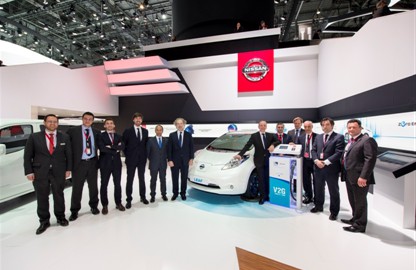
Power to spare - Nissan and Endesa sign pledge to promote Europe's first mass market vehicle-to-grid system (Image: Nissan)

Power to Spare – Nissan and Endesa Sign Vehicle to Grid Pledge

POWER TO SPARE – NISSAN AND ENDESA SIGN PLEDGE TO PROMOTE EUROPE’S FIRST MASS MARKET VEHICLE TO GRID SYSTEM

    • Nissan and Endesa, an Enel Group subsidiary, collaborate on bringing key technologies to market
    • Game-changing technology unlocks the potential of two-way charging and allows customers to reduce costs by selling power from electric vehicle batteries to the grid
    • First step towards integration of electric vehicles with the renewable energy sector
    • Madrid to host real-life demonstration of the system in March 2015

    Nissan and Endesa, an Enel Group subsidiary,  signed a ground-breaking agreement at the 85th Geneva International Motor Show that paves the way for a mass-market vehicle-to-grid (V2G) system.

    The two companies have pledged to work together to deliver a V2G system and an innovative business model designed to leverage this technology.

    Nissan- the world leader in EV sales with over 160,000 Nissan LEAF sold globally- is turning a page in zero emission mobility, and releasing the full potential of electric vehicle (EV) batteries with the Endesa two-way charging technology. It’s all part of Nissan’s commitment to support the entire EV ecosystem, not just the car..

    The two companies have agreed to collaborate on the following activities:

    • – Introduction of V2G services in the European market;
    • – Exploring the use of ‘second life’ EV batteries for stationary applications (including households, buildings, grid);
    • – Designing and evaluating potential affordable energy and mobility pack offers;

    Paul Willcox, Chairman of Nissan Europe, praised the innovative two-way charging system and the step-change towards a further acceleration of the EV market:

    We believe this innovation represents a significant development for Nissan Leaf and e-NV200 customers. Every Nissan electric vehicle battery contains a power storage capability that will prove useful in contributing towards smarter and responsible management of the power demand & supply of local power grids, thus reducing our EV total cost of ownership. Not only does this represent an opportunity for Nissan’s EV private and fleet owners, it could also support grid stability and fully demonstrate that each Nissan EV represents a tangible social asset.’

    Power to spare - Nissan and Endesa sign pledge to promote Europe's first mass market vehicle-to-grid system (Image: Nissan)
    Power to spare – Nissan and Endesa sign pledge to promote Europe’s first mass market vehicle-to-grid system (Image: Nissan)

    Indeed, one of the main challenges for electricity management systems is to assure grid stability. This situation is especially relevant in countries with a high level of renewable energy generation, and this will only increase in the future. The longer term zero-emission vision is for EVs to be at the center of a fully integrated system whereby owners can participate in wholesale energy markets using the power stored in the batteries of their electric vehicles, and thus significantly reduce their cost of operation. In a not-so-distant scenario, the EV user not only decides when and where they want to charge their EV, but how best they spend and re-sell the energy stored in their EV; receiving tangible financial benefits in terms of energy savings, while at the same time maximizing the use of green energy.

    The flexibility offered by V2G implementation in terms of storing and releasing green energy into the grid will further enhance the already significant and tangible benefits of electric mobility. This is why Endesa, together with its parent company Enel and partner Nissan, have decided to join efforts in promoting this technology.” said Javier Uriarte, Head of Market Iberia at Endesa.

    For Information

    This Vehicle to Grid (V2G) system consists of the Endesa two-way charger and an energy management system that can also integrate such off-grid, and renewable, power generation as solar panels and wind turbines. Using this equipment, a Nissan LEAF or e-NV200 owner can connect to charge at low-demand, and cheap tariff periods, with an option to then use the electricity stored in the vehicle’s battery at home when costs are higher, or even feed back to the grid with a net financial benefit. Electricity generated by solar panels or wind turbines can be used to charge a vehicle, to power the home or business, or to feed back to the grid.

    This unprecedented agreement between Nissan and Endesa means that European countries can now review their current energy management policies in order to respond to the technological innovation of the V2G system.

    Endesa has developed the ultimate low-cost V2G technology ready for the mass market after years of real-life testing. The company first showcased its V2G technology in 2008 in Smartcity Malaga, the Enel Group testing ground for smart cities. Later on, in 2012, Endesa presented the evolution of such technology at the ZEM2ALL demonstrator.

    On March 12, 2015, as the culmination of the V2G system development, together with Nissan as automotive partner, Endesa will host a full demonstration of the market-ready and low cost system in Madrid.

    ENDS

    About Nissan in Europe

    Nissan has one of the most comprehensive European presences of any overseas manufacturer, employing more than 17,600 staff across locally-based design, research & development, manufacturing, logistics and sales & marketing operations. Last financial year Nissan plants in the UK, Spain and Russia produced more than 675,000 vehicles including award-winning crossovers, small cars, SUVs, commercial vehicles and electric vehicles, including the Nissan LEAF, the world’s most popular electric vehicle with 96% of customers willing to recommend the car to friends. Nissan now offers a strong line-up of 23 diverse and innovative models in Europe under the Nissan and Datsun brands.

    About Nissan Motor Co.

    Nissan Motor Co., Ltd., Japan’s second-largest automotive company, is headquartered in Yokohama, Japan, and is part of the Renault-Nissan Alliance. Operating with approximately 236,000 employees globally, Nissan sold more than 4.9 million vehicles and generated revenue of 9.6 trillion yen (USD 116.16 b

    illion) in fiscal 2012. Nissan delivers a comprehensive range of over 60 models under the Nissan and Infiniti brands. In 2010, Nissan introduced the Nissan LEAF, and continues to lead in zero-emission mobility. The LEAF, the first mass-market, pure-electric vehicle launched globally, is now the best-selling EV in history.

    Source: Nissan Newsroom