A new study has found that the gas pump is the germiest, filthiest thing we touch in everyday life. That’s according to Dr. Charles Gerba of the University of Arizona — and he should know. A microbiologist, he’s known by the nickname “Dr. Germ.”
The research results released Tuesday found that 71% of gas pump handles and 68% of corner mailbox handles are “highly contaminated” with the kinds of germs most associated with a high risk of illness. The study by Kimberly-Clark Professional, and reported on in USA Today, says that 41% of ATM buttons and 43% of escalator rails are similarly teeming with germs.
Other highly contaminated places that many people probably never considered before, and now might fear using, are parking meters and kiosks, about 40% of which are fouled by germs. Crosswalk buttons and vending machines were tied at 35%.
As part of the study, hygienists swabbed suspected germ hotspots and then analyzed the findings. They used general industry sanitary standards as their benchmark.
Gerba analyzed the results for Kimberly-Clark’s Healthy Work Place Project, a subsidiary of the manufacturer of tissues, hand sanitizer and the like. (The project’s website says sick employees cost the average business about $1,320 per employee.)
So what are we supposed to do? Apparently, it’s all about “hand hygiene” — washing your hands throughout the day — and wiping down your work station with a cleaning product (naturally) because a desktop, keyboard and computer mouse can be a breeding ground for germs, says Gerba and the folks at Kimberly-Clark.
“As your computer boots up, wipe down your desk and mouse,” Brad Reynolds, leader of Kimberly-Clark’s Healthy Workplace Project, said in the USA Today article. He also advised swabbing conference tables between meetings.
Alliance to provide 200 pure electric vehicles to 2015 Paris climate conference
The first fully electric shuttle service for United Nation’s climate conference
Fleet to include Renault ZOE and Kangoo Z.E, Nissan LEAF and e-NV200
More than 50 charging stations powered by renewable energy to be established in and around Paris.
PARIS (May 27th , 2015) — The Renault-Nissan Alliance, the world leader in zero-emission mobility*, will provide a fleet of 200 all-electric vehicles as the official passenger-car provider for the United Nation’s COP21 climate conference in Paris later this year.
The partnership agreement was signed today between the Renault-Nissan Alliance and the General Secretary in charge of the preparation and organization of the 21st annual Conference of Parties (better known as COP21). The fully electric car fleet will shuttle delegates during the event from Nov. 30 to Dec. 11.
More than 20,000 U.N. participants from 195 countries are expected to attend the annual climate summit. It will be the first time the U.N. will use a zero-emission fleet for its entire passenger car shuttle at a COP event.
The goals of the Paris summit are to have a new global climate-change agreement in place by the end of 2015 and to have the Climate Green Fund, established to help developing countries adapt to climate change and reduce emissions, start allocating funds.
“We are delighted to announce that the Renault-Nissan Alliance is an official partner of COP21 in Paris. Thanks to the Alliance’s fleet of 100% electric vehicles, it will contribute to our goal of achieving a carbon neutral event. The technology of electric vehicles helps reduce greenhouse gases in the transportation sector efficiently,” said Laurent Fabius, Minister of Foreign Affairs and International Development, President of COP21.
“Electric vehicle technology is an efficient solution for a practical and affordable mode of transportation. This solution has a positive impact on the climate and air quality in our cities,” said Carlos Ghosn, Chairman and CEO of the Renault-Nissan Alliance. “It’s time to accelerate the shift to zero-emission mobility by working together with all parties concerned.”
The COP21 car fleet will feature the Renault ZOE subcompact car, the Renault Kangoo Z.E. van, the Renault Fluence Z.E. sedan, the Nissan LEAF compact car and the 7-seater Nissan e-NV200 van. The vehicles will be available to shuttle delegates 24 hours, seven days week to key venues around the conference, as a complement to public transportation.
The Renault-Nissan Alliance will work with companies in France to set up a network of more than 50 quick and standard charging stations powered by 100% renewable energy in strategic locations. The quick charging stations will be able to charge the EVs from 0 to 80% capacity in about 30 minutes.
[From 26 May] Today this paper launches a new initiative to encourage Londoners to adopt, develop and promote the kind of green technology that could help clean our air. It is backed by the chairman of the Committee on Climate Change, Lord Deben, who urges us to embrace change: there are, he says, “a whole lot of things we can do which mean that we can live exactly the same lifestyle at half the impact on the environment”. Electric cars are one example; remote-controlled heating systems are another.
Meanwhile, the Mayor has announced £8 million support for pioneering schemes to improve air quality, such as pollution-absorbing walls and zero-emission car clubs. This coincides with a World Heath Organisation meeting today in Geneva to combat air pollution.
These are excellent moves and signs of hopeful change. Yet they come less than a month after the Supreme Court ordered ministers to come up with a new plan for tackling air pollution. Britain is in breach of EU-mandated pollution levels for both nitrogen dioxide and PM10 diesel particulate (the tiny particles of soot emitted by diesel exhausts). Our filthy air is estimated to cause around 29,000 premature deaths a year in the UK and is a major contributor to lung diseases such as asthma.
London’s problem is how to clean up its air at the same time as meeting the demands of transport in Europe’s largest and busiest city. Despite increasing numbers of Londoners cycling, and increased passenger numbers on public transport, pollution from road transport remains well above EU limits. The Mayor’s long-term solution is the Ultra Low Emission Zone, which aims to encourage drivers of the most polluting vehicles to change their vehicles by charging a new daily levy for those entering the congestion charge zone from 2020.
Yet this represents a watering-down of the Mayor’s original plans in this respect: critics charge that it is too little, too late. Clearly air pollution is no respecter of land boundaries like those of the congestion charge zone. Air pollution readings from test sites outside the central zone — for instance in Brixton — are worryingly high. Other European cities are pressing ahead with more drastic plans for eliminating the biggest culprits in air pollution, diesel engines. Refitting existing bus engines would help too. Above all, the problem simply needs to be given a much higher political priority than it has to date. Air pollution kills: London needs to tackle it urgently.
Drivers and pedestrians have been misled by EU tests aimed at cutting lethal air pollution
WHEN Victoria Kelly sets off around her home city of Manchester she finds the fastest roads — and then goes out of her way to avoid them.
Instead she plots a route that will take her around the clouds of diesel air pollution found along those busier roads, sticking to the leafiest and smallest streets she can find.
It means simple journeys can double in length, but for Kelly, 23, the detours are vital to avoid the airborne toxins that have twice put her into intensive care with asthma attacks like those that have killed two of her friends.
“An attack is like breathing out through a straw into a bucket of sand with an elephant sitting on your chest,” she said. “Air pollution is one of the most likely things to set it off — so I do all I can to avoid it.”
Kelly is one of 5.4m people in Britain diagnosed with asthma. The condition kills three people a day — and traffic pollution, mainly from diesel vehicles, is a key cause. A fifth of those are children — such as Will Cort, a 13-year-old whose childhood in central London has been blighted by asthma.
“I normally get attacks at night and wake up because I can’t breathe. It can go on for days,” he says.
Will Cort, 13, who lives in central London, says he frequently finds it difficult to breathe (Image: F. Guidicini)
Asthma can be triggered by many factors but it is no coincidence that whenever air pollution levels rise, Britain’s hospitals and GPs see a surge of patients with asthma. Last month Public Health England published research showing that thousands of people suffered attacks when smog laden with tiny “particulate” particles and nitrogen dioxide (NO2) gas typical of diesel emissions hit Britain last spring.
Europe’s largest oil companies are banding together to forge a joint strategy on climate-change policy, alarmed they’ll be ignored as the world works toward a historic deal limiting greenhouse gases.
Royal Dutch Shell Plc, Total SA, BP Plc, Statoil ASA and Eni SpA are among oil companies that plan to start a new industry body, or think tank, to develop common positions on the issues, according to people with knowledge of the matter. So far the largest U.S. companies — Exxon Mobil Corp. and Chevron Corp. — have decided not to participate, the people said, asking not be named before a public announcement expected as early as next month.
Efforts to reduce fossil-fuel investments and spur renewables such as solar and wind power have gathered pace in the past two years with oil companies sitting largely outside the debate. One aim of the European producers will be to push natural gas as more climate friendly in generating power than coal, the people said. Of the most used fossil fuels, gas is the one that pollutes the least while coal tops emissions.
“There are companies that are now going beyond the industry’s traditional defensive position by at least appearing to rethink strategy and practices,” said Carole Mathieu, research fellow at the French Institute for International Relations in Paris.
‘Strong Statement’
The heads of the biggest European oil producers have been pushing the idea of more active engagement with climate policy in recent weeks.
On Thursday, Shell Chief Executive Officer Ben van Beurden said his company would “put a really strong statement out on what we think should happen.” He cited the increased use of gas in power generation as key to tackling emissions.
“Targets will not be enough,” he said. “We will argue for what we think should be done to bring carbon down.”
The industry is slowly waking up to the existential danger to their operations emerging from policies designed to limit climate change. With global temperatures and carbon emissions at a record, governments are looking for a way to clamp down on pollution. The International Energy Agency, a policy adviser to industrial nations, says half of all fossil-fuel reserves may have to remain in the ground to prevent overheating.
Common Language
“We’re trying to put together a group of people to begin to speak the same language” on climate, BP CEO Bob Dudley said at a meeting hosted by IHS Inc.’s CERA consulting unit in Houston in April. “There’s a bit of different language coming out of different companies and therefore our voice is lost in this.”
His counterpart at Total, Patrick Pouyanne, said in Paris on Wednesday that the industry needs to work together. “If each of us is attacked separately, we will be stronger as a group.”
Statoil CEO Eldar Saetre has embraced the United Nations’ goal to limit global warming to 2 degrees Celsius, a level beyond which scientists say disastrous climate change will bring more violent storms and rising sea levels. He set up a renewable-energy unit and described steps the industry should follow, starting with a shift to cleaner fuels such as gas, reducing flaring and support for carbon pricing.
“If we don’t, we risk becoming an industry that neither gets access nor acceptance — and that’s not a good thing,” Saetre said at the CERA gathering.
Investments Scrapped
Shell is urging the industry to get out of its defensive crouch and make its views understood. It wants alternative arguments to counterbalance the divestment campaign, which has persuaded institutions such as the Rockefeller Brothers Fund and Stanford University to scrap fossil-fuel investments.
“In the past we thought it was better to keep a low profile on the issue,” Van Beurden said in February. “It’s not a good tactic. We have to make sure that our voice is heard by members of government, by civil society and the general public.”
The European companies are more sensitive to environmental issues because governments in the region are leading the way on climate and voters are demanding action. The 28-nation European Union plans to cut carbon emissions 40 percent by 2030, double the commitment it made for 2020.
Exxon, Chevron
For their part, Exxon and Chevron say there’s little difference in the approach between them and their European competitors. Exxon CEO Rex Tillerson has said he’ll speak more openly about the issue and has acknowledged that the risks of climate change warrant action. He is urging policy makers to consider a global price on carbon emissions and since 2007 included carbon prices in his company’s business planning.
Chevron said Wednesday in a statement that it shared the concerns of governments and the public about climate change and action was needed to address the risks. Exxon declined to comment.
While Europe’s big oil groups present a friendlier position toward climate change, they are continuing with investments that environmental groups sharply criticize, including drilling in the Arctic.
Emissions data released through the Carbon Disclosure Project show little difference between the U.S. and European oil companies over the past four years. All have reduced pollution “slightly” since 2011, with BP in the lead mainly because of asset sales needed to pay more than $40 billion in costs associated with the Gulf of Mexico disaster in 2010.
“All companies need to be low-carbon or zero-carbon by 2050,” said Paul Simpson, CEO of the Carbon Disclosure Project, which helps 822 institutional investors with $95 trillion in holdings analyze risks from sustainability issues. “The oil and gas sector is one that doesn’t yet show a clear transition. The longer that goes on, the more concern investors will have.”
Even before she got behind her desk in Whitehall, Amber Rudd, the new energy secretary, was promising to “unleash a new solar revolution”.
A million people now live in homes with solar panels on the roof, and she says that number needs to increase further.
Yet the residents of one small town in Cornwall need no extra persuasion.
Around 500 houses in Wadebridge on the Camel estuary already have panels on their roofs – nearly 10% of homes in the area – making the town a contender for the solar power ‘capital’ of the UK.
“It is fairly likely from the information we’ve been able to gather that Wadebridge has the highest concentration of panels in the country,” says Jerry Clark, of the town’s Renewable Energy Network.
Cornwall, with 1,541 sunshine hours every year, is particularly rich in this resource.
Residents of Wadebridge have been amongst the fastest in the UK to install solar panels
But people living anywhere in the UK can also benefit.
Providing you are prepared to invest at least £5,000 – and wait for a decade to get your money back – the eventual savings could be considerable.
Anglo-Dutch company’s search for resources in the Arctic is a sign that the world is running out of options for new oil reserves
In his critically acclaimed 2005 book ‘Twilight in the Desert’, the prominent oil economist Matthew R. Simmons predicted that Saudi Arabia’s oil wells would soon run dry.
His argument was based on the age of the seven main fields, which the kingdom still to this day depends upon to pump the bulk of its 10m barrels per day (bpd) of crude. These fields in the main have been producing for over a generation and, despite official figures placing Saudi Arabia’s proven reserves at over 260bn barrels, Mr Simmons argued that the kingdom would struggle to increase its output to keep pace with the projected increases in the demand over the next half century marking the beginning of a period known as “peak oil”.
The kingdom, which enjoys some of the lowest production costs in the world, has the capacity to pump 12m bpd if required and shows no signs of slowing down. However, the big question remains whether the Middle East’s energy superpower along with the world’s other major oil producers will be able to keep up with the expected increases in demand over the next 25 years?
Protests won’t halt rush for Arctic oil (Image: REUTERS/J. Redmond)
By 2040, the Organisation of the Petroleum Exporting Countries (Opec) predicts the world will need to produce 111m bpd of crude to meet world demand. That represents another 20m bpd on top of existing output which means the world needs to find and develop and additional 800,000 bpd of oil a year on average to keep up with supply. To put that challenge into perspective, this figure represents repeating the US shale oil boom all over again, or finding a developing a new North Sea 20 times over.
Although, Mr Simmons was perhaps wrong in focusing on a potential collapse in Saudi Arabia’s oil production he was right in warning about the dangers of “Peak Oil” but too early in predicting its onset. That time is now upon us. Despite, oil prices being forced lower over the last six months the world is entering into a “peak oil” scenario whereby the cost of a barrel could feasibly quadruple to around $200 per barrel over the next 10 years.
Lots of people eagerly study all the polls and reports on how many people believe that climate change is real and urgent. They seem to think there is some critical mass that, through the weight of belief alone, will get us where we want to go. As if when the numbers aren’t high enough, we can’t achieve anything. As if when the numbers are high enough, beautiful transformation will magically happen all by itself or people will vote for wonderful politicians who do the right thing.
Climate March poster on the London Underground (Image: T. Larkum)
But it’s not the belief of the majority or the work of elected officials that will change the world. It will be action, most likely the actions of a minority, as it usually has been. This week’s appalling Obama administration decision to let Shell commence drilling in the Arctic sea says less about that administration, which swings whichever way it’s pushed, than that we didn’t push harder than the oil industry. Which is hard work, but sometimes even a tiny group can do it.
Take San Francisco, population 850,00, which is near the very top for percent of people who believe in climate change, according to a pollster I spoke to recently. I wish that meant that there were 850,000 climate activists in my town, or even 425,000. But I’ve watched for two years (and sometimes joined) the group of people pushing the San Francisco Retirement Board to divest its half billion dollars or so in fossil fuel investments. In April of 2013, the San Francisco Board of Supervisors passed an exhilarating unanimous (but nonbinding) resolution asking the Employee Retirement Board to divest.
Out of the 850,000 San Franciscans, seven or eight dedicated people have kept the divestment initiative alive, while the retirement board balks, stalls and grumbles about how straightforward changes in a modest portion of their portfolio are difficult, impossible, dangerous (even as they lost tens of millions when petroleum and coal stocks crashed). The activists pushing this forward are not one percent of San Franciscans, which would be 8500 people, or .1%, 850, but about .001% of people in the city.
Advertisement
They’ve come this far by being dedicated, tenacious, deeply informed on the issue and on board policy, and by regularly meeting among themselves and attending most of the meetings. Occasionally they get more people to show up, but they’ve carried the weight for two years. Recently they had a substantial victory, and they may yet win. For all of us. Otherwise divestment might have slipped away in San Francisco. It’s been the same at schools from Rutgers to Stanford: small groups of students and allies have pushed divestment and, sometimes, won. This is the kind of race that tortoises, and not hares, tend to win.
Sometimes small groups matter. Larger groups often do. People have the power, when we choose to use it, to act on it, to dedicate ourselves to change. We have so many stories about how power is elsewhere. As the Obama Administration nears its end, I keep hearing from the bitterly disappointed and the generally bitter, who seem to believe that one man should have reversed the status quo more or less singlehandedly. They blame, credit, and obsess about the 53-year-old in the White House. But Obama is just the weathervane, and he knew it when he was elected.
Then, he implored the great wind that lifted him up and carried him along to keep going. Instead, people believed the job was done when it had just started and went home. Had the exhilarating coalition of the young, the nonwhite, the progressive, the poor who are usually excluded from political power kept it up, had they believed the power was ours, not his, we could have had an extraordinary eight years. The failures are not his alone – we can’t expect more of politicians than of the civil society that could push them. We can expect more of ourselves.
The climate movement is picking up steam – or rather wind. This January you could even see Mitt I-Will-Build-the-KXL-Pipeline-Myself Romney start to waver on the reality of climate change and its causes.
Yes, that’s the same Mitt “I’m not in this race to slow the rise of the oceans or to heal the planet” Romney we heard from in 2012.
In 2004 Senator John McCain actually said, while pushing emissions-control legislation:
“There is strong scientific consensus about the fact that global climate change is occurring, and occurring as a result of human activity.”
By 2008, he was picking a climate denier as his running mate. Corporate wind machines make them spin and spin, these ambitious men.
“Marco Rubio Used to Believe in Climate Science. Now He’s Running for President”, ran a Mother Jones headline.
He knows, as my mother would’ve said, on which side his bread is buttered.
We complain about politicians spinning, rather than recognizing that this is exactly what we want a weathervane — or hey, a wind turbine — to do, or recognizing that it’s up to us to be that wind. That’s why the ordinary people of Richmond, California, managed to beat the candidates mighty Chevron Corporation backed to elect a full sweep of green populists to city government last November. It’s also popular to say that we need to get money out of politics, but the people in that Chevron-refinery-dominated town proved that even money can’t buy everything if people are passionately engaged. As my friend Jamie Henn of 350.org said, we don’t need to get money out so much as we need to get people in (and by that I don’t think he means obediently voting at the end of the process, but transforming the process, inside and outside electoral politics).
Too many of us seem far too fond of narratives of our powerlessness, maybe because powerlessness lets us off the hook. As we head into that most dismal of situations, another unbearably long electoral cycle, many who care about climate change will say that we need an elected official who will represent us or a great majority who agree with us. But we don’t need everyone on board; we don’t need one magic person in office; we need ourselves. To act. It’s the wind, not the weathervanes.
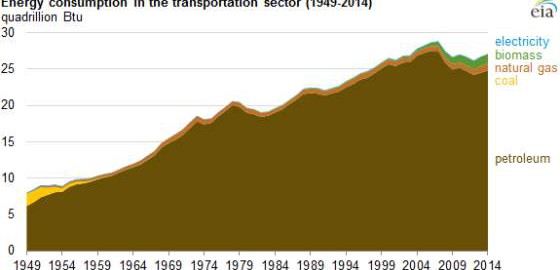
More than 8% of fuel used by the transportation sector came from non-petroleum sources in 2014
The transportation sector is moving away from oil slowly but surely. Driven by growth in the use of biofuels and natural gas, non-petroleum energy now makes up the highest percentage of total fuel consumption for transport since 1954, according to a new report from the U.S. Energy Information Administration (EIA).
In total, 8.5% of fuel used by the transportation sector came from non-petroleum sources in 2014. Biomass from corn-based ethanol—still supported by generous government subsidies—represented the largest non-petroleum energy source and was used primarily to fuel cars and other light vehicles. Use of natural gas to operate pipelines followed close behind. The report also shows smaller but still significant increases in the use of electricity, biodiesel and natural gas in vehicles.
Climate change and fluctuating oil prices has made moving away from petroleum when possible a priority for governments and corporations alike. But it’s still uncertain which fuel will be the best and greenest replacement, according to Christopher R. Knittel, an MIT professor of energy economics . Ethanol, natural gas, hydrogen and electricity are all possibilities.
“We don’t know where we’ll be 50 years from now,” said Knittel. “There are four potential replacement for petroleum, and, ultimately, we don’t what’s going to win out.”
Energy consumption in the transportation sector, 1949-2014 (Image: US EIA)
While the overall trend away from petroleum is encouraging—petroleum accounts for over a third of global greenhouse gases—the newfound reliance on biomass might be seen as a double-edged sword. Using ethanol, which is currently mixed with petroleum and represents around 10% of the gas sold for most cars in the U.S., provides only “marginal benefit” over petroleum in terms of greenhouse gas emissions, according to Knittel. Using electricity in the transport is generally better and cleaner, but the technology is still in its early stages. Where it does exist, as in Tesla cars, it’s often expensive and impractical for large-scale use.
‘Shocking’ revelation finds $5.3tn subsidy estimate for 2015 is greater than the total health spending of all the world’s governments
Fossil fuel companies are benefitting from global subsidies of $5.3tn (£3.4tn) a year, equivalent to $10m a minute every day, according to a startling new estimate by the International Monetary Fund.
The IMF calls the revelation “shocking” and says the figure is an “extremely robust” estimate of the true cost of fossil fuels. The $5.3tn subsidy estimated for 2015 is greater than the total health spending of all the world’s governments.
The vast sum is largely due to polluters not paying the costs imposed on governments by the burning of coal, oil and gas. These include the harm caused to local populations by air pollution as well as to people across the globe affected by the floods, droughts and storms being driven by climate change.
Nicholas Stern, an eminent climate economist at the London School of Economics, said:
“This very important analysis shatters the myth that fossil fuels are cheap by showing just how huge their real costs are. There is no justification for these enormous subsidies for fossil fuels, which distort markets and damages economies, particularly in poorer countries.”
Lord Stern said that even the IMF’s vast subsidy figure was a significant underestimate:
“A more complete estimate of the costs due to climate change would show the implicit subsidies for fossil fuels are much bigger even than this report suggests.”
The IMF, one of the world’s most respected financial institutions, said that ending subsidies for fossil fuels would cut global carbon emissions by 20%. That would be a giant step towards taming global warming, an issue on which the world has made little progress to date.
Ending the subsidies would also slash the number of premature deaths from outdoor air pollution by 50% – about 1.6 million lives a year.
Furthermore, the IMF said the resources freed by ending fossil fuel subsidies could be an economic “game-changer” for many countries, by driving economic growth and poverty reduction through greater investment in infrastructure, health and education and also by cutting taxes that restrict growth.