I asked a few weeks back whether you’d buy a used Nissan LEAF, revealing that I myself am mulling such a purchase.
No sooner do I start to explore the decision in depth that some of those familiar naysaying headlines start popping up. Over at Autoblog Green, I see this: Electric cars can be dirtier than gas ones. Meanwhile over at Torque News, I learn that a LEAF is greener than a Prius in most states—but is only borderline in my home state of North Carolina.
Now there are way too many ambiguities to discuss here: The study quoted in Autoblog Green did not, for example, take into account the fact that refining gasoline requires vast amounts of (usually) coal-burning electricity too. Without a true well-to-wheels (or mine to wheels) analysis, the whole exercise becomes a bit moot. Equally, how does it change the equation if an electric car driver chooses to buy from a green energy tariff? And how do we plan for a changing electricity grid in the future?
What really interests me is the bigger point, however: We may be spending too much time worrying about our own, specific carbon footprint—and not enough time worrying about the role we are playing in a broader transition to a low carbon economy.
The case of electric cars is just one example of this phenomenon. If we need to decarbonize both electricity supply and our transportation systems, then the idea that a gas-fired car is (or may be) currently greener becomes largely irrelevant. What matters is that we need both emission-free cars and emission-free electricity in the very near future, and any form of oil-powered car, however efficient, is simply not going to get us there. (One recent study suggests that a future based on autonomous, electric vehicles could create 94% reductions in CO2 emissions as the grid gets greener.)
So buy your electric car (if you need a car), and then work like hell to defend and promote clean energy where you live, and maybe reduce car dependence too.
Other examples of this phenomenon range from the constant whining about Al Gore’s carbon footprint (as opposed to his leverage) to the dangerous notion that “voting with your dollar” is as important as engaging with the political system.
Yes, your personal impact on the planet is part of the bigger picture. But it’s that bigger picture that actually matters.
WASHINGTON—Evoking cataclysmic scenes of extreme weather and widespread drought and famine, the nation’s climate change deniers held a press conference Wednesday to describe exactly what the Earth must look like before they will begin to believe in human-induced global warming.
The group of skeptics, who said that the consensus among 97 percent of the scientific community and the documented environmental transformations already underway are simply not proof enough, laid out the precise sequence and magnitude of horrific events—including natural disasters, proliferation of infectious diseases, and resource wars—they would have to witness firsthand before they are swayed.
The skeptics laid out four conditions that must be met for them to accept that climate change isn’t simply a theory: 100 named hurricanes a year, the full evaporation of the Mississippi River, nine-month-long heat waves, and the complete extinction of every animal in the class Reptilia
“For us to accept that the average surface temperature of the Earth has risen to critical levels due to mankind’s production of greenhouse gases, we’ll need to see some actual, visible evidence, including a global death toll of no less than 500 million people within a single calendar year,” said spokesperson William Davis, 46, of Jackson, NJ, who added that at least 70 percent of all islands on the planet would also have to become submerged under rising seas before he and his cohort would reconsider their beliefs. “To start, we’re going to have to see supercell tornadoes of category F4 or higher ripping through Oklahoma at least three times a day, leveling entire communities and causing hundreds of fatalities—and just to be perfectly clear, we’re talking year-round, not just during the spring tornado season.”
“I don’t think it’s too much to ask to see a super hurricane destroying the Southeast U.S. and another one at the same time decimating the Pacific Northwest before I make up my mind about this.”
“The reality is that we’re still experiencing cold, snowy winters, and the entire global population is not currently embarking on cross-continental migrations in search of arable land,” Davis continued. “Until that changes, we cannot be expected to believe climate change is occurring.”
Davis went on to say that certain events, such as massive, uncontrollable wildfires across the U.S—not just restricted to the American West, but in areas including Florida and New England—would render climate change deniers open to reevaluating the decades’ worth of data that show the planet is warming at a catastrophic rate. Additionally, Davis said that for the community to begin believing a single word of any scientific journal article corroborating climate change, every one of Earth’s glaciers would have to retreat at a rate exceeding 20 miles per year, and each of the skeptics, individually, would have to go a decade without seeing naturally occurring ice anywhere.
Furthermore, climate change deniers maintained that if the total number of plant and animal species on the planet remained higher than 200 in aggregate, they would not be dissuaded from their belief that Earth is simply experiencing one of its natural warming cycles that would eventually resolve itself on its own.
“I don’t think it’s too much to ask to see a super hurricane destroying the Southeast U.S. and another one at the same time decimating the Pacific Northwest before I make up my mind about this,” said global warming skeptic Michelle Wilkinson of Medina, MN, adding that she would be willing to recognize the findings of the Intergovernmental Panel on Climate Change if repeated and unpredictable storm surge flooding rendered every major East Coast city, including Boston, New York, Philadelphia, and Washington, D.C., wholly uninhabitable. “The fact of the matter is that if I walk outside at any time of day at any point in the year and it’s below 90 degrees, then there simply isn’t enough proof that we need to be cutting carbon emissions.”
After clarifying that the desertification of major population centers, and the global refugee crisis that would result, would be necessary but not sufficient evidence of climate change, the skeptics reportedly unveiled a vivid artist’s rendering of the vast expanse of parched, lifeless earth and dead trees that each of them must see through the windows of their homes before reversing their opposition to public schools teaching children about global warming.
“We keep hearing all this mumbo-jumbo about the sixth mass extinction we’re in the midst of,” said Mitch McConnell, a U.S. senator from Kentucky, at the conclusion of the press conference. “Well, if that’s the case, then tell me this: Why aren’t the streets littered with human bodies right now, with the ragged bands of the still-living siphoning the moisture from the corpses of the dead?”
“We’re not unreasonable; we just need the evidence to be convincing before we make a decision,” McConnell added.
A Hard Deadline: We Must Stop Building New Carbon Infrastructure by 2018
In only three years there will be enough fossil fuel-burning stuff—cars, homes, factories, power plants, etc.—built to blow through our carbon budget for a 2 degrees Celsius temperature rise. Never mind staying below a safer, saner 1.5°C of global warming. The relentless laws of physics have given us a hard, non-negotiable deadline, making G7 statements about a fossil fuel-phase out by 2100 or a weak deal at the UN climate talks in Paris irrelevant.
“By 2018, no new cars, homes, schools, factories, or electrical power plants should be built anywhere in the world, ever again unless they’re either replacements for old ones or are carbon neutral? Are you sure I worked that out right?”
I asked Steve Davis of the University of California, co-author of a new climate study.
“We didn’t go that far in our study. But yes, your numbers are broadly correct. That’s what this study means,”
Energy storage is heralded as the critical technology that will make widespread adoption of renewable energy possible. Storage bottles sunlight, addressing a key drawback to solar energy — that it can’t provide electricity when the sun isn’t shining. Energy storage also cures additional utility ailments from grid resiliency to power smoothing.
Due to a rise in incentives and a drop in storage costs, the market for this storage is heating up in the U.S. The market is expected to grow 250 percent just this year.
California is leading the energy storage market thanks to Assembly Bill 2514, which requires state utilities to procure 1.3 GW of storage by 2020. Now California’s three largest investor-owned utilities, Southern California Edison (SCE), Pacific Gas and Electric (PG&E) and San Diego Gas & Electric, are installing cost-effective storage solutions. SCE, for example, invested in a wind farm in the Mojave Desert equipped with giant lithium-ion batteries. The East Coast is following California’s example. New York recently budgeted $25 million to promote storage development.
While the utility-scale market gets most of the attention, a quietly growing storage market segment with a lot of potential is residential solar. After all, residential solar is a fast growing solar market segment — increasing 49 percent in 2014. Unsurprisingly it offers immense opportunity for storage.
The trend towards cheaper home energy storage shows no sign of slowing down
London startup tailors smaller, cheaper battery for UK households to use more of their own generated solar energy
When Elon Musk, the chief executive of Tesla, took to the stage in California in April to launch a solar battery for the home, the audience hollered and whooped at every detail. On the other side of the Atlantic, a more modest, quieter challenger plans to take on the US electric car giant.
Based within a railway arch, with the sound of trains running overhead from nearby London Bridge station and surrounded by other ecologically minded startups, the offices of Powervault are a far cry from Tesla’s showpiece Californian stage. The similarity lies in the product – the Powervault battery, which stores energy from domestic solar panels.
“Some people, especially if they don’t have solar panels, just assume solar panels come with a battery,”
says Joe Warren, Powervault’s managing director. They don’t.
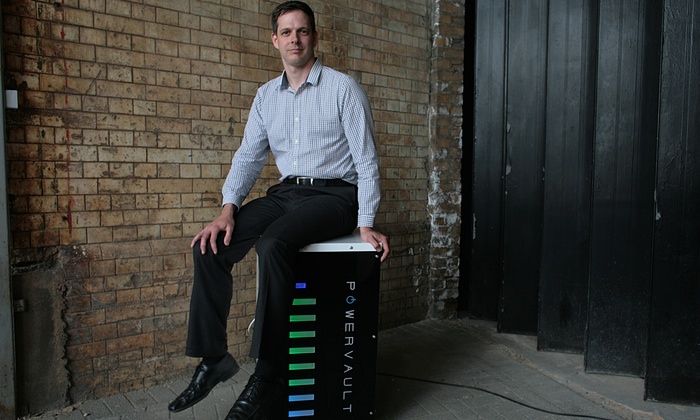
Joe Warren and his Powervault domestic solar power battery (Image: M. Godwin/Guardian)
Home energy generation has blossomed in the UK over the past four years, with an estimated 650,000 homes fitted with solar panels. In 2010, the government introduced the feed-in tariff scheme to pay householders who produce and supply energy. The scheme aims to push renewable energy in the UK towards 15% of total energy by 2020. In 2009, the figure stood at 2%.
Powervault, Tesla and other players in the emerging solar battery market aim to supply the means for householders to store energy produced during the sunniest part of the day for use at peak times, when more people are at home but the sun is down.
Finally the G7 world leaders are waking up to what needs to be done
(From 13 June) This past week, the Group of Seven (G7) world leaders met in Germany for the group’s 41st annual summit.
Needless to say, much was discussed, from the threat of international terrorism to the stability of national economies and, of course, climate change.
G7 leaders in Krun, Germany (Image: White House/P. Souza)
In relation to that final point, the leaders made an ambitious declaration.
The group’s members will use their collective influence to try to stop fossil-fuel consumption by the end of this century.
A goal of reducing consumption by 40 to 70 percent from 2010 levels by 2050, and eliminating it completely by 2100, was set in the summit declaration.
The G7 comprises the world’s seven largest economies–including Canada, France, Germany, Italy, Japan, the U.S., and U.K.–as well as representatives from the European Council, EU Commission, and the International Monetary Fund (IMF).
A positive view of renewables from an oil publication
In April, 2010, BP took the front page, and held it for months, as it struggled to plug the blowout on the bottom of the Gulf of Mexico that would cough up 3 or 4 million barrels.
The Deepwater Horizon disaster was a bitter reminder of the coming difficulties and risk involved in getting what is left of the world’s oil reserves up and out of places that are a lot harder to get at – deep sea, where pressures are extreme; the arctic, where conditions are even more challenging; tar sands, the poster child for too much carbon; and in thousands of small, disparate patches, where ‘tight oil’ comes from driving water, sand and a few chemicals into fissures miles underground. In the U.S., these wells average around 100 barrels a day (see chart below). Herding cats does not seem a likely way to make the U.S. the swing producer to knock Saudi Arabia off its perch.
Things got harder for explorers as 2014 came to an end, and the price of Brent, the international benchmark, was well on its way to a total 61 percent fall in under 12 months. The question is not so much whether the price of oil will be high enough to get the next trillion barrels out of the ground (roughly the current world rate of consumption for another 30 years); it is whether or not the climate can “afford” to have that happen. Peak oil, whether from insufficient supply or demand, makes for an interesting cocktail party discussion. It has even become a political litmus test. However, it is largely irrelevant. Sheik Yamani’s dictum, that the Stone Age did not end because we ran out of stones, should not be dismissed.
This sounds like good news for London’s pollution problem, and for electric car sales
DRIVERS OF diesel cars could be hit with a “pollution penalty” every time they enter London from as early as next year in an attempt to clean up the capital’s air quality.
The charge would be the first of its kind in Britain and comes after new evidence revealed that diesel cars are far more polluting than official figures suggest. A Sunday Times investigation last month found that even diesel cars certified under EU rules as the cleanest yet built are emitting exhaust fumes at up to 9.9 times the official limit.
Diesel cars have traditionally been more fuel-efficient than petrol counterparts but produce higher levels of particulates and nitrogen oxides, which are thought to contribute to respiratory illness and have been blamed for more than 50,000 early deaths in Britain each year.
As previously reported in Driving, London is currently in breach of EU air-pollution rules and the government must submit new air-quality plans to the European Commission by the end of the year or face mounting fines for failing to hit its targets.
Members of the London assembly passed a motion last week calling on the capital’s mayor, Boris Johnson, to investigate new ways of bringing down the city’s pollution levels.
The Liberal Democrat assembly member Stephen Knight said:
“To help tackle the problem, every tool in the public policy toolbox needs to be used, and one option that could be investigated is adapting the congestion charge to add a modest levy on all diesel vehicles entering central London from 2016.”
Some rather controversial views on fossil fuel usage – not just as a fuel – and particularly on carbon capture; it makes depressing reading
The most powerful leaders in the West used the G7 summit in Germany to make a big statement on the environment. Their stated goal is to cut carbon emissions by 40% to 70% by 2050 and then end all fossil-fuel use by 2100. They announced a US$100bn (£65bn) fund by 2020 comprising public and private money to help smooth the transition. My response to David Cameron, Angela Merkel and the rest is pretty simple: good luck with that.
When people talk about decarbonisation, they tend to make the mistake of thinking about energy only in terms of electricity. If you ask how to wean us from fossil fuels, they will say build more solar power, more wind farms and so forth. There are several problems with this. We are already struggling with capacity on the grid and have a huge task to add as much renewable energy as it can cope with. To cover the extra requirements to make heat and domestic transport electric, we would need five times more. I don’t know anyone who thinks this is remotely realistic.
Because most forms of renewable energy only work when the power source is available, be it wind, sun or whatever, we will need large amounts of storage capability to allow them to replace electricity powered by fossil fuels. And while it’s easy to see how you can store kilowatts and megawatts of green power in the batteries of the future, getting up to gigawatts is another matter. The huge engineering requirement makes it almost impossible to get the costs to a point where this is viable.
Electricity is also the least of the big drains on energy. The big challenges are transport fuels, especially for long-distance haulage and trans-ocean shipping. We really don’t have any smart ideas for replacing diesel for these yet, and it’s difficult to see where they will come from. The Royal Academy of Engineering did a study in 2013 looking at the options for low-carbon fuelling of shipping. The best it could come up with was LNG (liquefied natural gas).
You can conceive of running large numbers of domestic cars on green electricity by charging them on the grid. But the idea that anybody is going to be able to produce a battery big enough to store the electricity to power a passenger aircraft or a major container ship is laughable.
A view on electric vehicles taking over – possibly a pessimistic one?
What would the world look like if electric cars took the lead in market share by 2030? “Couldn’t happen,” you say?
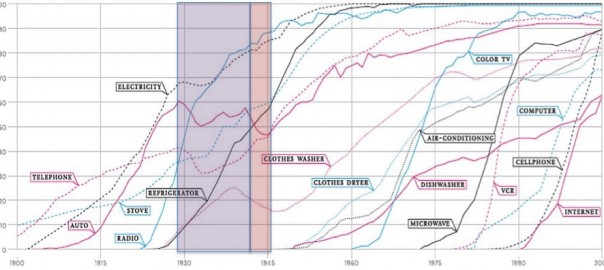
Consider the ramping up of some of the most basic items that have conquered the American market over the past century. Refrigerators went from a luxury item to 60 percent household penetration during the Depression and World War II. Technologies we used to live without including PCs, the Internet, and cell phones have become an integral part of daily life.
Once a breakthrough gets its footing, the rise to mainstream requirement is meteoric and, for reasons unknown (Copernicus has yet to weigh in), the rocket burn lasts about 15 years as the chart above indicates. Trace the rise of both electricity and automobiles. Radios had the sharpest rise of all, which may be why the 1920s were known as the Radio Days. Since the war, color TVs, microwaves, VCRs, PCs, the Internet and cellphones have all caught on as fast as radio. The air-conditioning vector appears to have been bent by the oil embargo in 1973. Auto production sputtered and coughed during the Depression, and throughout the war years, as factories churned out tanks and airplanes. It is not a coincidence that when the stock market peaked in 1929, auto production did too; neither would exceed the 1929 level until 1953.
We are about to find out if electric vehicles can make their mark and become mainstream. The launch sequence and liftoff phase (now barely underway) will soon reveal the extent of their fuel supply, i.e. How much interest will consumers have in EVs when a 200-mile-per-charge car costs less than $25,000? When a 60 kilowatt-hour (kWh) battery costs $9,000, there will be plenty of room in the budget to build a lightweight car around it. (UBS says that at $150 per kWh, the key variable in the calculation above, the EV market will take off.