Category Archives: Energy and Climate Change

News and articles on climate change, vehicle pollution, and renewable energy.

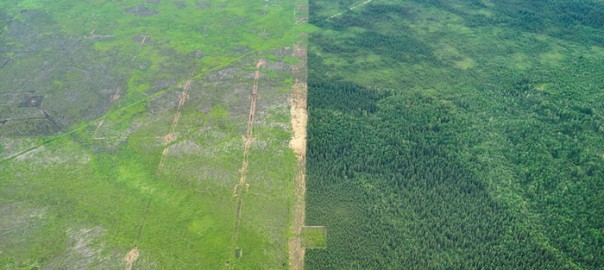
Mildred Lake Extension: Forest-clearing, as part of a process known as overburden removal, in preparation for the expansion of the North Mine (Image: L. Helbig)

Canada’s tar sands landscape from the air

A new book of aerial photographs, Beautiful Destruction, captures the awesome scale and devastating impact of Alberta’s oil sands with stunning colours, contrasts and patterns. The book also includes 15 essays by prominent individuals from environment and industry, sharing their insights, ideas and opinions. Photographs by Louis Helbig

Mildred Lake Extension: Forest-clearing, as part of a process known as overburden removal, in preparation for the expansion of the North Mine (Image: L. Helbig)

Read more: The Guardian

It’s not climate change, it’s everything change

Oil! Our secret god, our secret sharer, our magic wand, fulfiller of our every desire, our co-conspirator, the sine qua non in all we do! Can’t live with it, can’t — right at this moment — live without it. But it’s on everyone’s mind.

Back in 2009, as fracking and the mining of the oil/tar sands in Alberta ramped up — when people were talking about Peak Oil and the dangers of the supply giving out — I wrote a piece for the German newspaper Die Zeit. In English it was called “The Future Without Oil.” It went like this:

The future without oil! For optimists, a pleasant picture: let’s call it Picture One. Shall we imagine it?

There we are, driving around in our cars fueled by hydrogen, or methane, or solar, or something else we have yet to dream up. Goods from afar come to us by solar-and-sail-driven ship — the sails computerized to catch every whiff of air — or else by new versions of the airship, which can lift and carry a huge amount of freight with minimal pollution and no ear-slitting noise. Trains have made a comeback. So have bicycles, when it isn’t snowing; but maybe there won’t be any more winter.

Then there’s Picture Two. Suppose the future without oil arrives very quickly. Suppose a bad fairy waves his wand, and poof! Suddenly there’s no oil, anywhere, at all.

Everything would immediately come to a halt. No cars, no planes; a few trains still running on hydroelectric, and some bicycles, but that wouldn’t take very many people very far. Food would cease to flow into the cities, water would cease to flow out of the taps. Within hours, panic would set in.

Read more: Medium

Electric Car Tipping Point Within 10 Years

It’s encouraging to hear this kind of optimisim made public!

Tesla Motors CTO JB Straubel was the headliner at Intersolar North America last week. He talked about the transition to lithium-ion batteries and how that opened the floodgates for electric cars and stationary storage (eventually); the synergy between EVs, solar, and grid storage; the growth of solar power and grid storage; blah blah blah.

I know, I actually love all that stuff as much as the rest of you — it’s what I read, edit, & write about every day(!) — but it’s basically all general history and trends we know all about. But then JB dropped the awesome-bomb:

“I think we’re at the beginning of a new cost-decline curve, and, you know, this is something where there’s a lot of similarities to what happened with photovoltaics. Almost no one [would have predicted] that photovoltaic prices would have dropped as fast as they have, and storage is right at the cliff, heading down that price curve. It’s soon going to be cheaper to drive a car on electricity — a pure EV on electricity — than it is to drive a gasoline car. And as soon as we see that kind of shift in the actual cost of operation in a car that you can actually use for your daily driver, you know, from all manufacturers I believe we’re going to see electric vehicles come to dominate the whole transportation fleet.

“Also, that same battery cost decrease is going to drive batteries in the grid. There’s going to be much faster growth of grid energy storage than I think most people expected. You suddenly get to have energy that’s 100% firm and buffered from photovoltaics that’s cheaper than fossil energy. And we’re within sort of grasping distance of that goal, which is very, very exciting.

“Because once we get to that, and there really is no going back, it will make sense to do this economically without any environmental consideration whatsoever. So that’s the amazing tipping point that’s going to happen within I’m quite certain the next 10 years.

Read more: EV Obsession

The parallel between food and oil prices (Image: FoodDownTheRoad.ca)

Peak Oil Primer

An introduction to Peak Oil

Contrary to popular opinion we do not live in the Information Age. What we live in is the Oil Age. Look around you and you’ll have a virtually impossible task of trying to find something that isn’t tied back to oil – be it hip replacement surgery, the little pieces of plastic wrapped around the ends of your shoelaces, or the vast infrastructure that makes the so-called “Information Age” possible.

But not only is the relatively superfluous dependent on oil, but so is the very non-superfluous, such as food we eat. Not simply an issue of food being shipped around the world on the back of fossil fuels, the fact of the matter is that fossil fuels are used to plant and harvest our foods, and upon much else, the very fertilizers we spread on our fields are mined from the ground and even derived from fossil fuels themselves (the ammonia and urea we apply to our fields for nitrogen are products of nitrogen atoms paired in the air around us of which were split and combined with hydrogen from natural gas). Simply put, oil and the rest of the fossil fuels are the “lifeblood” of industrial civilization and our modern way of life.

The parallel between food and oil prices (Image: FoodDownTheRoad.ca)

Enter peak oil.

Read more: From Filmers to Farmers

Can these new Greek gods (minus the ties) conjure energy from thin air?

Is Greece Planning to Print Energy?

My first repost – I suspect of many – on the subject of Peak Oil

Over the past couple of months the story keeping many people on the edge of their seats has been the ongoing dilemma of Greece’s detested debt burden, its Great Depression-worthy 25% contraction of its economy, and its voluntary or even forced withdrawal from the eurozone – the fabled “Grexit.”

Can these new Greek gods (minus the ties) conjure energy from thin air?
Can these new Greek gods (minus the ties)
conjure energy from thin air?

For about five years now, heavy austerity policies (cutbacks in government spending) have contributed to what is being described by some as a “humanitarian crisis.” As per stated in the conditions of €240 billion in loans that Greece has received over these years, the Greek government has had to significantly cut back on expenditures, which has included laid off government workers, reduced pensions, a gutted minimum wage, and the selling of state institutions. Partially as a result of this, general unemployment is a bit above 25% while youth unemployment is at nearly 60%; suicide rates are up by 35%; rates of divorce, depression, children suffering from malnutrition, children suffering from physical and emotional abuse, and hospitals lacking basic equipment and medicines are all up; infant mortality has increased 43%; and married women are begging brothels to let them work, but who are then turned away because, well, it’s apparently illegal to sell oneself for sex if one is already betrothed.

Nonetheless, and to the acclaim of many alternative media outlets, late-January saw the stunning election-win of what is called a far-left political party, Syriza. The prime mandate on which it was voted in on by the Greek electorate was to reverse the five-year policy of austerity and to essentially tell its Troika creditors (the European Union, the European Central Bank, and the International Monetary Fund) to shove it where the sun don’t shine.

With Syriza promising to repeal all the aforementioned discomforts, accolades came pouring in, possibly the most astoundingly hyperbolic drivel coming from the online magazine Truthdig.

Read more: From Filmers to Farmers

Oil’s place in the global energy mix is transforming, including in mobility, which uses three-fifths of world oil (Image: Thinkstock/curraheeshutter)

Oil Prices are on a Roller Coaster

Why do oil prices go down? Because they went up. Why do oil prices go up? Because they went down. That’s what they do. To avoid oil-price volatility, you must kick the oil habit.

You can do this by switching to efficiency and renewables. You’ll get cheaper energy services at steady prices; free price insurance; and lower risks to climate, health, environment, global development and security, and America’s independence and reputation.

In contrast, the oil for which the U.S. pays $1 billion a day — and paid $2 billion a day until mid-2014, when $100+ per-barrel prices halved — comes with price risk and far bigger hidden costs that at least triple the real societal cost to upwards of $4 billion a day.

So why, after four relatively placid years, did the world oil price tumble starting in mid-2014, and what’s next?

Why Oil Prices Fluctuate

People burn 1.3 cubic miles of oil a year, or 93 million barrels a day (each barrel equal to 42 U.S. gallons or 159 liters). Scott Pugh, energy advisor to the Department of Homeland Security, visualizes those barrels, each 20 inches in diameter, laid end-to-end and joined to form a pipeline. It’d stretch 1.8 times around the earth. To traverse that pipeline in 24 hours, the oil must flow at 1,835 miles per hour — 2.44 times the speed of sound.

Crude oil’s price fluctuates at more like the speed of light, varying with global, regional, local, and firm-specific market conditions. Despite many complexities, some broad observations are usually valid.

Oil prices tend to rise with instability in major exporters — Persian Gulf, Nigeria, Venezuela, Russia — though diversified supplies, suppliers, and delivery routes have made markets more placid. Strong economic growth also tends to raise prices — until they get high enough to dampen or reverse the economic growth. Conversely, oil prices fall when major exporters do what John D. Rockefeller used to do regularly: “sweat the market” with oversupply to bankrupt high-cost producers and thus raise one’s own monopoly rents.

Read more: Medium
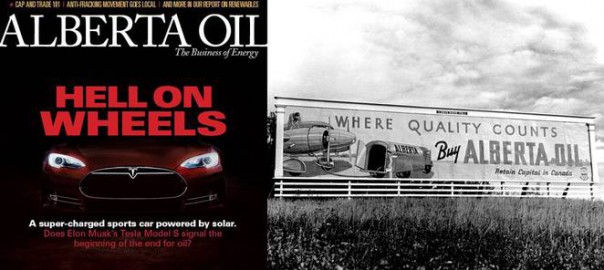
Tesla on industry magazine - end for oil? (Image: Wikipedia)

Tesla is the beginning of the end for oil?

A good find by our friends at EV Obsession, apparently a trade magazine from the oil industry, Alberta Oil, has put a Tesla Model S electric car on its cover (“Hell on wheels”) and published an article with this title and sub-title: “Is Tesla’s Model-S the Beginning of the End for Oil? Why battery technology could drive the electric vehicle to new heights – and disrupt the fossil fuel industry in the process”.

You get the feeling that the thinking of many inside the oil industry is starting to change; for the longest time, most of the comments and official forecasts from the industry basically said that, yes, electric vehicles are coming, but they won’t be a big deal for many decades, and that maybe in 30-40 years they’ll represent a few percents of the vehicles out there.

Tesla on industry magazine - end for oil? (Image: Wikipedia)
Tesla on industry magazine – end for oil? (Image: Wikipedia)

This reassuring (for them) prognostication about the status quo was repeated like a mantra until even most people who heard it over and over in the media accepted it as truth. But that’s not how things work. We can’t know that far in advance how things will be, and if you had asked someone in 2006 whether billions of people were going to own super-powerful internet-connected smartphones within less than a decade, they’d have thought you were crazy. What looks obvious in hindsight isn’t obvious at all looking forward. Why? Because change is non-linear. Things move slowly for a long time, and then you reach a special tipping point where change accelerates. For example, solar power adoption was relatively slow until the price per watt of solar started getting close to other sources (first with incentives, and now without). That changed the game and things shifted in a higher gear. And as we get close to solar being cheaper than all other sources of energy, things will shifter in even higher gear…

Read more: Treehugger

Assess climate change like nuclear war?

Should climate risk be assessed in the same way as risk of nuclear war or pandemic?

When assessing the risk of serious climate change there is not enough focus on the worst-case scenarios that could trigger societal and economic collapse. That’s the conclusion of a major new report assessing the risks posed climate change, commissioned by the UK Foreign Office.

Climate Change: A Risk Assessment argues climate risk should be assessed in the same way as risks to national security or public health – considering the worst-case scenario first, and working backwards to avoid that risk coming to pass.

imageR_climate_change_unk

For example, when assessing the risk of a global pandemic scientists and politicians assess the risk of a worst-case scenario and plan accordingly. Similarly, planning for nuclear conflict has long started by addressing the risk of the worst case scenario. Conversely, most assessments of the impact of climate change tend to focus on the impact of two-, three- or four-degree rises in global temperature – when the worst-case long term scenario is closer to a nine or 10-degree rise.

Read more: Business Green

Avoiding climate burnout – top tips

I have spent my lifetime face to face with some of the most brutal and inhumane acts ever committed, but nothing has been as traumatizing for me as trying to get action to tackle the climate crisis.

As a long time human rights defender and prior Executive Director at WITNESS, I helped produce and direct films on rape as a weapon of war and amputations in Sierra Leone’s recent bloody conflict, I conducted an undercover investigation into the Russian mafia’s involvement in trafficking women for forced prostitution, I investigated hit squads in apartheid South Africa, and I spent countless hours in editing rooms watching first hand images of death, destruction, and devastation.

But spending my days and nights trying to get our country to tackle global warming is more emotionally demanding than any job I have ever done.

When I was at WITNESS, people used to say “The work you do must be so difficult. How do you manage?” to which I would respond “Well, I can see the results. And it’s not as bad as environmental work would be!” What I meant when I said that five years ago is that I felt overwhelmed by our inexorable march to “pave it all” — parking lot by parking lot, McDonald’s by Wal-Mart.

But seeing former Vice President Al Gore give his now famous slideshow at the TED conference in 2006 convinced me that nothing mattered more than tackling global warming, and that climate change had massive humanitarian and human rights consequences. There was no looking back, so in mid-2007 I leapt, knowing that I was headed straight towards my deepest fears and concerns.

As I started to immerse myself in the science and early impacts of global warming, I became increasingly distraught. But I soldiered on, hoping against hope that I would be so busy in an ambitious new start up campaign at 1Sky, and so relieved to be trying to do something about it, that I would not be overwhelmed with existential angst and despair. Looking back on the last year and a half since I started as 1Sky’s Campaign Director in the fall of 2007, my wish has generally come true. But since President Obama’s inauguration and the 2009 clock started ticking on the countdown to Copenhagen, I feel myself slipping. And I know I am not alone.

Read more: Grist