All posts by Trevor Larkum

March record month for EV sales

[7 April] Electric vehicle registrations had another record braking month in March, this time seeing more cars eligible for the UK Government’s Plug-in Car Grant (PiCG) sold than ever before. March’s total of 7,144 PiCG eligible cars smashes the previous best monthly total of 6,104, set in March 2015.

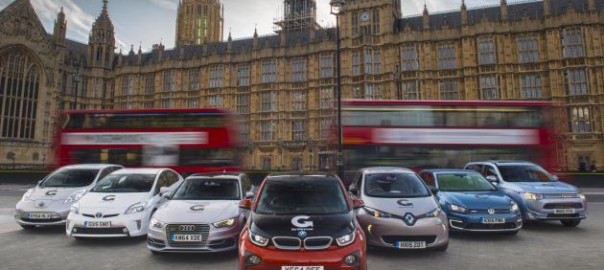
goultralow2015_EVs_parliament_GUL
The record sales again took almost 1.4 per cent of total UK car registrations – at 1.37 per cent – and sees the 1.3 per cent ratio reached or exceeded for the last five consecutive months. This is according to figures released by the Society of Motor Manufacturers and Traders (SMMT).

This strong take up of PiCG eligible cars comes in a record month for UK registrations with more than half a million cars sold. The total of 518,707 is the largest monthly sales figure since the change to the bi-annual number plate change in 1999.

Pure electric vehicles (EVs) saw something of a renaissance in March, having dropped behind plug-in hybrid vehicle (PHEV) sales in recent times. Last month’s registrations saw 2,341 EVs sold, up 22.9 per cent on last year’s figure. PHEVs still saw solid growth but increased 14.1 per cent to 4,803 units in March.

The stronger increase in EV sales was expected after changes to the PiCG came into effect from 1st March. Beforehand, all plug-in cars eligible for the grant had £5,000 taken off the list price, where now there is a stronger incentive for EVs over PHEVs. Both had a cut in grants available but EV buyers now get £4,500 off the cost of a vehicle, where PHEVs are only eligible for £2,500.

SMMT figures also show that there have now been 58,186 PiCG eligible cars registered since the grant began in January 2011, with just under 10,500 of those coming in 2016. This sees a 22.7 per cent increase in year-to-date registrations for PiCG cars when compared to 2015’s statistics, compared to the the 5.1 increase for overall sales.

Read more: Next Green Car
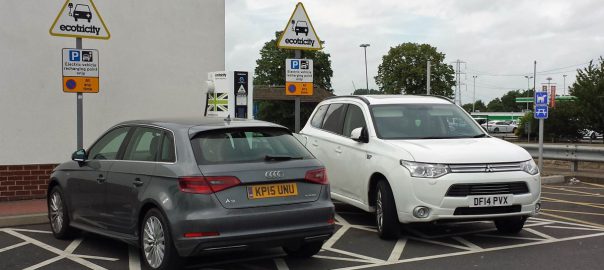
A full charge point at Newport Pagnell services, and my first ever sight of an Audi A3 e-tron (Image: T. Larkum)

Queuing to Charge

On my long distance travels in the ZOE I’ve noticed that it’s becoming more common to have to queue at a charge point. We’ve not yet had a big problem with it – either we’ve had to wait no more than a few minutes, or else on the motorway we’ve just moved on to the charge point at the next services.

A full charge point at Newport Pagnell services, and my first ever sight of an Audi A3 e-tron (Image: T. Larkum)

However, it is an occurrence that I expect to become more frequent over time. It will be interesting to see if Ecotricity’s policy, in particular, of gradually increasing the number of charge points at motorway services will keep the issue at bay.


The costs of setting up a diesel scrappage scheme wouldn't merit the benefits says RAC Foundation

Bin diesel scrappage idea and support EVs says RAC Foundation

A proposed diesel car scrappage scheme would have very little effect on air quality – unless implemented on a huge scale – and instead support should be given to electric vehicles, according to analysis by the RAC Foundation.

The costs of setting up a diesel scrappage scheme wouldn't merit the benefits says RAC Foundation
The costs of setting up a diesel scrappage scheme wouldn’t merit the benefits says RAC Foundation

The idea, proposed by think tank Policy Exchange last month, suggested that a scrappage scheme be set up for drivers of older, more polluting diesel cars, in a similar fashion to the 2009/10’s vehicle scrappage scheme. This would give owners an incentive – previously around £2,000 off the price of a new car – to have their highly polluting vehicle taken off the road to benefit air quality.

The RAC Foundation has found that around 1.9 million older diesel cars are on UK roads, fitting into Euro standard categories 1, 2 and 3. Currently, all new cars sold have to be certified to Euro 6 standards.

These older models account for 17 per cent of all diesel cars on the road – more than 11 million in total – and are responsible for 15 per cent of total NOx emissions from diesel cars says the RAC Foundation.

Analysts went on to calculate the benefits of such a scheme if, as would be expected, it ran along the same lines as the vehicle scrappage scheme around seven years ago.

Around 400,000 old diesel cars would be taken off the UK’s roads, at a cost of around £800 million should the government and manufacturers each contribute £1,000 for the incentive for customers to buy a new model.

If every one of those cars was replaced with a zero-emission vehicle, the annual cut in NOx emissions from the diesel fleet would be about 4,900 tonnes, or 3.2 per cent of total emissions from diesel cars.

Should the 400,000 models scrapped be replaced with new Euro 6 diesels, that saving would drop to 2,000 tonnes NOx per year at 1.3 per cent of the total, accounting for drivers covering the same mileage as with their old diesel car.

Read more: Next Green Car
Red Tesla Model S (Image: T. Larkum)

Why Would You Power A Clean Electric Car With Dirty Energy?

Buying a Tesla might lead to greener choices elsewhere

Red Tesla Model S (Image: T. Larkum)
You’ll want to know how the electricity is produced, right? (Image: T. Larkum)

NEW YORK — It’s one thing to get people to care about the price of energy. It’s quite another challenge to get them to care about the source of energy and its environmental impact.

But buying an electric car — presumably, in part, to reduce one’s carbon footprint — may push people to think about where the electricity to power that vehicle comes from, according to one early investor in Tesla Motors.

“The electric vehicle is like a Trojan horse for energy literacy,”

Nancy Pfund, managing partner at the venture capital firm DBL Partners, said during a panel discussion at the Bloomberg New Energy Finance Summit in Manhattan on Monday morning.

Pfund said she noticed the possible linkage a decade ago, when DBL first invested in Tesla, which sells luxury electric cars, and its sister company, SolarCity, which markets solar power systems. Both are chaired by billionaire Elon Musk.

“In the early days of Tesla, early adopters would buy the Roadster or the Model S, and weeks later we’d see an uptick in solar adopters,” she told The Huffington Post in an interview. “They’re really examples of the connection between transportation and the green electrical grid.”

The idea is that no one wants to go greener by buying a battery-powered electric vehicle only to charge it with electricity generated from burning coal or gas.

Most Americans buy electricity from utility companies that produce energy by burning fossil fuels or generate power from water flow, wind turbines or solar panels. A small but growing number of people generate power from rooftop solar panels or backyard wind turbines and then sell any excess energy to the utility companies. To really go green, people need batteries to store their own clean energy for later use.

If purchasing an electric car focuses the buyer on other ways to access cleaner energy and use it in lower quantities, that can work to improve the whole system.

“Anytime you get people to be more literate and understand where something is coming from, they have a voice,” Pfund added. “And a more engaged and vocal population will demand more energy choices.”

Read more: Huffington Post

Electric Vehicle at charging station

Big Oil Gearing Up to Battle Electric Vehicles

[7 April] Last week Tesla unveiled the Model 3, a mass market, affordable electric vehicle with a starting price of $35,000 and a two hundred mile range.

Electric Vehicle at charging station

In just over five days, more than 276,000 people put down $1,000 to reserve their own Model 3, signaling that American appetite for electric vehicles (EVs) is on the rise.

That’s good news because greenhouse gas emissions from transportation are growing faster than in any other sector in the U.S. and account for about 30 percent of the total. A major shift to electrified vehicles in the transportation sector is necessary to give us a fighting chance to meet our climate goals.

Yet, just as EVs are poised for growth, oil industry interests are sharpening their knives. Energy companies, including Koch Industries, are increasing their public opposition to electric vehicles because they are realizing the significant potential impacts of EVs on oil demand.

Recently, for example, Jim Mahoney, board member of Koch Industries, penned an oped in Fortune about opposing government subsidies that favor one form of energy over another.

“Koch opposes all market-distorting policies, including subsidies and mandates—even if they may benefit the company,” he wrote.

What Mahoney was really taking aim at were incentives offered to the small but growing electric vehicle market in the U.S.

His op-ed was mum on fossil fuel subsidies—which the International Monetary Fund pegs at $5.3 trillion. And he certainly didn’t mention the 11 fossil fuel federal tax subsidies identified by the Department of Treasury that cost U.S. taxpayers $4.7 billion per year—some of which have been in place for more than 100 years. Or the numerous public lands leasing and royalty breaks for oil and gas production.

Mahoney singles out the electric vehicle tax credit because electric vehicles are a threat to oil, which is mainly used for transportation and his op-ed is part of a broader attempt to roll back tax credits that support advanced vehicles.

If you doubt that the tiny but growing electric vehicle market could threaten big oil, consider this: Bloomberg New Energy Finance (BNEF) projects that oil displacement as a result of increased electric vehicle deployment could lead to an oil crash by 2023. BNEF flags battery prices and strong policies as important drivers of EV growth. In fact, battery costs have dropped dramatically—falling by 65 percent since 2010. By 2030 they are estimated to fall from $350 per kilowatt-hour (kWh) to below $120 per kWh.

To-date, oil producers have underestimated the competitiveness of electric vehicles, but they are seeing the threat to their market share and are taking aim at the EV industry. Because they can’t do much to improve the environmental profile of their own core products, we can expect a growing effort by the oil industry to undermine the electric vehicle sector. It’s no surprise that Koch Industries is leading the way.

Read more: EcoWatch

Solar Power (Image: ARENA)

Wind and Solar Are Crushing Fossil Fuels

Record clean energy investment outpaces gas and coal 2 to 1

Solar Power (Image: ARENA)

Wind and solar have grown seemingly unstoppable.

While two years of crashing prices for oil, natural gas, and coal triggered dramatic downsizing in those industries, renewables have been thriving. Clean energy investment broke new records in 2015 and is now seeing twice as much global funding as fossil fuels.

One reason is that renewable energy is becoming ever cheaper to produce. Recent solar and wind auctions in Mexico and Morocco ended with winning bids from companies that promised to produce electricity at the cheapest rate, from any source, anywhere in the world, said Michael Liebreich, chairman of the advisory board for Bloomberg New Energy Finance (BNEF).

“We’re in a low-cost-of-oil environment for the foreseeable future,” Liebreich said during his keynote address at the BNEF Summit in New York on Tuesday. “Did that stop renewable energy investment? Not at all.”

Read more: Bloomberg

Car exhaust pollution (Image: Wikipedia)

Dutch government wants to ban petrol and diesel cars

Dutch Labour party wants to halt the sales of petrol and diesel cars by 2025; is this the beginning of the end for the mass-produced combustion engine?

Dutch Labour party PvdA is pressing for the banning of sales of all petrol and diesel cars in the Netherlands from 2025.

The proposal has been met with support from the country’s lower houses of Parliament and could mean that only alternatively fuelled vehicles – such as electric cars – could be sold in the market nine years from now.

European leaders have been talking about such a ban for many years – insiders have suggested Paris will be the first to implement a zero-emissions-vehicle-only zone within its boundaries – but if it were introduced, the Dutch policy would come as the first complete ban on combustion-engined vehicles.

The proposal arrives a year after the Netherlands joined the International Zero-Emission Vehicle (ZEV) Alliance, which aims to make all new vehicles use electric power by the year 2050. The country is already one of the fastest growing markets for alternatively fuelled cars, with nearly one in 10 cars bought last year using electric power.

The UK has seen similarly rapid levels of growth, although the overall number of sales for alternatively fuelled vehicles is comparably small. The latest figures from March reveal that sales of alternative-fuel vehicles grew by 21% year on year, compared with sales growths of 4.8% and 4.7% for diesel and petrol cars respectively.

Read more: Autocar

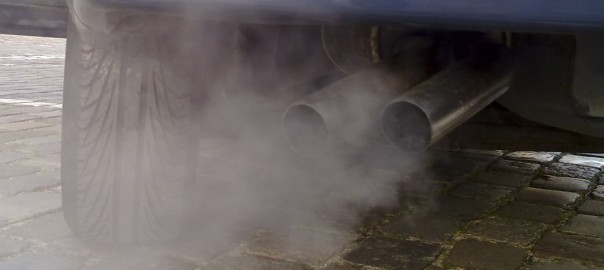
Car exhaust pollution (Image: Wikipedia)

‘Extend congestion charge as far as North and South Circular roads to halt pollution’

The congestion charging zone should be extended out as far as the North and South circular roads by 2019 to tackle London’s growing air pollution problem, a major study said today.

Car exhaust pollution (Image: Wikipedia)

Transport for London should look at expanding the zone, which costs £11.50 a day to enter, to merge it with the wider low emissions zones currently in place.

The major report from independent think tank IPPR said the scheme could be one of the best ways of simultaneously tackling air pollution and congestion as well as raising funds to reinvest in public transport, cycling and walking.

It warned that without new policies to manage increased congestion, there will be an estimated 43 per cent increase in miles driven between 2013 and 2030, making emissions even worse.

The death toll in London from air pollution is more than 9,000-a-year and experts are particularly worried about the impact on the health of children. The economic cost is put at £3.7 billion.

Other key recommendations include speeding up the “greening” of TfL’s bus fleet so it meets air pollution standards by 2019, expanding the electric vehicles charging network and bringing in on-street parking permits reserved for car-sharing schemes.

The report, London: Global Green City, said:

“The deadly spectre of air pollution has risen once again in the form of invisible pollutants such as nitrogen dioxide and particulate matter.

“This is a public health problem of the highest order and once again London sits on the frontline. London stands at a crossroads, and nothing short of a world-leading transport programme is required.”

Read more: Standard

Photo Credit:Leslie R in San Diego waits in hours-long line to pre-order the Tesla Model 3. Tesla Motors received more than 250,000 pre-orders within 72 hours of the vehicle’s unveiling

The Electric Car Goes Big

[6 April] This past week was unprecedented in the history of the automobile. Tesla Motors began accepting orders on the Model 3. In three days, they took some 300,000 reservations for the car, each with a $1,000 deposit.

If they all come through, that equates to over $10 billion in sales–in three days. For perspective, the Toyota Camry, the best-selling car in the country, sold about 430,000 units for all of 2015. Thousands stood in line for hours at Tesla stores around the world, including more than a few of us at Plug In America.

Photo Credit:Leslie R in San Diego waits in hours-long line to pre-order the Tesla Model 3. Tesla Motors received more than 250,000 pre-orders within 72 hours of the vehicle’s unveiling
Photo Credit:Leslie R in San Diego waits in hours-long line to pre-order the Tesla Model 3. Tesla Motors received more than 250,000 pre-orders within 72
hours of the vehicle’s unveiling

This feat was a tremendous accomplishment for Tesla and a tribute to the enormous power of the brand that Elon Musk and his team have built. But it was also an indicator of the excitement around the electric car, the sense that it is going mainstream, and an early indicator of the market transformation that we believe is coming.

Studies have suggested that a battery range of 200 miles is about the point where most people stop worrying about range and demand moves from early adopters into the broader market. The opening of reservations for the Tesla Model 3 has been the first true test of what the demand might be for a moderately priced car with a 200 mile range. In fact, demand turns out to be vastly larger than anyone had previously imagined.

While certainly a great success for Tesla, this incredible sales event should also give comfort to Carlos Ghosn of Nissan, Mary Barra of General Motors, and other automakers who are boldly investing billions of dollars into building the new generation of 200 mile range electric vehicles–and wondering whether the demand for the cars is really there. Well, it’s there. It turns out that this is a very big sandbox and there is plenty of room for everyone to play.

The fact that Tesla uncovered such extraordinary demand for a vehicle that is still years from delivery suggests that there is plenty of room for others to succeed as well. People have diverse needs and lifestyles. Just as there are many different gasoline cars that are successful in meeting the varying needs of a variety of consumers, there is every reason to believe that there will be a number of successful electric vehicles meeting various needs in this newly developing market, driven by the biggest change in automobile technology since the Model T.

Source: Plugin America