
Source: Skeptical Science
Source: Skeptical Science

The most important new Volvo in quite some time has made its first auto show appearance, with the second-generation XC90 debuting at the 2014 Paris Motor Show.
The new XC90 remains a three-row crossover for 2015, although it ditches the first-gen model’s top-end, turbocharged six-cylinder in favor of a single twin-charged, 2.0-liter, four-cylinder engine. By pairing that with a plug-in-electric powertrain, the king of the XC90 range, the T8 TwinEngine, will offer up 400 horsepower. So yeah, performance should be brisk.
Also appearing on 2015 XC90 will be an entirely new, Apple CarPlay-compatible infotainment system with a big, vertical touchscreen display at its heart. Based on the videos we’ve seen, the new system looks responsive, feature-laden and quite attractive.
See more: Autoblog


Audi R&D boss confirms all-electric version of new 2015 R8, plus plug-in hybrid model is possible, too
Audi’s head of technical development, Dr Ulrich Hackenberg, has confirmed that the new R8 supercar, due next year, will be offered as an all-electric e-tron model with a range of 250 miles. A plug-in hybrid variant, using a development of the powertrain from the Lamborghini Asterion LPI 910-4, is also under consideration.
The new R8 will use a slightly stretched version of the Lamborghini Huracan’s aluminium and carbon-fibre chassis, and come with a choice of V8 and V10 engines. However, the e-tron version has been a pet project of Hackenberg’s ever since he took over his new role in June 2013.
The first R8 e-tron concept appeared in 2009, and was originally slated for a 2013 launch, but the project was canned by Hackenberg’s predecessor Wolfgang Durheimer. Hackenberg revived the project and set a target of 400km (250 miles) before it could be sold to the public. Clearly, that target has now been reached.
And his plans don’t stop there, as a version of the Lamborghini Asterion LPI 910-4’s plug-in hybrid powertrain could also be fitted to the new R8. The Lambo’s system uses a V10 engine and three electric motors to produce 897bhp, power all four wheels and deliver a pure electric range of 30 miles.
Hackenberg told us:
“You can make it with less power, too. The [Asterion] chassis isn’t the same as the R8, but the powertrain fits, so a plug-in hybrid is definitely a possibility. The hybrid system is an engine, gearbox, electric motors and power electronics. It’s a package; it’s just a case of making it fit.”
Source: Auto Express

Member States now obliged to ensure minimum coverage of refuelling points for EU-wide mobility
New EU rules have been adopted today to ensure the build-up of alternative refuelling points across Europe with common standards for their design and use, including a common plug for recharging electric vehicles. Member States must set and make public their targets and present their national policy frameworks by end-2016.
“Alternative fuels are key to improving the security of energy supply, reducing the impact of transport on the environment and boosting EU competitiveness”,
said Commission Vice-President Siim Kallas, commissioner for transport.
“With these new rules, the EU provides long-awaited legal certainty for companies to start investing, and the possibility for economies of scale. EU Member States requested flexibility in deploying the infrastructure. It is now up to them to develop the right national policy frameworks.”
Up to now, clean fuels have been held back by three main barriers: the high cost of vehicles, a low level of consumer acceptance, and the lack of recharging and refuelling stations. This is a vicious circle. With the new “directive for the deployment of the alternative fuels infrastructure”, Member States will have to provide a minimum infrastructure for alternative fuels such as electricity, hydrogen and natural gas, as well as common EU-wide standards for equipment needed and user information. Access to liquefied natural gas (LNG) for inland barges and maritime ships will provide a realistic option to meet challenges on lower emissions, in particular stricter sulphur emission limits in sensitive areas.
The directive sets a regulatory framework for the following fuels:
Electricity: The directive requires Member States to set targets for recharging points accessible to the public, to be built by 2020, to ensure that electric vehicles can circulate at least in urban and suburban agglomerations. Targets should ideally foresee a minimum of one recharging point per ten electric vehicles. Moreover, the directive makes it mandatory to use a common plug all across the EU, which will allow EU-wide mobility.
Liquefied Natural Gas (LNG): Natural gas/bio-methane vehicles offer today a well-developed technology, with performances and cost equivalent to petrol or diesel units and with clean exhaust emissions. Natural gas use in trucks and ships can substitute diesel. For the development of LNG for road transport, Member States have to ensure a sufficient number of publicly accessible refuelling points, with common standards, on the TEN-T core network (see IP/13/948), ideally every 400 km, to be built by end-2025. The directive also requires a minimum coverage to ensure accessibility of LNG in main maritime and inland ports.
Compressed Natural Gas (CNG): The directive requires Member States to ensure a sufficient number of publicly accessible refuelling points, with common standards, to allow the circulation of CNG vehicles, both in urban and sub-urban areas as well as on the TEN-T core network, ideally every 150 km, to be built by end-2025.
Hydrogen: The directive aims at ensuring a sufficient number of publicly accessible refuelling points, with common standards, in the Member States who opt for hydrogen infrastructure, to be built by end-2025.
In addition, the directive requires that clear information is given to consumers about the fuels that can be used by a vehicle, using standardised labelling in vehicle manuals, at dealerships and on the recharging and refuelling points. It also aims at providing clear information to users to compare alternative fuel prices with conventional fuel prices. Moreover, Member States must ensure that information about the geographical location of publicly accessible recharging and refuelling points is made available in an open and non-discriminatory manner.
Source: Europa.eu

More powerful plug-in hybrid version of V6 diesel to get first showing in Audi A8 e-tron, then rolled across the range
Audi will add a second more powerful e-tron drivetrain to its model range using the new 3.0-litre V6 diesel, appearing first in the Audi A8 e-tron.
The new model follows the smaller A3 e-tron Sportback, which uses a smaller 1.4-litre engine paired to an electric motor. The new set-up will be used to power larger models in the range, and Audi’s board ember for technical development Dr Ulrich Hackenberg confirmed that the A8 would be the first car to get the tech.
There were no details on the size of electric motor, but Audi did confirm that the new system would have 368bhp and up to 700Nm of torque. The manufacturer also confirmed that it would have an all-electric range of 30 miles.
The new system will be presented at the beginning of 2015, before going into production. It will then rolled out across other cars in the range. Dr Hackenberg told us. “The 3.0-litre e-tron will be used in different cars. The plugin hybrid is an exciting combination.” That means it’s likely to turn up in things like the Q7 and A6, too.
Dr Hackenberg also revealed that the the A8 e-tron should boast some impressive figures when it does arrive. “It will go under the 100g/km barrier, especially in Europe,” he explained.
Source: Auto Express

Volkswagen has unveiled the plug-in hybrid Passat GTE prior to its official premiere during the Paris Motor Show next week.
Based on the eight generation Passat, the model is the third plug-in hybrid from the German manufacturer after the limited-run XL1 and the Golf GTE. When sales start in the second half of 2015, the vehicle will be available in both saloon and estate body styles.
Visually the GTE modification differs from the standard Passat with its blue accents on the radiator grille, the restyled front bumper with integrated C-shaped LED lights and the bigger alloy wheels. The interior benefits from a blue ambient lighting, a redesigned gear knob and a leather-trimmed flat bottom steering wheel.
The Passat GTE is powered by a petrol-electric hybrid system that includes a tuned version of the 1.4-liter TSI petrol unit rated at 156 HP (115 kW), supported by an electric motor with 115 HP (85 kW) and 400 Nm (243 lb-ft). The combined output is 218 HP (160 kW), while the transmission is a six-speed dual-clutch automatic.
Volkswagen says the average fuel consumption is 2.0 l/100 km (141 mpg) and 13.0 kWh/100 km, which responds to CO2 emissions of less than 45 g/km. With full 50-liter fuel trunk and lithium-ion battery fully charged, the car has a range of 1000 km (622 miles). The 0-100 sprint (0-62 mph) takes less than eight seconds, while top speed reaches 220 km/h (137 mph).
Source: Volkswagen

The new Mercedes S 500 Plug-In Hybrid will do 101mpg and emit just 65g/km of CO2
The super-economical Mercedes S 500 Plug-In Hybrid will cost from £87,965, be exempt from road tax, and return up to 101mpg. That makes it the most economical Mercedes S-Class ever, despite being able to do 0-62mph in 5.2 seconds and hit a top speed of 155mph. It’s the third hybrid model in the S-Class line-up, joining the S 300 BlueTEC diesel hybrid and S 400 petrol hybrid versions. The S 500, however, is the first plug-in version – giving it an electric-only range of more than 20 miles.
The S 500 Plug-In Hybrid is not to be confused with the standard S 500 petrol version. That model will only manage 31.7mpg, while emissions of 207g/km mean it’ll cost £285 per year to tax. The Plug-In version will do 100.9mpg and emit just 65g/km of CO2 – the latter surely making it very popular in London, where it will escape the daily Congestion Charge. Mercedes has tuned the S 500 to read the road ahead and minimise energy loss. That means the Hybrid can store power on motorways and open roads, ahead of urban areas where it can then run on electric power alone.
The S 500 Plug-In uses a 328bhp petrol engine mated to an 114bhp electric motor, for impressive performance and acceleration. The 0-62mph time of 5.2 seconds makes it faster than a Porsche Cayman, and only 0.4 seconds slower than a Porsche 911. Based on the long wheelbase Mercedes S 500 AMG Line, the S 500 Hybrid gets 19-inch alloy wheels, a sporty AMG body kit and noise-insulating glass. Leather seats, sat-nav and LED lighting are also standard. Like all S-Class models, the S 500 Hybrid is available with imitation hot stone massage seats, as well as heating and ventilation systems in the front and rear. Magic Body Control, which uses a camera to read the road and prep the suspension for a soft ride, is also available as an option.
The S 500 Hybrid can be charged using a standard three-pin plug, but a typical top-up at a public power point will take around two hours. Of course, like all other plug-in models, when the batteries run dry, the Mercedes will seamlessly switch to petrol power to allow owners to continue their journey stress-free. It’s on sale now priced from £87,965, with first deliveries from November.
Source: Car Buyer

The Caravan Club, formed in 1907 and now representing over 375,000 members, has honoured Mitsubishi Motors with its ‘Award for Innovation’ for the Outlander Plug-in Hybrid Electric Vehicle (PHEV). The award was made at The Caravan Club’s Towcar of the Year presentation at the Royal Automobile Club, London.
The Outlander PHEV is a full-sized family 4×4 SUV. It uses both electric and petrol power to propel itself. Unlike many other traditional hybrid vehicles, the Outlander PHEV can travel 32.5 miles without using any petrol. It emits just 44g/km of CO2 and the official combined fuel consumption figure is 148mpg.
Stewart Mckee, Mitsubishi Motor’s General Manager for Press, Public Affairs and Events received the award from Nick Lomas, Director General of the Caravan Club. Stewart said:
‘We are very grateful to the Caravan Club for recognising the plug-in Outlander with its special award for innovation.’
The annual Towcar of the Year Competition tells members which is the best towcar to buy in 2015. The judging is carried out by caravan journalists, national motoring journalists and Caravan Club members at Millbrook Proving Ground in Bedfordshire and attracted 39 entries this year.
Vehicles are evaluated using the same criteria; acceleration, braking, reversing, ergonomics, hill-starting, visibility, traction and the suitability of the gear box.
Source: Next Green Car
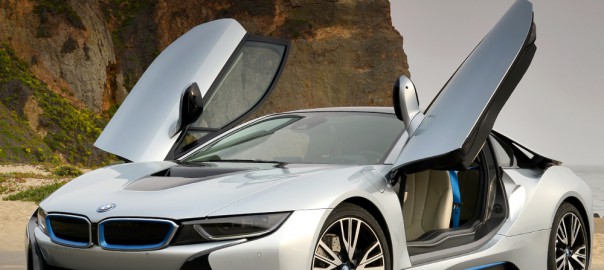
Most electric and plug-in hybrids have an image problem, seen as earnest transportation pods. The BMW i8 shatters that stereotype, earning attention normally reserved for Italian exotics but with a particularly modern sensibility. We talk about driving this very high-tech car.
There’s also some discussion of the Tesla Model S.

CIRENCESTER – Mitsubishi Motors in the UK is celebrating the news that the all-new Outlander Plug-in electric 4 x 4 is to receive the ‘Green Award’ at this year’s BusinessCar magazine’s Techie Awards.
Lance Bradley, Managing Director of Mitsubishi in the Motors UK, said:
“We are delighted that the Mitsubishi Outlander PHEV has won the ‘Green Award’ at the BusinessCar Techie’s. The Outlander PHEV is an exciting new vehicle, at the forefront of a new era in fleet and company car use.”
The BusinessCar Techie’s are the industry’s only technology-specific awards which celebrate clever use of technology that makes company car and fleet operation easier, cheaper, cleaner, safer and more straightforward. Now in the sixth year, the Techies are judged by BusinessCar’s expert and experienced editorial panel, covering all the major sectors of the corporate marketplace.
Paul Barker, Group Editor said:
“The Outlander PHEV is, as Mitsubishi claims, genuinely a game-changer in terms of opening up ultra-low emission vehicles to a wider audience, thanks to the car’s practicality and post-grant pricing against an equivalent diesel. Plug-in technology is going to form part of fleet mobility in the near future, and Mitsubishi is showing that, with the right deployment, it can make great financial sense as well as helping enforce a firm’s green credentials.”
Read more: Mitsubishi Media