All posts by Trevor Larkum

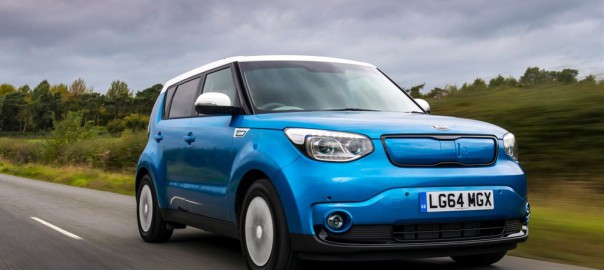
Kia Soul EV

Kia Soul EV Range Test

Since the Kia Soul EV’s UK launch in October 2014, its official range of 132 miles has been a positive talking point as it brings a new benchmark to its class.

To prove that the Kia really is capable of 132 miles on a single charge, Kia Motors UK set up a real-world range test, independently conducted and verified by Next Green Car. The test was conducted on 18th December 2014, with Dr Ben Lane, Next Green Car’s Managing Editor behind the wheel throughout.

Navigating the highs and lows of Somerset and Wiltshire’s cities, towns, villages and countryside, a specially designed route was planned to ensure all road types and traffic environments were included.

Bristol’s bumper to bumper traffic, A and B roads, hill climbs and descents, plus the high speed demands of the M4 were all part of the route to ensure real world conditions, with the aim of representing the wide variety of motorists’ daily journeys.

Bringing further authenticity to the test, the weather was not particularly favourable. With an average temperature of 8 degrees centigrade throughout the day, coupled with both light and heavy rain, it dampened performance slightly, triggered heavier traffic and used more battery power for on board heating, windscreen wipers and headlights. Throughout the test, satellite navigation and heated seats were used as and when required.

Although initially skeptical that the claimed range would be achieved, we can report that the actual range achieved on the day over the test route was an impressive 125.3 miles; we actually ran out of route to discharge the battery completely with a further nine available miles showing on the display. This implies that the Kia Soul EV does indeed have potential driving range of 134.9 miles, validating the claimed range.

According to Dr Ben Lane of Next Green Car: “The Kia Soul EV is an impressive drive with one of the best driving ranges in its class and welcome entrant to the UK electric vehicle line-up. The 27 kWh lithium-ion battery gives the Soul EV an official range of 132 miles beating everything but the Model S. The range test we conducted demonstrates that it is possible to achieve this range in typical UK driving conditions.

“The Soul EV also scores highly on the use of low impact materials including bio-degradable plastic, bio-foam and bio-fabric which are all used in the interior.”

The Soul EV comes with tax as well as emission benefits. Zero tail-pipe emissions mean zero London Congestion Charge and zero car tax (Vehicle Excise Duty). Priced from £24,995 the Soul EV isn’t cheap but it does come with Kia’s class-leading 7-year warranty.

With the test concluded, Next Green Car’s only criticism is that Kia is only making limited numbers available for the UK market in 2015. With the Soul EV as its first EV offering, Kia should have no trouble in taking a good slice of the future EV markey share.

Read more and see video: Next Green Car

Vauxhall Ampera Charging (Image: OLEV)

Do Gasoline Prices Correlate With Plug-in Vehicle Sales?

Introduction

“..it is fair to suggest that falling gas prices will reduce demand for fuel-efficient, hybrid and electric vehicles”
-Alec Gutierrez, Kelley Blue Book

“..gas prices”certainly” have an effect on electric-drive cars.“
-Jessica Caldwell, Edmunds.com

The idea has been repeated often enough; rising gasoline prices cause drivers to turn to alternative fuel vehicles for relief; falling gas prices must then lead to less drivers buying electric cars. Seems logical. But does the data back this up? Plug In America decided to investigate.

To answer this question, we considered the period between December 2010, when the Chevy Volt and Nissan LEAF kicked off sales of the current crop of electric vehicles, and November 2014, which is the most recent month for which we have complete data. We examined average monthly U.S. retail gasoline prices (“U.S. All Grades All Formulations Retail Gasoline Prices (Dollars Per Gallon)” 2014). And we looked at U.S. sales of plug-in electric vehicles (PEV). These are original equipment manufacturer (OEM) vehicles that come stock with a connector to charge up the traction battery from grid power. This includes battery-electric vehicles (BEV) and all plug-in hybrids (PHEV) and extended-range vehicles (EREV/REEV). The PEV category does not include conventional hybrid-electric vehicles (HEV) like the Toyota Prius, but it does include the newer Toyota Prius PHV (“Sales Dashboard”).

Conclusions

“Green cars: often hard to predict–and assuredly never dull.”
-John Voelcker, Green Car Reports

Data from the period between December 2010 and November 2014 shows zero correlation between gasoline prices and plug-in vehicle sales. The data does not support the idea that falling gasoline prices have a negative effect on sales of plug-in vehicles. Plug-in vehicle sales appear to be independent of gasoline prices.

Read more: Plug In America

How solar power and electric cars could make suburban living awesome again

The suburbs have had it rough in the last few years. The 2008-2009 economic collapse led to waves of foreclosures in suburbia, as home prices plummeted. More recently, census data suggest that Americans are actually shifting back closer to city centers, often giving up on the dream of a big home in suburbs (much less the far-flung “exurbs”).

It doesn’t help that suburbia has long been the poster child for unsustainable living. You have to drive farther to work, so you use a lot of gas. Meanwhile, while having a bigger home may be a plus, that home is also costlier to heat and cool. It all adds up — not just in electricity bills, but in overall greenhouse gas emissions. That’s why suburbanites, in general, tend to have bigger carbon footprints than city dwellers.

You can see as much in the amazing map from researchers at the University of California, Berkeley, showing how carbon footprints go up sharply along the east coast as you move away from city centers.

But now, a new National Bureau of Economic Research working paper by Magali A. Delmas and two colleagues from the UCLA Institute of the Environment and Sustainability suggests that recent technologies may help to eradicate this suburban energy use problem. The paper contemplates the possibility that suburbanites — including politically conservative ones — may increasingly become “accidental environmentalists,” simply because of the growing consumer appeal of two green products that are even greener together: electric vehicles and solar panels.

“There’s kind of hope for the suburbs, basically,” says Delmas — even though suburbia “has always been described as the worst model for footprint per capita, but also the attitude towards the environment.”

Here’s why that could someday change. Installing solar panels on the roof of your suburban home means that you’re generating your own electricity — and paying a lot less (or maybe nothing at all) to a utility company as a result. At the same time, if you are able to someday generate enough energy from solar and that energy is also used to power your electric car, well then you might also be able to knock out your gasoline bill. The car would, in effect, run “on sunshine,” as GreenTechMedia puts it.

A trend of bundling together solar and “EVs,” as they’re called, is already apparent in California. And if it continues, notes the paper, then the “suburban carbon curve would bend such that the differential in carbon production between city center residents and suburban residents would shrink.”

The reason is that, especially as technologies continue to improve, the solar-EV combo may just be too good for suburbanites to pass up — no matter their political ideology. Strikingly, the new paper estimates that for a household that buys an electric vehicle and also owns a solar panel system generating enough power for both the home and the electric car, the monthly cost might be just $89 per month — compared with $255 per month for a household driving a regular car without any solar panels.

This dramatic savings becomes possible to contemplate, notes the study, due to the growing prevalence of $0 down payment options both for installing solar panels, and for buying electric vehicles.

So are we really on the verge of a widespread phenomenon of green “bundling” — suburbanites installing rooftop solar, and then using it to power both their homes and also their cars? The paper points to four separate trends that are, at least, suggestive.

Read more: Washington Post

Volkswagen twin-up! PHEV (Image: VW)

Top Ten 2015 Green Car – Twin-up!

The year 2015 will see the strengthening of the market for electric vehicles (EVs); both pure electric and plug-in hybrids. With over 17,000 EVs already on UK roads, Next Green Car forecasts almost 40,000 will be in use by the end of the year.

New low emission petrol and diesel models will also be launched in 2015 with a shift to petrol cars reflecting the increasing concern about air quality. While diesel vehicles can offer lower CO2 emissions, petrol units provide lower NOx and particulates which are associated with poor respiratory health in urban areas. Look out for fuel-frugal petrol two- and three-cylinder turbo engines which can now offer the driving performance of larger engines.

As noted by Dr Ben Lane, Managing Editor of Next Green Car: “2015 will see a continuing roll out of battery electric and plug-in hybrid models as UK motorists become more accustomed to electric drive-trains. This year will be the year when EVs start to considered as ‘normal’.

“If an electric car isn’t right for your driving requirements, an ever increasing choice of sub-100 gCO2/km petrol and diesel models will become available with zero car tax and high MPG. You will need to choose a conventional model wisely, however, as the official MPG figures of some brands are increasingly at odds with the real-world fuel economy data.”

To mark a year which will bring high quality, high-tech, low emission models to UK showrooms, the following ‘Top 10’ list highlights some of the most important models due for launch and delivery in 2015.

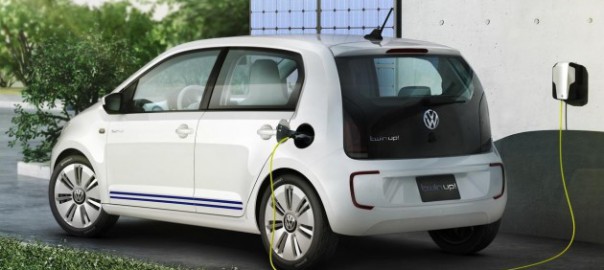
1: Volkswagen twin-up! – Plug-in Hybrid – CO2: 27 g/km

Volkswagen twin-up! PHEV (Image: VW)

The twin-up!’s 55kW powertrain consists of a 0.8 litre TDI diesel engine working in conjunction with a 35kW electric motor. The energy storage system includes a lithium-ion battery (energy capacity: 8.6 kWh), a conventional 12V battery for on-board electrics, and a 33 litre capacity fuel tank.

On the official test cycle, the twin-up! delivers a combined fuel economy of over 250 MPG with a CO2 emissions of just 27 g/km. In zero-emission operation the PHEV can cover a range of 31 miles and is anything but a slouch: the twin-up! accelerates up to 62 mph in 15.7 seconds and has an all-electric top speed of 80 mph. Pricing to be announced.

2: Smart fortwo 1.0 start/stop – Petrol – CO2: 93 g/km – NGC: 26

3: SKODA Fabia 1.4 TDI – Diesel – CO2: 88 g/km – NGC: 25

4: Kia Soul EV – Electric – CO2: 0 g/km – NGC: 32 (14)**

Kia Soul EV
Kia Soul EV

The new Soul EV is the result of almost 30 years of research and development into the feasibility of electric vehicles at Kia and it shows. A 27 kWh lithium-ion battery gives the Soul EV an official range of 132 miles beating everything but the Model S. As you’d expect for an electric car, the Soul EV is quiet and perfect for nipping around town. Unlike most other EVs, however, it also scores highly on the use of low impact materials including bio-degradable plastic, bio-foam and bio-fabric which are all used in the interior. Zero tail-pipe emissions mean zero London Congestion Charge and zero car tax (Vehicle Excise Duty). Priced from £24,995 the Soul EV isn’t cheap but it does come with Kia’s class-leading 7-year warranty.

 **If powered using renewable (e.g. wind, solar) electricity

5: Mazda2 1.5 SKYACTIV-D – Diesel – CO2: 89 g/km – NGC: 27

6: Mercedes-Benz B-Class Electric Drive – CO2: 0 g/km

Mercedes-Benz B-Class Electric Drive (Image: NGC)

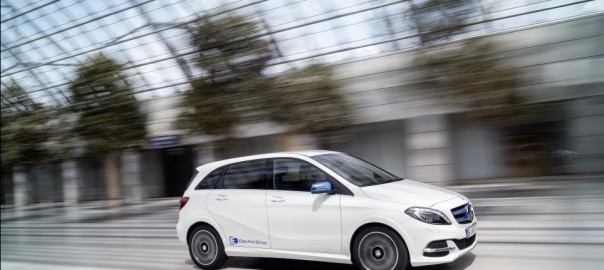
The Mercedes-Tesla relationship is evident (and welcome) in the B-Class ED with the drive-train and battery pack coming from the California-based company. Capable of 125 miles per full charge, the B-Class ED provides electric motoring in a quality package with more reserved styling than some other brands such as the BMWi range. While the motors can deliver up to 179 bhp (Sport mode), two other driving modes are available: ‘Economy’, where power is limited to 131 bhp; and ‘Economy Plus’ with just 87 bhp and a maximum speed of 70 mph. Expected to be priced from around £27,000.

7: VW Passat GTE – Plug-in Hybrid – CO2:

Volkswagen Passat GTE PHEV

Now in its eighth incarnation, the new Passat range includes the GTE, the first Passat with a plug-in hybrid drive. Powered by a turbocharged direct injection petrol engine (TSI) and an 85kW electric motor, the GTE is capable (on the official test) of over 141 MPG (petrol) and 13.0 kWh/100km (electric) with CO2 emission of under 45 g/km. On a full tank and fully recharged 9.9 kWh lithium-ion battery, the new PHEV has a total driving range of over 620 miles. In ‘E-Mode’, the Passat GTE can also cover a distance of up to 31 miles with zero emissions. AC charging options include standard (or ‘slow’) charging at 2.3 kW from a domestic socket in 4.25 hours or an optional a home 3.6 kW charger which provides a full charge in 2.5 hours. Anticipated pricing from around £20,000.

8: VOLVO XC90 – Plug-in Hybrid – CO2: TBC* g/km

Volvo XC90 Plug-in Hybrid (Image: AutoExpress)
Volvo XC90 Plug-in Hybrid

No doubt encouraged by the huge success of the Mitsubishi Outlander PHEV, Volvo will bring its own plug-in SUV to market in 2015, in addition to the usual range of petrol and diesel engines. While all will offer four-wheel drive, for the first time there will also be a front-wheel drive option. The XC90 PHEV will also feature a collection of entertainment and safety technology including a 9.3 inch screen compatible with Apple’s new CarPlay interface and Volvo’s new collision avoidance system. The XC90 range is priced from £45,750.

9: Toyota Mirai FCV – Hydrogen Fuel Cell – CO2: 0 g/km

10: Tesla Model X – Electric – CO2: 0 g/km

Tesla Model X
Tesla Model X

Originally scheduled for 2013, Tesla recently announced that the eagerly anticipated Model X crossover will be launched in the third quarter of 2015. Despite being larger than the Model S, the all-wheel electric drive will give the Model X a similar level of performance (that’s 0 to 60 mph in around 5.9 seconds!). With 10% additional weight, the expected driving range will be slightly less; around 170 miles for the 60 kWh battery pack or 230 miles for 85 kWh battery. One the striking features of the next Tesla will be its rear ‘Falcon’ doors which open upwards instead of swinging outward. Final pricing has yet to be announced. Although its been a while in coming, with the new Model X, Tesla is unlikely to disappoint.

Read more: Next Green Car

Blades Being Installed on Turbine 5, Yelvertoft Wind Farm (Image: T. Larkum)

North Sea oil industry ‘close to collapse’

The UK’s oil industry is in “crisis” as prices drop, a senior industry leader has told the BBC.

Oil companies and service providers are cutting staff and investment to save money. Robin Allan, chairman of the independent explorers’ association Brindex, told the BBC that the industry was “close to collapse”. Almost no new projects in the North Sea are profitable with oil below $60 a barrel, he claims.

Blades Being Installed on Turbine 5, Yelvertoft Wind Farm (Image: T. Larkum)
Blades Being Installed on a Wind Turbine (Image: T. Larkum)

‘Everyone is retreating’

“It’s almost impossible to make money at these oil prices”,

Mr Allan, who is a director of Premier Oil in addition to chairing Brindex, told the BBC.

“It’s a huge crisis.”

“This has happened before, and the industry adapts, but the adaptation is one of slashing people, slashing projects and reducing costs wherever possible, and that’s painful for our staff, painful for companies and painful for the country.

“It’s close to collapse. In terms of new investments – there will be none, everyone is retreating, people are being laid off at most companies this week and in the coming weeks. Budgets for 2015 are being cut by everyone.”

Mr Allan said many of the job cuts across the industry would not have been publicly announced. Oil workers are often employed as contractors, which are easier for employers to cut.

His remarks echo comments made by the veteran oil man and government adviser Sir Ian Wood, who last week predicted a wave of job losses in the North Sea over the next 18 months.

Decline

The US-based oil giant ConocoPhillips is cutting 230 out of 1,650 jobs in the UK.

This month it announced a 20% reduction in its worldwide capital expenditure budget, in response to falling oil prices.

Other big oil firms are expected to make similar cuts to their drilling and exploration budgets. Research from the investment bank Goldman Sachs predicted that they would need to cut capital expenditure by 30% to restore their profitability at current prices.

Service providers to the industry have also been hit. Texas-based oilfield services company Schlumberger cut back its UK-based fleet of geological survey ships in December, taking an $800m loss and cutting an unspecified number of jobs.

On Wednesday Aberdeen-based Wood Group announced a pay freeze for staff, and cut rates for its contractors.

Apache, one of the North Sea’s biggest producers, has followed suit and will impose a 10 percent reduction on its contractors’ wages from January 1st.

Investment record

The industry trade body, Oil and Gas UK, said:

“While Oil & Gas UK cannot comment on the commercial decisions, and individual opinions, of its members, the industry trade body recognises that the falling oil price is affecting activity across the UK Continental Shelf and companies are having to take hard decisions in light of this challenging business environment.”

UK oil and gas production has been in decline since 1999 – though the rate of decline slowed in 2013, a year which saw the highest level of investment on record.

The industry was hoping to see continued high levels of investment, stemming the inevitable decline of production as North Sea’s resources are used up. But falling oil prices have put that in doubt.

However, the Department of Energy and Climate Change said:

“The recent sharp reductions in oil prices are very challenging for companies active in the North Sea. We have seen very little evidence of new projects being cancelled or deferred in reaction to lower oil prices.”

Read more: BBC

Fastned Charging Station (Image: Fastned)

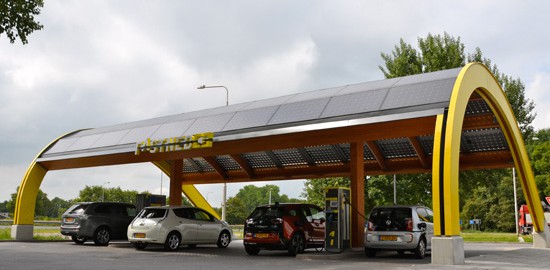
The EV Tipping Point will arrive quickly

An Interview With Fastned CEO Michiel Langezaal; Why The Mass Adoption Of EVs Is Inevitable

Though the Netherland’s EV sales are picking up, Fastned’s co- founder & CEO Michiel Langezaal does think they will reach the national goal of 200,000 electric cars on the road by 2020. According to Michiel this number includes not only fully electric cars, but also the Hybrids.There are still parts of the country that are beyond the reach of EVs with a 100 kilometers per charge range. Around 85% of the population do not have their own parking spaces. Yet Fastned’s co- founder & CEO Michiel Langezaal says the EV tipping point will arrive quickly.

EVs Replace Gas Cars

He gave four reasons for expecting to see EVs replace gas cars

  1. Batteries get better every year. They charge faster, hold more energy, last longer and are cheaper.
  2. Charging will eventually be as filling up at a gas station
  3. Once the infrastructure is there, the switch to electric will be much easier
  4. Electric cars are “computers on wheels,” developed by software engineers. A gasoline car has one function, going forward. The apt comparison is an old dial phone to an iphone.

The Dutch may not meet their target for 200,000 fully electric cars in 2020, but Langezaal expects the to surge past the goal of 1 million EVs and hybrids by 2025.

He explained:

“One million is only 15% of the total cars in the Netherlands. History shows us that once you hit 5% or 6%, if the product is better, then the breakthrough comes much quicker. So I think that 2020 figure will be hard to achieve. We will work very hard, 200,000 is quite a lot, but beyond 2020 we will not go to one million cars on the roads we will go to 8 million.”

Read more: The Eco Report

"Nissan Leaf got thirsty" (Image:Mariordo/Wikimedia)

Charge your Car partners with European networks

Users of electric vehicles in the UK will soon be able to to recharge their vehicles in Europe, thanks to an agreement between two of the largest networks of publicly-accessible charge points.

Charge Your Car, the UK’s largest EV charge point network with over 2,000 units, has formed an interoperability agreement with The New Motion, the leading charge-point network in mainland Europe.

It means that Charge Your Car members in the UK can now access over 15,000 points located in the Netherlands, Germany, Austria, Luxembourg and Belgium. Similarly, members of The New Motion travelling to the UK will be able to use any of the charge units forming part of the Charge Your Car network.

As well as enabling the UK’s EV drivers to drive more electric kilometres overseas, the agreement also accelerates moves to create ‘open roaming interfaces’ between international charge-point networks. The goal is to make it much easier for EV drivers to travel further afield in the knowledge that they will have unfettered access to roadside recharging units.

Alexandra Prescott, operations director at Charge Your Car, said of the landmark agreement,

“This agreement is a logical step to enhance services for both The New Motion and CYC drivers. Continental roaming is easier, opening up new e-mobility opportunities across Europe for our drivers.”

Ritsaart van Montfrans, founder of The New Motion, added:

“It is important for EV drivers to be able to take their car wherever they want, and through this agreement with Charge Your Car, we have added the UK to our expanding European infrastructure. This will open up new routes and new adventures for EV drivers on both sides of the Channel, in line with our mission to continue to facilitate and enable more electric kilometres to be driven by more EV drivers across Europe.”

Source: Fleet News

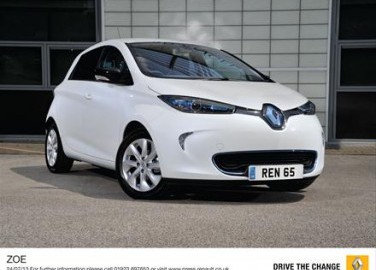
Leasing industry welcomes Renault battery U-turn

A new ownership package for two of Renault’s most popular electric vehicles has been welcomed by the leasing industry.

It will now offer customers in the UK the chance to buy the Kangoo ZE and Zoe with a battery; previously the only option was to lease the power source separately.

It’s a shift in policy that has won the support of some of the country’s biggest leasing companies, which struggled to forecast accurate residual values for the vehicles.

In fact, Zenith Leasedrive simply chose not to include the Kangoo ZE and Zoe in its EV line-up at all, but told Fleet News that both vehicles will now be offered to customers.

Ian Hughes, commercial director at Zenith Leasedrive, said:

“We are delighted with the change of direction by Renault in its electric vehicle strategy.

“It was particularly difficult to forecast an accurate residual value in circumstances when a vehicle is bought but the battery hired – a bit like trying to sell a car without an engine.”

The policy required Alphabet to create a complicated “workaround”, according to its head of consultancy services, Jon Burdekin. He said:

“This move from Renault removes the complication. It will also remove any potential confusion in the market as to whether the battery is included in the quote or not. By making things easier to understand, Renault brings itself in line with other manufacturers in an area which it was previously behind on.”

Lex Autolease, like Alphabet, was already offering Renault EVs, with Kangoo ZE and Zoe amongst a fleet of some 700-plus plug-in vehicles leased by the company.

But Chris Chandler, Lex Autolease’s principal consultant, also recognised the difficulties that came with the leased battery option. He said:

“The introduction of a battery purchase option will make contract hire simpler for Lex Autolease. It is much simpler for us as a business to own both the battery and the vehicle.”

The French manufacturer had insisted that its battery leasing model offered the best deal for drivers contemplating a plug-in car. It argued that it reduced the transaction price of its plug-in vehicles and made them more competitive (fleetnews.co.uk, March 11, 2014).

However, pricing expert CAP refused to forecast used values for Renault’s EVs until the battery was included, and new tax rules meant the cost of replacing the battery would have to be added to the car’s list price for P11D purposes from 2015/16 (fleetnews.co.uk, April 5, 2013).

Renault hopes that by simplifying its offer to the leasing industry it could create greater traction in the fleet market.

“This will open the door to fleet [customers],”

said Ken Ramirez, managing director of Renault UK.

“The addition of full purchase versions on our core EV models will offer business customers a greater choice and further strengthen our position in the EV market.”

The Zoe i – the ‘i’ stands for battery included – is available from £18,443 on-the-road, after the Government’s plug-in car grant, compared to £13,995 on battery lease. The Kangoo Van i range starts at £16,161 (+VAT) after the grant, compared to £12,995 (+VAT) if the battery is leased.

Steve Jones, general manager of asset risk at Leaseplan, agrees that the change could generate more interest from corporate customers. He said:

“Both Zoe and Kangoo are strong propositions in the electric vehicle market, but the leased battery added a level of uncertainty for fleets and contract hire companies alike.

“The process came across as complicated and some companies may not have considered Zoe and Kangoo ZE in their selection process as a result. Now this complexity has been removed, it’s much easier for customers to work with Renault so we should start to see an increase in adoption.”

This could also have a positive effect on RVs.

“The used car market doesn’t like uncertainty and the position on the battery lease has always been that,”

explained Nick Hardy, sales and marketing director at Ogilvie Fleet.

“The true test will be in how the used car market views these vehicles in three to four years’ time and what, if any, difference it makes with actual, real-world residual values.”

Source: Fleet News

C&C's Nissan e-NV200 Electric Taxi (Image: Nissan)

Taxi company hails new Nissan e-NV200

https://www.youtube.com/watch?v=1sMsAzT1G50

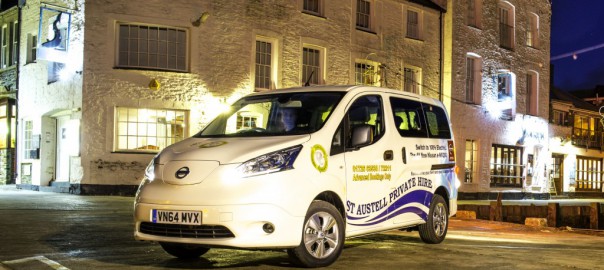
A PIONEERING Cornwall taxi company has taken delivery of one of the first all-electric Nissan e-NV200 Combi models to arrive in the UK.

St Austell-based C&C Taxis added the award-winning van to its six-strong fleet of 100% electric Nissan LEAFs earlier this month.

The five-seater Combi – Next Green Car’s LCV of the Year – has since clocked up more than 1,000 miles across the Duchy.

Already C&C’s fleet manager, Mark Richards, is sure the company’s onto another winner, calculating that, just like each LEAF on the fleet, the e-NV200 Combi will save £10,000 in fuel bills per year.

And the additional versatility and practicality the e-NV200 Combi – added to the LEAF’s winning formula of low cost, zero emissions motoring – has convinced him to commit to a long-term strategy of phasing out the company’s remaining diesel vehicles and replacing them all with EVs.

Mark said: “We’ve had such great success with our LEAFs we decided we were going to buy an e-NV200 the minute we learnt it was going to be launched.

“Now we have one, we’re absolutely delighted with it. It does everything the LEAF does but is much bigger and offers more space.”

“We’ll definitely be ordering more.”

Priced from £17,855 – incorporating £5,000 Government Plug-in Car Grant (PICG) – the e-NV200 Combi is capable of covering 106 miles on a single charge and can be charged from zero to 80% full in as little as 30 minutes.

Meanwhile, running costs are as low as two pence per mile and users also benefit from low maintenance costs that make for unrivalled total cost of ownership – £1,200 lower than a conventional diesel van over four years.

Source: Nissan Insider

B-Class Electric Drive reduces CO2 emissions by as much as 64 percent

Stuttgart. Locally emission-free, significantly more eco-friendly over its complete life cycle thanks to 64 percent lower CO2 emissions than the equivalent B 180 petrol model, generous in terms of space and range (200 km) and still dynamic on the road (output of 132 kW): the B-Class Electric Drive is a convincing proposition in all sorts of ways. Its high environmental compatibility has now also been confirmed by the inspectors at the TÜV Süd technical inspection authority, who have awarded the electric-drive Sports Tourer from Mercedes-Benz the environmental certificate in accordance with ISO standard TR 14062. This certification is based on a comprehensive life-cycle assessment of the B-Class Electric Drive, documenting every detail of relevance for the environment.

“The fact that we are able to integrate the electric motor and batteries into a perfectly ‘normal’ B-Class does not only mean that we can assemble the Electric Drive alongside the other B-Class vehicles on one production line, but almost more importantly means that our customers do not have to make any compromises at all in terms of spaciousness, safety or comfort”,

explained Professor Dr Herbert Kohler, Chief Environmental Officer at Daimler AG.

“The B-Class Electric Drive is an important milestone along our journey towards emission-free driving.”

Mercedes-Benz analyses the environmental compatibility of its models throughout their entire life cycle – from production, through their long years of service, to recycling at the end of their lives. This analysis goes far beyond the legal requirements. The Environmental Certificate and supplementary information are made available to the public as part of the “Life Cycle” documentation series, which can be accessed at http://www.mercedes-benz.com.

Over its entire life cycle, comprising production, use over 160,000 kilometres and recycling, the B-Class Electric Drive produces emissions of CO2 that are 24 percent (7.2 tonnes – EU electricity mix) or 64 percent (19 tonnes – hydroelectricity) lower than those of the B 180 – despite the higher emissions generated during the production process. This is due primarily to the exceptional efficiency of the electric motor, which gives rise to significant advantages during the use phase. One key factor here is its ingenious energy management system: the optional radar-based regenerative braking system, for example, ensures the optimal recuperation of braking energy back into the battery. This further enhances the efficiency of the drive system and enables even greater ranges.

CO2 emissions during the use phase here depend upon the method used to generate electricity. In 160,000 kilometres of driving use, the new B-Class Electric Drive (NEDC combined consumption from 16.6 kWh/100 km) produces 11.9 tonnes of CO2, assuming use of the EU electricity mix. When electricity generated by hydroelectric means is used to power the electric vehicle, the other environmental impacts relating to electricity generation are also almost entirely avoided. The B 180 (NEDC combined consumption 5.4 l/100 km) on the other hand emits 23.8 tonnes of CO2 during the use phase.

Source: Daimler