All posts by Trevor Larkum

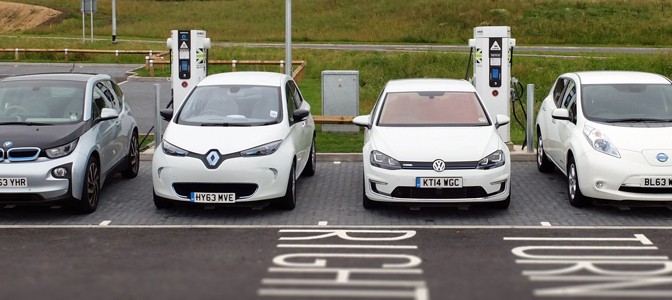
Electric Cars Fast Charging (Image: BusinessCarManager.co.uk)

OLEV explores higher funding for EVs for next Plug-in Car Grant

The Office for Low Emission Vehicles (OLEV) will begin a review of the Plug-in Car Grant in May, seeking to launch a replacement scheme which will recognise the diversity of the technology available.

Launched in 2011, the grant offers funding of up to £5,000 or 35% of the car’s value against the purchase of a new vehicle, provided it emits less than 75g/km CO2, offers an electric range of 70 miles (10 for plug-in hybrids) and can reach 60mph, as well as satisfying safety and warranty criteria.

OLEV began sorting eligible vehicles into three categories on the 1st April, but the scheme will continue to offer the current funding level until all 50,000 grants have been awarded. It’s likely the subsequent scheme will offer progressively higher funding for vehicles which prioritise electric driving.

So Category 1 is tailored towards fully electric cars, with a 50g/km CO2 cap and a battery-powered range of at least 70 miles, though the BMW i3 REX is eligible.

Category 2 and 3 cover most plug-in hybrids and range extenders, the first setting a 50g/km cap but with a range of between 10 and 69 miles, and the latter spanning CO2 emissions of between 50 and 75g/km with an electric range of at least 20 miles.

Plug-in Hybrids, led by the Mitsubishi Outlander PHEV, outsold battery electric vehicles more than two-fold in the first quarter of 2015, according to data from the SMMT. However, not all plug-in hybrids are eligible for the grant.

OLEV said it will announce the structure of the new grant scheme once the review is complete.

Source: Fleet World
First London Customers Review All-New Metrocab – Video

A pilot fleet of Metrocab plug-in hybrid taxis developed by Frazer-Nash Research Ltd and Ecotive Ltd has been tested in London since November 2014.

Developers just released video showing first customer reactions, which seem very positive.

Metrocab chairman, Sir Charles Masefield, said:

“This is the first purpose-built Range-Extended Electric taxi to be licensed in any metropolitan area in the world and we are thrilled with our customers’ reactions to it, as shown in the film. It’s comfortable, quiet, spacious, has a panoramic glass roof affording unrivalled views of our great city, day or night, and our drivers love it too. I am delighted with the pilot fleet’s success, it allows us to gather invaluable operational, customer and driver data before committing the vehicle to volume production.”

Source: Inside EVs

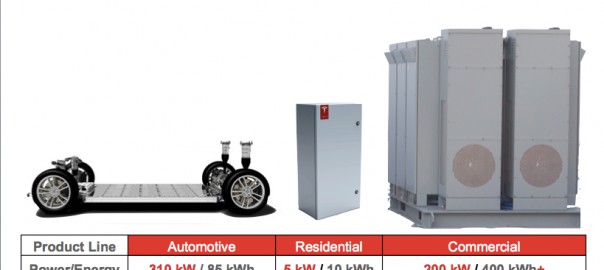
Tesla’s stationary energy storage (Image: Tesla)

IHS Predicts 9% Of Solar PV Installations Will Have Battery Energy Storage Systems By 2018

Good news for Tesla Motors and others in the battery energy storage market:

“IHS…announced that 9 percent of solar photovoltaic (PV) systems in North America will include attached storage in 2018. Led by commercial systems, IHS expects 700 megawatts (MW) of PV systems with energy storage will be installed by 2018, compared to just 30 MW in 2014.”

“The commercial PV energy storage market in the United States has gained huge momentum in recent months,” said Sam Wilkinson, research manager for solar and energy storage for IHS Technology.”

Tesla’s entry into this segment is mostly focused on residential, but rising usage in all segments will be a plus for the electric automaker and others who supply energy storage systems.

Tesla’s stationary energy storage (Image: Tesla)

Source: Inside EVs

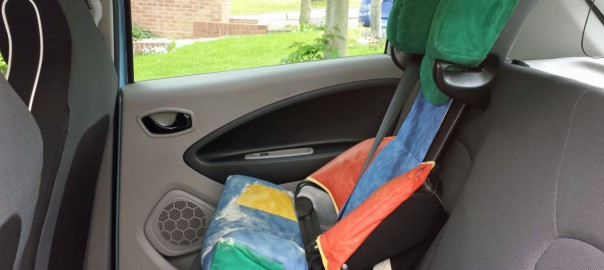
A large child’s car seat fitted in the rear of our Renault ZOE (Image: T. Larkum)

Renault ZOE Car Seats and Headrests

In answer to some questions about the back seat of the ZOE I did some experimentation on the fitting of car seats and head restraints (‘headrests’).

A large child’s car seat fitted in the rear of our Renault ZOE (Image: T. Larkum)

Our youngest daughter used a tall car seat in the back of the ZOE until she was about 11. I don’t know if it’s generally the case, but the seat we had (a ‘Concord Lift’ about 10 years old) fitted fine so long as the respective headrest was removed from the ZOE’s back rest. Then the seat fitted well, flush with the back of the backseat.

A large child’s car seat fitted in the rear of our Renault ZOE (Image: T. Larkum)

With regard to head restraints the ZOE has two for the outer positions on the back seat. Renault certainly provides the option for a third, central one, for example as part of the Luxe Pack. What is not clear is if this can be a post-delivery or even DIY option.

Today, after attending a customer test drive at a Renault dealership, I called into the parts office and enquired about buying just a head restraint. For that I was quoted £21.36 plus VAT (making £25.63) which seemed like a very reasonable price. Unfortunately there was not one in stock so I couldn’t see what parts were included.

The back seat zips are tucked into the corner as highlighted (Image: T. Larkum)

At home I was curious to learn more and so took apart the back of the seat. The back is held on with two zips. To make things a bit more difficult – presumably to discourage fiddling – the zips don’t have handles on them, and the loose ends are tucked into the hole formed where the zips come together. With a bit of patience it’s possible to pull out the ends of the zips and open them.

Inside the back seat showing an existing head restraint, left, and the fittings waiting for a central head restraint, right (Image: T. Larkum)

Inside the back of the seat it is clear that there are structural tube supports for a central head restraint so it should be straightforward to fit one, though of course it would be necessary to pierce the fabric on the top edge (which appears seamless otherwise). A bit more investigation is required, however, to find out if all the parts required for DIY fitting are included in the standard part set – for example, the plastic liners to the tube supports (these can be seen for the existing head restraint but are not in place for the central one).

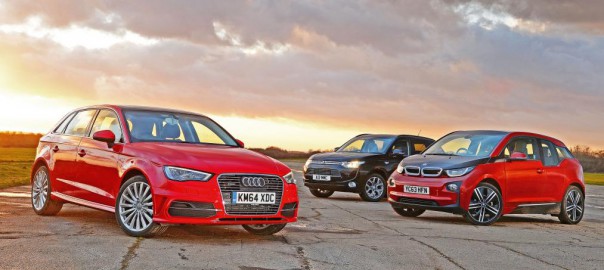
Audi A3 e-tron, Mitsubishi Outlander and BMW i3 plug-ins

Fancy test driving an electric car in Bristol?

Fancy test driving an electric car? Head down to a new motor show coming to Millennium Square

BRISTOL revealed its 100th electric car charging point last month, with more than £1 million being spent on installing them around the city.

But despite the Source West project, it was revealed that the points were only used on average once a month since they were first installed in 2012.

But next month, the charging points could finally come in handy when a fleet of electric cars descend on the city for a special motor show dedicated to the vehicles.

And the Evolution Bristol Motor Show is the only show of its kind where visitors will get the chance to test drive the cars around the city.

Evolution, which will be pitching up in Millennium Square on June 6, will showcase the latest in technology and innovation whilst also offering motorists advice and education on how to travel sustainably with low carbon, electric or hydrogen vehicles as well as advice on how to save money at the pumps.

The event is being staged in association with EDF Energy, and together with the Office for Low Emission Vehicles (OLEV), and Bristol City Council and Source West, as part of the official programme for Bristol European Green Capital.

The event is free, and is open to anyone that interested about alternate fuel transportation, battling excessive fuel and running costs, or who would simply like to take an electric or hybrid car for a spin.

There will be the opportunity to experience the cars on show by taking test drives as well as speaking to experts about the vehicles, leasing and finance deals and the supporting recharging infrastructure. Visitors will also be able to receive information on government grants, innovative technology and future fuels.

The inaugural event is the only motor show where everyone gets to experience the latest vehicles on the market, including more than 230 models of low emission, plug-in hybrid, electric vehicles to test drive, as well as experts on hand to answer all low carbon motoring questions.

Martin Elliott, product development manager for electric vehicles at EDF Energy, said:

“EDF Energy is pleased to be supporting Evolution Bristol in demonstrating technology to decarbonise UK transport. We will have a range of electric vehicle charge points on display and visitors will see that plugging in an electric vehicle is as easy as plugging in your phone.

“For the kids, or the young at heart, the EDF Energy stand will feature an electric model car racing track which is free to take part in and has prizes on offer for the winner of each race and the overall fastest lap of the day. We look forward to meeting the people of Bristol, having some fun, and discussing all the benefits of electric motoring at this exciting show.”

Read more: Bristol Post

Volkswagen e-Golf Video Review

Alex L. Dykes from the Alex on Autos channel released an in-depth review of Volkswagen e-Golf.

If you’re considering the e-Golf among other EVs and have a spare 25 minutes, this is the review you should check out.

Presentation includes exterior, engine motor, charging options, seats, interior, infotainment, cargo area capacity, drive including regenerative braking, comfort and price. The detailed review will appeal especially to the customers new to the EV world.

In the summary, Alex compares some of the features and prices of the e-Golf to the Nissan LEAF and Kia Soul EV. As always, every car has its strong and weak points, so you must decide which needs are most important for you.

Ultra-low emission registrations up 386% on first quarter of 2014 (Image: OLEV)

Record number of UK car buyers choose ULEVs

A record number of UK car buyers are opting to reduce their fuel bills by choosing ultra-low emission vehicles (ULEVs), according to research by Go Ultra Low.

The latest registration figures from the Society of Motor Manufacturers and Traders (SMMT) reveal that more than 41% of all alternatively-fuelled cars registered in the first quarter of 2015 qualified for the government’s plug-in car grant, up from 13% over the same period in 2014.

Ultra-low emission registrations up 386% on first quarter of 2014 (Image: OLEV)

In the first quarter of 2015, 8,573 passenger vehicles with CO2 emissions lower than 75g/km were registered, a year-on-year increase of 386%, as more drivers saw ULEVs as great alternatives to traditionally-fuelled cars. The most popular choice was the Mitsubishi Outlander PHEV, followed by the Nissan LEAF and BMW i3.

Business operators are benefiting too, with those seeking lower maintenance fees and tax rates, plus the potential for reduced whole-life running costs, contributing to a 421% increase in fleet and business ULEV volumes in the quarter.

Businesses running commercial vehicles also showed signs of increasing adoption of electric vans, with volumes up 263 units on January-March 2014 – a growth rate of 353%.

Hetal Shah, Head of Go Ultra Low, said: “The latest plug-in vehicle uptake figures prove that ultra-low emission cars and vans make sense for both private and business users, especially with the potential for fuel costs as low as 2p a mile and reduced whole life running costs.”

Thanks to CO2 emissions of less than 75g/km, all ULEVs are exempt from car tax. Other advantages such as typical annual fuel savings of £660 per vehicle, a nationwide network of recharging points and no congestion charge to pay in London have helped accelerate uptake over the past five years.

The latest registration figures show that car buyers in the South are most likely to opt for an ultra-low emission vehicle, followed by Londoners and the east of the country.

Yorkshire and the North West complete the list of top five regions. The figures also show that car buyers in East Yorkshire are least likely to choose an ultra-low emission option.

With an increasing choice of models qualifying for the £5,000 plug-in grant, the government is well on the way to hitting its aim for ULEVs to make up 5% of all new registrations by 2020.

Most popular ultra-low emissions vehicles

1. Mitsubishi Outlander PHEV
2. Nissan LEAF
3. BMW i3
4. Renault ZOE
5. BMW i8

Regions where ultra-low emissions vehicles are most popular

1. South
2. London
3. East
4. West Midlands
5. North West

Regions where ultra-low emissions vehicles are least popular

1. East Yorkshire / Lincolnshire
2. Northern Ireland
3. West
4. South East
5. East Midlands

Source: Newspress

Do electric vehicles take a long time to charge? Mostly it doesn’t matter and here’s why.

The concern: EV’s take a long time to charge don’t they?

When I meet someone new to electric vehicles, the first two questions about them are usually “How far can EVs go?” quickly followed by “How long does it take to charge?” The response most want to hear is “1000 miles” and “Blink and it’s done”.

Concerns with charging time are the product of a mind-set that comes from driving cars with internal combustion engines; you drive around until near empty, de-tour to a petrol station, swiftly slake your vehicle’s unyielding thirst for explosive hydrocarbon and continue onwards. It’s because of this that people can be a little sceptical when it comes to matters of re-charging. To make my point I usually offer the sceptic the worst case scenario; “a Nissan LEAF has a real world range of about 80 miles and could take up to 10 hours to charge from a 13A socket” and watch them fall about laughing. For a bit anyway…

When trying to convince a sceptic some might try and point out that faster charge times are possible with rapid chargers but not only is this still not as fast and thus “good” as a petrol pump, it is fighting the wrong fight.

Why it doesn’t matter: Your car can charge when it’s stopped, which is most of the time.

Read more: Pod-Point

Climate March poster on the Underground (Image: T. Larkum)

In historic move, BP’s shareholders adopt global warming resolution

BP’s shareholders overwhelmingly supported a resolution on Thursday that would force the company to disclose some of its climate change-related risks. The shareholder vote was extraordinarily lopsided, with about 98% of shareholders approving the resolution, which had the backing of BP’s chairman, Carl-Henric Svanberg.

The embrace of the climate change resolution is being called a watershed event in the history of climate-related shareholder resolutions, which investors large and small have been pursuing since 1999 to try to encourage oil, coal and gas companies to inform shareholders of their climate change-related risks and shift their investments into renewable sources of energy.

Previously, companies from Exxon to BP have spurned such resolutions.

Climate March poster on the Underground (Image: T. Larkum)
Climate March poster on the London Underground (Image: T. Larkum)

The risks that global warming poses to the business models of companies like BP are clearer now than ever before. Scientists are warning that in order to avoid the worst consequences of global warming, much of big oil’s fuel reserves, which these companies value so highly, would need to be left in the ground, rather than burned to create energy.

The BP vote and support of a similar resolution at Shell show that climate change has moved beyond the world of socially-responsible investing and into the mainstream, says Shanna Cleveland, a senior manager at Ceres, which advocates for more sustainable business practices and open disclosure of climate-related risks to investors, among other goals.

In an interview with Mashable, Cleveland called the BP vote:

“A sea change in the type of support and voting that we’ve ever seen in a climate-related resolution.”

“That is unprecedented… to have a fossil fuel company to actually come out and support a climate-related resolution has not happened before to have a fossil fuel company to actually come out and support a climate-related resolution has not happened before,” she said.

The resolution was filed by a coalition of shareowners in the U.S. and the UK, including the California Public Employees’ Retirement System (CalPERS). It asks BP to report on the risks and opportunities associated with climate change through routine annual disclosures, including ongoing emissions management at company facilities, preparation for the effects of global warming and low carbon research and development strategies and investments.

“What happened today I would classify it as historic, not only passing but getting that number of votes,” Cleveland said.

On Friday, a separate coalition of investors coordinated through Ceres is planning to ask the SEC to strengthen disclosure requirements from U.S.-based fossil fuel companies.

Read more: Mashable

Construction on the Tesla Motors Gigafactory east of Reno, Nev., March 25, 2015 (Image: D Calvert/Washington Post)

Experts: Powering your home with batteries is going to get cheaper and cheaper

In the past few weeks, there’s been a battery of new studies on batteries. Not the kind in your cellphone, but a much more revolutionary make – the kind that is already powering many cars, and that might someday help power your home.

A recent study in Energy Policy, for instance, found that the cost of batteries for home systems (to store the energy collected by rooftop solar panels) is starting to decline – although even with these systems, it probably won’t be economically optimal for most people to ditch the grid entirely. Another report by the Rocky Mountain Institute similarly found that within 10 to 15 years in some places, the most economical choice for home energy could be a solar plus battery system, meaning that there could be a great deal of “load defection” from the traditional electricity grid.

Finally, a new study in Nature Climate Change documented that there has been a steep decline in the cost of lithium ion batteries for electric vehicles like Teslas – 14 percent per year plunge since 2007.

All of which is being hailed as pretty revolutionary. “Solar-plus-batteries is set to begin a dramatic transformation of human civilization,” wrote Bloomberg commentator Noah Smith recently, commenting not only on the declining price of batteries for electric vehicles, but also the potential for more batteries in homes.

Construction on the Tesla Motors Gigafactory east of Reno, Nev., March 25, 2015 (Image: D Calvert/Washington Post)

But there’s a need for caution. People with home battery systems paired with solar panels certainly exist, but are quite rare for the moment. One problem is that right now, there just aren’t many ways to make a home energy storage system investment pay off.

So why do some analysts nonetheless think that solar plus battery systems could become quite prevalent in homes, and maybe sooner than we think?

Read more: Washington Post