All posts by Repost

How Does The EV Revolution Change Coming Out Of The Coronavirus Crisis?

No doubt — we don’t know how this coronavirus thing is going to play out.

We don’t know what the health consequences will end up being, and we don’t know what the short-term, mid-term, and long-term economic results will be. So much depends on what we do today, and then on what we do tomorrow, and then on what we do the day after that. If I’ve lived through any acute societal wild card in my life, this is it. (Climate change is clearly a chronic, long-term wild card.)

So, yes, it is entirely presumptuous to consider and discuss how the transition to electric vehicles (the “EV revolution” as many of us like to call it) will change from the coronavirus crisis. But I couldn’t help myself. Let’s roll through some possibilities.

Bankruptcies

This is one of the big questions that jumps out first. Depending on how long the crisis goes on, and depending on economic stimulus packages that result, consumers may or may not delay that next car purchase or lease — or SUV/truck purchase or lease. We know that auto companies live by a bit of a thread, since it seems like only yesterday that we bailed a couple of them out in the US after a different economic crisis.

Whether in the USA, Germany, or the home of another auto company, if things get bad enough, Ford, GM, BMW, Daimler, or some other automaker may be looking for how the government can keep them alive. If this happens, whether the government requires them to or not, it seems like it would only be sensible to use the restructuring in order to transition more quickly into electrification. Cut off 20th century assets that are going nowhere, reorganize and rebuild around becoming an electric leader, say goodbye to dead limbs that make it hard to transition.

We’re yet to see it play out, but something that comes to mind is what Volkswagen Group has been doing as a result of the diesel emissions crisis it spent years cultivating. Volkswagen walked itself into a corporate disaster by cheating incessantly on emissions testing, but the result once it became a major scandal was that Volkswagen had to dramatically shift course and steer toward a full electrification strategy — or got to do so. The wisest executives and managers saw the situation as an opportunity more than a crisis.

Ford, GM, and others appear to also be taking electrification seriously, but as we’ve explained numerous times, this is a wicked tightrope walk they must complete. They have to transition quickly enough that they ride the wave of the overall market transition rather than getting left behind, but if they transition “too quickly,” due to their vast fossil-related assets, investments, factories, and executive/manager expertise, they will crash and burn. Some auto company CEOs have admitted that outright. Related to that, you have the problem of the Osborne effect to surf through.

The opportunity arises when the auto company’s house is burning down for other reasons and the burn can be guided in a visionary way.

Read more: Clean Technica

It’s Time to Go Green!

If you would like to know more about Solar Panels and the PowerBanx range of home battery systems, and get a free instant quote, please complete our online form:

MINI Electric

Mini Electric Level 2 review: Little hatchback makes big green statement

Ten years ago, Mini experimented with an all-electric car which it called the Mini E.

We tested it, even though it never went on general sale, because instead it went to companies and selected members of the public who undertook real-world trials of the car.

Now Mini is producing a proper full production EV.

MINI Electric
MINI Electric

It’s called the Mini Electric and uses the three-door body style.

You can bet that the other models will soon be electrified too.

The key news is that the battery pack is fitted into the Mini without robbing the car of any legroom or luggage space.

This is a relief because the three-door hatchback isn’t the most spacious of small cars as it is.

Driving the front wheels is a 182bhp electric motor which ironically is the same horsepower as the 2.0-litre petrol engine in the Cooper S – but electrification has added 145kg of weight.

Mini claims a range of between 124 and 144 miles. On our test drive in Oxfordshire in cold and windy weather, we got nearer 100 miles.

But data gleaned from current Mini owners revealed that, on average, they drive no more than 25 miles a day so this range will be entirely adequate.

The Mini Electric is supplied with a three-pin domestic charging cable. But most owners will want to buy a wallbox for home and a 11kW cable.

Read more: Mirror

It’s Time to Go Green!

If you would like to know more about Solar Panels and the PowerBanx range of home battery systems, and get a free instant quote, please complete our online form:

Vauxhall Corsa-e (Image: Vauxhall.co.uk)

The Top Gear car review: Vauxhall Corsa-e

The Corsa’s gone EV with as little risk as possible, and ought to be a doddle to drive every day as a result

Overview

What is it?

Here is a Vauxhall Corsa that’s almost pioneering. And that’s something we’ve never been able to say before. This is the Corsa-e, and it’s a fully electric hatchback that looks just like its petrol-powered base car.

It’s not alone in its offer, nor is it the first of its kind. We did say almost pioneering. Indeed, it’s only come about because Vauxhall’s now owned by PSA and this is – effectively – a Peugeot e-208 in a plainer suit.

Vauxhall Corsa-e (Image: Vauxhall.co.uk)

But this is an electric Corsa long before there’s an electric Fiesta or Polo. For people who like buying badges they know from dealers around the corner, that could be enough to garner rather a lot of sales. Prices start at £27,165 with the government’s current EV grant applied, making it pricier than a base e-208, but it does come with more equipment.

The Corsa-e faces a tough bunch of rivals, launching at exactly the same time as the e-208 as well as the reijgged Renault Zoe and the adorable Honda e and Mini Electric. You won’t be buying this one to make a visual statement – especially among that lot – but perhaps that’s its appeal; electric power without making a song and dance about it.

It uses the same combination of 100kW power and 50kWh battery as the e-208, adding 345kg to a regular Corsa’s kerb weight but keeping it all in the floor. Better for handling, and it means room for people and luggage is mostly unimpeded too. The fully charged range is quoted at 209 miles.

Read more: Top Gear

It’s Time to Go Green!

If you would like to know more about Solar Panels and the PowerBanx range of home battery systems, and get a free instant quote, please complete our online form:
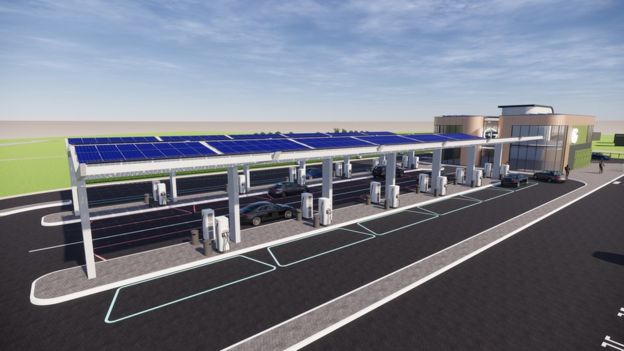
Proposed electric forecourt at Great Notley (Image: Gridserve)

Work starts on ‘electric petrol station’ in Essex

Work has started on an electric vehicle charging forecourt that will be able to charge 24 cars at once.

It is being built on a 2.5 acre site at Great Notley, near Braintree, Essex, by sustainable energy company Gridserve.

Proposed electric forecourt at Great Notley (Image: Gridserve)

The company hopes the roadside forecourt, which will use solar power, will “solve the challenge” of where to charge electric vehicles.

Chief executive Toddington Harper said it was “updating the petrol station model for a net-zero carbon future”.

It is set to open in the summer and is due to be the first of more than 100 similar sites around the country.

Conservative MP for Braintree James Cleverly said it was part of the “charging infrastructure that we need to support [the Conservative government] policies”.

Red more: BBC

It’s Time to Go Green!

If you would like to know more about Solar Panels and the PowerBanx range of home battery systems, and get a free instant quote, please complete our online form:
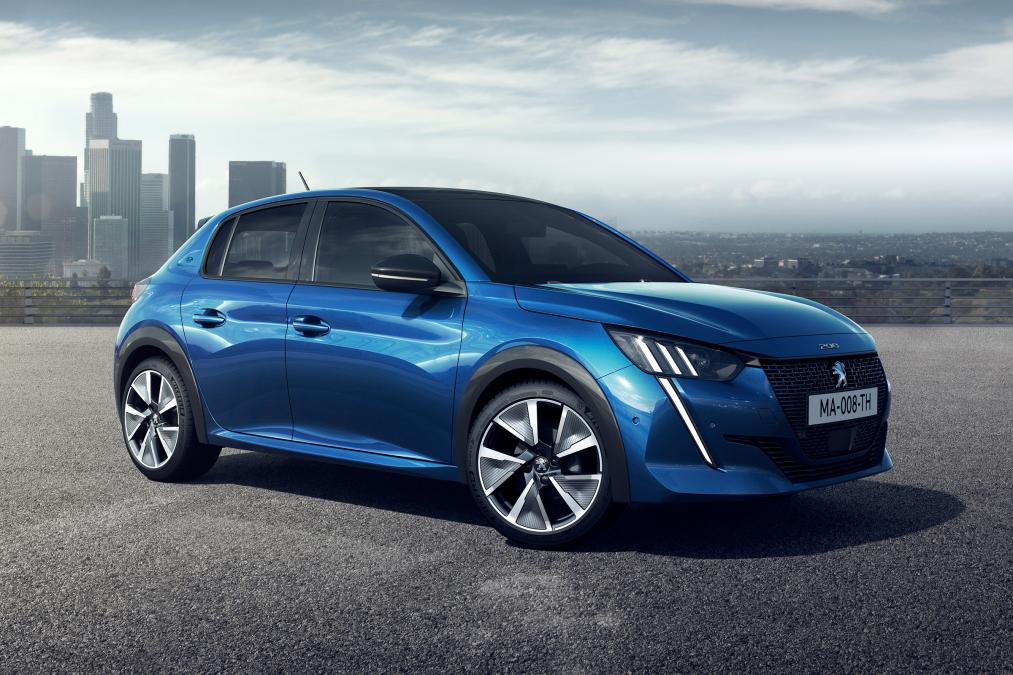
Peugeot e-208 (Image: Peugeot)

Brilliant new Peugeot E-208 is a serious contender in supermini class

Peugeot has dived into the electric car market with the excellent e-208 supermini. We check it out in GT trim.

What’s new?

Peugeot has taken the plunge and entered the EV market with two stylish offerings – the e-208 supermini and the e-2008 crossover.

Peugeot e-208 (Image: Peugeot)

The French manufacturer has taken a different route from rivals like Renault and Volkswagen, making the electric version just another option in the range, rather than a specialised vehicle like the Renault Zoe, Nissan Leaf or VW’s forthcoming ID.3.

It’s fair to say this is definitely not tokenism from Peugeot; the e-208 is an excellent car that’s been clearly made with the belief that the day of the zero-emissions car has finally dawned.

It fits brilliantly into the new 208 range and makes a strong statement that not only is Peugeot committed to electrification, but that electric vehicles are actually its very future.

In short, if you’re interested in a smaller electric car, the e-208 should be at the top of your consideration list: it’s stylish, fast, bursting with tech and has an excellent official range of 211 miles – more than enough for most drivers. Should you need juice away from home, it will charge to 80% in half an hour.

Plus, it has Peugeot’s brilliant 3D iCockpit system that brings everything into the driver’s eyeline in a fabulously innovative way.

What does it look like?

Impressive, actually – just like the new 208 in general. It will appeal to a range of buyers, young and old, with or without families.

Read more: Belfast Telegraph

It’s Time to Go Green!

If you would like to know more about Solar Panels and the PowerBanx range of home battery systems, and get a free instant quote, please complete our online form:

Kia Soul EV 2020 (Image: Kia.com)

Kia Soul EV 2020 UK review

Appealingly quirky electric crossover touches down in the UK with a 64kWh battery and a 280-mile range

What is it?

If the e-Niro is to be thought of as Kia’s ‘normal’ electric vehicle, you get the sense the Korean firm might want you to think of the new Soul EV as its cool older cousin. You know, the one who vapes and listens to bands you’ve never heard of.

Kia Soul EV 2020 (Image: Kia.com)

Its looks are key to that. The third-generation Soul retains the unabashedly boxy profile and boosted ride height of its predecessors. To this tester’s eyes, it’s not quite as energetically styled as it once was; perhaps that’s got something to do with the sort of sleepy look the new headlight design lends the front end. Nevertheless, it’s quite appealing; there’s still a healthy amount of quirk appeal about the design, which is an increasingly rare phenomenon.

In Europe, Kia will be selling the Soul only as a battery electric vehicle (BEV), while petrol models will still make their way to the US. Here in the UK, the decked-out First Edition model, which costs £33,795 post-Government grant, is for now the sole offering (sorry).

Despite the initial lack of choice, however, Kia UK seems pretty confident in the Soul EV’s potential. It already has some 2000 units on order, along with 8000 e-Niros. Given that just under 38,000 BEVs were sold here throughout the entirety of last year, it looks like Kia is gearing up to claim a fairly sizable chunk of the market for itself between now and December.

Read more: Autocar

Honda e Electric Car (Image: Honda.co.uk)

Coronavirus forces shutdown of Geneva Motor Show, but BMW i4 and other EVs will be unveiled online

Geneva Motor Show decided to cancel this year’s event because of the coronavirus, but we are still going to see a few of the electric cars that were going to be unveiled at the show.

As we previously reported, a few electric vehicles were scheduled to be unveiled in Geneva next week.

Honda e Electric Car (Image: Honda.co.uk)

However, the organization behind the auto show decided to cancel the event due to the coronavirus threat.

Maurice Turrettini, Chairman of the Foundation Board, said in a statement:

“We regret this situation, but the health of all participants is our and our exhibitors’ top priority. This is a case of force majeure and a tremendous loss for the manufacturers who have invested massively in their presence in Geneva. However, we are convinced that they will understand this decision.”

Several automakers have confirmed plans to still unveil their electric vehicles through online presentations.

BMW is set to unveil its the BMW i4, its next electric car.

The German automaker said in a statement:

“The BMW Group will carry out the program planned for Geneva including the world premiere of the BMW Concept i4 at a digital press conference with CEO Oliver Zipse in Munich at the originally scheduled time (Tuesday, March 3, 2020, 8.15 a.m. CET) and broadcast it via live stream. Further details concerning the live broadcast will follow as soon as possible.”

Fiat-Chrysler was set to unveil its next-generation Fiat 500e electric car and it confirmed today that it didn’t have a plan in place to unveil the vehicle without the show, but the automaker said that it was looking into a way to unveil the car.

Read more: Electrek

It’s Time to Go Green!

If you would like to know more about Solar Panels and the PowerBanx range of home battery systems, and get a free instant quote, please complete our online form:

Just about to finish at Cherwell (Image: T. Larkum)

Electric vehicle charge points at supermarkets double in two years

The number of electric vehicle (EV) charge points at supermarkets has doubled in the last two years, according to data analysed by Zap-Map and the RAC.

Some 542 EV charger units were installed by supermarkets from the end of October 2017 to the end of 2019, taking the total on their sites to 1,115 – a growth of 95%. This means 6.5% of all the UK’s public charge points are located at supermarkets with growth in-line with the overall growth of public charge points.

Just about to finish at Cherwell (Image: T. Larkum)
(Image: T. Larkum)

The number of stores offering charging facilities has also doubled with 608 supermarket sites now catering for battery electric and plug-in hybrid vehicles which equates to 5% of all supermarkets – while this appears low it is no doubt in part due to a considerable proportion of smaller supermarket sites not having car parks. Between 2017 and 2019, 313 stores added chargers with, on average, two charging units being installed per site.

The RAC and Zap-Map have both long advocated the importance of supermarkets offering customers charging facilities due to the fact that customers spend 45 minutes on average in their stores – a more than reasonable amount of time to top up an electric car.

Asda and Morrisons have the greatest proportion of stores with charge points

From 2017 to 2019, the proportion of the UK’s 11,979 supermarkets which have EV charging facilities has increased from 3% to 5%. When looking at each supermarket’s store portfolios Asda has the greatest proportion of locations where an EV can be charged – 122 of its 633 sites (19%).

Morrisons is in second spot with EV charging available at 89 of its 494 stores (18%), while Waitrose comes in third place with 14% – 49 of 349 stores.

While Tesco currently only has 4% of stores with charging capability, it has highest total number of stores with charging facilities (142 of 3,961 stores).

Read more: RAC

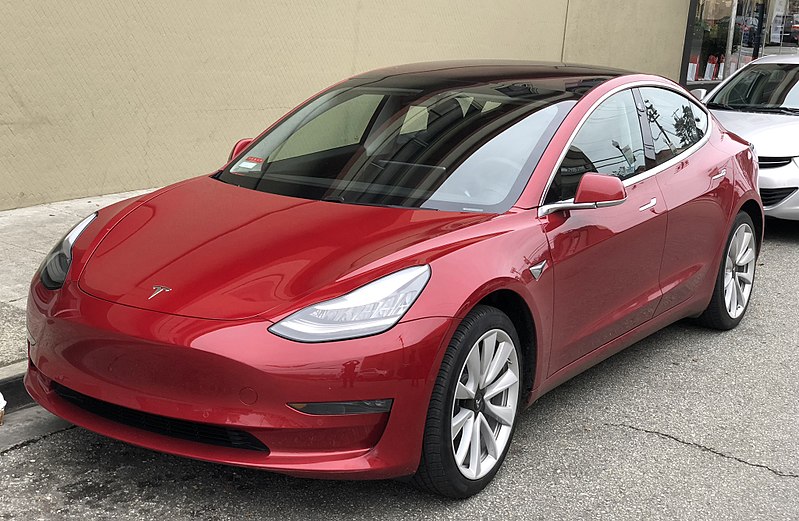
Tesla Model3 (Image: Wikimedia/Carlquinn)

Tesla Model 3 wins UK Car of the Year 2020 award

Tesla’s Model 3 has been crowned UK Car of the Year 2020, making it back-to-back wins for electric vehicles at the awards following the Jaguar I-Pace’s victory in 2019.

After emerging triumphant as Best Executive car when the category winners were announced on February 12, the Tesla battled it out against eight other category winners for the overall title.

Tesla Model3 (Image: Wikimedia/Carlquinn)

Three of these cars were electric vehicles (EVs) and the popularity of another one of the trio – the Kia e-Niro – ensured the closest-ever winning margin in the history of the UK Car of the Year Awards.

John Challen, director of the UK Car of the Year awards, said: “Game-changer is an often-overused phrase, but the Tesla Model 3 has shaken up the executive segment and got many brands thinking. Electric vehicles attract a broad spectrum of opinions, but it’s clear that with its technology, performance and range, the Model 3 is converting a lot of people….

Read more: Telegraph

It’s Time to Go Green!

If you would like to know more about Solar Panels and the PowerBanx range of home battery systems, and get a free instant quote, please complete our online form:
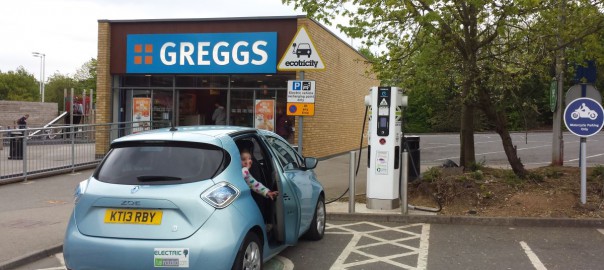
Used EV guide: how to buy a second-hand electric car

EV anxiety remains, but the switch to electric power is gathering momentum. And, what’s more, you don’t have to pay a premium and buy new

Never mind all the new electric cars arriving this year, could 2020 be the year people start buying used ones? It’s an important question since whether people are prepared to buy used electric cars and for how much will help determine how successful the new models will or won’t be.

Simply put, it’s used EVs that will provide nervous buyers with their first, more affordable experience of an electric car that one day may give them the confidence to purchase a new one. It’s used EVs that will determine how much people pay each month for a new model on a PCP. And it’s used EVs that, if they sell easily and for a profit, will give dealers the confidence to market and support the new models.

Fortunately, it looks as though EVs may have turned a corner. Consumer interest is increasing as new models with longer ranges arrive, the charging infrastructure expands and city centres begin penalising fossil-fuel cars. Sales of new and used models are growing while, crucially, the residual values of used EVs are, for the most part, stabilising and even rising in one or two cases, albeit from a very low base.

Leading auction house Shoreham Vehicle Auctions believes the market has reached a “tipping point of acceptance”. It cites the example of a 2015-reg Nissan Leaf Acenta with 20,000 miles that in 2017 was valued at £8850. Last year, the same model with the same mileage but registered in 2017 was, it says, worth £11,000.

It’s not a universal trend, though. CAP, a valuation guide, says the EV sector is a two-speed market with cheaper used EVs such as the Peugeot iOn and Renault Zoe rising in value, while premium models such as the Jaguar I-Pace, Audi E-tron and Tesla Model X are still falling.

“There is a growing market for a used EV bought for use as a second car for city commutes and we expect to see demand increase as clean air zones are rolled out and new models are launched,” says Chris Plumb, senior valuations editor at Cap HPI. “On the other hand, the high price of new premium models is yet to translate into higher used prices.”

Read more: Autocar

It’s Time to Go Green!

If you would like to know more about Solar Panels and the PowerBanx range of home battery systems, and get a free instant quote, please complete our online form: