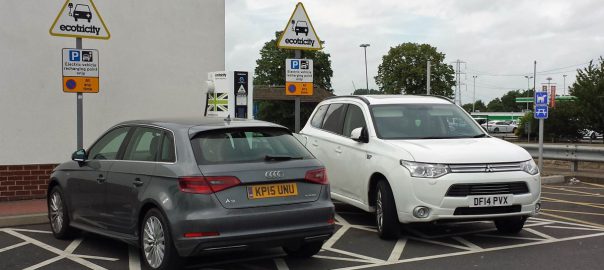
On my long distance travels in the ZOE I’ve noticed that it’s becoming more common to have to queue at a charge point. We’ve not yet had a big problem with it – either we’ve had to wait no more than a few minutes, or else on the motorway we’ve just moved on to the charge point at the next services.
A full charge point at Newport Pagnell services, and my first ever sight of an Audi A3 e-tron (Image: T. Larkum)
However, it is an occurrence that I expect to become more frequent over time. It will be interesting to see if Ecotricity’s policy, in particular, of gradually increasing the number of charge points at motorway services will keep the issue at bay.
A proposed diesel car scrappage scheme would have very little effect on air quality – unless implemented on a huge scale – and instead support should be given to electric vehicles, according to analysis by the RAC Foundation.
The costs of setting up a diesel scrappage scheme wouldn’t merit the benefits says RAC Foundation
The idea, proposed by think tank Policy Exchange last month, suggested that a scrappage scheme be set up for drivers of older, more polluting diesel cars, in a similar fashion to the 2009/10’s vehicle scrappage scheme. This would give owners an incentive – previously around £2,000 off the price of a new car – to have their highly polluting vehicle taken off the road to benefit air quality.
The RAC Foundation has found that around 1.9 million older diesel cars are on UK roads, fitting into Euro standard categories 1, 2 and 3. Currently, all new cars sold have to be certified to Euro 6 standards.
These older models account for 17 per cent of all diesel cars on the road – more than 11 million in total – and are responsible for 15 per cent of total NOx emissions from diesel cars says the RAC Foundation.
Analysts went on to calculate the benefits of such a scheme if, as would be expected, it ran along the same lines as the vehicle scrappage scheme around seven years ago.
Around 400,000 old diesel cars would be taken off the UK’s roads, at a cost of around £800 million should the government and manufacturers each contribute £1,000 for the incentive for customers to buy a new model.
If every one of those cars was replaced with a zero-emission vehicle, the annual cut in NOx emissions from the diesel fleet would be about 4,900 tonnes, or 3.2 per cent of total emissions from diesel cars.
Should the 400,000 models scrapped be replaced with new Euro 6 diesels, that saving would drop to 2,000 tonnes NOx per year at 1.3 per cent of the total, accounting for drivers covering the same mileage as with their old diesel car.
Buying a Tesla might lead to greener choices elsewhere
You’ll want to know how the electricity is produced, right? (Image: T. Larkum)
NEW YORK — It’s one thing to get people to care about the price of energy. It’s quite another challenge to get them to care about the source of energy and its environmental impact.
But buying an electric car — presumably, in part, to reduce one’s carbon footprint — may push people to think about where the electricity to power that vehicle comes from, according to one early investor in Tesla Motors.
“The electric vehicle is like a Trojan horse for energy literacy,”
Nancy Pfund, managing partner at the venture capital firm DBL Partners, said during a panel discussion at the Bloomberg New Energy Finance Summit in Manhattan on Monday morning.
Pfund said she noticed the possible linkage a decade ago, when DBL first invested in Tesla, which sells luxury electric cars, and its sister company, SolarCity, which markets solar power systems. Both are chaired by billionaire Elon Musk.
“In the early days of Tesla, early adopters would buy the Roadster or the Model S, and weeks later we’d see an uptick in solar adopters,” she told The Huffington Post in an interview. “They’re really examples of the connection between transportation and the green electrical grid.”
The idea is that no one wants to go greener by buying a battery-powered electric vehicle only to charge it with electricity generated from burning coal or gas.
Most Americans buy electricity from utility companies that produce energy by burning fossil fuels or generate power from water flow, wind turbines or solar panels. A small but growing number of people generate power from rooftop solar panels or backyard wind turbines and then sell any excess energy to the utility companies. To really go green, people need batteries to store their own clean energy for later use.
If purchasing an electric car focuses the buyer on other ways to access cleaner energy and use it in lower quantities, that can work to improve the whole system.
“Anytime you get people to be more literate and understand where something is coming from, they have a voice,” Pfund added. “And a more engaged and vocal population will demand more energy choices.”