Category Archives: Renault

News and reviews of Renault electric cars (including plug-in hybrids).

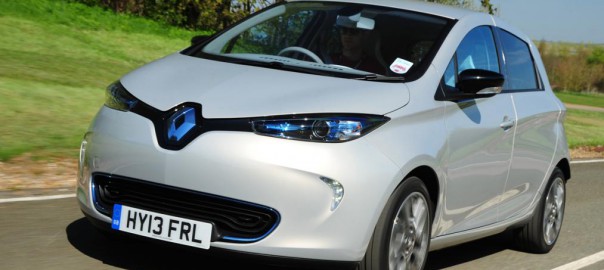
Car sharing club chooses Renault ZOE (Image: Renault)

Car Sharing Club is on a charge thanks to all-electric Renault ZOE

  • 20 electric Renault ZOE superminis added to Co-wheels fleet
  • New Renault ZOEs drive growth of Co-wheels to over 50 UK locations
  • 100% electric vehicle perfect for car sharing club model
  • ZOE is the most affordable car to hire from Co-wheels 
Car sharing club chooses Renault ZOE (Image: Renault)

A 20-strong fleet of 100 per cent electric Renault ZOEs has enabled the only independently owned national car sharing club to expand its social enterprise-focused operation to over 50 UK locations.

Co-wheels has introduced the innovative Renault ZOE to a number of new sites in Scotland this year, the most recent being in Aberdeen, Dumfries and Dundee. The club, which provides low emission, hybrid and electric cars on a pay-as-you-go basis for organisations and communities, has further locations for EVs in the pipeline with the ZOE confirmed as its electric car of choice.

The club chose the Renault ZOE against other electric cars due to the value it represents and also its driveability. Co-wheels are finding the five-door hatchback very easy to use and ideal for members who have never driven an electric car before. All of the club’s ZOEs have been bought outright or funded via Government grants.

Co-wheels customers can hire a Renault ZOE for only £3.75 an hour or £22.50 for 24 hours. As part of the club’s drive to encourage electric car use, Co-wheels does not make an additional charge for mileage – making the ZOE its most affordable car to hire.

Pierre Fox, Director, Co-wheels, said:

“Feedback to the Renault ZOE has been excellent, customers liking how simple it is to drive and finding the controls to be very straightforward. It’s the ideal size too, and is the perfect vehicle for our car sharing model with 90 per cent of customers’ journeys being local.

“Using the ZOE also fits with us operating as a social enterprise with a commitment to improving society and the environment. We aim to help our members save money, reduce car ownership and create a cleaner environment by making lower impact transport options available, and because we have received grants for some of the cars, we are able to pass this saving onto our customers.

“Everyone who has driven one of our ZOEs has been very positive about the experience, so much so that when it comes to adding more electric cars at new or existing locations, it will be our preferred choice of vehicle.”

Ben Fletcher, Renault UK’s Electric Vehicle Product Manager, said:

“Co-wheels’ decision to use the Renault ZOE as its number one electric car perfectly illustrates how more and more drivers are finding the versatile hatchback ideal for their requirements and how Renault is rapidly increasing its share of the growing EV sector. We’re very pleased that the ZOE is proving so popular with Co-wheels customers and is helping them to lower their motoring costs and also do their bit to help preserve their local environment.”

The Renault ZOE is an all-electric, five-door family hatchback available in three trim levels that comes with a very high level of standard specification, despite its competitive price-tag, which starts from £13,445 after the Government Plug-in Car Grant. Standard specification includes items such as climate control and sat-nav. 

ZOE is available with a number of features that make for seamless electric vehicle ownership including remote monitoring of the battery and pre-heating the cabin via your smartphone. ZOE also benefits from the patented Chameleon™ Charger that allows it to make the most of the widest range of power supplies and also keep charging times to a minimum – charging from zero to 80 per cent full in as little as 30 minutes.  The official NEDC range is 149 miles – Renault estimates that in real-world driving conditions that this equates to around 106 miles in summer and 71 miles in winter. Retail ZOE customers also enjoy the free installation of a fast-charging 7kW wall box at home, giving a standard charge time from 0-100 per cent of just 3-4 hours.

Awarded the titles of What Car? 2015 ‘Best Electric Car for less than £20,000’ and ‘Best Electric Vehicle’ in the Auto Express Driver Power 2015 survey, the Renault ZOE is an affordable route to zero emissions in-use motoring. 

In addition to the ZOE supermini, the Renault Z.E range also includes the Twizy urban runaround, an innovative open-sided two-seater vehicle, and the Kangoo Van Z.E that is perfectly suited to many commercial applications with its choice of four bodystyles and 106-mile range (NEDC).

In a UK electric car market up 54.5 per cent September year-to-date, sales of Renault electric vehicles in the UK were up by 92.4 per cent, to 1,316 vehicles, compared to the same period last year – dramatically outpacing the overall EV market of 54.4%. Renault Group UK sales for September YTD – comprising Renault cars, vans and Dacia vehicles – were up 17.4 per cent to 97,257 vehicles on the same period in 2014, again, significantly outpacing the overall market growth of 8.2 per cent.

Source: Renault Press Release
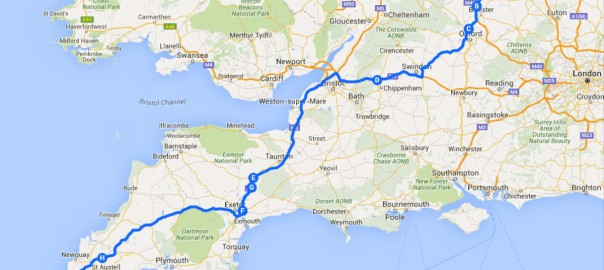
Google Maps view of the route and stopping points (Image: T. Larkum)

320 Miles in a Day, 620 in a Weekend

A few months back I beat my previous record of driving our ZOE 300 miles in a day by taking it from Northampton to Falmouth and back in a weekend. The occasion was a friend’s 50th birthday party (which I confess took place just a month after mine).

Just about to finish at Cherwell (Image: T. Larkum)

I took notes of the various charging stops (timings, energy usage, etc.) but rather than give a blow-by-blow account I’ve put all the details in the table below. The consumption figures are from the ZOE’s dashboard, mpkWh is miles achieved per kWh used, and total kWh used. The charge percentage figures were before charging, each charge took this back to 99%.

TimeLocationMap KeyDistanceChargeConsumption
1245NorthamptonA
1345-1420Cherwell Services M40B32.059%
1440-1540Kidlington (family visit)C10.54.88 mpkWh
1700-1750Leigh Delamere Services M4D69.129%4.49 mpkWh, 15 kWh
1915Tiverton Services M5E70.028%4.18 mpkWh, 16 kWh
2010Exeter Services M5FFailed to charge
2115-2150Cullompton Services M5G3858%3.58 mpkWh, 10 kWh
2340Cornwall Services A30H83.6, 8 left10%4.24 mpkWh, 19 kWh
0100FalmouthI29.855%4.10 mpkWh, 7 kWh

The Key letters in the table for each location relate to the map below.

Google Maps view of the route and stopping points (Image: T. Larkum)

On the whole the journey went pretty well. Although charging points are increasingly busy – for example, an orange BMW i3 was leaving the Cherwell charger just as we arrived – we never had to queue for a charge. However, reliability and availability are still an issue. To start with, the charges at Leigh Delamere and Tiverton started on the third and fourth attempts respectively.

Charging at Leigh Delamere (Image: T. Larkum)

As many EV drivers are aware, the south-west is a charging desert with very few opportunities for rapid charging after you come off the end of the M5. I knew in advance that it would be a stretch to get from Exeter all the way to the Cornwall Services at Victoria without a charge (73 miles) so when planning the route was only nervous about this part.

Topping up at Tiverton (Image: T. Larkum)

Unfortunately, it turned out to be worse than expected. We tried the charger at Exeter only to find it broken. Since I knew that going on was not an option we had to turn back and return up the M5 to Cullompton Services. We charged there fine, but of course we now had an even longer distance to get to Cornwall Services (84 miles).

Setting out I was pretty confident that we would be fine – I can generally coax 90-95 miles from the ZOE when needed. However, the weather deteriorated and we were soon driving into heavy rain, and driving on wet roads. Over the first half of the route it was very difficult to keep the consumption/mpkWh figure up high enough to be confident of arriving.

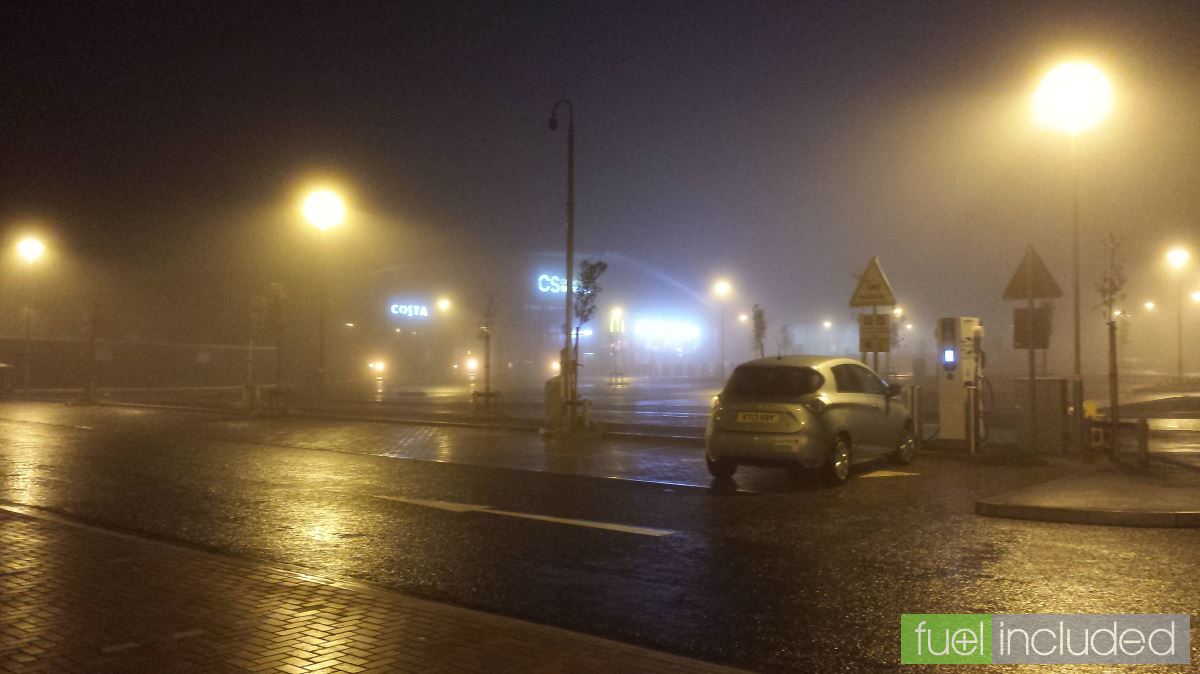
A miserable Cornwall Services late at night (Image: T. Larkum)

However, once past the half way point it started to improve – perhaps we had actually been climbing in altitude too and gone over a peak, and we actually arrived at Cornwall Services without incident. Having said that, we had gone 83.6 miles and the range predicter was showing just 8 miles left and was beeping in panic. It was a welcome sight to turn into the services after midnight despite it being cold, dark, wet and closed.

The view from our hotel window in Falmouth, ZOE in foreground (Image: T. Larkum)

The last leg of the journey was uneventful and we arrived at our hotel at 1am, with at least an hour of the journey time down to the broken charger at Exeter. Overall we had had 5 successful charges out of 6 attempted.

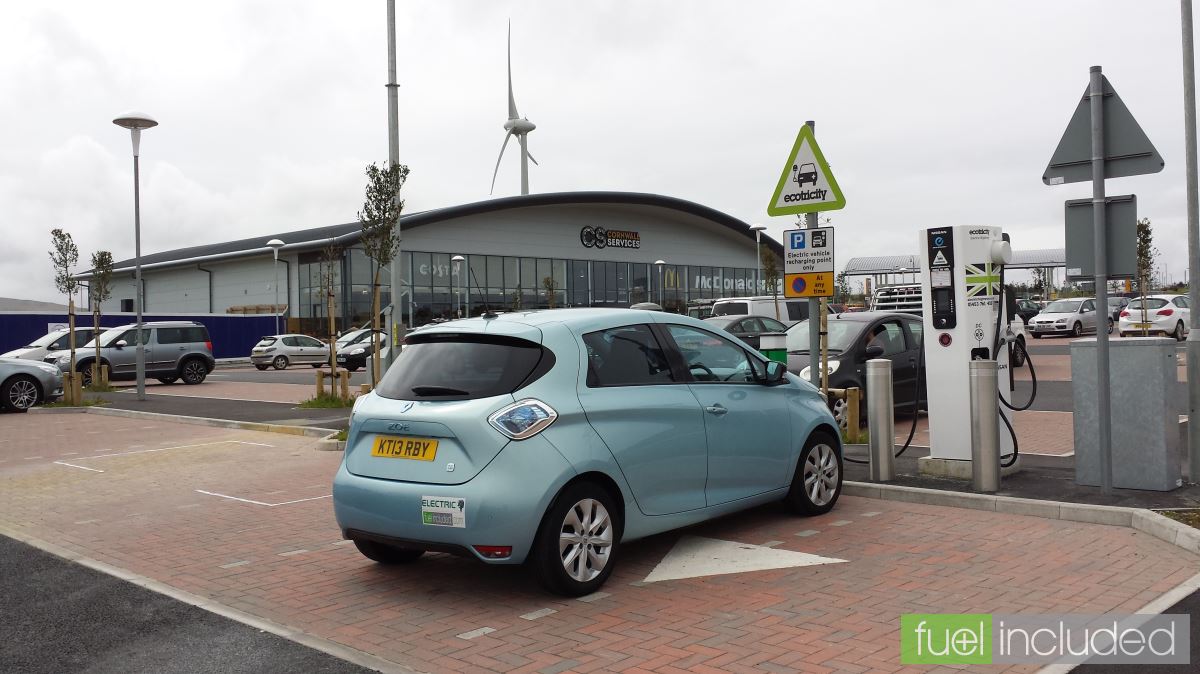
Cornwall Services looking better in daylight (Image: T. Larkum)

We had a good weekend in Falmouth and the party went well. We had a nice room at The Greenbank Hotel with a lovely view over Falmouth Harbour. Unfortunately neither Falmouth nor the hotel had facilities for charging so we had to explore the town on foot to conserve the charge for getting back to Cornwall Services on the return journey.

An extra stop at Sedgemoor (Image: T. Larkum)

The journey home was straightforward, the only issue being a broken charge point at Leigh Delamere East Services, forcing us to cross over to use the westbound services. Returning home is always easier than outbound trips since you know that there’s a working chargepoint at your destination, so you don’t need to charge once you’re within reach of it. We could have managed with four stops to charge, but in fact stopped an extra time (at Sedgemoor) for a toilet break having been stuck in traffic and made use of that with an extra charge.

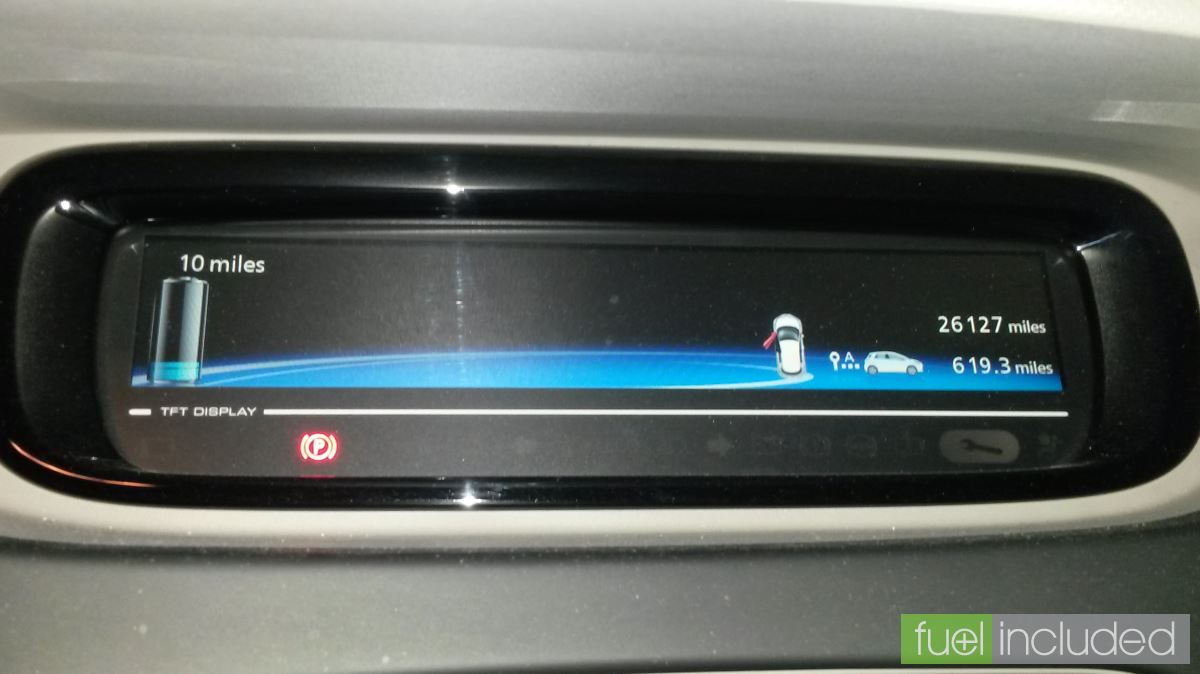
The dashboard display on arriving home (Image: T. Larkum)

On getting back home we found we had driven 619.3 miles between Friday lunchtime and Sunday evening.

Nissan Leaf vs Renault Zoe: which electric vehicle is best?

They are two of the most affordable EVs around, but which is best for you?

68937_1_5_Renault

Electric vehicles are now a viable alternative to their diesel- and petrol-powered counterparts. Offering low running costs, sophisticated travelling and a range long enough for most journeys, they are – rightly – more popular than ever.

The statistics back up this surge in popularity. The UK’s Society for Motor Manufacturers and Traders claims 512 electric vehicles were sold in the first month of this year, which has a lot to do with the Nissan Leaf and the Renault Zoe. Based on affordable city-runners like the Nissan Micra and Renault Clio, both cars bring all the benefits of electric power to a tried-and-tested platform. The result? Electric power for the masses – and at a very reasonable price.

But which EV is best for you? We analyse the key aspects of each car, from the running costs and performance to the technology inside, to find out which provides the most seamless, cost-effective crossover from a traditional car.

Read more: Alphr.com

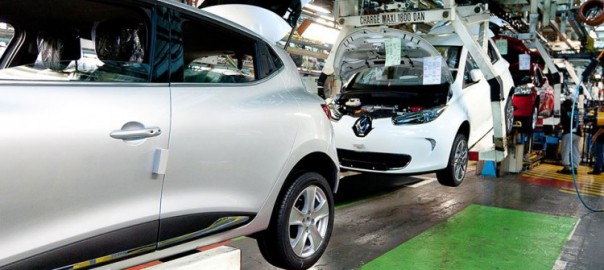
Renault ZOE Rolling Down Assembly Line

Renault To Increase ZOE Production

Renault believes in the strong potential growth for ZOE electric car sales, and as such is gearing up for increased production.

Renault ZOE Rolling Down Assembly Line

The Flins factory (in France) is already producing about 120 ZOE a day (up from 90 in the Spring, when the Superbonus was launched in France).

Now the company says that production will expand again – to 150 units a day by the end of November. The sudden change is probably adjusting for expected growth from the expanded diesel scrapping scheme in France next year and also higher demand throughout Europe.

To date, over 18,000 ZOE were sold in just France alone (nearly 7,000 in the first nine months of 2015) and 32,000 in total worldwide.

At 150/day, Renault would be able to deliver 3,000 ZOE a month (considering the French employees on the single shift working 20 days a month). Annual production would be ~36,000, a level of sales that the ZOE has never experienced such high volumes in the past.

Source: Inside EVs

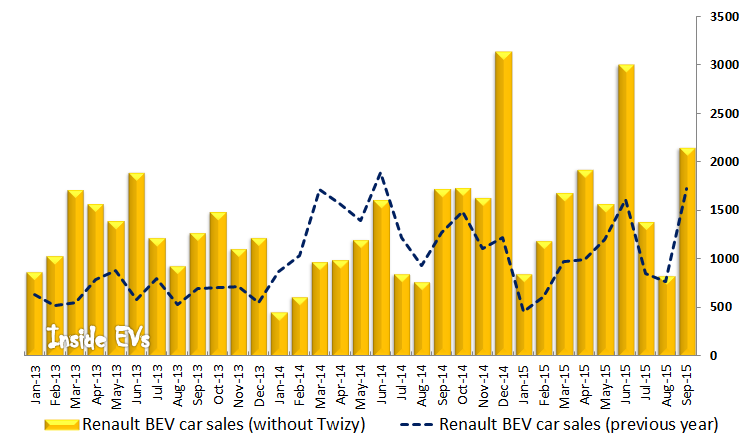
Renault Electric Car Sales Up 25% In September

Renault, thanks to having one of the most popular pure electric cars in Europe – the ZOE – increased its BEV car sales in September by 25% year-over-year.

Renault BEV Sales Worldwide – September 2015 (Image: InsideEVs)

Most of the total 2,149 (1,665 for ZOE) car sales worldwide obviously come from Europe (over 97%) where the company makes its home.

With an additional 169 Twizy, total BEV sales hit 2,318 (up 19% because Twizy is down 25% YoY).

1,665 ZOE’s sold stands for nearly 72% of all electric Renaults.

In the first nine months of 2015, the French manufacturer sold nearly 12,000 ZOE, compared to just over 6,000 year ago.

Source: Inside EVs

Renault electric vehicles propelled by wind power into the Outer Hebrides

  • 10 Renault electric vehicles available to hire in the Outer Hebrides
  • EVs powered by renewable energy generated by the islands’ wind turbines
  • 100% electric ZOE supermini and Kangoo Van Z.E. ideal for rural and urban areas
  • Vehicles available to hire on an hourly or daily basis
  • New six turbine wind farm to power Outer Hebrides domestic electricity requirements opened today

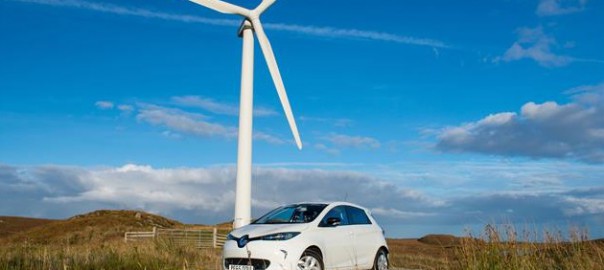
A 10-strong fleet of 100 per cent electric Renault vehicles powered almost entirely by renewable energy can now be hired by residents and visitors to the Outer Hebrides of Scotland.

Much of the electricity will be generated by the Pentland Road Wind Farm, the largest on any Scottish island that was officially opened today.  The nine ZOE hatchbacks and a Kangoo Van Z.E. have been introduced into the remote region through a unique partnership between E-Car Club and the wind farm operators.

CHR3696_1_nlm_Renault_c

The joint venture brings affordable, zero carbon transport to the area and underlines the suitability of electric vehicles in rural as well as urban environments, with the public being able to hire the innovative models on an hourly or daily basis from a number of locations across the town of Stornoway on the Isle of Lewis.

E-Car Club – the UK’s first entirely electric pay-per-use car club – chose the Renault ZOE and Kangoo Van Z.E. for the Outer Hebrides following the success it has experienced with the models at its other nationwide locations, including its St Andrews operation which opened earlier this year. The models’ specification, fun drive, reliability and excellent customer feedback were also key factors in the decision.

Representing an investment of £24 million and developed over a 12-year period, Pentland Road Windfarm will generate power for the new vehicles as part of providing renewable electricity to the islands. Such is the efficiency of the wind farm and the suitability of the local climate to support wind power, the six turbines will supply sufficient electricity to meet the entire domestic load of the Outer Hebrides.

Nearly 700 households in the Newvalley, Guershader and Laxdale Lane, Sheshader, Knock and Swordale, and Stornoway General communities will also receive 50 per cent of the biannual lease payments made by Pentland Road Windfarm to the Stornoway Trust as landlord, while there will also be agreed annual payments to the Western Isles Development Trust.

Great effort has also been made to minimise the impact of the wind farm on the local landscape. Great care was taken during the design and construction stages so as not to upset the free movement of water across the site and habitat reinstatement measures are also ensuring that plant communities typical of moorland are now returning to areas surrounding the turbine bases and access tracks. Local bird species have also been unaffected by the project.

Ben Fletcher, Renault UK’s Electric Vehicle Product Manager, said:

“This deal underlines that Renault is a leader in the fast-growing EV sector and the rapidly-increasing popularity that our vehicles have with car sharing clubs and the general public alike. As well as offering residents and tourists a great way to save money and help improve air quality, the car sharing scheme perfectly illustrates that our electric offering has the range and ease of use – not to mention driving pleasure – that makes it ideal for all kinds of drivers in all types of areas.”

Those living in or visiting the Outer Hebrides will be able hire one of the Renault ZOEs from E-Car Club for only £5.50 per hour or £45 per day (24 hours). Power and insurance are both included in the price. The Kangoo panel van is available for £7.50 per hour or £60 per day.

In its drive to help combat congestion, reduce parking and enhance local mobility in an environmentally-friendly and affordable way, E-Car Club has over 20 locations across the UK with several more in the pipeline.

Chris Morris, Managing Director of E-Car Club said:

“I’m delighted to be able to officially announce the launch of E-Car Club in the Outer Hebrides. This is an exceptionally exciting project combining shared e-mobility with renewable power generation in what is undoubtedly a landmark sustainable transport project both in Scotland and around the world.”

“The Islands are a perfect fit for electric car sharing with a community who are already committed to a sustainable lifestyle and current car use limited to relatively short journeys and a frequency which does not always justify private ownership.”

“The intention of E-Car is to provide everyone living in, working in or visiting the region with access to flexible, low cost transport whilst at the same time minimising their environmental impact in what is a truly stunning part of the world.”

Peter Crone, Director of Pentland Road Wind Farm and Zero Carbon Marine, said:

“Electric cars are without doubt the future and car sharing is certain to become increasingly more common too, so it’s wonderful that we have been able to introduce both to the community as part of Pentland Road Wind Farm.

“Local reaction to the wind farm has been excellent and the availability of shared electric cars adds another benefit for people in the region. After having driven one of the ZOEs from the most southern to the most northern point of the Outer Hebrides earlier this week, I am certain that the vehicles will prove very popular.”

Dr Alasdair Allan MSP, Scottish National Party (Western Isles) and Mr Angus Brendan MacNeil MP, Scottish National Party, both attended the launch of Pentland Road Windfarm.

Dr Allan said:

“I am happy to see the Pentland Road wind turbines becoming a reality and creating a benefit to the community. I appreciate the great amount of effort that has gone into this project over many years to make it a reality.

“The Isles are uniquely placed to be at the forefront of renewable energy development. Clearly linking the electric car scheme with locally produced wind energy shows the possibilities we have here for a low-carbon future.

“I am looking forward to electric cars becoming more common around the Isles and to seeing the wider community benefits these two schemes should bring in.”

The ZOE is an all-electric, five-door family hatchback available in three trim levels that comes with a very high level of standard specification, despite its competitive price-tag, which starts from £13,445 after the Government Plug-in Car Grant. Standard specification includes items such as climate control and sat-nav.

ZOE is available with a number of features that make for seamless electric vehicle ownership including remote monitoring of the battery and pre-heating the cabin via your smartphone. ZOE also benefits from the patented Chameleon™ Charger that allows it to make the most of the widest range of power supplies and also keep charging times to a minimum – ZOE can charge from zero to 80 per cent full in as little as 30 minutes.  The official NEDC range is 149 miles – Renault estimates that in real-world driving conditions that this equates to around 106 miles in summer and 71 miles in winter.  Retail ZOE customers also enjoy the free installation of a fast-charging 7kW wall box at home, giving a standard charge time at home from 0-100 per cent in just 3-4 hours.

Awarded the titles of What Car? 2015 ‘Best Electric Car for less than £20,000’ and ‘Best Electric Vehicle’ in the Auto Express Driver Power 2015 survey, the Renault ZOE is an affordable route to zero emissions-in-use motoring.

The Kangoo Van Z.E is perfectly suited to many commercial applications with its choice of four bodystyles and 106-mile range (NEDC) – Renault estimates that in real-world driving conditions that this equates to around 84 miles in summer and 53 miles in winter.

In addition to the ZOE supermini and Kangoo Van Z.E, the Renault Z.E range includes the Twizy urban runaround, an innovative open-sided two-seater vehicle.

In a UK electric car market up 54.5 per cent year-to-date, sales of Renault electric vehicles in the UK were up by 92.4 per cent, to 1,316 vehicles, compared to the same period last year.  Total Renault car sales in the UK stood at 59,221 – up 16.7 per cent on first nine months of 2014.

Renault Discusses EV Battery Second-Life

Renault promises to take care of batteries that lose 30% of initial capacity by using them in second life as energy storage systems.

70-80% is typically considered the point at which an electric car owner would be willing to swap an old battery for new one, although the battery itself still works just fine.

If old batteries, with 70% capacity, are not suitable for cars, they can still be used in energy storage systems to support the rollout of renewable energy, or for emergency power supply for another decade or so – thus enjoying a second life.

Only the deeply depleted batteries should go to the recycling process under Renault’s circular economy concept, to recapture things like cobalt, nickel, copper, manganese, aluminum, lithium and solvents.

“The batteries of electric vehicles may have several lives. They are reused, for example in response to energy storage requirements for the building. At end of life, all the elements contained in these batteries are recovered for recycling.”

Source: Inside EVs

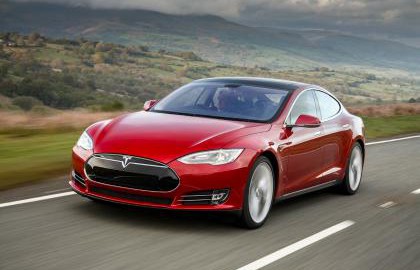
Tesla Model S (Image: AutoExpress)

Don’t buy an electric car

Don’t buy an electric car before you’ve read our 11 things you must know – The stuff they don’t always tell you

Like any radical new technology, electric vehicles (EVs) can be confusing. Are they cheap or expensive to buy and run? Do they actually do any good for the environment? Are range anxiety and charging real worries? And what are they really like to own, to drive and to look after?

The good news is there are undoubted up sides to owning an EV, but you need to know about the battery-powered pitfalls too. Good news for you, then, that this here is our guide to the 11 things every driver should know about electric cars.

1. Some electric cars are ludicrously fast

The latest Tesla Model S sports a ‘Ludicrous Mode’ that allows the four-door saloon to blast to 60mph in just 2.8 seconds. That’s precisely the same performance as Porsche’s 918 Spyder supercar and faster than just about anything else on the road. In other words, electric cars today are most definitely not the feeble carts of yesteryear. Just like combustion cars, they’re available in a wide range of specifications with performance to match. You simply cannot generalise about electric cars being slow any longer.

2. Some electric cars are cheap

front-tracking_renault_zoe_AutoExpress

Yes, the aforementioned Tesla might break the bank at upwards of £80,000, but cars like Renault’s Zoe are much more accessible. In many ways, the Zoe is a standard compact hatchback, similar in size to Renault’s own Clio or the Ford Fiesta. You can buy one from just £13,995. You can also put one on your drive for around £160 a month and a deposit of just £600 £155 a month and a deposit of just £250. So EVs are no longer the preserve of well-heeled early adopters. If you are in a position to buy almost any new car, you can probably afford to add electric to your shortlist.

Read more: T3

New Renault ZOE from £155 per month fuel included


Warning: preg_match(): Compilation failed: invalid range in character class at offset 4 in C:\inetpub\vhosts\fuelincluded.com\httpdocs\wp-content\plugins\maxbuttons\assets\libraries\simplehtmldom\simple_html_dom.php on line 1389

Warning: preg_match_all(): Compilation failed: invalid range in character class at offset 4 in C:\inetpub\vhosts\fuelincluded.com\httpdocs\wp-content\plugins\maxbuttons\assets\libraries\simplehtmldom\simple_html_dom.php on line 694

Warning: foreach() argument must be of type array|object, null given in C:\inetpub\vhosts\fuelincluded.com\httpdocs\wp-content\plugins\maxbuttons\assets\libraries\simplehtmldom\simple_html_dom.php on line 701

Warning: preg_match_all(): Compilation failed: invalid range in character class at offset 4 in C:\inetpub\vhosts\fuelincluded.com\httpdocs\wp-content\plugins\maxbuttons\assets\libraries\simplehtmldom\simple_html_dom.php on line 694

Warning: foreach() argument must be of type array|object, null given in C:\inetpub\vhosts\fuelincluded.com\httpdocs\wp-content\plugins\maxbuttons\assets\libraries\simplehtmldom\simple_html_dom.php on line 701

Fatal error: Uncaught Error: Attempt to assign property "href" on array in C:\inetpub\vhosts\fuelincluded.com\httpdocs\wp-content\plugins\maxbuttons\blocks\basic.php:171 Stack trace: #0 C:\inetpub\vhosts\fuelincluded.com\httpdocs\wp-content\plugins\maxbuttons\classes\button.php(382): MaxButtons\basicBlock->parse_button() #1 C:\inetpub\vhosts\fuelincluded.com\httpdocs\wp-content\plugins\maxbuttons\classes\button.php(476): MaxButtons\maxButton->parse_button() #2 C:\inetpub\vhosts\fuelincluded.com\httpdocs\wp-content\plugins\maxbuttons\classes\button.php(903): MaxButtons\maxButton->display() #3 C:\inetpub\vhosts\fuelincluded.com\httpdocs\wp-content\plugins\maxbuttons\classes\maxbuttons-class.php(525): MaxButtons\maxButton->shortcode() #4 C:\inetpub\vhosts\fuelincluded.com\httpdocs\wp-includes\shortcodes.php(434): MaxButtons\maxButtonsPlugin->shortcode() #5 [internal function]: do_shortcode_tag() #6 C:\inetpub\vhosts\fuelincluded.com\httpdocs\wp-includes\shortcodes.php(273): preg_replace_callback() #7 C:\inetpub\vhosts\fuelincluded.com\httpdocs\wp-includes\class-wp-hook.php(324): do_shortcode() #8 C:\inetpub\vhosts\fuelincluded.com\httpdocs\wp-includes\plugin.php(205): WP_Hook->apply_filters() #9 C:\inetpub\vhosts\fuelincluded.com\httpdocs\wp-includes\post-template.php(256): apply_filters() #10 C:\inetpub\vhosts\fuelincluded.com\httpdocs\wp-content\themes\twentythirteen\content.php(43): the_content() #11 C:\inetpub\vhosts\fuelincluded.com\httpdocs\wp-includes\template.php(812): require('...') #12 C:\inetpub\vhosts\fuelincluded.com\httpdocs\wp-includes\template.php(745): load_template() #13 C:\inetpub\vhosts\fuelincluded.com\httpdocs\wp-includes\general-template.php(206): locate_template() #14 C:\inetpub\vhosts\fuelincluded.com\httpdocs\wp-content\themes\twentythirteen\category.php(28): get_template_part() #15 C:\inetpub\vhosts\fuelincluded.com\httpdocs\wp-includes\template-loader.php(106): include('...') #16 C:\inetpub\vhosts\fuelincluded.com\httpdocs\wp-blog-header.php(19): require_once('...') #17 C:\inetpub\vhosts\fuelincluded.com\httpdocs\index.php(17): require('...') #18 {main} thrown in C:\inetpub\vhosts\fuelincluded.com\httpdocs\wp-content\plugins\maxbuttons\blocks\basic.php on line 171