Ford has won an important contract to further electrify Deutsche Post’s fleet of delivery vehicles.
Deutsche Post has already been deploying electric vehicles in its fleet, but this new contract should quickly add 2,500 all-electric vans on the roads.
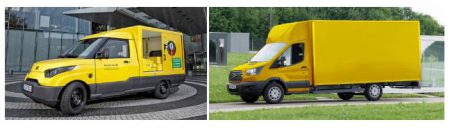
The company has already been producing its own all-electric delivery vehicle, the Streetscooter (left), but the new vehicle built on the Ford Transit will be significantly bigger, Streetscooter XL (right)
They will use the chassis of the Ford Transit, which will be equipped with a new battery-electric powertrain.
Ford had already announced plans for a plug-in hybrid version of the Ford Transit for 2019, but it looks like this new contract is changing the plan by using an all-electric version built on the same chassis.
Production is set to start next month and expected to be completed by the end of 2018.
Jürgen Gerdes, member of the executive board of the Deutsche Post AG, commented on the news:
“I consider this partnership another important boost for electro-mobility in Germany. This step emphasizes that Deutsche Post is an innovation leader. It will relieve the inner cities and increase the people’s quality of life. We will continue working on completely carbon neutral CO2-neutral logistics!”
Along with the new contract, Deutsche Post plans to double its production of the Streetscooter to 20,000 units per year – making the logistic company a significant EV manfacturer.Read more: electrek
Volkswagen (VW) is to send its microbus-styled minivan, previewed at the Detroit Auto Show early in 2017 as a concept named the I.D Buzz, into production as an electric vehicle (EV).
The news comes as part of the German manufacturer’s push to market a wide range of EVs under the I.D electric car sub-brand.
The concept is based around an update of the classic VW Transporter, and VW brand chief Herbert Diess told UK magazine Auto Express:
‘Emotional cars are very important for the brand. We are selling loads of Beetles still, particularly in US markets. But we will also have the Microbus that we showed, which we have recently decided we will build.’
The production version will be based on the company’s Modular Electric Drive (known as MEB) platform, which was first shown at the Paris Motor Show in 2016, where the I.D branding was launched with a compact car. The Buzz concept features an electric motor at each axle, which produced around 369bhp total, with a claimed range of 372 miles and an 80% recharge time of 30 minutes. It is unknown how these figures will hold up in the production version.
The concept version also featured extensive autonomous technology, which is currently not ready for use on roads in Europe, but is under development. The model is expected to arrive in showrooms by 2022, with multiple versions likely to be offered, and could include a camper and pickup truck version to tie in with the original Bus model of the 1960s. It will join the I.D CROZZ, an electric SUV planned for launch in 2020.
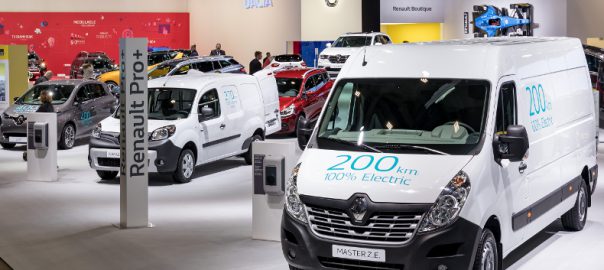
The Kangoo Z.E. is the all-electric, zero emissions version of Renault’s smallest van
The Renault Kangoo ZE is the electric version of the Kangoo, Renault’s smallest van. Like the diesel version, it’s available in standard, Maxi and Maxi Crew body styles. In reality the only difference between the diesel and ZE (Zero Emissions) version is the fact there’s an electric motor under the bonnet instead of an engine, and a battery pack under the load area where the fuel tank would normally be.
Renault Kangoo ZE
The Kangoo ZE has a payload of 650kg, which is the same for the Maxi ZE, while the two versions have a load volume of 3.4 and 4 cubic metres respectively. This pair are two-seaters, while the Maxi Crew ZE has five seats.
Prices start from around £16,500, thanks to a Government Plug-In Car Grant of up to £8,000, while Renault offers two purchase options; you can either buy the Kangoo ZE outright, or buy the van and hire the batteries to help keep costs in check and eliminate any concerns about the batteries losing their longevity.
Power for the Kangoo ZE comes from a 44kW electric motor, which is the equivalent of 60bhp from a conventional engine. While that means the ZE has less power than any of the conventional Kangoo range (and 0-62mph takes a laborious 20.3 seconds), it doesn’t feel slow, thanks to a healthy 226Nm of torque (only the more powerful dCi 110 does better), and this torque is available as soon as you put your foot on the accelerator, so it really does nip away from the traffic lights.
Renault claims a range of 106 miles for the Kangoo ZE – it’s the same for the Kangoo Maxi, and is the same quoted for the Kangoo’s main rival, the Nissan e-NV200 – but in the real-world you can expect a range of around 75 miles on a full charge.
The first five fleets have signed on to participate in Ford’s new plug-in hybrid van trial project in London, which is scheduled to get underway this Fall.
In total, Ford intends to test 20 vehicles over a 12-month period, prior to introducing the PHEV van on the European market (unfortunately, no U.S. version is planned at this stage).
Ford still has yet to reveal the all-electric range, but has stated that it will be enough for the majority of inner-city trips; which means to us that likely we won’t be all that excited about the offering when it finally comes to market.
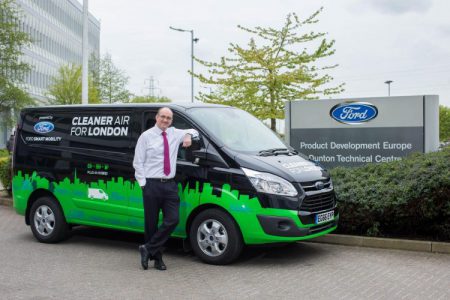
Mark Harvey, Director of the Urban Electrified Van programme – Ford Transit Custom Plug-in Hybrid
But then again, more EVs in the commercial space is never a bad thing.
The multi-million pound project is designed to explore how lower-emission plug-in hybrid electric vans could support cleaner air targets, whilst boosting productivity for operators in urban conditions – the toughest working environment for commercial vehicles.
The project, supported by Transport for London, features a 12-month trial of 20 new Ford Transit PHEVs that reduce local emissions by running solely on electric power for the majority of inner-city trips. Equipped with range extenders, the fleet is not limited by battery range, making them capable of the longer journeys that may be required by businesses and ‘blue light’ services.
The participating fleets represent a cross-section of city-based businesses which will integrate the Ford Transit PHEV vans into their day-to-day operations. Using a Ford telematics system, each Transit PHEV will collect data on the vehicles’ financial, operational and environmental performance to help understand how the benefits of electrified vehicles could be maximised.
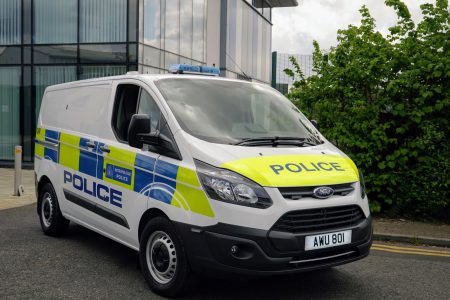
Ford Transit Custom Plug-in Hybrid – Police
The five fleets include the Metropolitan Police with two Transit PHEV vans: one marked for second response to traffic accidents and one un-marked as a forensic support unit. In addition, Transport for London will use three of the vans for freight duties.
Warning: preg_match(): Compilation failed: invalid range in character class at offset 4 in C:\inetpub\vhosts\fuelincluded.com\httpdocs\wp-content\plugins\maxbuttons\assets\libraries\simplehtmldom\simple_html_dom.php on line 1389
Warning: preg_match_all(): Compilation failed: invalid range in character class at offset 4 in C:\inetpub\vhosts\fuelincluded.com\httpdocs\wp-content\plugins\maxbuttons\assets\libraries\simplehtmldom\simple_html_dom.php on line 694
Warning: foreach() argument must be of type array|object, null given in C:\inetpub\vhosts\fuelincluded.com\httpdocs\wp-content\plugins\maxbuttons\assets\libraries\simplehtmldom\simple_html_dom.php on line 701
Warning: preg_match_all(): Compilation failed: invalid range in character class at offset 4 in C:\inetpub\vhosts\fuelincluded.com\httpdocs\wp-content\plugins\maxbuttons\assets\libraries\simplehtmldom\simple_html_dom.php on line 694
Warning: foreach() argument must be of type array|object, null given in C:\inetpub\vhosts\fuelincluded.com\httpdocs\wp-content\plugins\maxbuttons\assets\libraries\simplehtmldom\simple_html_dom.php on line 701